

 Amie Dawson, Ph.D.
You slow down. Then speed up. Then change the angle. Then move half an inch to the left. Then you wonder whether you just missed it again.
That loop is common. It also teaches people the wrong lesson.
Usually the problem isn’t that your body is difficult. It’s that you’re trying to learn a pattern while changing everything at once.
The thing you’re looking for usually isn’t one perfect spot
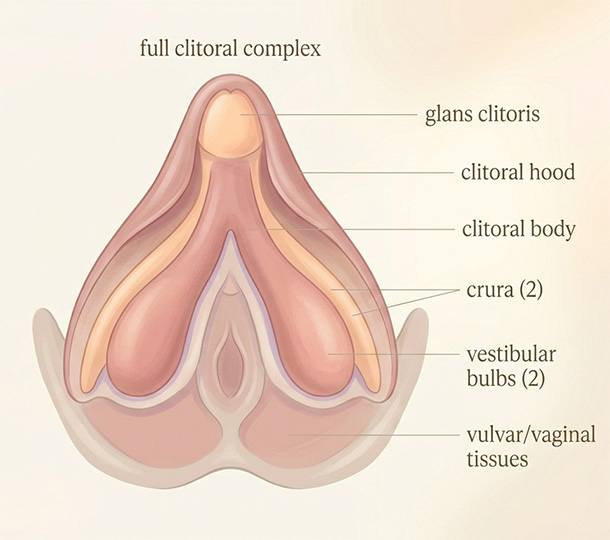
When I say pattern, I don’t mean a secret button hidden somewhere in your anatomy. I mean a repeatable combination of where you touch, how you move, how fast you move, and how long you stay there before changing anything.
That matters because the clitoris isn’t just the small external glans. It’s a larger structure with internal parts, and touch around the glans, the hood, the nearby vulvar tissue, and even the vaginal wall can register very differently. Women also report different preferences not only for location, but for pressure, shape, and pattern of touch. There is no single best setting that everyone’s body is secretly supposed to discover.
A lot of people keep asking, “Where is the right spot?” and then get frustrated when that question doesn’t get them anywhere. The more useful question is different: what sequence does your body keep responding to?
That is a different search, and usually a better one.
Start with a pattern simple enough to hear
If you want useful information from your body, reduce the noise first.
Pick one setup. Same position. Same hand or same toy. Same lubricant if you use one. Same general area. Then change one variable for a short stretch and leave the rest alone.
Not five.
Clinical guidance around orgasm difficulties often includes directed masturbation for exactly this reason. It gives people a way to learn their responses through deliberate exploration instead of random guessing. Mayo Clinic includes it in treatment guidance, and Merck Manual lists self-stimulation as a first-line approach in female orgasmic disorder.
A simple pattern test might look like this:
- same spot, different tempo
- same tempo, different motion
- same motion, slightly different area
- Or keep everything the same and stay there longer than your impatient brain wants to.
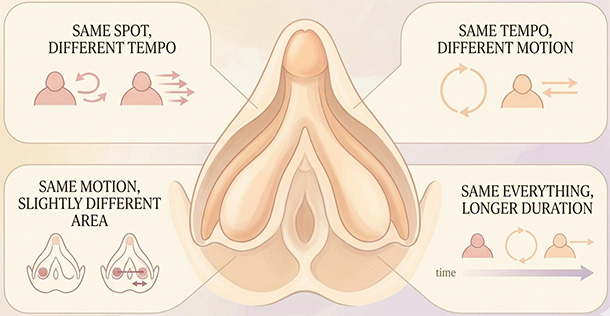
That is how you get an answer you can trust. Otherwise you’re just creating a blur and trying to interpret it afterward.
Don’t judge the pattern in the first three seconds
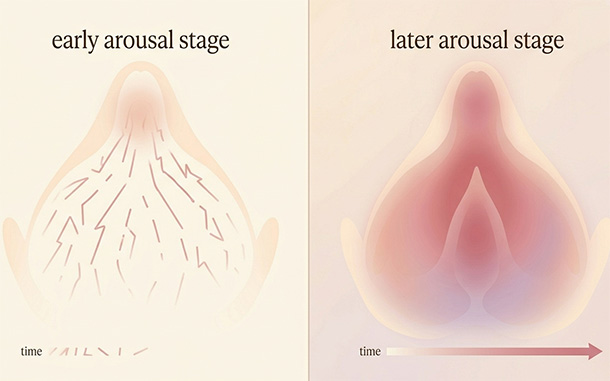
Some touch grabs your attention immediately and then goes nowhere. Other touch seems almost too plain at first, then starts building in a way that feels steadier, warmer, and easier to stay with.
The wrong pattern often feels busy. The right one often feels like the signal is getting cleaner.
This is where people sabotage themselves constantly. A sensation starts to gather, they get hopeful, and then they change it too early. Faster. Harder. Lower. More direct. Then the build breaks and they assume they lost the right spot, when what they actually lost was continuity.
Many women need steady clitoral stimulation to orgasm. That detail matters more than people think. A good pattern doesn’t just feel promising for one second. It keeps getting better when you stop editing it.
Sometimes the entire difference is that your body wanted the contact to deepen instead of being refreshed over and over. A pattern can seem weak when it’s interrupted too early, especially if you respond better to steady pressure instead of more movement.
That is the test I trust most.
What this looks like in real life
Sometimes the easiest way to understand pattern is to picture it in a body, not in theory.
One person notices that direct contact on the glans feels too bright, almost sharp. But a small circle just above it, through the hood, with almost no extra pressure, starts to gather heat after twenty seconds. It doesn’t feel dramatic. It feels like the body stopped arguing. For some people, the better pattern begins the second the contact gets a little less exact, which is why broader contact can work better than pinpoint contact.
Another person keeps chasing orgasm with constant movement and never quite gets there. Then they try something that looks almost boring from the outside: place, hold, tiny pelvic rock. Suddenly the sensation stops scattering. It starts stacking.
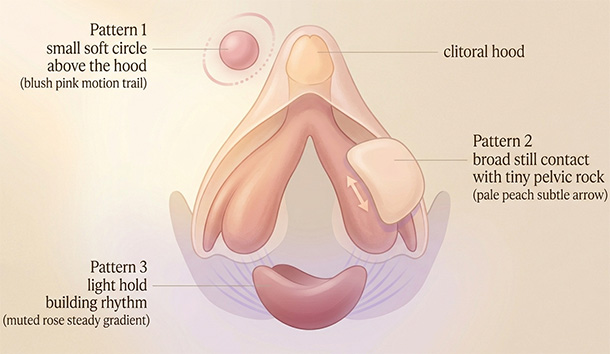
Someone else figures out that the first minute isn’t about climax at all. It’s about laying down a rhythm the body can trust. Once that rhythm is there, even a small adjustment later feels good because it’s built on something stable.
This is why “best” can look so unsexy from the outside. It may be slower, plainer, and less performative than you expected.
It doesn’t feel smaller. It feels less thin.
Signs you’ve found a promising pattern
You don’t have to wait for orgasm to know you’re onto something. Usually the body tells you earlier than that.
- You stop making constant corrections.
- The sensation spreads or deepens instead of staying flat.
- Staying with it starts feeling easier than improving it.
- Your body leans in instead of bracing, chasing, or micromanaging.
That third one matters.
When a pattern is right, your next instinct usually isn’t “change it.” It’s “stay there.”
Turn sensation into instructions
Once you find something promising, put it into words immediately. Not poetic words. Usable words.
Try a sentence like this:
“Upper-right through the hood, tiny side-to-side motion, medium speed, keep it steady, don’t switch when it starts building.”
Or:
“Broad contact, almost still, let my hips do the movement.”
Or:
“Light touch at first, but the important part is not moving off the area.”
This matters for two reasons. First, memory gets bad when you’re highly turned on. Second, a good pattern is easier to repeat when it becomes a sentence instead of a vague impression you hope you’ll remember later.
Your body isn’t asking for a better performance. It’s asking for clearer instructions.
That distinction matters because the second you start performing your way toward the pattern, performance pressure gets louder than sensation, and the signal becomes much harder to trust.
When pattern-searching isn’t the real issue
Sometimes the problem really isn’t technique.
If pleasure has changed suddenly, if touch that used to feel good now feels numb or painful, or if orgasm has become harder across the board, zoom out. Pain, dryness, depression, anxiety, trauma, medication effects, menopause-related changes, and conditions like diabetes or multiple sclerosis can all affect orgasm and sensation. SSRIs and other medications are especially common culprits.
That means pattern work has limits. Useful limits.
Talk with a clinician if you notice:
- a clear sudden change in sensation or orgasm
- pain with touch or penetration
- persistent numbness
- a major shift after starting or changing medication
If sexual problems are worrying you or affecting your relationship, Mayo Clinic explicitly recommends bringing them to a healthcare professional.
Sometimes the kindest thing you can do is stop treating a body change like a skill issue.
The better way to think about this
I don’t think most people need more tricks. I think they need a better frame.
Your best clitoral stimulation pattern isn’t a secret buried somewhere in your anatomy. It’s a response pattern your body recognizes, rewards, and lets you return to. Earlier I said this wasn’t about one perfect spot, and this is where that really matters. A good pattern is usually less like cracking a code and more like noticing what your body keeps saying yes to when you stop interrupting it.
You’re not trying to solve pleasure once.
You’re building a map you can actually use.
And when the map gets clearer, something important shifts. Pleasure stops feeling like a quiz you might fail. It starts feeling like information, which is a much easier thing to work with on a real Tuesday night.
Reviewed medical and clinical sources
- Health Library Editorial Team. Clitoris: Anatomy, Location, Purpose & Conditions. Cleveland Clinic. Updated January 26, 2026.
- Herbenick D, Fu T-J, Arter J, Sanders SA, Dodge B. Women’s Experiences With Genital Touching, Sexual Pleasure, and Orgasm: Results From a U.S. Probability Sample of Women Ages 18 to 94. Journal of Sex & Marital Therapy. 2018;44(2):201-212.
- Mayo Clinic Staff. Anorgasmia in Women: Diagnosis and Treatment. Mayo Clinic. February 29, 2024.
- Mayo Clinic Staff. Anorgasmia in Women: Symptoms and Causes. Mayo Clinic. February 29, 2024.
- Conn A, Hodges KR; reviewed by Goje O. Female Orgasmic Disorder. Merck Manual Professional Edition. Revised July 2023.
- Leicestershire Partnership NHS Trust. Female Orgasmic Difficulties. NHS patient information leaflet.
Add comment