

 Amie Dawson, Ph.D.
You turn the vibrator on, find the spot, and within seconds your body does that maddening split-screen thing where it feels good and too much at the same time.
You pull away. Go back. Pull away again.
Instead of building, the sensation starts to fray.
A lot of people assume this means the toy is too strong, or their body is too sensitive, or they need to push through until pleasure catches up.
Usually, none of that is true.
Usually, the problem is simpler. The sensation is arriving in a way your body cannot use well yet.
More intensity doesn’t automatically create more pleasure
This is the distinction that clears up most of the confusion.
Intensity is how strong the input feels.
Pleasure is how well your body can use that input.
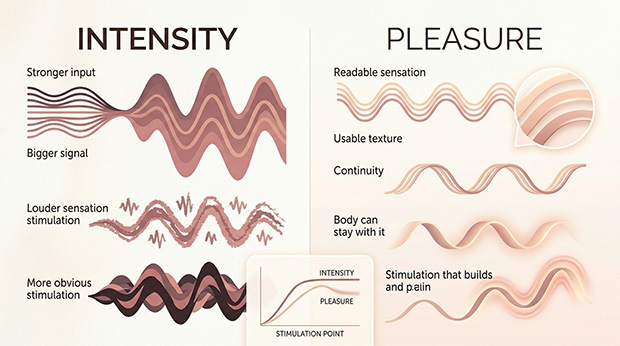
Those are not the same thing.
A setting can feel bigger but less useful. More obvious, less erotic. Louder, but somehow farther away. You turn it up because you feel close, then something odd happens. The sensation gets stronger, but flatter. Harder to build with. Harder to stay inside.
That is why a higher setting can feel more dramatic and less satisfying at the same time.
The body is not a contest between you and a motor. At a certain point, stronger stops feeling better and starts feeling thinner. The texture drops out. The build gets replaced by signal.
That is why “not enough” is not always the problem.
Sometimes the problem is that the sensation has stopped being readable.
That is often the moment people describe as overstimulation. Not because the toy suddenly became objectively too strong, but because clitoral stimulation starts feeling too intense before the body has a way to use it.
Overstimulation is usually a pacing problem, not a power problem
A lot of people assume overstimulation means the toy is too strong, full stop.
Sometimes that is true. Often it isn’t.
Often the real issue is timing.
The most sensitive tissue gets the full hit before the rest of your body is warm, swollen, lubricated, settled, and ready to receive it. In that state, even a medium toy can feel abrupt. The nerves are awake, but the pleasure has nowhere to spread yet.
Overstimulation is not too much pleasure.
It is pleasure arriving faster than your body can absorb it.
That is why the same toy can feel harsh at the beginning and perfect ten minutes later. The tool did not change.
Your body did.
A lot of people are not actually chasing more power.
They are chasing more readiness.
Gentle doesn’t mean weak
This is the second distinction that matters.
A gentler session is not a weaker session.
It is a less exposed one.
For some bodies, the issue is not intensity in the abstract. The issue is where that intensity lands. A toy can feel better without being lower-powered if the sensation spreads through the hood, the sides, or the surrounding tissue instead of striking one exposed point head-on.
It doesn’t feel smaller.
It feels less thin.
For a lot of people, that is the whole difference between contact that builds and contact that overwhelms. The sensation is still strong, but it lands more like broad stimulation instead of pinpoint stimulation, which is often easier to stay with.
That is why gentler can still feel strong. You are not downgrading pleasure. You are making the sensation easier for your body to keep saying yes to.
Gentle is not the opposite of intense.
It is the opposite of abrasive.
Don’t make the most sensitive spot take the first impact
This is the most useful shift I know.
If direct clitoral contact is the thing most likely to overload you, don’t start there.
Start nearby. Above it. To one side. Over the hood. On the inner labia. On the mons. Let the surrounding tissue wake up first.
The goal is not to hit the most sensitive spot first.
It is to give that spot somewhere to go.
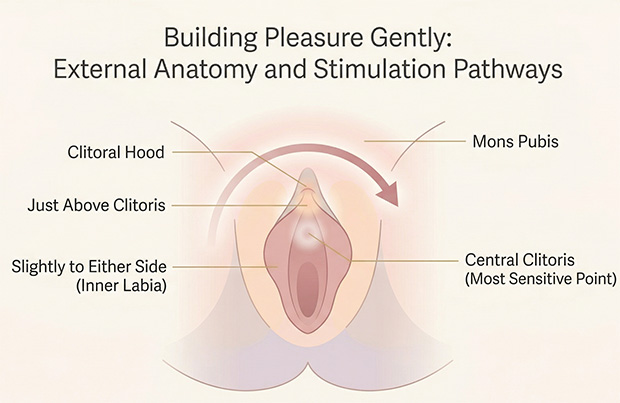
In practice, that can look like this:
- turn the toy on low before it touches you
- place it slightly above or beside the spot you usually aim for
- stay there longer than your impatient brain wants to
- slide inward only when your body starts asking for more
That waiting matters.
A body that startles easily often enjoys arriving slowly.
Keep the power. Change how the toy lands.
When people try to make a toy gentler, they usually go straight to the power button.
Sometimes that helps. Often the bigger change is mechanical.
Before you decide a toy is too much, change how the sensation arrives:
- move the toy slightly above the clitoris so the sensation filters through the hood
- rest it to one side instead of dead center
- let the broadest part of the toy touch you instead of the tip
- angle it so the vibration spreads into surrounding tissue instead of one exact point
- add more glide
- lighten the pressure
Those changes are often bigger than dropping one setting.
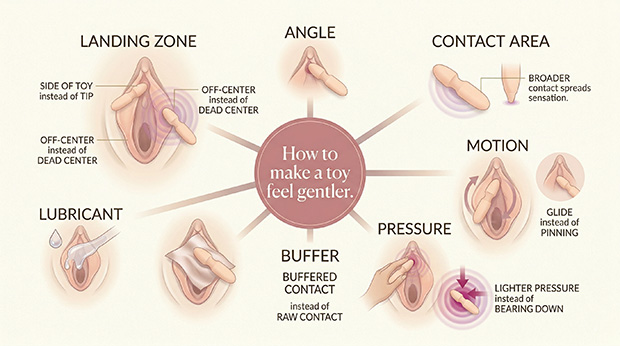
This is why some people feel better on a higher level with broader, lighter, moving contact than on a lower level with hard, direct, pinned-down contact.
The issue was never just the motor.
It was the landing.
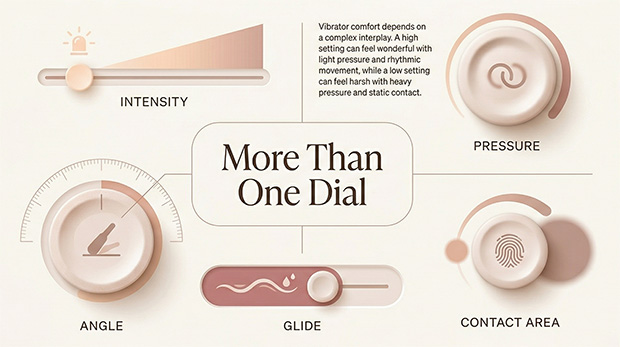
You have more than one dial to turn
People talk about overstimulation as if intensity setting is the only dial.
It isn’t.
You are really working with pressure, angle, contact area, glide, motion, and time. A high setting can feel surprisingly good with light contact and movement. A low setting can feel awful if you press hard and hold it in one exact place.
More pressure doesn’t always feel stronger.
Very often it feels thinner.
That is the sensory trap. When you bear down, you may get more raw signal but less usable pleasure. The feeling stops blooming and starts drilling.
Friction matters too. If the area feels dry, sticky, or draggy, the vibration can start feeling scratchy or irritating long before it feels orgasmic.
Sometimes what feels “too intense” is really too dry, too direct, or too unbuffered.
So before you decide the toy is the problem, change the mechanics first.
Movement often works better than force
When people try to make a toy work, they often hold it very still and press harder.
That can create a tiny hot spot that goes from good to overwhelming in seconds.
Sometimes the answer is less pressure and more motion.
A slow glide. A tiny rock. A loose oval. A drift on and off the spot instead of pinning the toy there like a thumbtack. Or keeping the toy steadier and letting your hips rock against it so the signal changes slightly from moment to moment.
That changes the feeling in a very specific way.
The sensation becomes more continuous and less piercing.
Your body gets a pattern instead of a drill.
That small change matters because pleasure often builds better when the signal keeps a little movement in it instead of hammering one exact patch of tissue. For many people, that is the deeper difference between steady pressure and movement once arousal is trying to organize itself.
A still toy on a still body can become too much very fast. One small patch of tissue keeps taking the exact same signal, in the exact same way, without relief. Even slight movement spreads the sensation across a slightly larger area and keeps it from turning jagged.
If you have ever thought, I like the buildup but not the contact, this is often the missing piece.
Buffer the contact, not the pleasure
Lowering the setting is only one way to soften a toy.
Often it is not even the best one.
A better move is to keep enough motor strength to stay interesting while adding a little buffer between the toy and your most sensitive tissue.
That can mean letting the toy work through the clitoral hood instead of direct glans contact. It can mean using your fingers or palm so the vibration diffuses before it reaches the spot that gets overwhelmed fastest. It can mean more lubricant. For some people, it can mean a thin fabric layer at the beginning, then removing it later once the body wants more direct contact.
This is worth remembering:
friction and intensity are not the same thing.
Sometimes the sensation is not too strong. It is too concentrated.
That is usually the moment to stop thinking only in settings and start thinking in layers. For a lot of bodies, the real fix is not less stimulation but one more layer between direct touch and the tissue.
Build in stages instead of going straight to your max
A gentler session usually fails when it starts with a demand.
The toy goes right to the strongest useful spot, the strongest useful pressure, the strongest useful setting. There is nowhere to go from there. So the body either numbs out, braces, or peaks too fast and falls off.
A better build is layered.
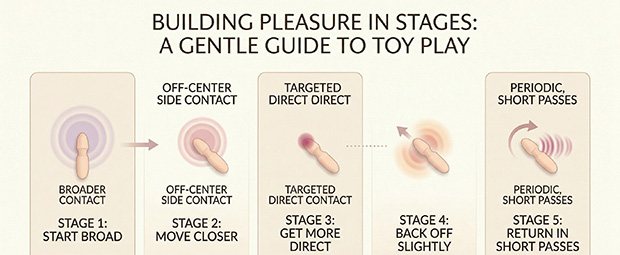
Start broad.
Then get closer.
Then get more direct only if your body is actually asking for it.
That might look like this:
- broad contact on surrounding tissue
- side contact near the clitoris
- brief direct contact
- backing off slightly once pleasure spikes too sharply
- returning to direct contact only in short passes if it still feels good
This is not performative teasing.
It is pacing.
You are giving your nervous system time to want the next step.
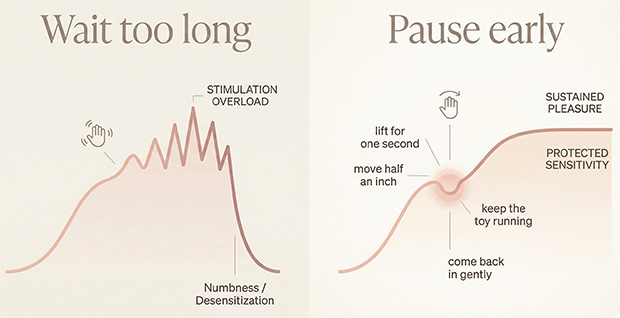
The best pause is the one you take early
Most people wait too long to pause.
They wait until they flinch. Until the feeling gets sharp. Until the nerves feel blown open. By then the reset takes longer.
A better method is to interrupt the build a second before it turns.
You feel the sensation getting thinner. Less full. More exposed. A little glassy around the edges.
That is the moment.
Lift the toy for one second. Move it half an inch. Keep it running, but place it on nearby tissue. Then come back in. Not as a full restart. More like taking your foot off the gas before the turn.
When sensation turns thin, sharp, or glassy, keep going is usually the wrong move.
This is not losing momentum.
It is protecting momentum.
What this looks like in real life
Theory helps. Actual scenarios help more.
With a bullet vibrator
The most common mistake is obvious and understandable: tip straight onto the clitoris, firm hand, no warm-up.
Try this instead. Place the side of the bullet against the hood or just off to one side. Keep the contact light. Drift in and out rather than parking it there. If you want more intensity, move closer before you press harder.
With bullets, location usually matters more than level.
With a wand
Wands give broad stimulation, but people still overstimulate with them by pushing too hard and not moving enough.
Let the head rest lightly on the mons, outer labia, or over the hood first. Then rock into it. If the center starts feeling overlit, pull the contact slightly wider instead of quitting altogether. Use the edge of the head if the full face feels too diffuse, or the full face if the edge feels too sharp.
A lot of wand users do not need less vibration.
They need less force.
With an air-pulse or suction-style toy
These toys can feel intense very quickly because the stimulation is focused and rhythmically repeated.
If you are prone to overload, do not chase a perfect seal right away and then hold it there like a test of endurance. Approach lightly. Use shorter passes. Release sooner than you think you need to. Let arousal rise between contacts instead of demanding that each contact do all the work. A slightly looser angle at first can also help.
Sometimes one millimeter is the whole difference.
The body often likes being invited more than captured.
Four signs you have crossed from “more” into “too much”
Sometimes the setting is not wrong forever.
It is wrong for that moment.
A few signs you crossed that line:
- you are still stimulated, but the sensation has lost warmth and depth
- you keep making tiny corrections because the contact suddenly feels too exacting
- your body starts tightening around the stimulation instead of leaning toward it
- you feel less present and more task-focused, like you are trying to get over a finish line
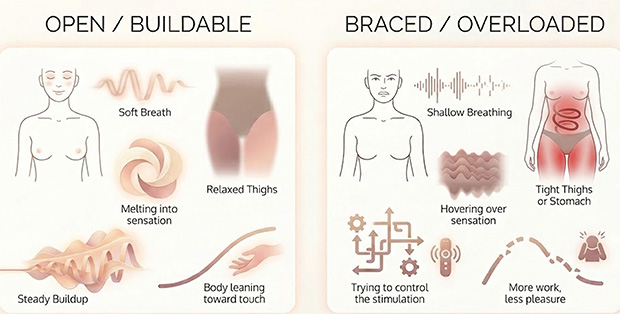
That usually means the answer is not more.
It is different.
Sometimes the issue is not technique at all
If a vibrator feels like too much only in certain moments, technique is the first thing to troubleshoot.
If light touch feels burning, stinging, raw, dry, or wrong in a more persistent way, the issue may be bigger than vibrator skill.
Pay attention if:
- light touch hurts even before you are highly aroused
- burning or soreness lingers after very brief stimulation
- dryness and drag are a recurring problem
- penetration, tampons, or orgasm are often painful
- your body seems to brace or clamp no matter how gentle you are
- underwear, wiping, or everyday contact can feel irritating too
That does not automatically mean something serious is wrong.
It does mean the body may be asking for care, not better performance.
And if stronger stimulation has suddenly become the only way you can feel much of anything, or if it has suddenly started feeling irritating, unreachable, or strangely numb, do not assume you just need a more powerful toy. Medication effects, dryness, hormonal changes, pelvic floor tension, pain conditions, stress, or nerve issues can change how stimulation feels.
“Turn it up” is a bad answer to the wrong question.
The better question
The useful question is not:
How do I make this stronger?
It is:
What kind of sensation can my body actually build with right now?
That question changes everything.
It moves you out of force and into fit. Out of escalation and into responsiveness. Out of the idea that your body is underpowered and into the much more accurate idea that your body is discerning.
Some bodies do want a lot of intensity.
But even then, what works is usually not raw power alone. It is power delivered in a way the body can trust, follow, and keep turning into pleasure.
The real skill is not tolerance
A vibrator is not supposed to be something you survive until it finally works.
It is supposed to help sensation organize itself.
For some bodies, that means broad contact first. For others, lighter pressure. For others, tiny breaks before the edge gets jagged. None of that is failure. It is technique. It is information. It is how a sensitive system teaches you the route in.
The body that needs a slower runway is not difficult.
Very often, it is the body that gives the richest response once you stop treating sensitivity like a flaw.
Reviewed medical and clinical sources
- Leicestershire Partnership NHS Trust. Female orgasmic difficulties. Department of Medical Psychology, NHS patient information leaflet.
- Cleveland Clinic. Vulva: Location, Anatomy, Function, Conditions & Care.
- Mayo Clinic. Female sexual dysfunction – Diagnosis and treatment.
- Mayo Clinic. Painful intercourse (dyspareunia) – Symptoms and causes.
- Imperial College Healthcare NHS Trust. Overactive Pelvic Floor: Information for patients, families and carers. Pelvic health physiotherapy patient leaflet.
- Cleveland Clinic. Hypertonic Pelvic Floor: Symptoms, Causes & Treatment.
- Cleveland Clinic. Clitoris Pain (Clitorodynia): Causes, What It Means & Treatment.
Add comment