

 Amie Dawson, Ph.D.
You put your hand there and wait for your body to tell you something obvious.
Instead, you get static. Maybe it feels blank. Maybe it feels too exposed. Maybe every touch seems either underwhelming or oddly irritating, and none of it matches the way people talk about pleasure as if it should be immediate, natural, almost self-explanatory.
I want to say this early: not knowing what feels good yet is not the same thing as being incapable of pleasure.
A body can be capable of pleasure and still feel unreadable at first.
You are not failing. You are early.
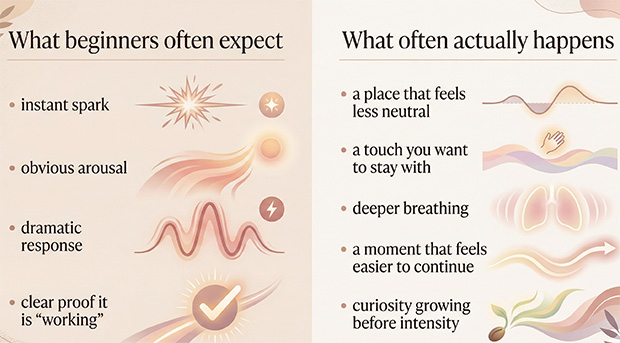
A lot of people expect pleasure to announce itself clearly. A spark. A rush. A strong yes.
For many bodies, that is not how it starts.
It starts with uncertainty. With comparison. With noticing that one kind of contact makes you pull away faster than another. With realizing one touch feels too sharp, while another feels easier to stay with. With finding that your mind wanders a little less in one position than in another.
That counts.
A lot of people think they should already know what works while they are still testing a script that was never built for their body.
That is why I would not start with orgasm. I would not even start with “turned on.”
I would start with noticing.
Your first goal is not intensity. It is interest.
Beginners often assume pleasure should arrive clearly. Fast. Undeniably. As if the body is supposed to light up and explain itself.
That is not how it begins for everyone.
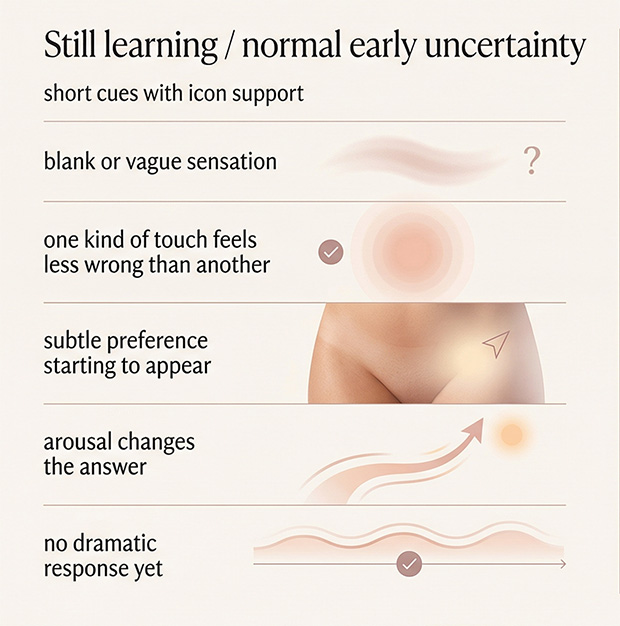
Sometimes the first useful signal is tiny. A place that feels less neutral. A touch you do not want to move away from. A moment where your breathing deepens instead of catching. A sensation that feels more interesting than intrusive.
It does not feel dramatic.
It feels easier to stay.
That counts.
Pleasure often arrives as interest before it arrives as intensity.
For a lot of people, that is the first useful shift. You are not waiting for a dramatic yes. You are learning what kind of stimulation feels easier for your body to keep following before it has words for it.
And that matters, because if you keep dismissing those small signals as “not enough,” you can miss the actual beginning. You keep waiting for fireworks while your body is offering a flicker.
The right early question is not, Did this make me orgasm?
It is, Did anything make me want to continue?
Pleasure often begins as “less wrong,” not instantly amazing
For a lot of people, pleasure does not begin as a yes.
It begins as a thinner no.
That is a very different thing.
Maybe one kind of touch feels exposed in a way that makes your whole body brace. Then you shift the angle, add a layer of fabric, soften the pressure, or move slightly off-center, and suddenly you do not want to move away. That may not feel thrilling yet.
But it is not nothing.
It is the first useful signal.
You are not trying to identify your forever favorite. You are trying to catch the first flicker of preference.
This is where people get lost. They expect “good” to feel dramatic. So they miss the small but important signs:
- you stay present instead of going mentally blank
- your breathing changes without you forcing it
- a touch feels easier to continue than to stop
- the sensation feels more interesting than intrusive
- your body softens instead of bracing
Neutral is not useless.
It is how your map starts.
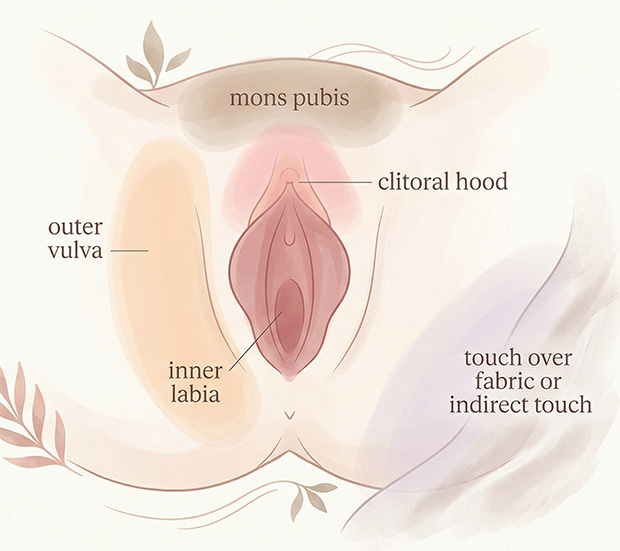
Start outside. The body is usually easier to hear there.
If you are new to pleasure, external exploration is often the cleanest starting point.
Not because internal pleasure is less real. Because external sensation is usually easier to track before you have much erotic context, much arousal, or much confidence in what you are feeling.
This is where a lot of people get lost. They think “start exploring” means “go straight to the most intense place.”
Not necessarily.
Very direct touch on a highly sensitive area can feel less erotic than expected when you are new. Sometimes it feels abrupt. Too exposed. Too bright.
The wrong touch can feel like being interrupted.
The better starting touch often feels easier to stay with, not instantly more powerful.
That is often the moment people realize the issue was never “not enough sensation.” It was that the first contact landed too exposed, which is usually where to start if direct touch does not feel good.
That can mean starting over underwear. Starting with your palm against the vulva instead of direct clitoral contact. Starting with broader, steadier contact instead of tiny precise movements. Starting with stillness before adding motion.
You are not being timid.
You are making the body easier to hear.
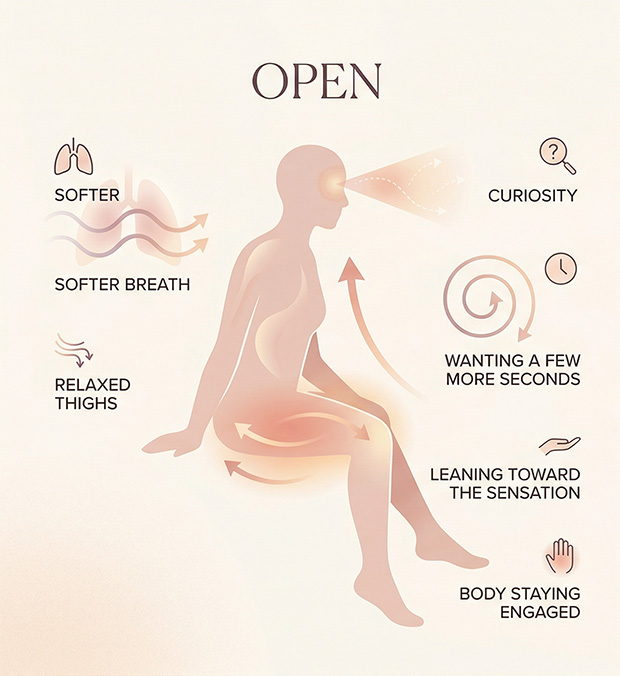
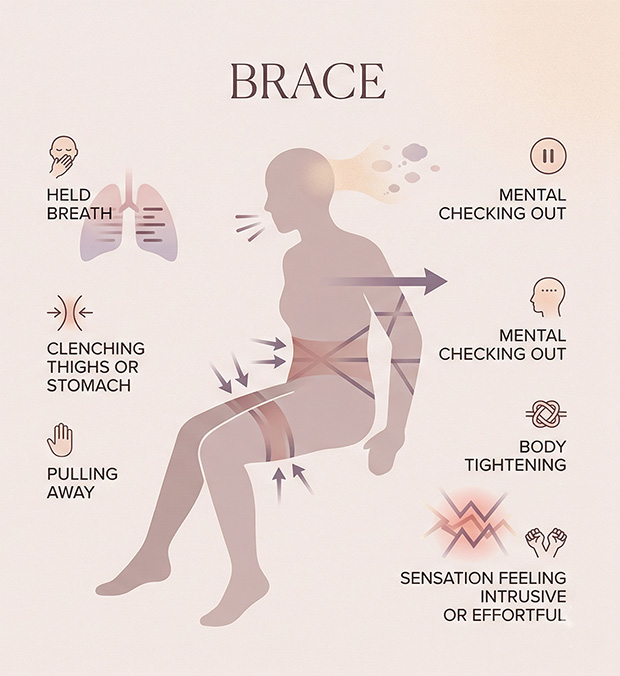
Use one simple test: does your body open or brace?
When I think about a first exploration session, I want it stripped down.
Not ten techniques. Not a full routine. Not a performance.
Just one question: does this make your body open, or does it make your body brace?
That is the frame.
If a touch makes you soften, lean in, stay curious, breathe deeper, or want another few seconds of the same thing, it is probably worth staying with.
If a touch makes you pull away, clench your thighs, tighten your stomach, hold your breath, or mentally check out, that is not failure.
Sometimes the most useful thing to notice is not what feels exciting yet, but what makes the body stop defending itself. That is often the quieter beginning of understanding how body tension changes what pleasure feels like.
That is information.
For a first session, I would keep it this simple:
- start when you are not rushed
- begin with a low-pressure area, even over underwear if that feels easier
- stay with one kind of touch long enough to actually notice it
- change only one variable at a time: pressure, location, movement, or buffer
- stop while you still feel curious, not only when you feel finished
That last part matters more than people think.
Ending after a useful, readable experience teaches the body that this is safe to return to. Pushing until you feel frustrated teaches the opposite.
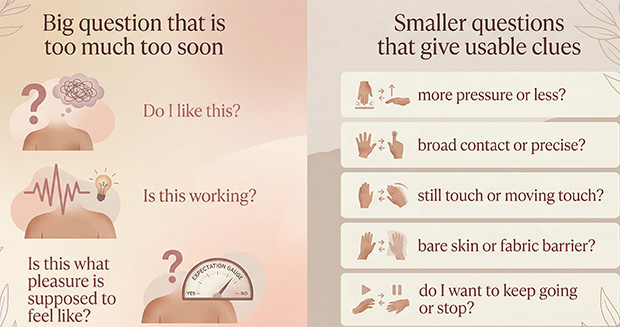
Ask smaller questions than “Do I like this?”
“Do I like this?” sounds simple.
It is not.
It asks your body for a polished answer before your body has learned the language.
Smaller questions work better. They lower the pressure and make sensation easier to read.
Try these instead:
- Does this feel better with more pressure or less?
- Does this feel better when contact is broad or precise?
- Does this feel better when the touch is still or moving?
- Does this feel better on bare skin or with a barrier like underwear?
- Does my body want to keep going, pause, or soften?
These are not final identities.
They are directional clues.
You are not taking a test.
That matters more than people think. The moment you stop demanding a polished answer from your body, it gets much easier to explore pleasure without turning it into a test.
You are learning your body’s accent.
Arousal changes the answer
One reason this can feel confusing is that a body that is not very aroused often gives vague answers.
A touch that feels pointless at the beginning can feel rich ten minutes later. A touch that feels too direct on bare skin can feel perfect once there is more blood flow, more lubrication, more anticipation, more sense of safety inside your body.
The reverse can happen too. Something that works one day can feel wrong the next.
That is not inconsistency in the dramatic sense.
It is normal sexual response.
So if you touched yourself once, felt mostly nothing, and decided the whole category was not for you, that was not really a conclusion.
It was one data point.
Another beginner trap is expecting a neat sequence: desire, then arousal, then pleasure, then orgasm.
Bodies are messier than that.
Sometimes interest comes first. Sometimes gentle physical stimulation helps arousal build afterward. Sometimes the body warms slowly.
That is not a malfunction.
It is a pace.
What early signal actually looks like in real life
This part matters because a lot of readers do have signals already.
They just do not trust them.
You touch your clitoris directly and your first reaction is not pleasure but overexposure. It feels too immediate. Too bright. Like the sensation has no padding. Then you keep your underwear on, touch through fabric, and your body stops flinching. You can stay there. You can listen longer.
That is information.
Or maybe a vibrator on the highest setting does not feel stronger in a good way. It feels thinner. More skittery. Your thighs tense. Your jaw tightens. Then you lower the setting, hold it still instead of moving it around, and after half a minute there is a slow gathering feeling low in your pelvis.
That is information too.
Or maybe you keep trying penetration because you think you should, but every time you insert fingers or a toy your attention moves away from arousal and toward mechanics. Angle. Depth. Wrist. Where exactly. Then you place your palm against your vulva with firm pressure and your whole body feels more grounded, more connected, more awake.
Again: information.
Or maybe you lie on your back, touch over underwear, and feel almost nothing for a minute or two. Your first instinct is to quit. Then you notice that one side feels warmer and less blank than the other. You stay. The feeling does not become huge.
It becomes more present.
That is a successful session.
It does not need to look impressive to be real.
Sometimes the first honest sign is simply this:
I do not want to stop doing that yet.
That line matters more than most people realize.
Discomfort is not a dare
This is where I want to be very clear.
Mild uncertainty is normal when you are new.
Persistent pain is not something to push through.
Neither is burning, stinging, ongoing dryness, deep pelvic aching, or a feeling that your body involuntarily shuts the door when anything approaches penetration.
Not enjoying something is one thing.
Enduring it because you think you are supposed to is another.
Pleasure is not supposed to feel like gritting your teeth and waiting for it to become worth it.
What not knowing yet is not
Not knowing what feels good yet does not automatically mean you have a disorder.
A lot of people panic too early because they have never had a dramatic orgasm, or because their first attempts felt confusing, flat, or awkward.
You do not need to label yourself after a few uncertain experiences.
Context matters. A lot.
But there are times when “I’m still figuring it out” stops being the full story.
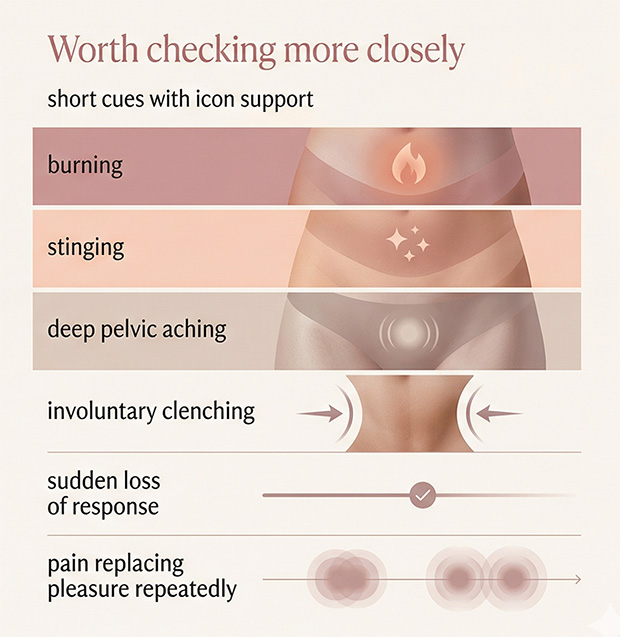
Pay attention if pleasure is repeatedly replaced by pain, burning, stinging, deep pelvic aching, muscle clenching you cannot control, or a sudden loss of response that is new for you.
The same goes for sudden orgasm changes after starting a medication, after childbirth, around menopause, after pelvic surgery, or when a neurological or pelvic floor issue may be in the picture.
Those are not moral problems.
They are health variables.
And this matters too: if the problem is upsetting you, that alone is reason enough to ask for help. You do not need to wait until it becomes extreme.
When it stops being beginner awkwardness and starts being a health question
There is a normal learning curve, and then there are situations where I would stop treating this as a DIY puzzle.
It is worth bringing in a clinician if:
- pleasure suddenly changes in a way that feels new and persistent
- touch becomes painful, sharply aversive, or distressing
- orgasm becomes much harder after a medication, illness, surgery, postpartum change, or menopause transition
- you notice fear, shutdown, pelvic tightening, or trauma-related reactions showing up consistently
You do not need to prove that something is “bad enough.”
Bothered is enough.
Sometimes the most self-respecting move is to stop privately optimizing and let someone help you sort out what is actually going on.
The goal is not immediate certainty
A lot of people delay exploration because they think they need a clear plan before they start.
You do not.
You need enough permission to notice.
Enough patience to stay with a sensation for a little longer than usual. Enough honesty to admit that what feels good in fantasy may not feel good on your body, and what feels good on your body may be much quieter at first than you expected.
Pleasure is not always dramatic on arrival.
Sometimes it is cumulative. Sometimes it is shy. Sometimes it appears only after your body believes it is not being judged.
A better way to think about this
I do not think pleasure is a hidden treasure your body is refusing to give you.
I think it is a language.
At first, all you hear is noise. Then repetition turns noise into pattern. Pattern turns into meaning. Meaning turns into choice.
That is when people start saying things like, Oh. Not that. This.
And that moment can be small.
It often is.
Small is enough.
Reviewed medical and clinical sources
- Mayo Clinic Staff. Anorgasmia in women – Symptoms and causes. Mayo Clinic. Updated February 29, 2024.
- Allison Conn, MD, and Kelly R. Hodges, MD. Orgasmic Disorder in Women. MSD Manual Consumer Version. Reviewed/Revised July 2023; modified January 2026.
- Leicester Partnership NHS Trust, Department of Medical Psychology. Female orgasmic difficulties. Leicester Partnership NHS Trust.
- Mayo Clinic Staff. Painful intercourse (dyspareunia) – Symptoms and causes. Mayo Clinic. Updated February 16, 2024.
- Cleveland Clinic. Dyspareunia (Painful Intercourse): Causes & Treatment. Cleveland Clinic. Medically reviewed; updated July 25, 2024.
- Cleveland Clinic. Anorgasmia: Causes, Symptoms, Diagnosis & Treatment. Cleveland Clinic. Medically reviewed; updated January 23, 2023.
Add comment