
 Amie Dawson, Ph.D.
You finally have a little privacy. You get comfortable. You find the angle. Your body is starting to say yes.
Then the toy dies.
Or the cord pulls. Or the batteries are weak in that especially annoying way where the motor still runs, but the sensation has gone flat.
When I talk people through this choice, I start in the least sexy place possible: interruption. Because that is what you are really buying here. Not just a power source. A pattern of friction.
A toy that dies at 70% arousal does not feel underpowered.
It feels interruptive.
You are not choosing a battery. You are choosing what gets to break the moment
On paper, this sounds like a technical question. In practice, it is intensely physical.
Some people need a toy that is simply ready when they are. Some need unlimited runtime because they warm up slowly, edge for a while, or hate the feeling of racing a battery. Some would rather manage charging than ever deal with a battery compartment at midnight. And some people know a cord will pull them out of their body the second they feel it drag across a thigh.
That matters more than many buyers realize.
Once your body likes a certain pressure, angle, and rhythm, fiddling with the device can feel bigger than it looks on paper.
The wrong power style does not just create inconvenience.
It changes how much mental bandwidth the toy steals from the experience.
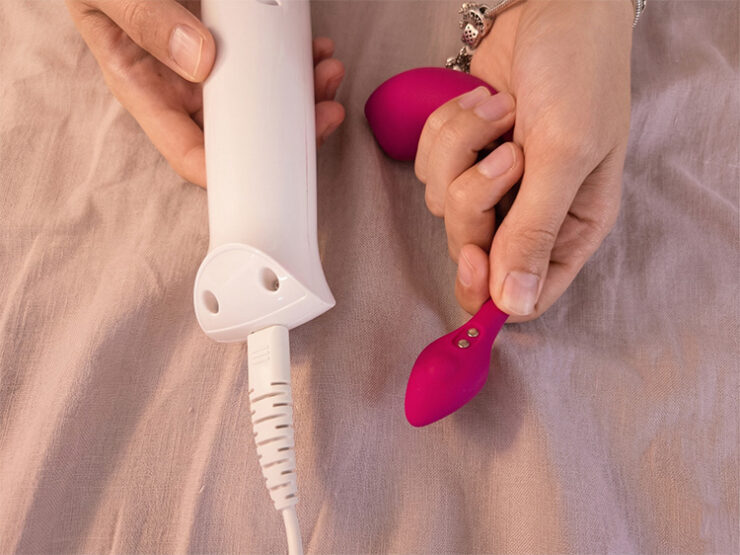
Rechargeable is best when your toy lives in your life, not in a forgotten drawer
For most people, rechargeable is the best default.
Not because it is morally better. Not because it is more modern. Because it usually creates the least day-to-day nonsense.
You charge it. You use it. You charge it again. No battery shopping. No half-dead alkalines rolling around in a nightstand. No tiny screwdriver. No realizing the spare batteries were somewhere in the house three months ago.
Rechargeable is usually the right pick if you use your toy often enough that charging becomes part of your routine. Once a week. A few times a month. Something like that. It also tends to make the most sense if you dislike clutter and want one less consumable to think about.
But there is a catch.
Rechargeable works beautifully for people who remember to recharge. It is much worse for people who are impulsive, busy, exhausted, or only reach for a toy once every six weeks. In that case, “I’ll charge it later” often turns into “why is this dead right now?”
That is not a character flaw.
It is a mismatch.
If your life runs on tiny windows of opportunity, rechargeable can be either perfect or infuriating. Perfect when you keep it topped up. Infuriating when the charger is in another room and your arousal is not in a patient mood.
That is usually the moment when rechargeable stops being a feature and starts being a habit problem. It helps to know how to charge a vibrator correctly if you want the convenience without the dead-battery betrayal.
Battery-powered is less glamorous, but sometimes a lot smarter
Battery-powered toys get dismissed too quickly.
They are rarely the sexy answer. They are often the practical one.
If you use toys unpredictably, want a backup in the drawer, travel often, or hate the idea of a device that becomes useless until it recharges, replaceable batteries have a real advantage: recovery is immediate. Dead batteries are annoying. But dead is at least solvable right now if you have fresh ones nearby.
That is one reason battery-powered toys often make sense for travel or as a drawer backup. A toy that comes back to life instantly is sometimes more useful on the road than one that depends on a cable you forgot to pack, which is exactly where traveling with vibrators on an airplane becomes a practical power-source question too.
That makes battery toys especially useful for occasional users. The person who masturbates once every weeknight and the person who reaches for a toy twice a season do not need the same power system.
Battery-powered also makes sense when you want a simple backup toy. Not your main event. Your insurance policy.
The downside is obvious. You have to keep batteries around. Performance can fade instead of failing cleanly. And the whole experience can feel a little more maintenance-heavy over time.
It is the difference between “ready once I planned ahead” and “ready once I stocked the drawer.”
Neither is automatically better.
Plug-in is for people who never want to negotiate with runtime
Plug-in toys solve one problem completely.
They do not run out.
If you want long sessions, intense wands, edging, partnered use that can stretch out, or simply the psychological relief of knowing the motor will feel the same in minute two and minute twenty-two, plug-in can make a lot of sense. For some people, that consistency is the whole appeal.
But the cord is not just a cord. It is part of the choreography.
You are now dealing with outlet distance, body position, furniture layout, and the very real possibility that the tether itself makes you feel watched, managed, or mechanically aware. Some bodies do not care. Others care immediately.
A plug-in toy can feel wonderfully dependable.
It can also feel like you invited the wall outlet into bed.
If that sounds familiar, the problem is not always the toy itself. Sometimes it is simply that the tether keeps changing how you hold your body. It helps to think about holding a vibrator more comfortably before you assume plug-in is automatically the wrong choice.
If you mostly use toys at home, in one or two familiar places, and hate session-ending power loss more than you hate physical tethering, plug-in is a serious contender. If you want freedom to roll, switch angles fast, take the toy under blankets, or use it in lots of positions, the cord may cost more than the unlimited power gives back.
The right answer gets obvious when you picture a real night
Not a product page. An actual night.
Picture these:
- You use a vibrator regularly, keep it by the bed, and hate buying little household extras. Rechargeable is probably your best fit.
- You use toys rarely, sometimes after long gaps, and do not trust yourself to keep anything charged. Battery-powered may actually serve you better.
- You love very long sessions or strong wand-style stimulation and mostly play near the same bed or couch. Plug-in may be worth the tether.
- You want one main toy and one emergency toy. Make the main one rechargeable. Make the backup battery-powered.
That last setup makes more sense than many people think.
One for your habits. One for your failures.
Power choice is also a safety choice
This part is not the fun part.
It is still the real part.
Lithium-ion safety guidance says to use the charging cord that came with the device, avoid charging on a bed, couch, or under a pillow, and stop using a battery if you notice odor, unusual heat, leaking, a change in shape, or odd noises. The same guidance also says listed products with recognized safety certification marks are a better bet than mystery electronics.
That sounds abstract until you remember these are tiny consumer electronics that live close to very sensitive tissue.
And battery problems are not theoretical. Consumer-safety warnings on defective lithium-ion devices have described overheating, ignition, and swelling serious enough to create burn and fire hazards. The lesson is not “rechargeable toys are bad.”
It is much simpler: a device that gets hot, swells, smells strange, or behaves oddly should stop being part of your sex life immediately.
At that point, the question is no longer which power source you prefer. It is when a vibrator should be replaced, because a failing battery or power system is not the kind of thing I would negotiate with near the body.
Body safety matters too. Shared sex toys can pass infections, and dirty toys can introduce harmful bacteria. So yes, power source is partly a convenience question.
It is also a cleaning, charging, storage, and inspection question.
That is especially true with older toys, exposed ports, battery doors, and seals that no longer look quite right. A power issue is often also a wear issue, which is why knowing what to check when a vibrator arrives matters just as much as knowing when it is time to retire one.
Especially with toys that have seams, battery doors, charging ports, or older rubber covers that wear out over time.
My simple rule for choosing is boring, but it works
- Choose rechargeable if this will be your main toy and you are willing to keep it charged.
- Choose battery-powered if you use toys unpredictably or want a reliable backup that can come back to life in two minutes.
- Choose plug-in if unlimited runtime matters more to you than mobility.
- Skip any option that depends on sketchy chargers, gets unusually hot, shows swelling, or feels cheaply sealed around the power area.
That is it.
You do not need to romanticize the decision. You need to make the boring part of the toy boring enough that it stops showing up during sex.
The best power source is the one that disappears
People often shop for vibrators as if specs create pleasure on their own.
They do not.
Pleasure is not a checklist. It is a chain of attention. And every unnecessary interruption takes a bite out of that chain. A dead charge. A missing battery. A cord you keep noticing. A toy that works, but keeps reminding you that it is an object.
The best choice is the one your body barely has to think about.
Not because the power source is unimportant.
Because when it is right, it finally stops being part of the story.
Reviewed medical and safety sources
- Cleveland Clinic. Vulva: Location, Anatomy, Function, Conditions & Care.
- Cleveland Clinic. Vaginal pH: Balance, Range & What Causes Fluctuations.
- National Health Service. Sex activities and risk.
- National Fire Protection Association. Lithium-Ion Battery Safety.
- National Fire Protection Association. Lithium-Ion Battery Safety Tips.
- U.S. Consumer Product Safety Commission. CPSC warning on defective lithium-ion power banks and fire hazards.
Add comment