
 Amie Dawson, Ph.D.
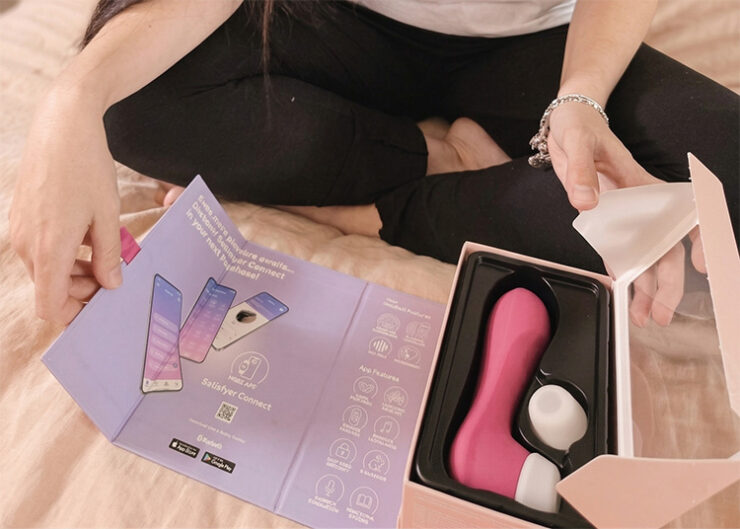
Before you plug anything in, slow down and look at the basics.
Does the model name match what you ordered? Is the color right? Are the attachments there? Is the charger the one the brand said it would include? Does the manual look like it belongs to this product, or does it feel generic in that strange, mass-printed way that makes everything look technically labeled but not quite real?
A good arrival should feel boringly consistent.
If that consistency starts slipping before the toy even turns on, I stop thinking about excitement and start thinking about where the vibrator actually came from. A product that arrives with mixed signals has already told you something useful.
That is the standard.
If the outer box says one model, the base of the toy says another, and the manual seems to belong to a third cousin of both, stop there. Same if the seal looks broken, the toy has lint on it, or a storage bag is missing when the listing clearly promised one. None of that proves danger by itself. It does mean you should stop treating the toy as ready to use.
If anything feels off enough that you are googling the brand in a suspicious tone, check the official recall database before you go further.
Your hands usually catch the problem first
Now inspect the toy the unglamorous way.
Run your fingers over every part that could touch skin. Not just the shaft or the head. Check the seam line. Check where the silicone meets hard plastic. Check the edge of the charging port. Check the battery door if it has one. Check removable caps and attachments. Twist anything meant to lock into place. Press on soft silicone and see whether the surface springs back cleanly or feels oddly gummy.
A new vibrator should feel finished.
Not sticky. Not gritty. Not sharp. Not loose in a way that makes you wonder whether that part is decorative or about to detach.
This is especially important with insertable toys. A tiny raised seam can look harmless in your hand and feel awful on a dry or sensitive entrance. A rough lip around a charging port may never touch you directly, but it tells me something about the overall finish quality. And if a toy has a battery compartment, I want that door to close flush, not with the kind of crooked snap that makes me think it will pop open mid-use.
It does not need to feel luxurious. It does need to feel intact. This is usually the moment when materials stop sounding like a boring spec and start sounding like the whole point. It helps to know what vibrator materials mean in real use before a surface that feels “mostly fine” talks you into ignoring what your hand already noticed.
If it smells loud, I pay attention
A lot of people ignore smell because they assume “new product smell” is normal.
Sometimes it is. Sometimes it is not.
If a vibrator arrives with a strong perfume smell, a sharp chemical smell, or that oily-plastic scent that clings to your hands after you put it down, I do not rush to test it on vulvar tissue. I wash it first, let it air out, and see whether the smell drops to almost nothing. If it does not, I return it.
The reason is simple. Vulvar skin is easy to irritate. If a product is announcing itself that loudly before use, I do not treat that like a cute quirk.
Strong scent is not elegance here.
It is interference.
The same goes for residue. If the toy feels oily, powdery in a weird way, or leaves a film behind that does not make sense for the material, treat that as information. Your body should not be the testing lab for mystery coatings.
If the smell stays loud after washing and airing out, I stop treating it like a personality trait and start thinking about why suspicious smells and mystery-soft materials matter. Your body should not have to forgive a toy into trust.
The first charge should be boring
This is one of my strongest rules.
The first charge should be uneventful.
That sounds almost too simple, but it is one of the clearest early signs of whether the product is behaving like a real device. It helps to know how to charge a vibrator correctly so you can tell ordinary setup from hardware that already feels sketchy.
Use the cable and charger that came with the toy. Make sure the connection is snug. Watch the toy for a bit instead of tossing it onto the bed and walking away. I want no fast heating, no blinking chaos, no hot charging brick, no smell of warm plastic, no port that only works if I tilt the cable just right.
For small rechargeable devices that touch the body, I borrow the FDA’s conservative charging habits: use the manufacturer’s charging accessories, inspect for damage, charge where you can see the device, and do not leave it charging overnight. If it gets hot quickly, the charger connection cuts in and out, or the charging port already looks warped, that is not “just one of those things.”
That is return-material.
A toy can be disappointing and still safe.
It should never be sketchy and still get a second chance.
Turn it on in your hand before you use it on your body
This is the step people skip because it feels like delaying the fun.
I see it differently. This is the step that saves you from learning a defect with your clitoris.
Turn it on and cycle through the settings while holding it in your palm. Test every button. See whether the motor ramps up smoothly or jumps unpredictably. Listen for harsh rattling, metal-on-plastic chatter, or a whine that sounds wrong for the toy type. If it has an attachment, keep the toy running while you gently press on that attachment to see whether it slips, stalls, or shifts.
A healthy motor sounds intentional.
If the vibration gets thin, rattly, or collapses under light pressure, that is often the fastest way to tell whether you are holding a quality vibrator or a low-quality one. The copy can still lie at that point. The motor usually cannot.
A bad motor sounds apologetic.
I also like a light pressure test. Not enough to strain the toy. Just enough to see whether the vibration collapses the second the head meets resistance. Some toys are simply weaker by design. Fine. But a motor that cuts out, surges strangely, or changes pitch every time it meets the slightest pressure is telling you something useful before it ever reaches skin.
Before first use, wash it anyway
Brand new is not the same as clean.
Even if the toy came sealed. Even if it looks pristine. Even if you are using it solo.
So yes, wash it before the first use.
Brand new is still not the same thing as clean, which is exactly where cleaning a vibrator properly matters before the toy ever has a chance to become part of your body’s memory of it.
Not because the factory is filthy. Because shipping boxes, warehouse shelves, returns mistakes, dust, handling, and plain common sense all exist.
Then do not make the first session a grand trial.
Make it a check-in.
A minute or two on the hand. Then the inner thigh. Then external vulvar contact on low power if that is how the toy is meant to be used. If anything feels prickly, numb in a bad way, hotter than it should, or just mechanically wrong, stop. Arrival day is not the day to push through and see if it gets better.
Four red flags that earn an immediate return
- A crack, split seam, sharp edge, or loose attachment on any body-contact area
- A strong chemical or perfumed smell that stays after washing and airing out
- A charging port, cable, or battery compartment that gets hot, cuts out, or looks damaged
- A motor that rattles hard, stalls fast, or behaves inconsistently across simple testing
What this looks like in real life
A wand arrives and the silicone head is smooth, the buttons respond cleanly, and the motor sounds stable. Great. Then you notice the charger only works if you push it sideways.
That is not a tiny quirk.
That is the whole story.
A rabbit comes out of the box looking gorgeous, but one ear has a visible seam ridge that catches your fingertip every time you stroke across it. Do not test that internally and hope your body is more forgiving than your hand.
A bullet feels fine structurally, but it smells like perfume and plastic mixed together. You wash it. You let it dry. It still smells loud the next morning.
I would not argue with that.
I would return it.
A curved internal vibe looks slightly underpowered in your palm, and that alone is not a defect. But if the motor remains steady, the surface is clean, the seams are smooth, and the charge is stable, that toy may still be completely worth trying. Weak for your taste is not the same as unsafe.
That distinction matters because sometimes the product is sound and the match is wrong. In that case, the better question is not whether the toy is defective, but whether it was ever the right kind of contact for your body in the first place.
The point is not to be suspicious. The point is to be selective
I think a lot of people treat the first use of a new vibrator like a test of their body.
Will I like it?
Will this finally work?
Why am I not reacting the way I thought I would?
But the first test goes the other way.
The product is being tested first.
You are not auditioning your nerves. You are inspecting an object. You are checking whether it is built well, finished cleanly, and calm enough in its behavior to earn contact with a very sensitive part of your body.
That shift changes a lot.
Because once you stop blaming yourself for every underwhelming first impression, you get much better at noticing when the problem is not your body at all.
It is the toy.
Reviewed medical and clinical sources
- Mayo Clinic Staff. Contact dermatitis – Symptoms and causes.
- NHS. Vulvodynia (vulval pain).
- NHS. Sex activities and risk.
- Planned Parenthood. Masturbation | Facts About Male & Female Masturbation.
- U.S. Food and Drug Administration. Tips to Help Charge Medical Devices Safely and Avoid Overheating.
- U.S. Consumer Product Safety Commission. Batteries.
- U.S. Consumer Product Safety Commission. Recalls & Product Safety Warnings.
Add comment