 Amie Dawson, Ph.D.
A technically good toy can still fail if the whole setup makes your body leave the room.
That matters more than a lot of reviews admit.
Sometimes the problem is not the vibration. It is that the toy asks you to look at, hold, angle, or name a part of your body in a way that shuts arousal down before sensation even has a chance to build. A toy can be physically right and emotionally impossible.
I do not treat that as a side issue.
I treat it as part of fit.
For some people, the fix is visual. Lights lower. Mirror gone. Blanket over the hips. Underwear partly on. A position that keeps the body from feeling too exposed to itself.
For some, it is language. Not thinking “I should use this on my ___” if that word already makes the body tighten. Think in sensations instead. Outside. Underside. Scar line. Base. Side. Pressure point. Warm area. The route matters more than the label.
For some, it is pacing. No immediate direct contact. No expectation that the first touch should already feel affirming. Sometimes the first win is smaller than that.
Sometimes the first win is simply this:
Your body did not flinch away from the experience.
That counts.
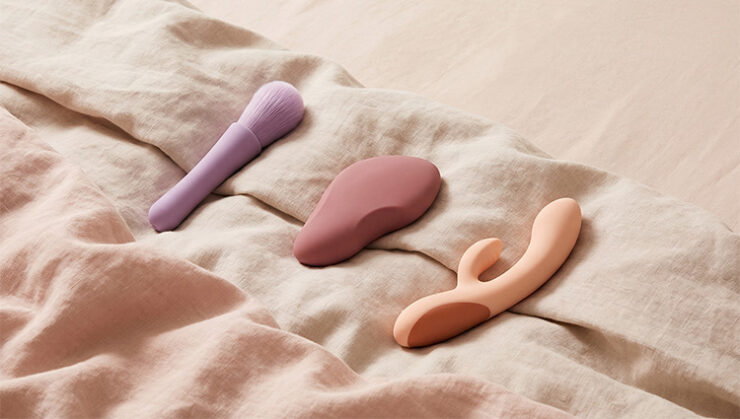
The best first test is usually broad, external, and adjustable
When the body has changed, or when the old map never fit in the first place, I do not think the smartest first move is the most “advanced” toy.
I think it is the toy that gives you the most room to negotiate contact without losing the whole thread.
That usually means:
- a shape that can touch more than one place without needing exact alignment
- a genuinely low first setting
- a surface that can be used through fabric, over skin, or beside the most sensitive area instead of directly on it
- a handle that lets you change angle without wrestling your wrist or pelvis
That is why broad external toys so often make sense as a first checkpoint. Not because everyone wants the same sensation. Because broad contact gives the body more than one way to say yes.
If a body has become more sensitive on testosterone, more exact after surgery, more dysphoria-prone around certain zones, or simply less tolerant of sharp contact than generic advice assumes, broader contact gives you room to learn before you have to commit.
A tiny, exact toy asks a very specific question.
A broader toy asks a kinder one.
A lot of bad toy experiences are really bad sequencing
This is one of the most common mistakes I see.
People try the most charged area first.
They go straight to the part that is supposed to matter most. The most obvious external target. The place with the most erotic expectation attached to it. And if that first contact feels wrong, they assume the whole category is wrong.
I would not read it that fast.
A body that has changed through hormones, surgery, healing, dysphoria, pain, or just long stretches of disconnection often does better when the first contact happens slightly away from the psychological center of the experience.
Not because pleasure needs to be timid.
Because trust usually builds outward in.
Try the surrounding tissue first. The base before the tip. The side before the center. The mons. The shaft base. The underside. The area beside a scar rather than the scar itself. The outer vulva before the most sensitive point. Pressure through fabric before bare contact. A broader toy before a pinpoint one. A slower pass before a parked hold.
A lot of bodies do not need more intensity.
They need a more believable entry into sensation.
If surgery changed sensation, think in layers, not verdicts
Surgery changes the route. It does not always remove the destination.
That is why I do not like all-or-nothing thinking here.
A scar line may feel blank for a while, then reactive, then neutral, then suddenly useful in a completely different way than expected. A chest may stop responding in the old hot spot but start waking up around the edges, under pressure, with warmth, or months later through a kind of sensation that does not read as sexual until it repeats a few times. A neoclitoris may like a narrower angle than a review writer assumed. A phallus may respond more clearly to base pressure, underside vibration, or broader contact than to direct tip-focused advice.
This is not inconsistency.
It is a new map refusing to be graded by the old one.
And that is why I think one of the most important mindset shifts after surgery is this:
Do not ask first whether the sensation is the same.
Ask whether the sensation is usable.
Usable is a much better category.
Usable means the body does not brace.
Usable means the contact can stay there.
Usable means curiosity lasts longer than flinch.
That is enough to build from.
Partnered sex gets easier when the toy is framed as translation, not replacement
This matters a lot for trans and non-binary bodies because the fear is often doubled.
Not just will this work?
Also:
Will I have to explain my body while already feeling exposed?
A toy can help there, but only if the partner understands what role it is playing.
I would frame it simply.
Not “this toy does what you cannot.”
More like: “this helps my body read the sensation more clearly.”
That is a different emotional world.
For some people, a partner using the toy feels better than self-use because it keeps connection in the room. For others, self-placement with partner closeness nearby works better because it preserves the exact pressure map. For others, the best version is the partner handling everything around the toy while the person receiving holds the angle and intensity themselves.
There is no one mature version of this.
The mature version is the one where your body does not have to disappear so someone else can feel competent.
That is especially important when the body in question already gets over-managed by medicine, language, or other people’s projections.
A good partner is not the one who guesses perfectly.
A good partner is the one who can stay beside the truth once you say it.
The fastest way to learn is to stop testing for orgasm first
I know that sounds unsexy.
It still works.
If the body has changed, if the map is unclear, if the toy category feels promising but not obvious, the most useful first question is usually not “Can I come from this?”
It is smaller.
Can I stay with this?
Does this feel neutral, promising, wrong, or too much?
Does the sensation get better with one degree more pressure or worse?
Does it make my body move toward it or away from it?
Do I want more contact, less contact, broader contact, more buffer, slower rhythm?
That is real information.
And it is much easier to gather when you are not trying to force the session to justify the toy immediately.
A lot of people think they need more courage with a new body.
Often they need less pressure to produce a result before the body has even finished answering the first question.
Three patterns I would trust quickly
1. “This feels almost right, but too direct.”
That usually means move wider, not stronger. Broader head. Softer angle. More fabric, hood, foreskin, hand, or surrounding tissue between the toy and the most reactive point.
2. “This feels good, but vague.”
That often means the body wants more defined pressure, a firmer surface, or a smaller target once arousal is already underway. Not necessarily a stronger toy. A clearer one.
3. “This feels emotionally wrong before it feels physically wrong.”
That is still real data. Do not push past it just because the toy is technically safe. Change the setup. Change the language. Change the body position. Change who is holding it. Sometimes the body is not rejecting pleasure. It is rejecting the frame around it.
When to stop experimenting alone
Sometimes the issue is simple mismatch.
Sometimes it is pain.
Sometimes it is healing.
Sometimes it is pelvic floor guarding.
Sometimes it is scar sensitivity.
Sometimes it is hormonal dryness or tissue fragility.
Sometimes it is a dysphoria response that keeps turning physical contact into threat faster than you can think your way around it.
If the pattern includes burning, persistent stinging, deep pelvic pain, bleeding, worsening scar pain, or contact that keeps feeling electrically wrong instead of just unfamiliar, I would stop treating this like a shopping problem.
The same goes for:
- pain with insertion that does not settle
- orgasmic pain after testosterone or after surgery
- ongoing dryness that makes internal toys feel draggy or punishing
- a body part that used to feel fine and now feels sharply off
- fear or dissociation that keeps showing up before the toy even lands
At that point, better technique may not be the answer.
Care may be the answer.
A pelvic floor physical therapist, trans-competent sexual health clinician, surgeon, or affirming therapist can sometimes do more for pleasure than another three toys and a month of self-blame.
The point is not to make your body fit the toy
I think that is the deeper correction here.
A lot of sex-toy advice quietly assumes the body should adapt to the device if the device is popular enough, expensive enough, or correctly categorized enough.
I do not think that is a smart standard for any body.
Especially not for one that has changed.
Especially not for one that has had to negotiate with gendered assumptions before touch even begins.
The job is not to become easier for the toy.
The job is to get more accurate about what your body actually opens to now.
That may mean a broad external vibrator used nowhere near the place the box suggests.
It may mean pressure through fabric.
It may mean a toy for a penis used on a body that does not call itself male.
It may mean a “women’s toy” used only externally on a transmasc body that wants no internal contact at all.
It may mean no vibrator yet, just a slower return to sensation.
All of those are real.
Because the right toy is not the one that confirms a category.
It is the one that lets your body stop translating and start answering.
Reviewed medical and clinical sources
- UCSF Gender Affirming Health Program. Information on Testosterone Hormone Therapy.
- UCSF Gender Affirming Health Program. Overview of Feminizing Hormone Therapy.
- UCSF Gender Affirming Health Program. Pelvic Pain and Persistent Menses in Transgender Men.
- UCSF Gender Affirming Health Program. Vaginoplasty Procedures, Complications and Aftercare.
- UCSF Gender Affirming Health Program. Phalloplasty and Metoidioplasty.
- UCSF Gender Affirming Health Program. Postoperative Care and Common Issues After Masculinizing Chest Surgery.
- UCSF Gender Affirming Health Program. Approach to Genderqueer, Gender Non-Conforming, and Gender Nonbinary People.
- Fenway Health. Sexual Health for Trans and Gender Diverse People.
- NHS. Vaginismus.
- NHS. Vulvodynia (Vulval Pain).
- Leicestershire Partnership NHS Trust. Female Orgasmic Difficulties.
- Calotta NA, Coon D. Sensibility, Sensation, and Nerve Regeneration after Reconstructive Genital Surgery: Evolving Concepts in Neurobiology.
- Goldstein B, et al. Sexual Health Outcomes Following Gender Affirming Metoidioplasty: a Systematic Review.
- Zack J, et al. Sexual Health Outcomes Following Gender-Affirming Phalloplasty: a Systematic Review.
Add comment