

 Amie Dawson, Ph.D.
Sometimes you are touching the right place and it still does not build.
You stay there. Nothing much happens. So you start moving. That helps for a second, then the feeling scatters. Or the opposite happens: motion keeps you near pleasure, but the moment you hold still and lean in, everything finally starts to gather.
That difference matters more than a lot of advice admits.
People spend years looking for the right spot without realizing there is a second question hiding underneath it:
How does your body want that spot stimulated over time?
For some bodies, pleasure builds when contact stays stable long enough to thicken. For others, it builds when the touch keeps changing just enough to stay alive. And for a lot of people, the answer is not one or the other forever.
It is an order.
This is not really about more stimulation. It is about how stimulation accumulates.
A lot of sex advice treats pleasure like a volume problem.
More pressure. More speed. More power.
That is not how many bodies work.
The deeper question is whether your body likes sensation to stay consistent long enough to build, or whether it likes sensation to keep changing enough to stay readable. Steady pressure and movement are not just two techniques. They are two different ways of feeding sensation to the nervous system.
Steady pressure says: stay here long enough for the feeling to collect.
Movement says: keep the sensation active enough that it does not flatten, sharpen, or disappear into the background.
Neither one is more advanced. Neither one is more correct.
They just build differently.
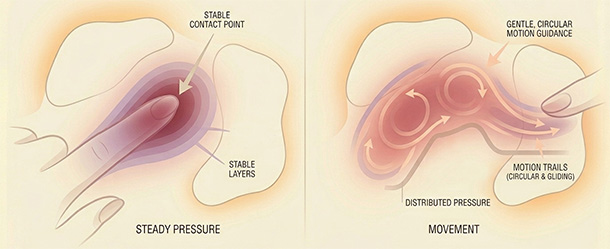
What steady pressure is actually good at
When steady pressure works, it usually does not feel dramatic right away.
It feels promising.
You settle onto one spot. Or just above it. Or slightly to one side. You stop adjusting. The contact stays continuous. Then the sensation starts changing from the inside rather than because your hand changed what it was doing.
It does not always feel stronger.
It usually feels less interrupted.
That is why steady pressure works so well for some people. It lets arousal stack on itself. The body stops having to reacquire the signal every few seconds. The touch gets time to deepen.
When steady pressure is right, it often feels like this:
- the build gets smoother, not choppier
- you stop making constant micro-corrections
- the sensation starts spreading inward even though the contact stayed in one place
- and you feel less tempted to “do more” because the pleasure is already organizing itself
A good steady-pressure build often feels less like chasing and more like dropping in.
What movement is actually good at
Movement helps for a different reason.
Instead of letting one contact point deepen, it keeps sensation active by reintroducing contrast. A glide. A circle. A rock. A small repeated pass over the same area. Not frantic motion. Not random motion. Just enough change to keep the nerves engaged.
For some people, that is what makes sensation readable.
Especially early on.
The touch does not feel thicker.
It feels brighter.
You notice it more. It wakes the area up. It gives your body something to respond to instead of one fixed point that may feel too direct, too exposed, or weirdly blank.
When movement is right, it often feels like this:
- the sensation stays alive instead of fading into the background
- you feel more present, not less
- the contact feels easier to enter
- the body responds to rhythm and return, not just one exact point
Some bodies want rhythm more than pinning.
For them, movement is not a distraction from pleasure. It is the thing that keeps pleasure happening.
Why people get confused: arousal can flip the preference
This is the part that makes people doubt themselves.
They assume what feels best at the start should also feel best near orgasm.
Not necessarily.
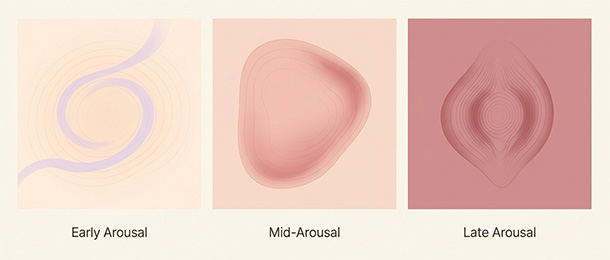
A lot of bodies want one kind of stimulation early and another later. Movement may be what wakes the area up. Steady pressure may be what carries the build once arousal is already there. Or steady pressure may feel grounding at first, but later the body may need a little movement to keep sensation from becoming too concentrated.
That is not inconsistency.
That is progression.
The body changes as arousal rises. Sensitivity shifts. Blood flow shifts. What felt vague can become exact. What felt exact can become too much. What felt barely there can become perfect.
So if movement worked at the beginning and then suddenly stopped helping, that does not mean it was wrong.
It may have just finished its job.
That is often the missing insight. A lot of bodies do not want one method forever. They want a pattern, and the useful part is noticing what kind of stimulation your body wants first and what it wants next.
What steady pressure feels like when it is wrong
Steady pressure is not always calming.
Sometimes it is exactly what makes pleasure stall.
When it is wrong, the contact starts feeling pinned down instead of buildable. Too exposed. Too raw. Or strangely blank. You hold still because advice says consistency matters, but the sensation does not deepen.
It just sits there.
You may notice:
- you brace instead of soften
- the signal feels loud but not cumulative
- the contact starts feeling more exacting than erotic
- pressing harder makes it worse, not better
A useful line to keep in mind is this:
Steady pressure should feel like it is gathering the sensation, not trapping it.
When it starts feeling trapped instead of buildable, the problem is often not the spot itself. It is that the contact has become too concentrated, which is often how clitoral stimulation starts feeling too intense without necessarily feeling painful.
What movement feels like when it is wrong
Bad movement often feels active in a way that tricks people.
You are doing plenty. The problem is that nothing gets to stay long enough to build.
You find the spot. Then glide off it. Re-find it. Lose it again. The sensation flickers. It never gets enough continuity to organize into a climb.
When movement is wrong, it can feel like this:
- you keep getting sparks, but not traction
- the pleasure stays surface-level
- every pass feels new instead of cumulative
- the build disappears the second the angle shifts
That pattern is easy to miss because it can still feel good.
It just never becomes enough.
That is the frustrating part of bad movement. Pleasure is present, but it keeps restarting before the body can do anything with it, which is often what people mean when they get close to orgasm and then lose it.
Same anatomy, different build
This is why generic advice fails so often.
Two people can be touching the same structure and still be doing completely different things to the nervous system.
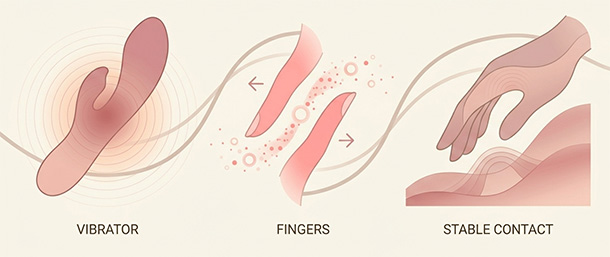
One person places a vibrator over the clitoral hood and barely moves it. After twenty seconds, the sensation starts feeling fuller. After a minute, it starts climbing.
Another person uses fingers in small side-to-side strokes over the same area. Holding still felt too concentrated. Motion makes the touch readable and sexy instead of sharp.
A third keeps the hand planted, but lets the hips do the moving. That becomes the bridge between the two modes. The contact point stays stable enough to build, while the body still gets the rhythmic change it wants.
Same anatomy.
Different route.
That is why “just stimulate the clitoris” is such incomplete advice. It tells you where, but not how.
The best answer is often a sequence, not a winner
A lot of bodies do not want you to pick one and stay loyal to it.
They want an order.
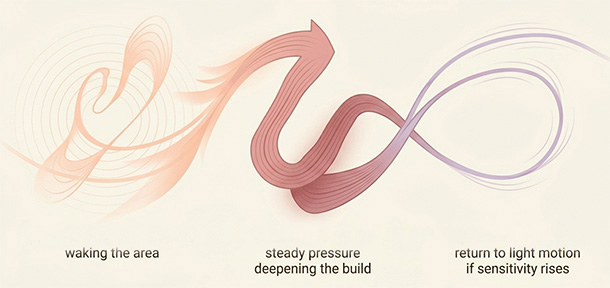
Movement to wake the area up. Steady pressure to deepen it. Or steady pressure first, then small movement once sensitivity rises. Or stable contact plus pelvic rocking. Or circles that gradually shrink until they become pressure.
This is the question that matters:
What is each mode doing for you at each stage?
Some bodies build pleasure like a dimmer switch.
Others build it like a spark that needs fresh contact to keep catching.
Many do both, just not at the same time.
That is why I would not frame this as a winner-takes-all question unless your body makes the answer very obvious. For many people, the real insight is not “I prefer movement” or “I prefer pressure.”
It is “I need movement first, then pressure.”
That is a much more useful answer.
A simple way to test this without turning it into homework
Keep the experiment tiny.
Pick one area. Keep everything else as similar as possible.
Then do two short rounds:
Round one: keep the contact point mostly the same, remove movement, and let the sensation build for thirty to sixty seconds.
Round two: keep the pressure light and similar, but add a small repeated motion.
Then ask only one question:
Which one made the sensation more cumulative?
Not which one felt strongest in the first five seconds.
Not which one sounded sexier in theory.
Not which one seems more “supposed to” work.
Which one actually let the pleasure keep building instead of restarting?
That is the clue you want.
If both feel wrong, stop treating it like a preference problem
Sometimes the issue is not whether your body prefers pressure or movement.
Sometimes the issue is friction. Dryness. Guarding. Pelvic tension. Pain. Irritation.
When that is the layer underneath the problem, switching between pressure and movement will not solve much on its own. Sometimes the real issue is that the body is too braced for pleasure to build cleanly in either mode.
If touch feels burning, irritating, persistently numb, or impossible to build with no matter how you change it, that is not a cue to try harder.
It is a cue to get gentler.
And sometimes to get help.
The same goes for pain with penetration, ongoing soreness, or a body that seems to clamp down no matter how careful you are. Those can look like technique problems from the outside, but they are not always technique problems.
The real skill
People spend years asking where the right spot is.
That is only half the question.
The other half is how your body wants that spot approached. Held. Revisited. Pressed into. Moved across. Stayed with.
A good touch is not just in the right place.
It arrives there in the right way.
Reviewed medical and clinical sources
- Debby Herbenick, Tsung-Chieh Jane Fu, Jennifer Arter, Stephanie A. Sanders, Brian Dodge, “Women’s Experiences With Genital Touching, Sexual Pleasure, and Orgasm: Results From a U.S. Probability Sample of Women Ages 18 to 94”, Journal of Sex & Marital Therapy, 2018.
- Annette Bischof-Campbell, Peter Hilpert, Andrea Burri, Karoline Bischof, “Body Movement Is Associated With Orgasm During Vaginal Intercourse in Women”, Journal of Sex Research, 2019.
- Cleveland Clinic, “Clitoris: Anatomy, Location, Purpose & Conditions”, Cleveland Clinic, last updated 2026.
- Cleveland Clinic, “Sexual Response Cycle: Order, Phases & What To Know”, Cleveland Clinic, last updated 2023.
- Mayo Clinic Staff, “Female Sexual Dysfunction — Diagnosis and Treatment”, Mayo Clinic, updated 2024.
- Cleveland Clinic, “Hypertonic Pelvic Floor: Symptoms, Causes & Treatment”, Cleveland Clinic, last updated 2022.
Add comment