

 Amie Dawson, Ph.D.
You can feel it building. Your body starts to gather around one point. The sensation gets heavier, warmer, more promising.
Then it slips.
Not all at once. It thins. The wave that felt like it was about to crest suddenly spreads out, weakens, or goes flat. Now you’re still turned on, but the thing that felt imminent is gone, and you’re left wondering what you just did wrong.
That specific experience matters, because it usually does not mean your body can’t orgasm. It means your body can get close, but something in the last stretch isn’t staying intact.
Close is fragile. It isn’t a guaranteed finish.
A lot of people imagine orgasm as a straight line. More arousal. More stimulation. More intensity. Then orgasm.
Plenty of bodies don’t work that way.
Getting close is more like holding a signal steady long enough for the body to tip. And when that signal gets interrupted, even a little, the build can collapse before it becomes orgasm.
That is one reason this happens so often with clitoral stimulation. NHS patient guidance on orgasm difficulties notes that most women need steady clitoral stimulation to reach orgasm, and many kinds of sex do not provide that on their own. A large U.S. survey published in the Journal of Sex & Marital Therapy found the same thing from another angle: women reported very different preferences for location, pressure, shape, and pattern of touch, which helps explain why a tiny change can matter so much near the edge. Herbenick and colleagues’ study is useful here because it shows just how specific those preferences can be.
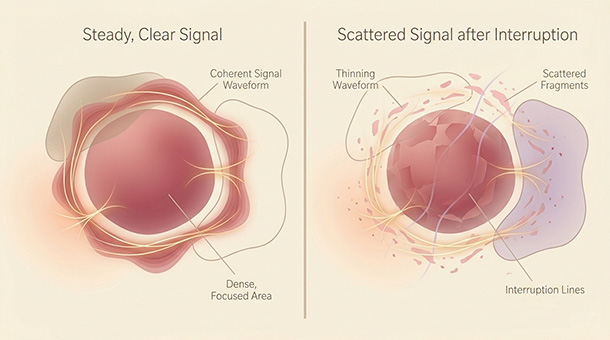
That is why “almost” feels so maddening. You were not far away in some simple, linear sense. You were in a very particular state, and then that state changed.
It doesn’t feel like starting over.
It feels like the door almost latched and then bounced open.
Right before orgasm, most people need less improvising, not more
This is where a lot of people accidentally ruin the thing that was working.
You feel the charge building and think, okay, now push it over the line. So you speed up. Or press harder. Or move to what seems like the most obvious spot. Or you tense your thighs, stomach, jaw, shoulders, hands, everything, like your whole body needs to force the orgasm through.
That is often the exact moment the build falls apart.
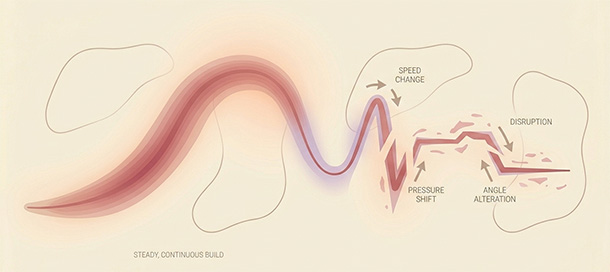
Because the thing that got you close was not just “strong stimulation.” It was a very particular mix of pressure, angle, rhythm, and nervous system state. Change three of those at once and your body has to recalibrate. Near orgasm, recalibration is expensive.
This is why people keep having the same frustrating realization: they thought they needed more, but more ruined it.
Not bigger. Not faster. Not harder.
More exact.
The second you start checking, you often start losing it
There is another way orgasm disappears, and it has nothing to do with where your hand or toy is.
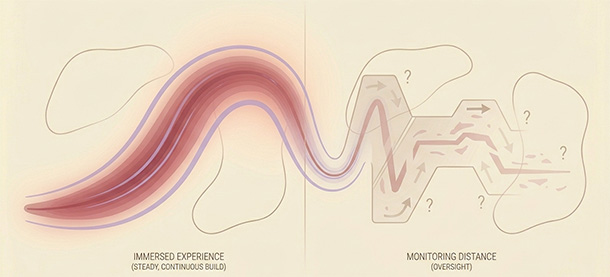
You stop feeling and start supervising.
You ask whether it is happening yet. You notice how long it has been taking. You wonder if your partner is getting bored. You become aware of your face, your sounds, the room, the goal, the outcome. A part of your attention steps outside the sensation and starts evaluating it.
That split matters. Merck Manual’s professional guidance on female orgasmic disorder notes that mindfulness-based approaches can help women stay with sexual sensation instead of judging or monitoring it, and that sex therapy can help with performance concerns. That matters here because “close, then gone” is often exactly the moment monitoring takes over.
The shift can be tiny. Tiny is enough.
Once attention slides from sensation into management, the body often loses the thread even if arousal is still there. It is the same trap people fall into when performance pressure gets louder than pleasure.
You feel the swell. Then you feel yourself step outside it.
And once you’re outside it, you try to think your way back in, which is usually the wrong tool for the job.
What this actually looks like in a body
Sometimes the clearest explanation is just a familiar scene.
You are using your fingers and finally find the strip of skin beside the clitoris that feels right. The pressure is steady. The arousal is building. Then, because you’re getting close, you move directly onto the most sensitive point and the sensation changes from building to sharp. Not painful exactly. Just too exposed. The wave breaks.
For a lot of people, that last-second switch is the whole problem. The sensation did not stop working because it got weaker. It stopped working because the contact suddenly became too intense for the stage of arousal you were already in.
Or you are using a vibrator and the angle is finally right. You can feel the orgasm gathering. Then you lift the toy for one second to add lube, switch settings, or adjust your grip. When it comes back, the sensation is still good, but the charge is gone.
Or your partner notices you’re close and asks, “Are you coming?”
Now you’re not in the feeling anymore. You’re in a conversation about the feeling.
That is enough to lose it for a lot of people.
Sometimes “almost there” is not really a technique issue
If this happens once in a while, it may just be how your body works on that day. Orgasm is not identical every time. Mayo Clinic’s guidance on anorgasmia is clear that the amount and type of stimulation needed can vary from person to person and from one experience to the next. The same source also notes that stress, anxiety, depression, pain, dryness, certain medications including SSRIs, and health conditions such as diabetes or multiple sclerosis can all interfere with orgasm.
So if you are doing the same things that used to work, and now the build keeps fading, it is worth thinking bigger than technique.
Pain is a common hidden spoiler. So is dryness. So is numbness after too much friction. So are hormones. So is a pelvic floor that is clenching instead of responding.
The pelvic floor matters more than many people realize. The FDA Office of Women’s Health notes that pelvic floor muscles help maintain sexual function, and Oxford University Hospitals patient guidance explains that these muscles can contribute to orgasm intensity and that diaphragmatic breathing helps them relax. That helps explain why some people get close, then lose the build the second they start bracing hard through the belly, hips, thighs, or jaw.
If this pattern is new, persistent, distressing, or paired with pain, dryness, numbness, or a major shift in sensation, it is worth bringing up with a clinician.
What to do when the build starts thinning out
This is the part most advice gets wrong. The answer usually is not to try harder. It is to protect continuity.
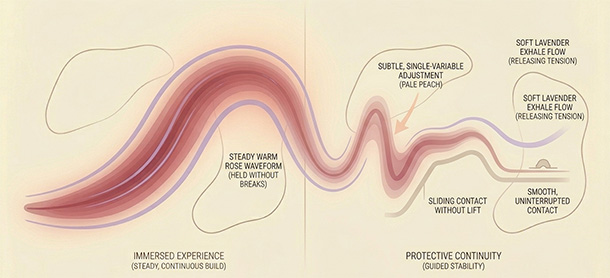
- Freeze the winning move. When something starts working, keep it going longer than feels intuitive. Same spot. Same pressure. Same rhythm. Near orgasm, consistency is usually sexier than creativity.
- Change one variable, not three. If the sensation gets too sharp, do not jump to a whole new technique. Shift slightly off-center. Add a layer of fabric. Flatten the toy angle. Keep the rhythm.
- Exhale instead of pushing. A long breath out can do more than an aggressive squeeze. A lot of people lose the build when they clench everywhere and stop letting sensation move.
- Do not fully break contact unless you have to. Slide instead of lifting. Soften instead of stopping. Even a short full break can drain the charge.
- Treat repeated almost-orgasms like data. Notice what was happening right before the drop: the exact spot, the pressure, whether you got more tense, whether you started thinking, whether sensation turned sharper, duller, or farther away.
One of the most useful questions is not, “Why didn’t I finish?”
It is, “What changed right before I lost it?”
That question gets you somewhere real.
When this keeps happening with a partner
There is a special kind of frustration here.
You are close enough that your partner can tell. Maybe they get excited and speed up. Maybe they switch techniques because they think orgasm needs escalation. Maybe they check in verbally right at the edge. Maybe you start performing closeness instead of staying inside it.
For some people, that is the whole split between solo and partnered orgasm. The body can still get close, but it gets much harder to stay there once another person’s awareness enters the moment too loudly.
This is why “almost there” is useful information to communicate clearly.
Not: “Keep doing something sexy.”
More like: “When I get close, do not go harder. Stay exactly there.”
Or: “If I go quiet, that does not mean stop.”
Or: “Please do not ask me if I’m coming when I’m right there.”
Precise guidance saves a lot of almost-orgasms.
Losing it is information
It is easy to make this mean something bigger than it is. That you are difficult. That your body is inconsistent. That you are broken right at the finish line.
Usually, that is not the story.
Usually, your body is telling you something more precise: orgasm for you is less about force and more about continuity. Less about chasing the peak and more about not interrupting the climb.
That is a different problem.
And it is a solvable one.
Losing it does not mean your body missed the exit. It means the road there is more exact than you were taught.
Reviewed medical and clinical sources
- Leicestershire Partnership NHS Trust, Department of Medical Psychology. Female orgasmic difficulties. Leicestershire Partnership NHS Trust.
- Conn A, Hodges KR. Female Orgasmic Disorder. Merck Manual Professional Edition. Reviewed by Goje O.
- Mayo Clinic Staff. Anorgasmia in women: Symptoms and causes. Mayo Clinic.
- Herbenick D, Fu TCJ, Arter J, Sanders SA, Dodge B. Women’s Experiences With Genital Touching, Sexual Pleasure, and Orgasm: Results From a U.S. Probability Sample of Women Ages 18 to 94. Journal of Sex & Marital Therapy.
- FDA Office of Women’s Health. What Women Need to Know About Their Pelvic Floor. U.S. Food and Drug Administration.
- Oxford University Hospitals NHS Foundation Trust. Pelvic Floor Awareness for Psychosexual Therapy for Women. Oxford University Hospitals NHS Foundation Trust.
Add comment