
 Amie Dawson, Ph.D.
You touch yourself, wait for something obvious to happen, and get almost nothing useful back.
Not a clear yes. Not a clear no. Just a weird mix of pressure, distraction, and second-guessing.
Then the panic starts filling in the blanks. Maybe I’m doing it wrong. Maybe I’m too in my head. Maybe other people just know this stuff faster.
I want to say this plainly: not knowing what kind of stimulation you like is a normal starting point. It doesn’t mean your body is unresponsive. Very often, it means you’re trying to read a complicated system while changing too many things at once.
Leicestershire Partnership NHS guidance on orgasm difficulties notes that most women need steady clitoral stimulation for orgasm, and that penetrative sex alone often doesn’t provide enough of it. A large U.S. probability study found wide variation in preferred touch location, pressure, shape, and pattern too. That matters. There is no single move your body was supposed to recognize on contact.
Stop chasing the “right move” and learn your body’s yes
A lot of people start with the wrong question.
They ask, What should make me orgasm?
I’d start earlier than that. I’d ask, What makes my body lean in instead of pull away? What makes me stay curious for another thirty seconds? What makes me want a little more, instead of making me check the clock?
Pleasure often announces itself quietly. Not as fireworks. As interest.
For a lot of people, that’s the first useful correction. The body isn’t always offering a dramatic yes yet. It’s often just showing the first signs of what starts to feel more possible than blank.
That distinction matters because orgasm is a high bar for a body you haven’t learned to read yet. Merck Manual’s overview of female sexual function makes the same broader point from the medical side: sexual response is shaped by overlapping factors, and distress, context, mood, medication, pain, and arousal all matter. In other words, “this didn’t work once” is not a diagnosis.
Here’s the shift I want you to make: stop judging each session by whether it ended in orgasm. Judge it by whether you learned something clean.
A blank answer is still data.
Change one thing at a time or you learn almost nothing
This is the biggest practical mistake I see.
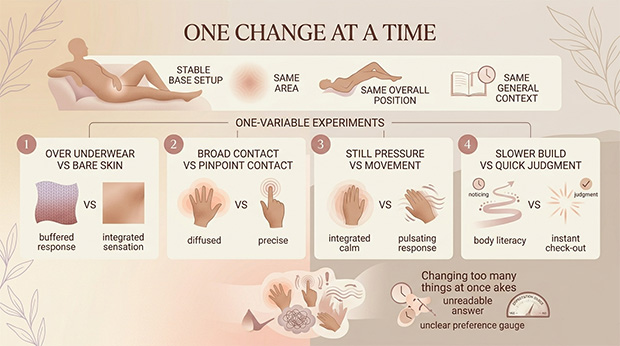
You change location, speed, pressure, position, toy, lube, fantasy, and mood all in one session. Then, if something feels good for five seconds, you have no idea why. And if it feels wrong, you still learn almost nothing because six different variables moved at once.
Keep the experiment boring enough to teach you something.
Pick one body area to focus on. Keep your overall setup the same. Then change only one variable in that session.
For example:
- same area, but over underwear instead of bare skin
- same area, but flatter contact instead of a small pinpoint point
- same area, but still pressure instead of constant movement
- same area, but a slower build before deciding whether it works
That isn’t sexy lab work. It’s cleaner listening.
And cleaner listening usually matters more than more intensity. A lot of bodies don’t need a new trick so much as one pattern held still enough to become readable.
The Herbenick study is useful here because it found that women’s preferences differ not just by body part, but by the details of how touch is delivered. So when one style does nothing for you, that doesn’t tell me much by itself. It may only tell me that one delivery method didn’t match your nervous system.
Use a three-part map: no, maybe, more
You do not need a full review of every sensation. You need a simple sorting system.
I like three categories:
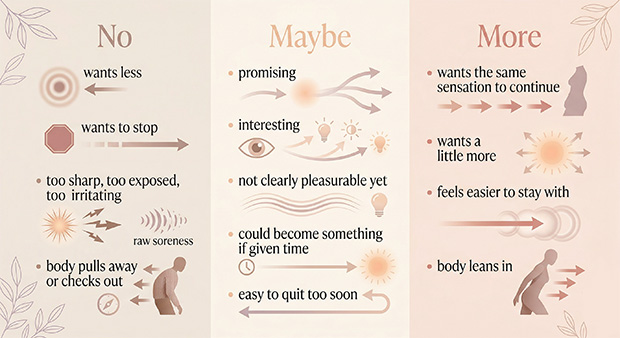
No means your body wants less of that, or wants it to stop.
Maybe means it isn’t clearly pleasurable yet, but it feels promising or interesting.
More means your body wants that same sensation to continue, deepen, or return.
This works better than forcing yourself to decide, Do I like this or not? too early.
Some touch is easy to reject because it feels bad. Some is easy to love because it clicks fast. The hardest category is the middle one. Touch that doesn’t feel wrong. Touch that doesn’t feel dead. Touch that feels like it might become something if you stop poking at it.
That middle zone is where a lot of people quit too early.
Pleasure is often not a lightning strike. It’s a gathering.
That’s why the middle category matters so much. A sensation doesn’t have to be dramatic to be promising, which is often the whole shift behind exploring pleasure without turning it into a pass-fail exercise.
Judge stimulation in two moments, not one
The first five seconds are not the whole story.
Some stimulation feels exciting on contact, then turns thin, irritating, or numbing. Other stimulation feels almost too subtle at first, then starts building once arousal catches up. If you judge everything at the first point of contact, you’ll misread both.
NHS psychosexual guidance is blunt about another reason this goes sideways: pressure to achieve orgasm can make orgasm harder. The minute you turn sensation into a pass-fail test, attention narrows and pleasure gets replaced by surveillance.
So give each promising type of touch two chances to speak.
First ask: what’s my immediate reaction?
Then ask, after a minute or two of consistent contact: is this building, flattening, or turning irritating?
Those are different answers.
For a lot of people, that second answer is the one that finally tells the truth. Something that seemed too subtle at first can turn into a real line of build once the body has time to follow it, which is often the quieter reason orgasm can take longer than expected without anything being wrong.
It doesn’t feel smaller. It feels less thin.
That’s the kind of distinction you’re listening for. Not just intensity. Texture. Shape. Whether the sensation spreads, deepens, sharpens, softens, or starts to feel too exposed.
What this looks like in real life
Theory helps. Scenes help more.
One person starts with direct bare-skin contact because that seems like the obvious thing to do. It feels abrupt. Not awful. Just too immediate. She changes nothing except the barrier. Same hand, same area, same pace, but over underwear. Suddenly her body stops bracing. The sensation isn’t stronger. It’s easier to stay with.
Another person assumes internal stimulation should be the main event because that’s what “counts” in her head. But every session turns into searching. Angle, depth, reposition, repeat. When she strips the session back and asks what reliably creates interest, she realizes the answer is external contact with steady pressure, and internal touch only works for her once that interest is already high.
A third person thinks she likes intense stimulation because subtle touch feels like nothing. But when she slows down and keeps one broad, steady sensation going for longer, she notices that the “nothing” was actually early-stage arousal. She had been interrupting it before it had time to become recognizable.
This is why I don’t want you chasing the most dramatic feeling first.
The body often gives its most useful answer one beat before obvious pleasure.
Sometimes “I don’t like this” is really pain, dryness, numbness, or overload
Preference and discomfort are not the same thing.
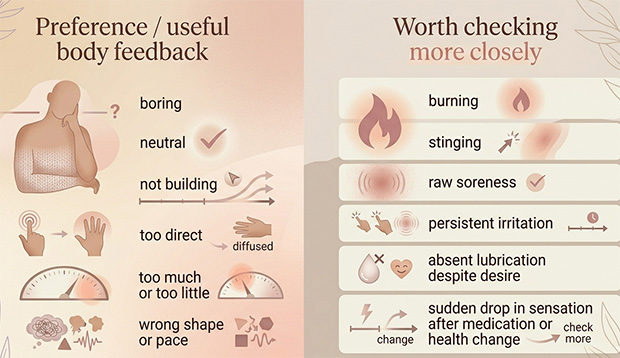
If a touch feels boring, that’s one kind of information. If it feels burning, raw, sharply irritating, or weirdly sore afterward, that’s different. Gloucestershire Hospitals’ patient guidance on vulvodynia describes burning, soreness, and stinging that can happen even with normal touch, sex, or clothing. Cleveland Clinic also notes that the clitoral glans is highly sensitive and that too much direct pressure or stimulation can feel painful.
That means “I hate stimulation” is sometimes not a preference statement at all. It may be a pain statement.
Merck’s clinical overview also lists overlapping medical and physical contributors to sexual difficulty, including vaginal dryness, menopause-related changes, fatigue, nerve damage, diabetes, multiple sclerosis, thyroid disorders, and medication effects, especially some SSRIs.
Please don’t try to mindset your way past these signs:
- touch feels burning, stinging, raw, or sharply painful
- you feel persistent soreness after ordinary stimulation
- lubrication and arousal seem absent even when you want to be engaged
- sensation drops off suddenly after a medication change or health change
Those are good reasons to talk to a clinician, ideally one comfortable discussing sexual pain or sexual function. That isn’t overreacting. It’s accurate sorting.
Pleasure is a literacy, not a test
I think this is the part people need most.
You are not trying to produce the correct sexual response on command. You are building a vocabulary. That’s the deeper shift. Once sensation starts feeling nameable, it gets much easier to learn what kind of stimulation you actually like instead of treating every session like a mystery.
That kind of knowledge changes everything, because once you can name sensation, you can shape it. You can repeat what works. You can stop apologizing for what doesn’t. You can give a partner better directions. You can buy toys with more confidence. You can stop treating every session like a referendum on your body.
You don’t need one magical answer.
You need fluency.
And fluency starts the moment you stop asking, Why am I not getting it? and start asking, What exactly did my body say?
Reviewed medical and clinical sources
- Herbenick D, Fu TCJ, Arter J, Sanders SA, Dodge B. “Women’s Experiences With Genital Touching, Sexual Pleasure, and Orgasm: Results From a U.S. Probability Sample of Women Ages 18 to 94.” Journal of Sex & Marital Therapy / PubMed.
- Conn A, Hodges KR. “Overview of Female Sexual Function and Dysfunction.” Merck Manual Professional Edition.
- Department of Medical Psychology, Leicestershire Partnership NHS Trust. “Female Orgasmic Difficulties.”
- University Hospitals Bristol and Weston NHS Foundation Trust. “Psychosexual Service.”
- Cleveland Clinic. “Clitoris: Anatomy, Location, Purpose & Conditions.”
- Gloucestershire Hospitals NHS Foundation Trust. “Vulvodynia.”
Add comment