
 Amie Dawson, Ph.D.
You pick a vibrator that seems right in every obvious way. The shape makes sense. The reviews look good. The power sounds like your kind of power.
Then it touches your body and something feels off.
Not bad exactly. Just wrong. Too sharp. Too vague. Too bare. Too cushioned. Like the toy is speaking almost the right language, but not quite.
I think this is one of the most overlooked parts of vibrator shopping: firmness.
Not the motor. Not the pattern. The layer between the toy and your nerves.
The part that feels wrong may be the shell, not the strength
A firm vibrator does not just feel harder. It feels more exact.
A soft vibrator does not just feel gentler. It feels more filtered.
That difference matters more than many people realize. Two toys can have similar power and still land completely differently because the material changes how pressure spreads, how much the surface gives, and how directly the vibration reaches you.
Same motor. Different translator.
This is also why people sometimes describe a toy as “too intense” when the real problem is not intensity at all. It is concentration. The sensation is landing too narrowly, too directly, too uncovered.
And the reverse happens all the time. A toy gets called “weak” when the motor is fine, but the softness is diffusing the contact so much that the body never quite gets a clear signal.
Soft does not always mean weaker.
Sometimes it means buffered.
Firmness changes the pressure map
The simplest way I can put it is this: firmness changes where sensation lands, and how thinly it lands.
A firmer head keeps its shape longer when you press it against the body. That usually means more of the sensation stays focused in one area. A softer head compresses first. It flattens, rounds off the edge, and spreads the contact over a wider patch of skin.
That can change the feeling dramatically.
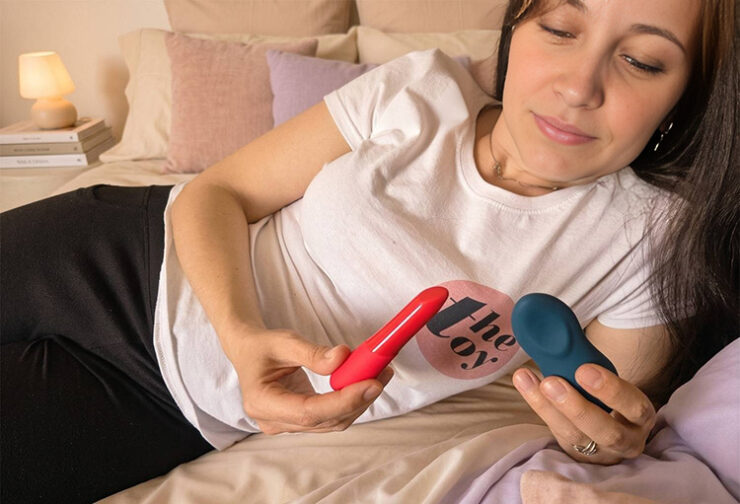
A firm toy often feels more pinpoint, more defined, more immediate. A soft toy often feels broader, blurrier, cushier, and easier to lean into for longer. Neither one is inherently better. They solve different problems.
One is not more powerful. One is not more advanced. They are different kinds of contact.
And contact is half the experience.
That is why firmness overlaps so often with whether your body prefers pinpoint or broad stimulation. The shell is not just changing comfort. It is changing how narrowly the signal lands.
On the clitoris, soft can feel protected and firm can feel exposed
This is where the difference becomes obvious fast.
The glans of the clitoris is extremely sensitive, and too much direct pressure can hurt. At the same time, many women need steady clitoral stimulation to reach orgasm, and intercourse alone often does not provide enough of it. Put those two facts together and a common pattern starts to make sense: a lot of people want consistent clitoral stimulation, but they do not necessarily want it delivered in the most direct, concentrated way possible.
For some bodies, very direct contact does not feel sexy. It feels unshielded.
Too much nerve. Too little buffer.
That is often the hidden difference between direct and indirect clitoral stimulation. Some bodies do not need less sensation. They need the same sensation filtered through a little more tissue.
A soft vibrator can make stimulation feel less exposed. Not vague. Just padded enough that your body stops bracing against it. Under the clitoral hood or slightly off the glans, that softness can turn “too much” into “keep going.”
It does not feel weaker. It feels less thin.
But the opposite happens too. Plenty of people try soft toys and feel like the sensation never quite arrives. The toy squishes. The target blurs. The pressure spreads wider than their body wants. In that case, a firmer head can feel clearer, cleaner, easier to read.
Some bodies do not hate vibration.
They hate exposure.
Other bodies do not need more power.
They need more precision.
Inside the body, firmness changes how much the toy keeps its shape
Internally, firmness matters for a different reason.
A soft insertable toy yields when your muscles press back. A firmer one resists more. That changes how much presence you feel, how clearly the curve holds, and whether the toy keeps pressing where you want it to press.
If you like a cushioned, forgiving feeling, softness can be a gift. It can make thrusting feel gentler, broader, and less pokey. It can also make a larger toy feel friendlier because the first layer your body meets is not rigid.
If you like distinct internal pressure, though, too much softness can feel like the toy keeps backing away from the sensation you were trying to create. The curve softens. The pressure diffuses. The contact becomes less legible.
That is why a softer toy can feel more comfortable but less communicative, while a firmer toy can feel more present but less forgiving.
Different trade-off. Different body. Different goal.
Three real-life examples make the difference obvious
Picture a small external vibrator with a plush silicone head.
You place it over the clitoral hood and lean in. The sensation spreads. You can stay there. Your breathing settles. Instead of tracking one tiny hot spot, you feel a wider field of stimulation that your body can absorb without flinching.
Now swap it for a firmer toy at similar power.
Suddenly the exact angle matters. A few millimeters higher feels blank. A few millimeters lower feels like too much. When you find the spot, it is electric. When you miss it, the toy feels annoyingly specific.
That does not mean the second toy is worse. It means it asks more of your positioning.
Here is another one.
A soft insertable vibrator may feel lovely on the way in and comfortable during movement, but when you want steady internal pressure, it can seem to melt away from the spot. A firmer insertable toy, with the same curve, may feel more there because it keeps its structure instead of yielding as much.
And one more.
Over underwear or against shifting tissue during partnered play, a firmer toy often cuts through movement better. Against bare skin, with lots of time and no rush, a softer toy may feel more luxurious because the contact stays gentler at the surface.
This is why people can sincerely love soft toys in one context and firm toys in another without being inconsistent.
They are not changing their mind.
They are responding to different kinds of contact.
It is one reason the same toy can feel amazing one day and wrong the next, even when the motor has not changed at all. The body it is meeting has.
Sometimes the problem is not firmness at all. It is friction.
This is where people get misled.
A toy feels sharp, raw, or irritating, so they assume they bought the wrong firmness. Sometimes they did. Sometimes what they are really feeling is drag.
Dryness changes everything. It changes how a toy glides, how much skin pulls, how much the surface catches, and how quickly “stimulating” turns into “why does this suddenly feel abrasive?” Vaginal dryness can happen around menopause, during pregnancy or breastfeeding, with some medications, and also when you just are not aroused enough yet.
That is why using lubricant with a vibrator can completely rewrite the read of a toy. Something that seemed too firm can suddenly feel much more usable once the drag is gone.
A toy that feels too firm on one day may feel perfectly good on another day when arousal is fuller, the tissue is less dry, and your body is not bracing. The motor may not have changed. The friction did.
That is a boring explanation.
It is also often the right one.
When sharp, raw, or burning enters the picture, stop treating it like a shopping problem
Firmness can explain a lot.
It cannot explain everything.
If the contact feels a little too exact, a little too blurred, a little too cushioned, or a little too bare, you are probably dealing with a fit issue. If it feels sharply painful, burning, stinging, or leaves you sore afterward, that is a different category.
Dryness can do that. So can tissue sensitivity, hormone shifts, irritation, pelvic floor guarding, and pain conditions. Vulvodynia, for example, can feel like burning, soreness, rawness, irritation, or sharp pain, sometimes triggered by touch.
If those words sound uncomfortably familiar, this may not be a soft-versus-firm preference at all.
It helps to separate ordinary mismatch from pain that a vibrator may be causing or worsening, because those are not the same problem and should not be treated like one.
Firmness can reveal a sensitivity issue.
It cannot solve one.
If light touch hurts, if you stay sore after stimulation, or if contact that used to feel good now feels wrong, do not force yourself to adapt to the toy. That is useful information. Listen to it.
The better question is not “soft or firm?” but “how do I want sensation delivered?”
I would not treat firmness like a quality ranking.
I would treat it like a delivery system.
Soft delivers sensation with more spread. Firm delivers it with more outline. Soft can cushion. Firm can clarify. Soft can make stimulation sustainable. Firm can make it readable.
Your body is not being difficult when it loves one and rejects the other.
It is being specific.
And specific is good. Specific gets you closer.
Because once you stop asking, “Why doesn’t this toy feel like it should?” and start asking, “Do I want this sensation buffered or exact?” the whole category gets easier to understand.
You are not bad at pleasure.
You may just be reading pressure more accurately than the packaging ever could.
Reviewed medical and clinical sources
- Leicestershire Partnership NHS Trust. Female orgasmic difficulties. NHS patient leaflet.
- Cleveland Clinic. Clitoris: Anatomy, Location, Purpose & Conditions. Updated January 26, 2026.
- NHS. Vaginal dryness.
- Cleveland Clinic. Vaginal Dryness: Causes, Symptoms & Treatment.
- Mayo Clinic Staff. Vulvodynia — Symptoms and Causes. Mayo Clinic.
Add comment