
 Amie Dawson, Ph.D.
If your toy came with its own cable, use that cable.
That sounds obvious until the original charger disappears into a drawer, and now a random USB cable “fits,” so it must be fine. Not always. FDA consumer charging guidance says to use the charging accessories provided by the manufacturer, because third-party cables, chargers, or adapters can increase overheating risk. A separate FDA safety notice on Abbott’s recalled glucose-monitor readers makes the same broader point in more dramatic form: wrong charging accessories, debris, and liquid exposure can all become part of a fire-risk story. If a device charges oddly, I do not start by assuming the battery is bad. I start with the whole charging chain.
Sex toys are not glucose monitors.
But rechargeable electronics all have the same weakness. The charger, the battery, and the port are a system.
That is also why I care so much about power style before I buy. A toy that depends on perfect charging habits is not the same thing as one that fits a real life, which is exactly where choosing between rechargeable, battery, or plug-in becomes less technical and more personal.
So I keep this part simple:
- use the original charger whenever possible
- plug into a normal, stable power source
- make sure the contact points are clean
- set the toy on a hard, flat surface where I can glance at it
Not on a pillow. Not under a blanket. Not half-buried in a nightstand tangle. FDA charging guidance is very plain here: charge the device where you can clearly see it, away from anything that can easily catch fire, and not on or near soft surfaces where it can overheat more easily.
A charger should not feel like a balancing act.
If it does, something about the setup is wrong.
Waterproof is a use claim. It is not permission to plug in a wet toy.
This is the mistake I see most.
A vibrator can be fully waterproof in use and still need completely dry charging contacts before you charge it. That is not a contradiction. It is just how electronics work. Moisture around the port or charging pins can interfere with the connection, encourage corrosion, and in the wrong conditions create a real safety problem. The FDA Abbott safety notice specifically warns against charging after liquid exposure, and that is a useful rule far beyond one product category.
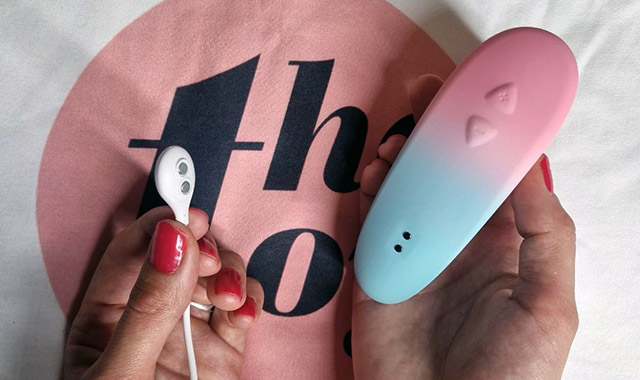
So after washing a toy, I do not just dry the silicone body and call it done. I pay attention to the charging area itself, especially if the toy uses magnetic pins. Water likes to sit there. So does leftover soap. So does lint from whatever you used to dry it.
Waterproof is about where you can use the toy. That is the part people miss when they read “waterproof” as if it solves every water-related question. It helps to know what waterproof versus splashproof actually means in real use before a wet toy starts feeling mysteriously unreliable at charging time.
Charging is about what is happening at the contacts.
Those are different questions.
Learn what “normal” looks like once
A lot of charging anxiety comes from not knowing what your toy usually does.
Some toys flash while charging and turn solid when full. Some glow steadily, then switch off. Some magnetic chargers snap into place in a way that feels secure but still sit slightly crooked. Some toys get a little warm.
They should not get hot.
That difference matters.
A dead vibrator can look broken when it is really just not making contact.
That is one reason I like paying attention to the very first charge on arrival. It helps to know what to check when your new vibrator arrives so later you can tell the difference between a toy that has always been fussy and one that has actually started going wrong.
When you first get a toy, I like doing one boring test on purpose: plug it in while you are fully awake, watch what the charging light does, and check it again after ten minutes. That gives you a baseline. Later, if the light starts blinking strangely, cutting out, or failing to come on unless you prop the cable at an angle, you know you are dealing with a charging problem, not a mystery.
If the toy becomes more than mildly warm, if the shell feels unusually hot in one spot, or if you notice a chemical or burnt smell, stop. Lithium-ion safety literature consistently treats overheating, overcharging abuse, over-discharging, and short circuit as the kinds of conditions that can move a battery from ordinary use into failure.
If it gets hot enough that you do not want it against your inner wrist, I would not keep seeing if it finishes charging.
The charging habits that shorten battery life
You do not have to baby a rechargeable vibrator.
You do have to stop doing the few things that age batteries fast.
Heat is one of them. Running a toy completely flat over and over is another. So is tossing it in a drawer dead and leaving it there for months. The battery literature is pretty consistent on this point: high heat and deep discharge are hard on lithium-ion cells, and repeated abuse makes failure and degradation more likely.
This is the version I use in real life:
Charge the toy before it is desperately dead.
Top it up if it has been sitting unused for a while.
Do not store it for ages at zero.
That is usually enough.
And once heat starts entering the story, I stop treating charging like a harmless little ritual. At that point, battery care and storage start overlapping, which is one more reason safe vibrator storage matters more than just finding a discreet drawer.
When a toy “won’t charge,” check these first
Before you decide the battery is done, check the boring stuff.
I mean really check it.
A charging light that flickers like it is thinking is often a contact problem, not a battery problem.
That is exactly where residue becomes a bigger deal than people expect. Dried lube, soap film, or a not-quite-dry charging area can all fake a battery failure, which is why cleaning a vibrator properly quietly affects charging too, not just hygiene.
Here are the first things I would look at:
- Magnetic pins with dried lube or soap film. Even a thin residue can break the connection.
- A charger sitting slightly off-center. It looks attached. It is not actually charging.
- A cable or adapter that has gone weak. Try a known-good power source with the original cable.
- A toy that was put away fully drained for a long time. Sometimes the battery is not dead-dead. It is just deeply depleted and slow to respond.
Real life, this is what that looks like.
You wash the toy, towel it off, click on the magnetic charger, see the light come on for a second, and walk away. Later it is empty. That is often moisture or residue.
Or the charger only works if the toy is lying very still on one edge. That is usually alignment.
Or the toy charges “fully,” then dies after five minutes of use. That can be battery wear. It can also be a charger that is making intermittent contact and never really finished the job. The FDA Abbott recall is useful here because it names the exact kinds of misuse people overlook: wrong charger, liquid exposure, damage, and debris in the port.
Small setup errors create very convincing fake failures.
Know when to stop troubleshooting
There is a point where “try another outlet” stops being sensible.
If you see any of these, stop charging and stop using the toy:
- the body is swelling, warping, or splitting
- it gets hot enough to feel wrong, not just slightly warm
- you smell burning, chemicals, or melting plastic
- the case is cracked near the battery or port
- it shuts off right after charging, over and over
Those are not maybe signs.
They are retirement signs.
At that point, I stop troubleshooting and start thinking about when a vibrator should actually be replaced. A toy that charges strangely, heats up, or keeps cutting out is no longer a reliability problem. It is an end-of-life problem.
CPSC battery guidance warns that charger and battery hazards can include overheating, fire, electrical shock, and thermal burns. If a device causes a burn, NHS first-aid guidance says to cool the area under cool or lukewarm running water for 20 minutes and get medical help for electrical burns.
Do not bargain with a swelling battery because the toy was expensive.
If the toy is done, let it be done. The next question is not whether you can squeeze out one more session, but how to dispose of a vibrator properly once the battery or charging system has crossed from annoying into unsafe.
One quiet rule matters more than all the others
Charge where you can see the toy.
Dry it fully first.
Use the right charger.
Pay attention to unusual heat.
That is most of the job.
People sometimes treat charging like background life admin. Something you do half-asleep, buried in a nest of sheets, while the toy is still damp from washing and the original cable is nowhere in sight.
That is how simple electronics start behaving strangely.
For me, charging is not really about electricity. It is about trust. A toy that charges cleanly feels easy to want. Easy to reach for. Easy to believe in. A toy that might be dead, hot, half-charged, or fussy before you even start changes the whole mood.
Pleasure is sensitive to friction.
Not just physical friction. Logistical friction.
A vibrator that charges correctly stays out of your way.
Reviewed medical and clinical sources
- U.S. Consumer Product Safety Commission. Batteries. CPSC.
- U.S. Food and Drug Administration. Tips to Help Charge Medical Devices Safely and Avoid Overheating. FDA.
- U.S. Food and Drug Administration. Abbott Recalls the Readers used with the FreeStyle Libre, FreeStyle Libre 14 day, and FreeStyle Libre 2 Flash Glucose Monitoring Systems for Risk of Extreme Heat and Fire. FDA.
- NHS. First aid. National Health Service.
- Li B, Parekh MH, Adams RA, Adams TE, Love CT, Pol VG, Tomar V. Lithium-ion Battery Thermal Safety by Early Internal Detection, Prediction and Prevention. Scientific Reports.
- Shen W, Wang N, Zhang J, Wang F, Zhang G. Heat Generation and Degradation Mechanism of Lithium-Ion Batteries during High-Temperature Aging. ACS Omega.
Add comment