
 Amie Dawson, Ph.D.
You reach into the drawer and pause.
There is a little lint on the head. The handle touched something else. You cannot tell whether it is actually clean or just drawer-clean.
That hesitation matters.
A vibrator is not like a hairbrush or a charger or a random beauty tool you can toss anywhere and forget. It touches tissue that gets irritated easily. It sometimes gets used internally. It may be used with a partner. And once your body starts second-guessing whether the toy feels fresh, intact, and safe, some of the ease is already gone.
The point of storage is not to hide the vibrator well.
It is to remove doubt before it touches you.
The real storage mistake is usually moisture, not the drawer
Most storage problems begin one step too early. The vibrator gets wiped. It looks dry enough. It goes into a pouch or back into the drawer.
But “not dripping” is not the same as dry.
Drying and storing are the last steps for a reason. If fibers are left behind, those tiny threads can later irritate very sensitive tissue. And if moisture is still sitting around seams, buttons, collars, caps, or soft joints, putting the toy away early does not solve anything. It just hides the problem until later.
With vibrators, this is where people get casual. A wand head feels dry on the surface, but moisture may still be sitting where the soft head meets the collar. A rabbit looks fine until you notice water near the buttons. A bullet seems simple, but it still spends time pressed against the body and then gets capped and forgotten.
Dry is not when the vibrator stops looking wet.
Dry is when you trust there is nothing hiding on it.
That is also why cleaning and storage are not the same job. A toy can look ready for the drawer and still need more attention first, which is exactly where cleaning a vibrator properly matters before storage even begins.
A covered vibrator is a safer vibrator
Once a vibrator is clean and dry, the next job is simple: protect the part that will touch your body next time.
That usually means storing it covered, by itself, in a dry place.
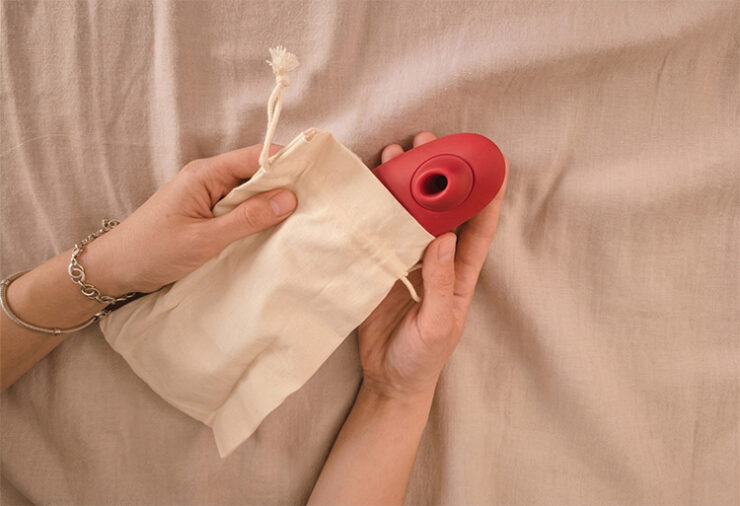
If the toy came with a dust bag or pouch, use it. That is not packaging theater. It is there to keep body-contact surfaces from becoming lint collectors. This matters even more for vibrators because so many of them have broad silicone heads, flexible ears, seams, ridges, insertable portions, or little textured areas that collect fuzz fast and carry it straight to very sensitive tissue.
This is why the classic “everything in one bedside drawer” system gets messy fast. The vibrator rubs against chargers, hair ties, receipts, old packaging, and whatever else is living in there. The surface that later touches your vulva does not stay protected just because it stayed indoors.
A pouch is not there to make the toy feel secret.
It is there to keep the body-contact surface from becoming a dust magnet.
And one more thing: a humid bathroom is a bad long-term home for most vibrators. A toy that is clean and dry should not go straight back into a damp environment that works against the whole point of drying it first.
“Waterproof” makes people sloppier about this than the toy deserves. A vibrator that can handle water during use still needs to be fully dried and stored well afterward, which is why waterproof versus splashproof matters in real life, not just on the product page.
Storage cannot fix a bad surface
This is the part people skip because it is annoying.
Some vibrators come back to baseline after cleaning and storage. Others only come back to looking clean.
That is usually where material stops being a boring spec and starts becoming the whole issue. It helps to understand what vibrator materials mean in real use before you trust storage to solve a surface problem it cannot actually fix.
Nonporous materials are safer and easier to clean well. Porous materials are much harder to disinfect properly and break down more easily over time. Storage only protects a surface that is still worth protecting.
So if a vibrator has turned sticky, started peeling, developed tiny cracks, or holds onto odor no matter what you do, the storage question is no longer “what bag should I keep this in?”
It is “why am I still trusting this near my body?”
If a toy has breaks, scratches, or damage, those areas can hurt you and give germs a place to hang on. A cracked vibrator is not safer because it lives in a velvet pouch.
Once the surface itself stops feeling trustworthy, storage is no longer the real fix. That is usually the point to ask when a vibrator should be replaced, not how neatly it can be put away.
It is just better dressed.
Your vibrator’s last use changes how you should store it
A vibrator does not go back into storage as a neutral object.
It goes back with a history.
That history matters.
If toys are shared, they should be washed between uses and covered with a new condom each time. Shared penetrative sex items can carry infected cervicovaginal or anal secretions from one person or one body site to another. So a vibrator you use alone and externally can have a very simple storage system. A vibrator you share with a partner, use internally, or move between anus and vulva should not just get tossed back in with the rest as if all use is the same.
Avoid vaginal contact with anything that has touched the anus. That includes sex toys. That is blunt. It is also useful.
Your vibrator remembers the last body site it touched, even if you do not. That is exactly why shared or multi-use toys need a storage routine that supports cleaner decisions instead of blurring them. It helps to think about safer sex with vibrators before a toy starts moving between bodies or between anal and vaginal use like those are all the same thing.
There is one more reason not to get casual with shared vibrators. A small study published in Sexually Transmitted Infections found HPV DNA on vibrators after use and, in some cases, even after standard cleaning, with persistence differing by material. That does not mean you should panic about every toy you own.
It does mean that shared vibrators deserve better habits than rinse, bag, forget.
What safe vibrator storage looks like in actual life
Good storage is usually boring.
That is a compliment.
Here is what that looks like with real vibrators:
- A bullet vibrator: fully cleaned, fully dry, then into its own pouch or small case in a dry drawer. Not loose beside receipts, dust, and lip balm.
- A wand vibrator: head dried carefully, then stored where the head stays covered and does not press against random drawer debris. Bigger toys are often easier to store well because they can have a dedicated space. Use that advantage.
- A rabbit or insertable vibrator: extra patience before storage. These often have more contours, controls, and seams. If you rush the drying step, you are bagging moisture, not preventing mess.
- A vibrator used with a partner or used anally: clean it properly, let it dry fully, and keep it separate enough that you know exactly what it was used for and what precautions it needs next time. Barriers, careful cleaning, and not moving bacteria or fluids casually between people or body sites still matter after the fun part is over.
The best storage system is not the most aesthetic one.
It is the one that lets you reach for the vibrator later and feel zero uncertainty.
No lint check.
No smell check. No “maybe it is fine” negotiation. If the setup is still leaving you unsure, the problem may not be the drawer but the state of the toy itself, especially if irritation or residue keeps returning. That is often when irritation, rashes, or infections linked to a vibrator setup become part of the conversation, not just storage.
No “I think this is the one I used for anal play once?” moment.
The safest way to store a vibrator is the way that keeps trust intact
People talk about storage like it is an organizational chore.
It is not.
It is part of the sexual experience, just earlier in time.
A well-stored vibrator does something very specific for the nervous system: it removes one more reason to brace, hesitate, inspect, or mentally pull away. You do not have to become the quality-control department right before pleasure. You do not have to negotiate with mystery fuzz or half-dried silicone or a toy you no longer quite trust.
That is the real point.
Not perfect storage. Not pretty storage. Not a sexy little drawer insert from social media.
Just this: when you reach for the vibrator, your body should not have to second-guess it.
Reviewed medical and clinical sources
- Helen Burkitt. “How To Clean Your Sex Toys.” SH:24.
- NHS. “Sex Activities and Risk.”
- Centers for Disease Control and Prevention. “Women Who Have Sex with Women (WSW) and Women Who Have Sex with Women and Men (WSWM).” STI Treatment Guidelines.
- Cleveland Clinic. “Bacterial Vaginosis (BV): Causes, Symptoms & Treatment.”
- Rubin ES, Deshpande NA, Vasquez PJ, Kellogg Spadt S. “A Clinical Reference Guide on Sexual Devices for Obstetrician-Gynecologists.” Obstetrics & Gynecology, 2019.
- Anderson TA, Schick V, Herbenick D, Dodge B, Fortenberry JD. “A Study of Human Papillomavirus on Vaginally Inserted Sex Toys, Before and After Cleaning, Among Women Who Have Sex with Women and Men.” Sexually Transmitted Infections, 2014.
Add comment