
 Michael Sampson
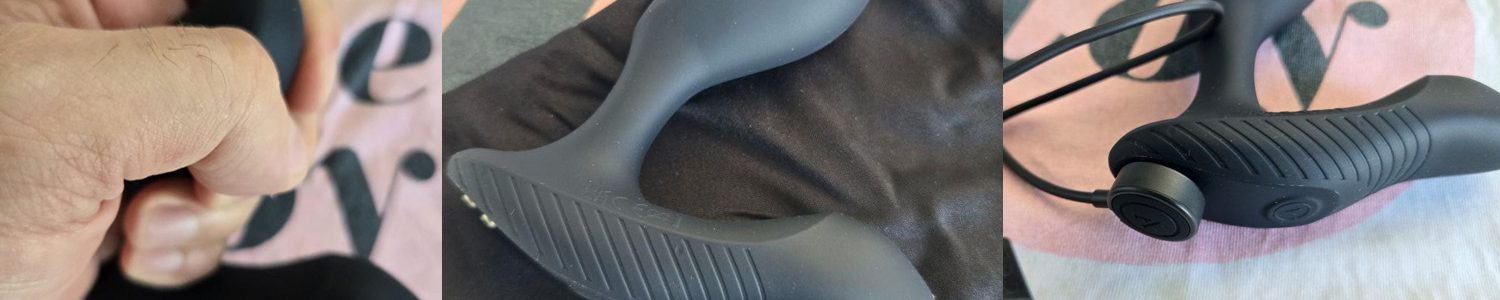
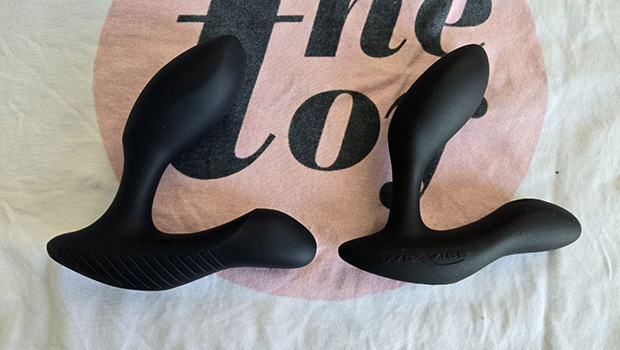
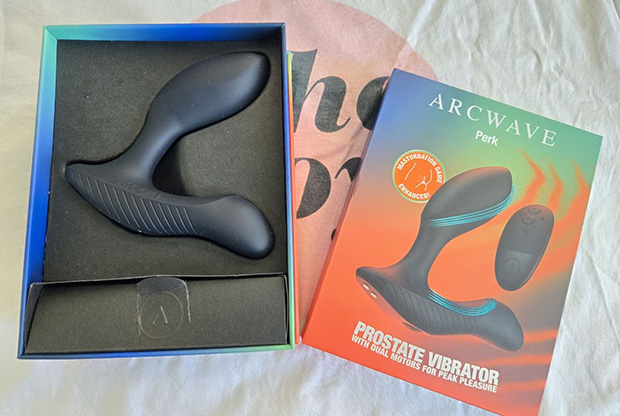
Here’s the thing nobody tells you about the Arcwave Perk: it’s basically a We-Vibe Vector+ wearing a different jersey. Same dual We-Vibe motors. Almost identical adjustable-arm design. Practically interchangeable insertable dimensions. The moment I pulled the Perk out of its box and held it alongside my Vector+, I thought, “Did the same engineer just submit this twice?”
And honestly, the vibration is excellent. Deep, rumbly, the kind of thrumming bass that you feel behind your navel rather than just at the surface. My vibrometer confirmed it — this isn’t some rebadged buzzy cheap-out. The Perk also produced one of the lowest noise readings in my prostate-massager dataset. It was tested in a quieter room than the Vector+, however, so I would describe it as very quiet rather than treating the raw dB gap as a controlled head-to-head result.
So why am I writing this review with a slight furrow in my brow?
Because the remote — the one feature that’s supposed to differentiate hands-free prostate play from fumbling-behind-your-back prostate play — never actually controlled my toy. I paired it. The toy vibrated to acknowledge the connection. And then… nothing. Plus button: nothing. Minus button: nothing. Arrows: nothing. I tried multiple times across multiple sessions. Dead air. And without that remote (or any app, because there isn’t one), the Perk becomes a single-button toy with 4 intensity levels and 6 patterns, sitting right next to a Vector+ that gives me a working remote, an app with 0–100% per-motor sliders, and not a single pairing headache.
For the modest price difference between the two, that’s the whole ballgame.
But I’m getting ahead of myself. Let me walk you through everything — because the Perk does get some things genuinely, measurably right, and for the right buyer at the right price, it could earn its spot in the drawer.
Quick Verdict: Is the Arcwave Perk Worth the Price?

| Overall: |  (3.0 / 5) (3.0 / 5) |
| Prostate targeting: |  (4.5 / 5) (4.5 / 5) |
| Vibration power: |  (3.5 / 5) (3.5 / 5) |
| Remote control: |  (1.0 / 5) (1.0 / 5) |
| Hands-free play: |  (2.0 / 5) (2.0 / 5) |
| Comfort and fit: |  (4.0 / 5) (4.0 / 5) |
Quiet, comfortable, and genuinely satisfying—if the remote works.
You can buy this toy here:
It depends entirely on whether your remote works. The Perk delivers deep, rumbly dual-motor vibration through a shape nearly identical to the Vector+. It hits the prostate, stimulates the perineum, accommodates different anatomy through its adjustable arm, and runs quietly enough for discreet use under bedding. If the remote pairs reliably for you, it’s a legitimate $99.99 prostate massager with genuinely satisfying sensation.
But if you draw the same short straw I did — and I’m not the only one; an Amazon reviewer reported the exact same pairing failure — you’re left operating a premium dual-motor toy with a single recessed button while it’s inside you. Meanwhile, the We-Vibe Vector+ (same parent company, same motors, near-identical shape) gives you a physical remote and a full app with independent motor control for about $10–30 more. No-app simplicity is only an advantage when the alternative actually works.
My honest recommendation: if you’re choosing between the Perk and the Vector+, buy the Vector+. If you find the Perk on a deep discount or specifically want a very quiet option and you’re fine with button-only control, it’s a legitimately good vibrator trapped inside an unreliable control ecosystem.
Who Should Buy It / Who Should Skip It
Buy it if:
- You find it discounted well below the Vector+’s price and want the same fundamental motor experience
- Discretion is a top priority — it measured 28 dB at maximum in my 18 dB test room and was very difficult to hear under bedding
- You want a solid adjustable prostate massager and you’re genuinely fine using only the on-toy button
- You’re a beginner who wants a comfortable insertable size with a tapered tip and soft perineum arm (Shore A 31 at the base — softer than the Vector+’s 43)
Skip it if:
- You want remote-controlled partner play you can rely on → Vector+ (or Lovense Edge 2 for long-distance)
- You want app control, custom patterns, or independent motor adjustment → Vector+ or Edge 2
- You want maximum raw vibration power → Edge 2
- You want the fullest, most intense premium option → Hugo 2
- You’re trying to learn prostate orgasms through contraction training → Aneros Helix or nJoy Pure Wand first (vibration doesn’t teach your body — it entertains it)
The Family Connection You Should Know About
Before we go further, here’s context that matters: Arcwave is part of WOW Tech Group — the same parent company that owns We-Vibe. The Perk doesn’t just use similar motors; it uses actual We-Vibe motors. The product page says it outright. This isn’t a critique — those are excellent motors. But it explains why the Perk and the Vector+ feel like siblings who raided each other’s closets. Same engine, different badge.
The key difference is what surrounds those motors: the Vector+ gets We-Vibe’s app ecosystem and a mature remote-control system. The Perk gets… a standalone remote and a prayer.
Perk vs Vector+ vs Edge 2 vs Hugo 2: The Numbers
Here’s the measured data first. All readings tip/base, loaded, in m/s² / mm/s / mm:
| Arcwave Perk | We-Vibe Vector+ | Lovense Edge 2 | LELO Hugo 2 | |
|---|---|---|---|---|
| Speed 1 (tip) | 6/15/0.17 @ 64 Hz | 2/7/0.1 @ 53 Hz | 18/26/0.15 @ 59 Hz | 8/19/0.19 @ 44 Hz |
| Speed 1 (base) | 6/9/0.07 @ 64 Hz | 0.7/4/0.05 @ 53 Hz | 13/20/0.1 @ 59 Hz | 4/10/0.11 @ 44 Hz |
| Speed 2 (tip) | 15/23/0.15 @ 73 Hz | 4/10/0.11 @ 59 Hz | 38/50/0.24 @ 59 Hz | 12/25/0.23 @ 59 Hz |
| Speed 2 (base) | 14/20/0.11 @ 73 Hz | 3/10/0.13 @ 59 Hz | 40/50/0.27 @ 59 Hz | 7/14/0.13 @ 59 Hz |
| Speed 3 / max (tip) | 25/35/0.24 @ 76 Hz | 20/40/0.33 @ 73 Hz | 34/35/0.15 @ 59 Hz | 34/42/0.2 @ 91 Hz (spd 10) |
| Speed 3 / max (base) | 16/21/0.13 @ 76 Hz | 16/24/0.14 @ 73 Hz | 28/28/0.12 @ 59 Hz | 22/30/0.16 @ 91 Hz (spd 10) |
| Weight | 4.0 oz (113g) | 3.4 oz (97g) | 5.2 oz (148g) | 4.2 oz (120g) |
| Insertable length | 3.0 in (76mm) | 3.0 in (76mm) | 3.0 in (76mm) | 3.15 in (80mm) |
| Widest diameter | 1.14 in (29mm) | 1.1 in (28mm) | 1.08 in (27.5mm) | 1.26 in (32mm) |
| Tip firmness | Shore A 36 | Shore A 41 | Shore A 35 | Shore A 53 |
| Base firmness | Shore A 31 | Shore A 43 | Shore A 21 | Shore A 53 |
| Base footprint | 1.34 x 4.29 in (34 x 109mm) | 0.83 x 3.82 in (21 x 97mm) | 0.94 x 4.61 in (24 x 117mm) | 1.26 x 3.94 in (32 x 100mm) |
| Noise @ 12 in (30 cm) | 18–28 dB | 41–44 dB | 40–42 dB | — |
| Price | $99.99 | ~$109–129 | ~$99 | ~$169–219 |
¹ The Perk was measured in a room with an ambient reading of approximately 18 dB.
² The Vector+ was measured separately in a room with an ambient reading of approximately 30 dB. These figures were not collected during a controlled same-room comparison.
What This Table Actually Tells You
The Perk’s low-end speeds are significantly stronger than the Vector+’s. Speed 1 on the Perk reads 6/15/0.17 at the tip versus the Vector+’s 2/7/0.1. That’s triple the acceleration. Remember how I told Vector+ buyers that speeds 1 and 2 were “phone-notification territory”? The Perk doesn’t have that problem. All three button speeds produce sensation you can actually feel. If you’ve read my Vector+ review, you know I called those dead low speeds a UX failure — the Perk quietly fixes it.
At the top end, it’s a wash with a subtle edge to Vector+. The Perk’s max (25/35/0.24 @ 76 Hz) delivers more acceleration than the Vector+’s (20/40/0.33 @ 73 Hz), but the Vector+ wins on displacement — 0.33mm versus 0.24mm. Displacement is what your body reads as deep, slow thud versus energetic rattle. That 73 Hz versus 76 Hz may look negligible on paper, but the Vector+ at max feels a shade more rumbly in the body, and the Perk a shade more active. Both are firmly in the “deep and pleasant” category — neither trends buzzy like the Hugo 2 at its ceiling (91 Hz).
The base motors are virtually identical at max. Perk: 16/21/0.13. Vector+: 16/24/0.14. Same perineum stimulation, same general character. If you liked one, you’d like the other.
The Perk was very quiet in my testing. I measured it at 18–28 dB from 12 inches, compared with 41–44 dB for the Vector+ and 40–42 dB for the Edge 2. However, the Perk and Vector+ were recorded in rooms with different ambient noise levels, so I would not treat the raw gap as a laboratory-grade head-to-head comparison. The result still points toward the Perk being the quieter toy in my dataset, but the size of that advantage needs a same-room retest.
The Adjustable Head: Nearly Identical to Vector+ — With One Practical Difference
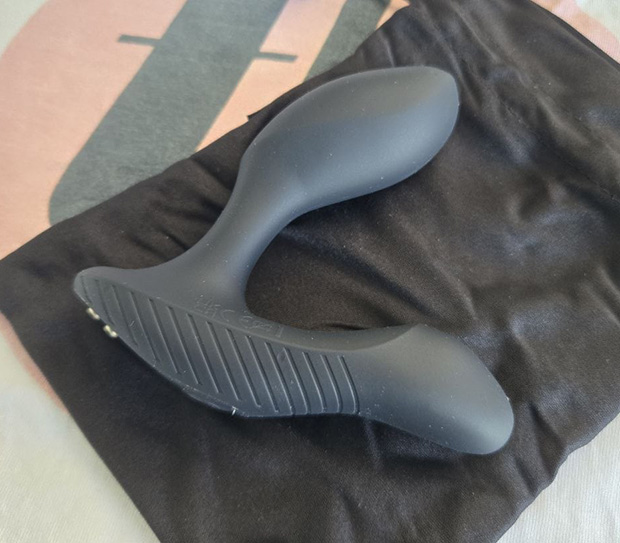
Both the Perk and the Vector+ use the same concept: a metal hinge joint connecting the insertable arm to the perineum arm, allowing you to bend the internal shaft to match your prostate’s position. Both hold their angle once set. Both cover roughly 30–40 degrees of usable adjustment. Both force you to wonder, the first time you bend them, whether you’re about to snap a $100 toy in half. (You’re not.)
Here’s where they diverge: the Vector+ head bends with noticeably less resistance. The Perk required more deliberate force to adjust the angle — not dramatically more, but enough that I noticed it on back-to-back comparisons. For a one-time setup, this is trivial. For mid-session micro-adjustments — changing the angle slightly when you shift from side-lying to seated — the Vector+ is more cooperative.
Both toys require you to bend the head before insertion. I’ve beaten this drum in my Vector+ review and I’ll beat it again here: if you insert the Perk factory-straight, you’ll get vibration near your prostate rather than on it, and you’ll think you wasted your money. Bend first. Twenty-five to thirty degrees toward the belly button. Insert. Fine-tune by rocking or shifting your hips. The difference between “adjacent” and “targeted” is that one bend.
One Amazon reviewer called the Perk’s adjustment excellent, noting it “allowed me to create a snug and comfortable fit against my perineum.” He specifically praised the angle’s role in improving both internal and external contact simultaneously. That matches my experience — changing the bend doesn’t just redirect the internal arm; it shifts the entire pincer geometry, altering how firmly the perineum arm presses against you. The Perk and Vector+ share this clever characteristic equally.
Tip I wish someone had told me: once you find your angle, leave the toy bent between uses. Re-bending every time introduces unnecessary wear on the hinge and costs you setup time. Both toys hold their shape when stored.
How It Feels: Deep, Rumbly, and Usable From the First Click
Let me say this clearly: the Arcwave Perk feels good. Strip away the remote issues, ignore the competitive positioning for a moment, and just focus on what the motors do inside your body — and it delivers.
The internal motor produces a low, throbbing rumble at 64–76 Hz across its three speeds. There’s no tinny buzz, no surface-level tickle. From the very first speed, the vibration reads as pressure more than vibration — a slow, deliberate push against the prostate that builds into genuine, building warmth. At speed 3, the 25 m/s² acceleration creates enough intensity to make your breath catch, and the 0.24mm displacement keeps it firmly in rumble territory rather than rattling your teeth.
The perineum motor matches well. You can feel both motors distinctly — the internal one pressing forward against the prostate, the external one humming against the taint — which is exactly the dual-stimulation proposition the marketing promises and, in this case, actually delivers. One Amazon reviewer put it well: you “can feel the motors separately, which is really nice, and both are strong enough that it provides sufficient sensation to both external and internal areas.” My vibrometer readings back him up — at max, the tip runs 25/35/0.24 while the base runs 16/21/0.13. Different enough to create distinct sensation, strong enough to both matter.
The Loaded Performance Question
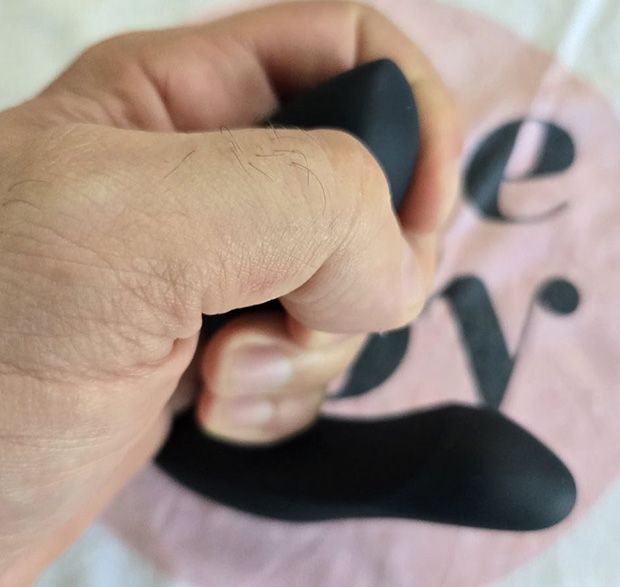
Here’s where it gets interesting. One Amazon tester reported that when he “really clamped down on the toy during intense points of usage, the motor couldn’t cope and would slow down.” He charged multiple times to rule out battery drain and concluded it was a load-handling issue.
I didn’t experience catastrophic motor stall, but I did notice a perceptible softening of intensity during strong pelvic-floor contractions at speeds 2 and 3. It’s not “the motor stops” — it’s more like “the motor takes a knee for half a second.” For context, the Edge 2 handles clenching with minimal drama (those 38 m/s² at speed 2 have headroom to spare), and the Vector+ with its 20 m/s² max holds its ground slightly better than the Perk during contractions in my testing.
Is this a dealbreaker? For most sessions, no. For the critical ten seconds when your pelvic floor is involuntarily contracting and you need the vibration to hold steady so you can get there — it’s noticeable. And it’s exactly the wrong moment for the motor to go soft.
Practical tip: if you feel the motor dip during contractions, try intentionally relaxing your pelvic floor and letting the vibration do the work. I know that’s counterintuitive when every fiber of your body wants to clench, but fighting the motor doesn’t serve either of you.
Patterns Worth Mentioning
The on-device button gives you 4 intensity levels and 6 vibration patterns. The remote (if it works for you) unlocks 10 patterns at 10 customizable intensity levels. Since my remote was a decorative paperweight, I can only speak to the button-accessible settings.
The constant vibration at speed 3 was my workhorse — deep, consistent, no surprises. Among the patterns, the wave and random modes stood out. One detailed Amazon reviewer — who also uses the Perk to replicate the sensation of pegging — preferred these two specifically because they “best replicated the more intense sensations I normally experience during anal sex.” That tracks: the alternating pulse creates a swelling-and-retreating rhythm that mimics thrusting better than any steady hum.
What I can’t tell you is whether the two motors are independently controllable through the remote’s 10 intensity levels, because I never got there. The on-device button appears to control both motors simultaneously. The Vector+ app, by contrast, gives you two separate 0–100% sliders for the internal and external motors — a level of fine-tuning the Perk simply doesn’t offer through its physical button.
The Remote That Wouldn’t Remote: The Elephant in the Room
I’m going to be blunt, because this is the single issue that shapes my entire recommendation.
The Perk comes with a wireless remote control. The manual describes a pairing process. I followed it. The toy and remote did not pair according to the instructions. I held both power buttons for approximately 7–8 seconds (longer than the manual suggests), and eventually the toy vibrated — acknowledging the connection. Great. Success.
Except: pressing plus, minus, or the arrow buttons on the remote did absolutely nothing. The toy sat there, oblivious. I re-paired. Same result. Tried again across multiple sessions. Same dead silence. The remote connected — the initial vibration confirmed that — but it wouldn’t control.
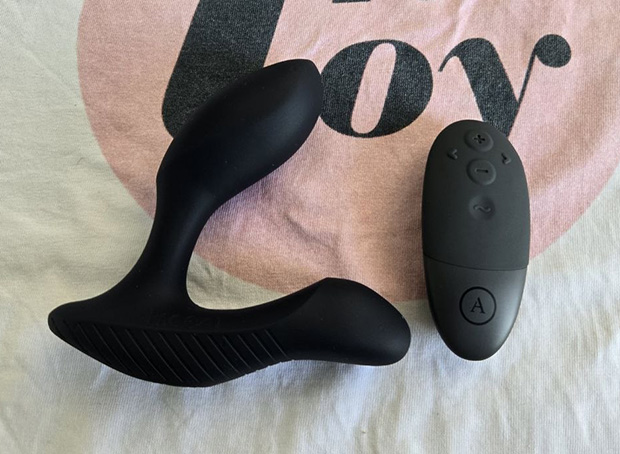
I’m not the only one. An Amazon reviewer who received this through a tester program described the identical experience: “The remote provided with the toy would never connect. I followed the steps in the instructions manual, changed batteries, charged the toy, and it still just would not connect.” He tried everything. Same wall.
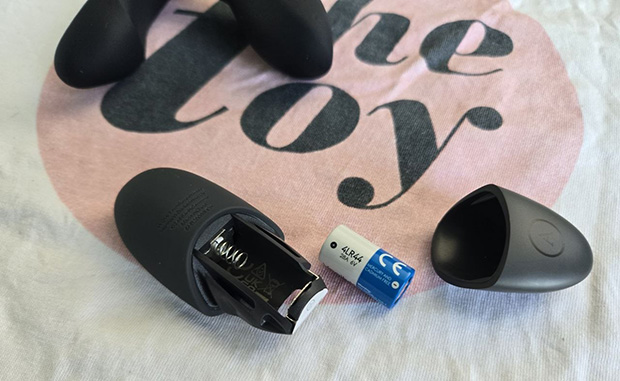
On the other hand: a thorough Amazon reviewer paired his remote easily “following the accompanying instructions” and used it extensively with his wife for partnered play, calling it “an exciting dimension.” He did note the battery compartment needs clearer polarity markings — suggesting the battery orientation might be a stumbling block for some units. Another Amazon reviewer got the remote working but complained about limited range.
So you’ve got three distinct outcomes from real users:
| Remote Experience | Source |
|---|---|
| Connected but non-responsive | My testing |
| Never connected at all | Amazon tester |
| Paired easily, enjoyed partner control | Amazon detailed reviewer |
| Worked, but limited range | Amazon brief reviewer |
That’s not “some testers had slightly different preferences.” That’s a reliability spread wide enough to drive a truck through.
Why this matters more than it would on most toys: the Perk has no app. The remote isn’t a bonus — it’s the only way to access the full 10 patterns and 10 intensity levels. Without it, you’re limited to 4 intensities and 6 patterns via the single physical button. That button, by the way, sits at the base of the toy — between your cheeks while inserted. Operating it solo means reaching behind yourself and blindly cycling through settings. Hands-free? Not exactly.
The Vector+ handles this entirely differently: if the remote acts up, you open the We-Vibe app. Two sliders, full control, custom patterns, independent motor adjustment. There’s always a fallback. The Perk’s fallback is… one button and a quiet prayer.
If you buy the Perk, test the remote immediately. Pair it. Confirm every button responds. Verify range across the room. Do this within the return window. If it works, you’ve got a solid toy. If it doesn’t, you’ve got the Vector+ without its most important feature.
No App: Freedom or Frustration?
The Perk has no companion app. No Bluetooth phone connection, no account creation, no app-store download, no “please enable location services” Android popup. There is no way to control this toy from your phone, create custom vibration patterns, adjust motors independently, or hand control to a long-distance partner.
Arcwave frames this as simplicity: fewer barriers, faster setup, no tech headaches. And in a vacuum, that’s fair. You charge it, you press the button, it vibrates. One fewer thing to troubleshoot.
But we don’t live in a vacuum. We live in a market where the Vector+ (same motors, same shape) offers full app control with no account requirement, the Edge 2 gives you long-distance partner control across continents, and even budget toys from Lovense include more connectivity options than a $99.99 Arcwave.
Where no-app genuinely helps:
- Zero setup friction for solo sessions — press and go
- No phone dependence (dead battery? doesn’t matter)
- No data privacy concerns whatsoever
- Slightly less chance of a Bluetooth dropout killing the mood
Where no-app actively hurts:
- No long-distance partner play — the remote is RF, not internet
- No independent motor control — can’t emphasize internal over external or vice versa
- No custom patterns beyond the factory presets
- No fine-grained intensity control (you get 4 button steps vs the Vector+’s 0–100% app slider)
- No firmware updates to fix issues like, say, unreliable remote pairing
For me, the absence of an app wouldn’t be a problem if the remote worked reliably. A good physical remote beats an app for in-person partner play — I’ve argued this in my Vector+ review, and I stand by it. But when the remote is the only advanced control method and it fails, you’re left with a premium toy operating in economy mode.
Noise & Discretion: Where the Perk Genuinely Wins
The Perk is genuinely quiet. I measured it at 18 dB on its lowest setting and 28 dB at maximum from 12 inches away. The room itself measured approximately 18 dB before the toy was switched on.
For context, my earlier Vector+ test produced readings of 41–44 dB, but that test took place in a room with an ambient level of approximately 30 dB. The Edge 2 measured 40–42 dB in my previous testing.
That means these numbers need context. The Perk and Vector+ were not measured side by side under identical conditions. You also cannot simply subtract the ambient number from the total reading and treat the remainder as the toy’s sound output, because decibels are logarithmic rather than linear.
What I can say confidently is that the Perk was difficult to hear during actual use. Under a duvet, normal breathing and small movements easily masked it. Once inserted, body tissue dampened the sound further.
Multiple Amazon reviewers reached a similar practical conclusion, describing it as unusually quiet for the intensity it produces. My vibration measurements also show that its low sound output does not come from weak motors. At maximum, the tip still delivered 25 m/s² of loaded acceleration.
So yes, discretion is one of the Perk’s strongest qualities. I would call it one of the quieter prostate massagers in my dataset. I would stop short of declaring it 16 dB quieter than the Vector+ or saying the comparison is “not close” until I measure both toys in the same room, on the same day, with identical meter settings.
Real-World Scenarios: Solo, Partnered, Hands-Free
Solo — Side-lying, On Your Back
The standard solo prostate-play position. Plenty of water-based lube on the tapered tip, slow insertion, let the bulb settle past the sphincter. Once seated, the narrow neck (tapering to about 0.79 in / 20mm) holds it comfortably without the constant “am I stretching?” awareness that wider toys create.
Speed 3, constant vibration, adjusted angle pressing into the prostate — this is where the Perk earns its keep. The sensation is a deep, spreading warmth that builds gradually. With the toy properly bent, I could feel the internal motor focusing pressure rather than broadcasting broadly. Lying on my back with knees up, the perineum arm had good skin contact and added a complementary hum that made the prostate stimulation feel more surrounded than pointed.
The annoying part: adjusting intensity or changing patterns means reaching behind yourself to find the single button at the base. It’s recessed enough that accidental bumps aren’t common, but deliberate presses require some contortion. With a working remote, this is a non-issue. Without it, it’s a recurring interruption.
Partnered Play — The Intended Highlight
This is where the Perk was supposed to shine. The remote in your partner’s hand, you on the receiving end, anticipation building with every click. One Amazon reviewer experienced exactly this vision: “Handing the control to my wife created a heightened sense of fun, anticipation, and lots of pleasure for both of us.”
I wanted that. I planned for that. My remote disagreed.
For those whose remote works, the promise is real: four directional buttons, no screen glow, operable by feel under a blanket, no app dropout, no phone distraction. One Amazon reviewer’s partner controlled pacing and intensity, creating what he described as “an enjoyable and rewarding experience.” The remote is designed for exactly this — physical, intuitive, bedroom-distance control.
But the Vector+ gives you the same experience with a remote that, in my testing, paired on the first try and offers the app as a backup if anything goes sideways. The Vector+’s remote became our “permanent” solution for partner play in my household. The Perk’s remote became a cautionary tale.
Hands-Free Wear — Sitting, Moving
The Perk’s design supports hands-free use: the perineum arm anchors against the body, and the 4.0 oz (113g) weight is light enough to stay put. Sitting in a firm chair pushes the base against the perineum and grinds the internal arm into the prostate — same chair-as-ally trick I described in the Vector+ review.
The Perk’s base is slightly wider than the Vector+’s (1.34 x 4.29 in / 34 x 109mm vs 0.83 x 3.82 in / 21 x 97mm), which means it sits a little less flush between the cheeks but also provides a slightly more stable platform against furniture. Trade-off, not a flaw.
Walking: I didn’t do extended outdoor testing with the Perk as I did with the Vector+, but around the house, it stayed planted. The heavier weight compared to the Vector+ (4.0 oz vs 3.4 oz) didn’t cause migration issues. The external arm did the familiar bouncing-with-each-step thing, which is either a feature or a distraction depending on where your head’s at.
During Sex
The base is compact enough to avoid interfering with most positions. Its low operating noise is unlikely to stand out over normal breathing, movement, bedding, or the other sounds already happening in the room. The challenge, as with all prostate toys during sex, is maintaining internal positioning while everything else is moving. The Perk held its angle better than I expected — the adjustable hinge’s stiffness actually helps here, because it resists being pushed out of alignment by pelvic thrusting. One point to the Perk’s stubbornness.
Shower or Bath
IPX7 waterproof on the toy — fully submersible, no concerns. The remote is only IPX4 (splashproof), so keep it away from the stream. In practice, shower use works fine with the on-device button, though the wet silicone can make gripping the base tricky. Add a water-based lube before stepping in — water is a terrible lubricant despite what your instincts tell you.
Size, Comfort & Beginner Suitability
Let’s separate this into what matters, because “beginner-friendly” means different things depending on which part of the experience you’re asking about.
Insertion
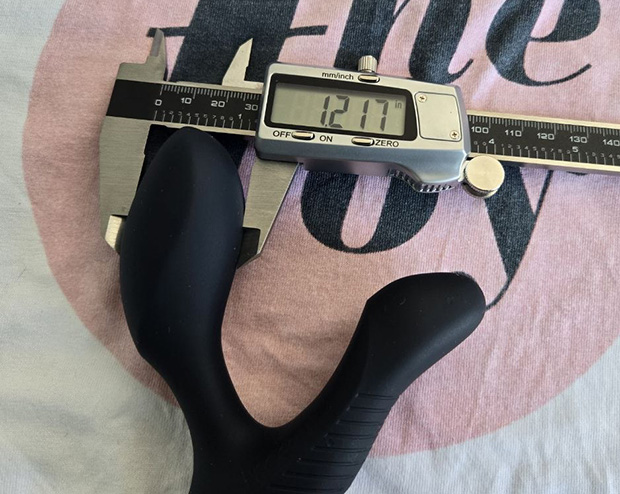
The tapered tip and gradual widening to 1.14 in (29mm) make initial insertion straightforward with adequate water-based lube. It’s fractionally wider than the Vector+ (1.1 in / 28mm) and the Edge 2 (1.08 in / 27.5mm), but we’re talking about 0.04 inches — a difference your body won’t register. The Shore A 36 silicone at the tip has pleasant give without feeling floppy.
One Amazon reviewer found the head had “a little more girth than some of the other similar toys” and flagged it for first-timers. Another described the bulb as “non-intimidatory” and suitable for “both novices and more experienced anal plug users alike.” Both are honest — it depends on your frame of reference. If the Perk is your first-ever anal toy, you’ll notice the bulb. If you’ve used a small butt plug before, it’s a non-event.
Once Inserted
This is where the Perk shines for comfort. The narrow neck behind the bulb — tapering to roughly 0.79 in (20mm) — means the sphincter rests around a thinner section, reducing the constant stretch-awareness that wider-necked toys produce. One Amazon reviewer specifically praised this: “the main plus for me is the neck is narrower so more comfortable for any long sessions.” I agree. The Perk is comfortable to wear, not just comfortable to insert.
Perineum Arm Comfort
Shore A 31 at the base. That’s softer than the Vector+’s 43 and much softer than the Hugo 2’s 53. In plain language: the Perk’s perineum arm is the squishiest in this comparison. It presses rather than digs. During hour-long sessions, I didn’t develop the pressure-point soreness that firmer toys can create against the taint. If you’re sensitive to perineum discomfort, the Perk is the gentlest option in this lineup.
Prostate-Targeting Learning Curve
Even with a comfortable size, there’s a learning curve to positioning. Bend the arm, experiment with angles, rock your hips — the prostate isn’t a large target, and finding the sweet spot takes a session or two. One Amazon reviewer acknowledged “a bit of a learning curve at first” but concluded “once you get used to it, it does exactly what it’s meant to do.” That matches my experience precisely.
Battery, Cleaning & Maintenance
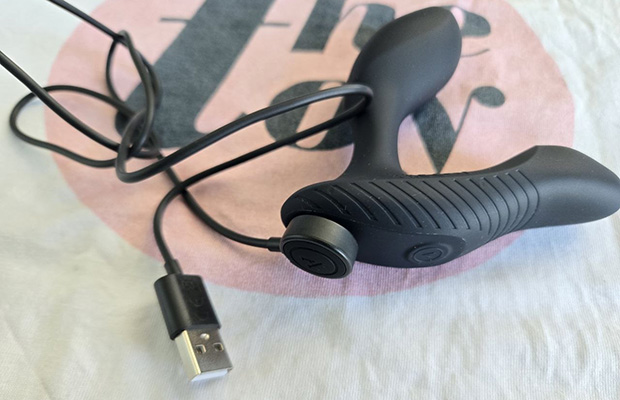
Battery: 90-minute charge via magnetic USB cable, approximately 120 minutes of runtime. I didn’t run a formal drain test, but across multiple sessions of 30–45 minutes, the battery never died on me. The magnetic charger holds firmly — more securely than the Vector+’s in my experience — but always verify the LED indicator confirms the connection. I learned with the Vector+ that magnetic chargers can sit just off the contacts and silently not charge. Fool me once.
Cleaning: IPX7 means you can rinse it under running water without worry. Warm water and mild soap, or a toy cleaner spray — 30 seconds and done. The adjustable hinge joint deserves a deliberate rinse; lubricant can collect in the crease where the two arms meet. I didn’t find deep seams or crevices that trapped residue, but run your finger along the flex point and make sure nothing’s hiding. Dry the charging contacts before docking.
Lube: water-based only. It’s a silicone toy — silicone lubricant risks degrading the surface over time. The tapered shape means you need less lube than you think, but use more than you think you need anyway. Trust me on this.
Storage: The included drawstring pouch is fine for keeping the toy dust-free and separated from other toys. Nothing fancy, but it does the job.
Warranty: 2 years from Arcwave. Standard for the premium tier.
What Disappointed Users — And Whether They’re Right
I track the most common complaints across my own experience, Amazon reviewers, and Reddit to weight what’s genuine versus noise. Here’s the Perk’s pattern:
“The remote doesn’t work.” Legitimate. I experienced it. An Amazon tester experienced it. This isn’t user error — the toy acknowledged the connection and then ignored the input. Whether it’s a firmware issue, a defective batch, or an inconsistent pairing protocol, it’s a real problem affecting a non-trivial number of units.
“The motor slows down when I clench.” Partially confirmed. I noticed softening under strong contraction, though not the dramatic slowdown the most critical Amazon reviewer described. His experience — motor stalling despite full charge — sounds more severe than mine. This could be unit variation or different contraction strength. Either way, it’s a real phenomenon: under load, the Perk’s motors don’t hold as firmly as the Edge 2’s.
“No app connectivity — it doesn’t compete.” Fair comparison, unfair absolute judgment. The Perk is a good vibrator at $99.99. But the market it enters includes the Vector+ with two control methods, the Edge 2 with long-distance capabilities, and even budget toys with app ecosystems. The lack of an app doesn’t make the Perk bad; it makes the price harder to justify when alternatives exist at similar cost.
“The head is girthier than expected.” Context-dependent. At 1.14 in (29mm), it’s 0.04 in wider than the Vector+ and 0.06 in wider than the Edge 2. That’s measurable but barely perceptible during insertion. If this is your first-ever anal toy, any prostate massager will feel significant. The Perk isn’t unusually large in its class.
“There’s a learning curve.” Accurate and universal. Every adjustable prostate massager requires positioning work. This isn’t a Perk-specific complaint — it’s an anatomy-specific reality. Bend the arm, experiment, be patient. Two sessions is typical before you find your spot.
The Comparison That Decides Everything: Perk vs Vector+
This is the review within the review, because these two toys share too much DNA to evaluate the Perk without holding the Vector+ in the other hand.
| Feature | Arcwave Perk | We-Vibe Vector+ |
|---|---|---|
| Motors | 2x We-Vibe | 2x We-Vibe |
| Shape | Adjustable L-shape | Adjustable L-shape |
| Insertable length | 3.0 in (76mm) | 3.0 in (76mm) |
| Widest diameter | 1.14 in (29mm) | 1.1 in (28mm) |
| Weight | 4.0 oz (113g) | 3.4 oz (97g) |
| Tip firmness | Shore A 36 | Shore A 41 |
| Base firmness | Shore A 31 | Shore A 43 |
| Noise (max, 30 cm) | 28 dB | 44 dB |
| Button speeds | 4 levels, 6 patterns | 3 speeds (+ patterns) |
| Remote | Included (inconsistent pairing) | Included (reliable in my testing) |
| App control | None | Yes (no account required) |
| Independent motor control | No | Yes (via app sliders) |
| Long-distance play | No | Yes (via app) |
| Waterproofing | IPX7 toy / IPX4 remote | IPX7 toy |
| Warranty | 2 years | 2 years |
| Price | $99.99 | ~$109–129 |
Where the Perk Wins
- Noise: The Perk produced the lower reading and was harder to hear during use. However, the two toys were measured against different ambient noise floors, so I cannot confidently claim a controlled 16 dB advantage without retesting them side by side.
- Low-end speed usability: Speed 1 on the Perk (6/15/0.17) is three times stronger than Speed 1 on the Vector+ (2/7/0.1). Every button press does something.
- Perineum comfort: Shore A 31 base versus 43. Meaningfully softer against the taint during extended sessions.
- Price: $10–30 cheaper depending on retailer.
- Button speed range: 4 usable levels versus the Vector+’s 2 usable ones (speed 1 and 2 on the Vector+ are decorative).
Where the Vector+ Wins
- Top-end rumble depth: 0.33mm displacement versus 0.24mm. Deeper throb at maximum.
- Remote reliability: Mine worked first try. Every time.
- App control: Two independent 0–100% motor sliders. Custom patterns. Battery display.
- Long-distance partner play: Possible through the app.
- Head adjustment ease: Less force needed to bend and micro-adjust.
- Weight and profile: 0.6 oz lighter, smaller base footprint.
- Fallback control: If the remote dies, the app is there. If the app drops, the remote is there. Redundancy.
The Honest Bottom Line
The Perk is not a bad toy. It’s a good toy with the same heart as one of the best toys in its class. The motors are quality. The vibration is pleasant, deep, and satisfying. The adjustable arm reaches the prostate. The perineum stimulation is real. It can deliver genuinely strong orgasms. And it is quiet enough to be one of the more discreet prostate massagers I have tested, especially once it is inserted or covered by bedding.
But for $10–30 more, the Vector+ gives you everything the Perk offers plus a reliable remote, a full app with independent motor control, custom patterns, and the peace of mind that if one control method fails, you have another. The Perk without its remote is the Vector+ with one arm tied behind its back. And since my remote didn’t work — and I’m not the only one — I’m not comfortable recommending a toy whose primary differentiating control feature is a coin flip.
If you’re reading this and you’ve already bought the Perk, and your remote works, and you don’t care about app control — congratulations, you’ve got a quiet, comfortable, rumbly prostate massager that genuinely earns its keep. Enjoy it.
If you’re still deciding between the two, buy the Vector+.
Final Verdict
6.5/10. The Arcwave Perk prostate massager delivers legitimately good dual-motor vibration through a well-designed, comfortable, adjustable body — using the same We-Vibe motors as the Vector+ at a lower price. It produced one of the lowest noise readings in my prostate-toy dataset, its low-speed settings are more usable than the Vector+’s, and its softer perineum arm is the most comfortable in this comparison. Because the noise measurements were taken under different ambient conditions, I would describe the Perk as very quiet rather than claiming a precise 16 dB advantage.
What drags it down is everything around the toy. The remote’s inconsistent reliability across multiple users (including me) strips away the hands-free control that makes this design worthwhile. The absence of an app means there’s no backup, no independent motor adjustment, no long-distance play, and no firmware path to fix the remote issue. At $99.99, you’re paying close to Vector+ territory and receiving a meaningfully less capable control experience.
Buy the Edge 2 for power. Buy the Hugo 2 for intensity and fullness. Buy the Vector+ for the most balanced, controllable prostate massager in this class. Buy the Perk if you find it discounted, if discreet operation is a major priority, and if you test the remote before the return window closes.
The bones are great. The muscles are strong. The nervous system just doesn’t always listen.
| Overall: | (3.0 / 5) |
| Prostate targeting: | (4.5 / 5) |
| Vibration power: | (3.5 / 5) |
| Remote control: | (1.0 / 5) |
| Hands-free play: | (2.0 / 5) |
| Comfort and fit: | (4.0 / 5) |
Quiet, comfortable, and genuinely satisfying—if the remote works.
You can buy this toy here:
Add comment