

 Amie Dawson, Ph.D.
You keep adjusting the angle. You correct the pressure. You chase the right spot. Something almost clicks, then slips away.
That near-miss feeling is often not about location.
It is about motion.
I think this is one of the most overlooked pleasure problems. People get told to find the sensitive area, use more lube, try a stronger toy, or relax harder, as if the body is refusing to cooperate out of stubbornness. Some of that can matter. But a lot of bodies are not just choosing a place. They are choosing a verb. A national probability sample of U.S. women found that preferences differ not only by location and pressure, but also by shape and pattern of touch. NHS guidance on orgasm difficulties supplies the other half of the picture: many women need steady clitoral stimulation to orgasm. Put those together and something useful appears. Steady does not mean still. It means the pattern stays coherent enough for your body to build on.
The problem is often not the spot. It is the verb.
You can touch the same exact area three different ways and get three completely different results.
One feels blank. One feels irritating. One starts pulling arousal upward almost immediately.
You are not missing the spot. You are using the wrong verb.
For a lot of people, that is the whole turning point. The breakthrough is not a better target so much as realizing the body has been waiting for a stimulation pattern it can actually follow instead of a location you keep trying to force into working.
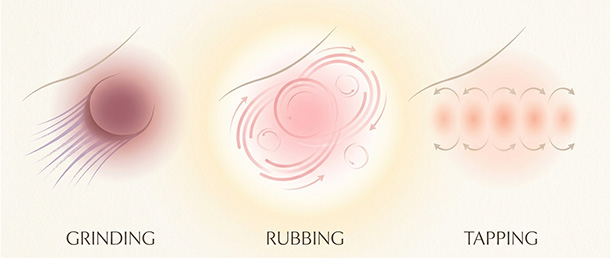
That is why advice that sounds precise can still fail. “Touch the clitoris” is not actually precise enough. A body may want drag, not glide. Glide, not weight. Intermittent contact, not constant contact. Until that piece is right, even the correct area can feel strangely unconvincing.
Grinding builds through drag, weight, and staying connected
Grinding is not little strokes on a target. It is sustained contact with bodyweight behind it. Against a hand, a toy, a pillow, a thigh, or the heel of your palm, the sensation builds because the contact does not keep disappearing.
Grinding does not feel busier. It feels heavier.
That heavier, wider landing is often what makes it easier to build on. For some bodies, the real difference is not more intensity but broader contact that feels less exposed than a smaller, brighter point of touch.
For a lot of people, that heavier feeling is exactly the point. The clitoris is not just the small external glans. It is a larger structure with erectile tissue, internal crura, and vestibular bulbs that swell during arousal. As those tissues fill with blood, broad pressure and drag can recruit more than one tiny point of sensation, which is one reason a slow grind can feel fuller and less sharp than more exact, pecking contact.
The same logic shows up in partnered sex. A nationally representative study found that “rocking,” where the base of a penis or toy keeps rubbing the clitoris instead of breaking contact with clean in-and-out thrusting, is extremely common. Another study found that body movement of the pelvis and trunk during intercourse was associated with more orgasms, while precise clitoral rubbing with an immobilized body was not.
Rubbing builds through glide and feedback
Rubbing is more active than grinding. You are moving across the area instead of settling into it. Back and forth. Small circles. Side-to-side arcs. Tiny figure eights.
This is the motion of mapping.
Rubbing gives quick feedback because each pass changes the contact a little. You can feel where the sensation thickens, where it thins out, where a little more hood, more lube, or a slightly flatter angle suddenly makes the whole thing come alive. For some people, that moving line of sensation is what builds arousal best. They do not want to pin one exact point down. They want to sweep across an area until the body starts answering back.
When rubbing works, it often feels like the most responsive motion of the three. Not as heavy as grinding. Not as tentative as tapping. More like tracking a live signal.
Tapping builds through contact, release, and return
Tapping is brief touch. Off, on. A pulse instead of a glide.
It can be fingertip tapping, dabbing with the pad of a finger, or a toy landing lightly and lifting again instead of staying planted.
Tapping can feel like knocking on a door instead of leaning on it.
That matters because the glans can be intensely sensitive. Cleveland Clinic notes that too much direct pressure there may feel painful. That is one reason tapping can work early in arousal, or during very sensitive moments, when continuous rubbing feels too exposed.
Sometimes the body does not want less stimulation. It wants the same area reached in a way that stops feeling so naked all at once, which is often what is happening when clitoral stimulation suddenly feels too intense.
Tapping usually is not the whole arc. For many people, it is a bridge motion. It wakes the area up. It buys time. It keeps pleasure moving when rubbing would feel abrasive and grinding would feel too heavy.
Arousal changes the landing
The same motion can feel perfect at one minute and wrong five minutes later.
Arousal changes the landing.
As the clitoral tissues and vestibular bulbs swell with blood, the hood, labia, and surrounding tissue can change how contact reaches the glans and adjacent structures. A motion that felt faint at the beginning can become ideal later. A motion that felt amazing early can suddenly feel like too much.
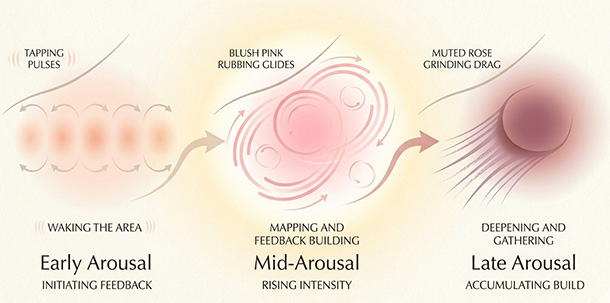
This is why some people start with tapping, shift into rubbing, and finish with grinding. Others do the reverse. Their body wants more motion when arousal is still gathering, then more anchored pressure once the signal is strong enough to carry weight.
You do not have one permanent style. You may have a sequence.
A lot of bodies do not want one motion forever. They want one motion to wake the area up and another to carry the build, which is often the deeper difference between how pressure and movement build pleasure at different stages.
What these motions look like in real life
On a pillow or folded blanket, grinding often creates a low, spreading hum. You are not hunting for a pinpoint. You are leaning in and letting the sensation thicken.
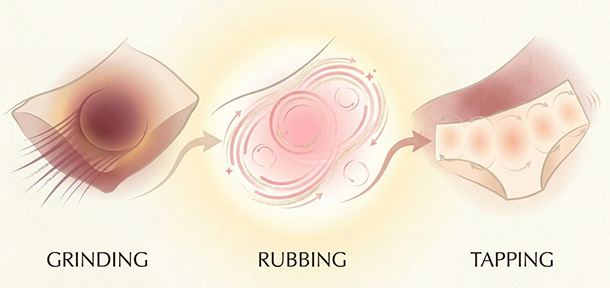
With two lubricated fingers, rubbing can feel more precise without becoming harsh. You make short side-to-side passes, then tiny circles, and you can tell quickly whether the sensation is getting warmer or whether it is starting to feel thin and effortful.
Under underwear, tapping can feel surprisingly good when bare contact is too much. The fabric softens the landing. The briefness of each touch prevents that raw, overexposed feeling.
During penetration, some people discover that rocking their pelvis with sustained clitoral contact works far better than thrusting that repeatedly breaks the contact line. Large survey data on women’s pleasure during penetration found that angling the hips and rocking to keep clitoral rubbing going are both extremely common strategies. For many bodies, staying connected beats leaving and returning.
A simple three-pass test
If you want to figure out your motion preference without turning pleasure into homework, keep everything else the same.
Same position. Same hand or toy. Same general area. Same pressure.
Only change the verb.
- Spend a minute grinding.
- Spend a minute rubbing.
- Spend a minute tapping.
Then ask one question: which motion makes your body want more of itself?
Not which one sounds best in theory. Not which one you think should work. The one that makes you lean toward it instead of manage it.
That is usually your answer.
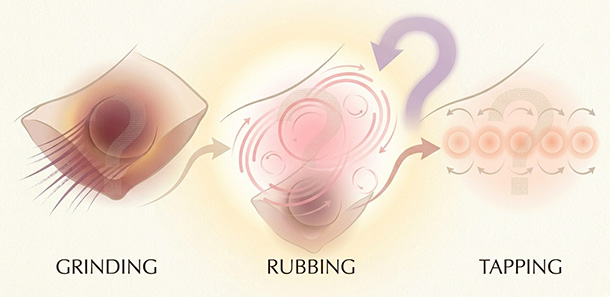
If both feel wrong, stop treating it like a preference problem
Sometimes the issue is not whether your body prefers pressure or movement.
Sometimes the issue is friction. Dryness. Guarding. Pelvic tension. Pain. Irritation.
When that is the layer underneath the problem, switching between pressure and movement will not solve much on its own. Sometimes the real issue is that the body is too braced for pleasure to build cleanly in either mode.
If touch feels burning, irritating, persistently numb, or impossible to build with no matter how you change it, that is not a cue to try harder.
It is a cue to get gentler.
And sometimes to get help.
The same goes for pain with penetration, ongoing soreness, or a body that seems to clamp down no matter how careful you are. Those can look like technique problems from the outside, but they are not always technique problems.
The real skill
People spend years asking where the right spot is.
That is only half the question.
The other half is how your body wants that spot approached. Held. Revisited. Pressed into. Moved across. Stayed with.
A good touch is not just in the right place.
It arrives there in the right way.
Reviewed medical and clinical sources
- Debby Herbenick, Tsung-Chieh Jane Fu, Jennifer Arter, Stephanie A. Sanders, Brian Dodge, “Women’s Experiences With Genital Touching, Sexual Pleasure, and Orgasm: Results From a U.S. Probability Sample of Women Ages 18 to 94”, Journal of Sex & Marital Therapy, 2018.
- Annette Bischof-Campbell, Peter Hilpert, Andrea Burri, Karoline Bischof, “Body Movement Is Associated With Orgasm During Vaginal Intercourse in Women”, Journal of Sex Research, 2019.
- Cleveland Clinic, “Clitoris: Anatomy, Location, Purpose & Conditions”, Cleveland Clinic, last updated 2026.
- Cleveland Clinic, “Sexual Response Cycle: Order, Phases & What To Know”, Cleveland Clinic, last updated 2023.
- Mayo Clinic Staff, “Female Sexual Dysfunction — Diagnosis and Treatment”, Mayo Clinic, updated 2024.
- Cleveland Clinic, “Hypertonic Pelvic Floor: Symptoms, Causes & Treatment”, Cleveland Clinic, last updated 2022.
Add comment