
 Amie Dawson, Ph.D.
You move your hand half a centimeter and suddenly the whole experience changes. Too light feels scratchy. Too firm feels dull. Somewhere in the middle, your body stops resisting and starts answering.
That is the part a lot of advice skips.
People talk about speed, toys, positions, technique. Pressure often ends up being the hidden variable. I have seen it change the whole sensation more than a new rhythm ever does.
Pressure changes what kind of sensation reaches you
I want to be clear about this, because “more” and “less” does not really cover it. Pressure does not only change intensity. It changes the kind of sensation your body gets.
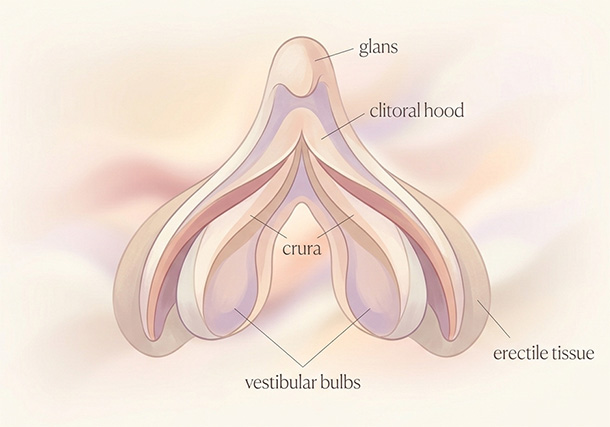
The clitoris is not just the small external glans. It is a larger structure of nerves and erectile tissue, with internal parts that swell during arousal. As Cleveland Clinic’s clitoris anatomy explainer outlines, the clitoris includes internal crura and vestibular bulbs, and those tissues expand with blood flow when you are turned on. That matters here because pressure can change whether sensation feels like it is skating across the surface or landing into tissue that feels more supported.
Sometimes more pressure does not feel stronger.
It feels steadier.
What changes is often not raw intensity so much as spread. A contact point that pulls a little more tissue into the sensation can feel easier to build on than one bright little spark, which is often the deeper difference between broad and pinpoint stimulation.
For some people, very light touch keeps brushing the most reactive part of the sensation without giving the body enough grounding. Add a little more pressure and the feeling becomes less fluttery, less precarious, less like you are trying to catch a moving target with the edge of your fingertip. Same spot. Different contact story.
Why lighter touch can feel sharper, and firmer touch can feel easier
This is the part many readers recognize the second they see it spelled out.
Light touch is not always gentler. Sometimes it feels thinner.
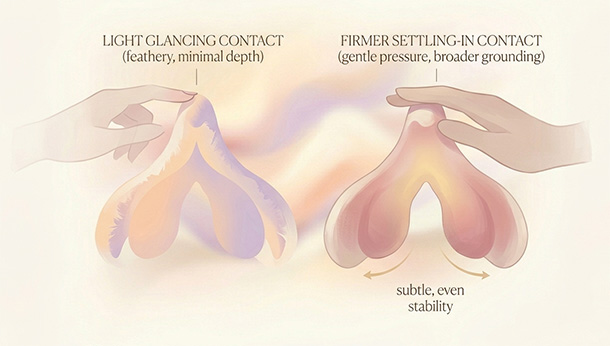
The external glans is densely innervated, and Cleveland Clinic notes that too much direct pressure can be painful. Their sexual response guidance also notes that as arousal rises, the clitoris can become highly sensitive and even painful to touch. In real bodies, that means a feathery, glancing contact can feel weirdly raw for one person, while a slightly firmer, more settled contact feels buffered and easier to stay with.
You can feel that even when location does not change at all. One kind of touch seems to graze the nerves. The other seems to hold them.
It does not feel smaller. It feels less thin.
That is why some people keep going lighter when the sensation feels off and accidentally make it worse. The body is not always asking for less contact. Sometimes it is asking for contact that lands more securely.
Arousal changes the pressure equation
Pressure does not live on its own. It changes with the state of the body.
An NHS psychosexual guidance leaflet on orgasm difficulties notes that orgasm intensity can vary with the form of stimulation and the area being stimulated, and also notes that most women need steady clitoral stimulation to orgasm. That is useful here because pressure is part of what makes stimulation feel steady enough to build instead of slipping away.
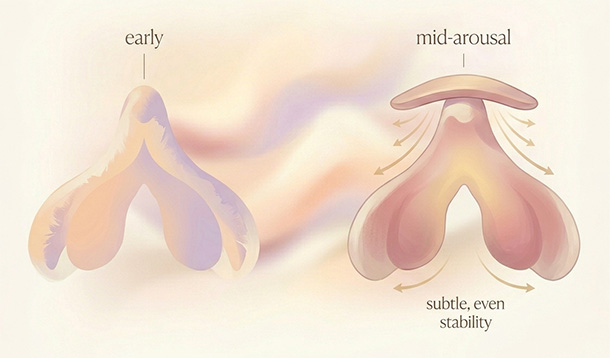
Early in arousal, firmer pressure may help the sensation feel clear enough to follow. Later, when blood flow increases and the tissue swells, that same pressure may feel ideal. Then close to orgasm it may suddenly cross the line into too much. Cleveland Clinic’s sexual response overview says this plainly: the clitoris becomes highly sensitive as arousal intensifies.
This is where people start doubting themselves.
The pressure was not wrong in some fixed way. The timing changed.
A pressure level that felt grounding early can feel abrupt later, the same way clitoral touch can start feeling too intense once arousal changes the tissue underneath it.
More pressure can either build pleasure or flatten it
There is a useful distinction here. Pressure can steady sensation, or it can shut it down.
Good pressure usually helps you stay connected to the feeling. It gives the sensation somewhere to land. Your body leans in a little. Your breathing stays more open. Pleasure has room to gather without turning into noise.
Too much pressure does something else. Your thighs tighten. Your pelvis pulls away even if your hand stays in place. The sensation stops building upward and starts spreading into irritation, numbness, or that maddening almost-dead feeling where you know you are touching the right place but the pleasure goes flat. Cleveland Clinic also notes that direct overstimulation can leave the glans sore.
The goal is not to press harder.
It is to stop giving your body a reason to defend itself against the contact.
What this looks like in real life
Picture a fingertip on the clitoral glans. You keep circling lightly because lighter seems like it should be safer. But the touch keeps skimming. It never settles. You notice every millimeter. You correct the angle. You chase the spot. Nothing gathers. Then you pause, stay still, add a little more pressure, and the sensation stops flickering. It starts accumulating.
Now picture a vibrator. You do not change the speed. You do not change the pattern. You just press it in a bit more. At first, that can make the vibrations feel deeper and more coherent. Past a certain point, though, the toy stops transmitting sensation cleanly and starts pinning the tissue down. Pleasure gets compressed instead of amplified.
Grinding works differently again. A lot of what people love there is that the contact does not keep vanishing and restarting. It stays broad and present long enough for sensation to organize, which is often the deeper difference between steady pressure and movement.
Same anatomy. Same person. Different pressure story.
Sometimes this is not preference at all. It is pain, dryness, or guarding
Not every pressure problem is a tuning problem.
If contact feels burning, stinging, stabbing, or sore even with gentle touch, that is not a sign that you simply have not found the magic angle yet. NHS guidance on vulvodynia describes vulvar pain as burning, throbbing, stabbing, or soreness, and notes that it can be triggered by touch, tampon insertion, or sex even when the vulva looks normal.
There is another layer here too. An Imperial College Healthcare NHS Trust leaflet on overactive pelvic floor explains that pelvic floor overactivity can be linked with painful sex and sexual function problems, and that pain systems can become so sensitized that even non-painful touch gets read as pain. That helps explain why some people are not dealing with “preference” at all. They are dealing with guarding.
Dryness can distort pressure too. The MSD Manual notes that vaginal dryness can cause pain during sexual activity, and that lubricants or moisturizers can help. It also notes that after menopause, tissues around the vaginal opening and vagina can become thinner, less elastic, inflamed, and easier to irritate as estrogen declines. Even when the clitoris is the main focus, that surrounding tissue context changes what pressure feels like.
If pressure that used to feel good suddenly feels wrong, or if even light touch feels sharply unpleasant, I would not frame that as a body-failure story. I would treat it as information worth taking seriously.
A simple way to test pressure without turning pleasure into homework
Keep everything else as still as you can.
Same spot. Same rhythm, or no rhythm. Same position. Then try three passes:
- contact so light it barely stays there
- contact with a little settling-in weight
- contact firm enough to feel secure, but not pinned
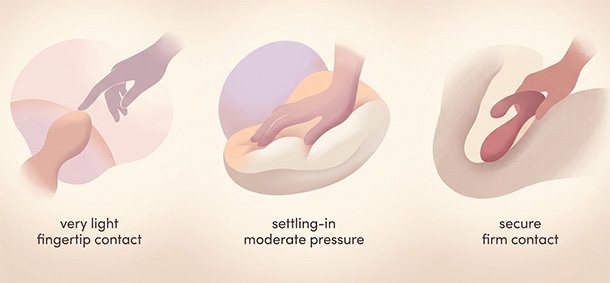
Give each one a real moment. Not two seconds. Long enough for your body to answer.
Then ask a better question than “Which one was strongest?”
Ask which one let the pleasure keep developing without making you tense up.
That answer usually tells you more. It keeps the question where it belongs: on what your body is actually doing, not on whether you are passing some little private exam about pleasure. That is the difference between learning and turning exploration into a test.
The real clue is what your body does next
When pressure suits you, the sensation usually starts organizing itself. Your breathing drops lower. Your hips stop making frantic corrections. The feeling becomes easier to follow.
When pressure does not suit you, your body starts troubleshooting. You lift away. You chase. You brace. You speed up because the sensation is fading. Or you go lighter and lighter trying not to overwhelm yourself, even though the real problem is that the touch feels too exposed to build on.
That difference matters.
Because it means pleasure is not random. It is readable.
A better way to think about pressure
A lot of people treat pressure like a strength test. How much can I handle. How little do I need. What is the correct setting.
I do not think that lens helps.
Pressure is not a measure of toughness, sensitivity, or sexual skill. It is information about how your nervous system likes to receive contact on that day, in that moment, at that stage of arousal.
The better question is not “How hard should I press?”
It is “What kind of pressure helps my body stop guarding and start opening?”
Once you feel that difference, things get less mysterious.
Not because your body changed.
Because you finally learned how to read it.
Reviewed medical and clinical sources
- Cleveland Clinic. Clitoris: Anatomy, Location, Purpose & Conditions. Cleveland Clinic.
- Cleveland Clinic. Sexual Response Cycle: Order, Phases & What To Know. Cleveland Clinic.
- Leicester Partnership NHS Trust. Female orgasmic difficulties. Leicester Partnership NHS Trust.
- NHS. Vulvodynia (vulval pain). National Health Service.
- Imperial College Healthcare NHS Trust. Overactive Pelvic Floor: Information for patients, families and carers. Imperial College Healthcare NHS Trust.
- MSD Manual Consumer Version. Overview of Sexual Function and Dysfunction in Women. MSD Manuals.
Add comment