

 Amie Dawson, Ph.D.
You put the vibrator where it usually works. There is a spark for a few seconds. Then the feeling starts to thin out. You press harder. Turn it higher. Stay on the spot longer. And suddenly the strangest part happens: instead of building pleasure, everything starts to feel flatter.
Not exactly painful. Not exactly good. Just blank.
If you know that feeling, I want to say this clearly: your body is probably not failing, and you probably have not damaged your clitoris.
This usually isn’t damage. It’s overload.
A lot of people panic when a vibrator makes them feel numb because the internet has trained them to panic first and think later. “Dead vagina syndrome” sounds dramatic, medical, and permanent. It isn’t. The International Society for Sexual Medicine notes that temporary genital numbness after vibrator use can happen, but in the study it cites, most people who noticed numbness said it resolved within an hour, and only a very small fraction said it lasted longer than a day.
That matters because the next move people make is usually the exact one that digs the hole deeper. They chase the fading signal.
Past a certain point, more vibration doesn’t feel stronger. It feels blurrier.
That is often the same turn people are describing when stimulation stops feeling exciting and starts feeling like too much signal without enough shape, which is a big part of why clitoral stimulation can feel too intense even before it crosses into pain.
Vibrators themselves are not the villain here. In a nationally representative U.S. study, most women reported never having genital symptoms associated with vibrator use, and recent vibrator users scored higher on several sexual function measures. In a separate prospective study of women with arousal or orgasm concerns, therapeutic genital vibration was linked with improvements in orgasm, sexual function, and genital sensation rather than deterioration.
So the better question isn’t whether vibrators are ruining sensitivity. It’s why this session flattened out instead of building.
What many people call numbness is often sensation with no edges left
A lot of the time, numb doesn’t mean you feel nothing at all.
It means you can tell something is happening, but it has stopped feeling distinct. The sensation loses detail. It stops blooming. It becomes one hard little buzz your body can no longer turn into pleasure.
It doesn’t feel quieter. It feels less readable.
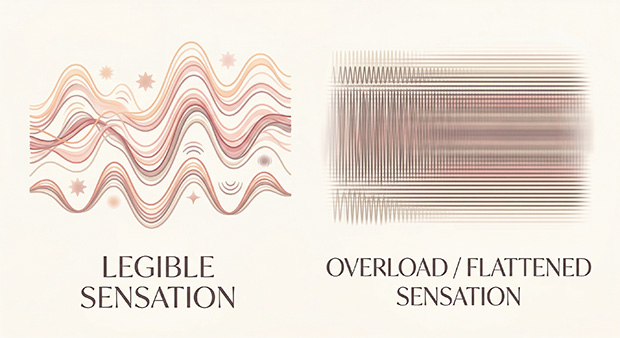
That usually happens when a few things stack on top of each other:
- Too direct, too soon. You start on the most exposed, sensitive spot before your body is fully aroused.
- Too much pressure. You pin the toy down so firmly that the feeling gets compressed instead of spread.
- Too much sameness. One exact angle, one exact frequency, one exact patch of tissue, over and over until the signal loses shape.
- And too long after the fade starts. Your body has already begun dropping out, but you keep drilling the same sensation into it anyway.
That fits what clinical guidance already makes clear about orgasm more broadly: the type, amount, and area of stimulation matter, and they vary from person to person and from session to session. Mayo Clinic notes that orgasm depends on adequate arousal and stimulation, and that the kind of stimulation needed can differ not only across people but across encounters. NHS guidance on female orgasm difficulties also notes that many women need steady clitoral stimulation, and that the form and area of stimulation change how orgasm builds.
That variability matters here.
The same vibrator can feel precise when your body is open and aroused, then feel like static when your body is tense, dry, rushed, or under-stimulated everywhere else.
What to do the moment sensation goes flat
When pleasure starts turning numb, I would not power through. I would reset.
First, stop for a minute. Not a symbolic half-second pause. A real break. Let the tissue rest. Let your breathing slow down. Let the little voice saying come on, get it back lose some authority.
Then change the setup, not just the setting.
Move off the most direct point. Use the toy a little to the side, over the clitoral hood, over the outer labia, over the mons, or even through underwear if direct contact has become too sharp or too blank. Add more glide. Use less pressure. Let the toy travel instead of parking it in one exact place.
Sometimes the body doesn’t want less stimulation. It wants one more layer between the toy and the tissue, which is often the first useful move when direct touch does not feel good.
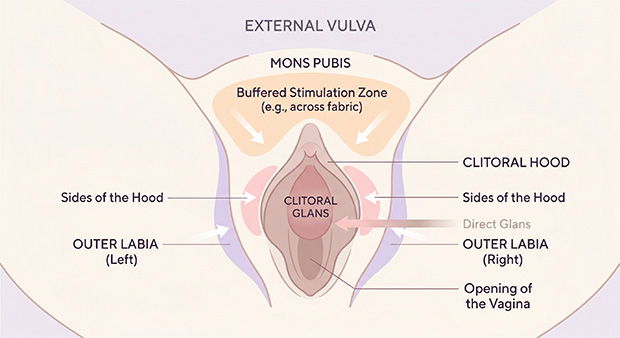
The goal is to bring sensation back into focus.
Sometimes the best restart is smaller, not bigger. Lower speed. Broader contact. Shorter passes. More whole-body arousal before you go back to the spot that went flat.
And if nothing comes back, I would stop the session instead of treating it like a stubborn machine problem. You do not need to teach your body that solo play means chasing a disappearing signal until you are irritated and discouraged.
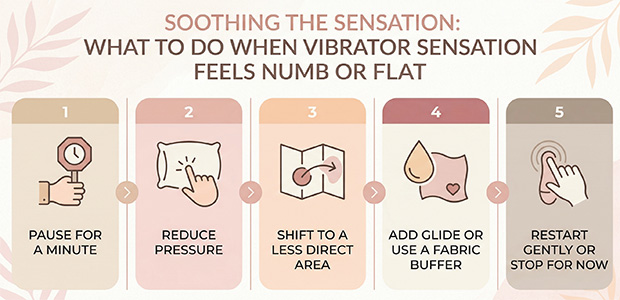
What this looks like in real life
One person uses a powerful bullet straight on the clitoral glans at top speed. It feels electric for twenty seconds, then suddenly cottony. She assumes she needs even more intensity. She doesn’t. She needs less directness and more spread.
Another person masturbates while half-braced. Jaw tight. Thighs tight. Mind split between pleasure and the rest of the day. The toy is technically on the right spot, but the body never really opened around it. What she calls numbness is partly overload and partly a body that never got fully involved.
That split matters. Sometimes the toy is not overpowering an open body. It is landing on a body that is already guarded, which is often what people are feeling when body tension makes pleasure harder.
A third person notices that the toy that used to work now feels dull, irritating, or strangely far away. That is the moment to widen the question. Medication changes, dryness, hormonal shifts, pelvic floor tension, and medical conditions can all change sexual response. Mayo notes that orgasm difficulties can be affected by medications including SSRIs, antihistamines, and some blood pressure drugs, as well as conditions such as diabetes and multiple sclerosis, pain, dryness, and age-related menopausal changes.
This is why “just use a stronger vibrator” is such bad advice.
Sometimes the issue is not intensity. It is context.
That is also why one session can feel precise and another can feel dull, irritating, or strangely far away. Often the toy did not change. The body conditions did, which is exactly how the same toy can feel amazing one day and wrong the next.
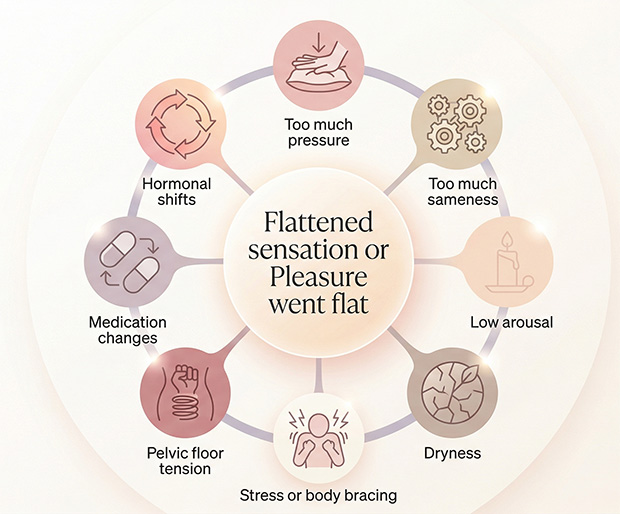
Sometimes the vibrator is exposing a body issue instead of causing one
If numbness only happens after a long stretch of very intense vibration and clears fairly quickly, that is one thing.
If sensation keeps dropping out even with gentler use, or the area feels persistently off outside of play, stop assuming it is a toy problem. Pelvic floor tension can interfere more than people realize. Cleveland Clinic notes that a hypertonic pelvic floor can affect sexual function and orgasm. A body that is gripping instead of releasing does not process stimulation the same way.
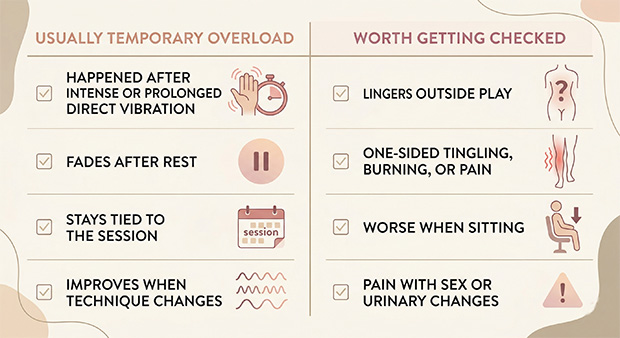
There are also times when I would stop troubleshooting solo and get it checked. I would take it seriously if you have:
- numbness that lingers well after a session or shows up when you are not using a toy
- one-sided tingling, burning, or pain
- symptoms that get worse with sitting
- pain with sex, urinary changes, or a feeling that the whole pelvic area is off
That is not me trying to scare you. It is me drawing a line between common temporary overload and something more persistent. NHS guidance on pudendal neuralgia lists genital numbness, tingling, pain with sex, and symptoms that worsen while sitting among the signs that can show up when the pudendal nerve is irritated.
If something feels newly wrong, repeatedly wrong, or wrong outside sexual play, it is worth bringing to a gynecologist, pelvic floor therapist, or another qualified clinician.
The real fix isn’t tougher tissue. It’s better contrast.
I think this is the part people need most.
Your body does not earn pleasure by tolerating more force.
Pleasure builds when sensation stays legible. When there is enough intensity to wake the body up, but not so much sameness that everything blurs together. When arousal has room to spread. When the tissue is not being pinned into silence. When the signal still has shape.
A vibrator that makes you go numb is not always telling you to quit toys.
Sometimes it is telling you to stop treating pleasure like a volume contest.
Reviewed medical and clinical sources
- Leicestershire Partnership NHS Trust. Female orgasmic difficulties. Leicester’s Hospitals NHS Trust.
- International Society for Sexual Medicine (ISSM). Is “dead vagina syndrome” a real medical condition? ISSM Sexual Health Q&A.
- Herbenick D, Reece M, Sanders S, Dodge B, Ghassemi A, Fortenberry JD. Prevalence and characteristics of vibrator use by women in the United States: results from a nationally representative study. Journal of Sexual Medicine.
- Guess MK, Connell K, Mendez DD, et al. The Effects of a Genital Vibratory Stimulation Device on Sexual Function and Genital Sensation. Journal of Sexual Medicine.
- Mayo Clinic Staff. Anorgasmia in women: Symptoms and causes. Mayo Clinic.
- Cleveland Clinic. Hypertonic Pelvic Floor: Symptoms, Causes & Treatment. Cleveland Clinic.
- NHS. Pudendal neuralgia. National Health Service.
Add comment