

 Amie Dawson, Ph.D.
You set aside time. You try to relax. You touch the places that are supposed to work. Then, halfway through, something changes. The whole experience stops feeling erotic and starts feeling procedural.
You track the angle. You correct the pressure. You chase the right spot. You notice every little shift.
Now you are not inside the pleasure. You are supervising it.
I want to say this plainly: when someone says, “I can’t orgasm when I masturbate,” I do not hear one single problem. I hear several different experiences packed into one sentence. That matters, because the fix for “I have never orgasmed” is not the same as the fix for “I used to orgasm and now I can’t,” and neither is the same as “I can only do it under very specific conditions.” Mayo Clinic is useful here because it defines orgasm difficulty broadly: orgasm can be absent, delayed, less intense, or difficult only in certain situations, and the kind of stimulation a body needs can vary a lot from person to person.
The sentence is too vague. Your pattern is the real clue.
Start there. Have you never had an orgasm during masturbation? Did you used to have them, then lose access to them? Does it only happen with one technique, one position, one toy, one fantasy, one very specific setup?
Those are not little details. They are the map.
Mayo Clinic breaks orgasm difficulty into lifelong, acquired, situational, and generalized patterns. Merck Manual makes a similar point: some people have never orgasmed, some used to and then stopped, and some do orgasm but much less often or much less intensely. That is already a much better frame than one flat label like “broken.”
Another piece matters too. Not reaching orgasm every time is not automatically a disorder. Both Mayo Clinic and Merck note that distress is part of what makes the issue clinically meaningful. That does not mean your experience only counts if it is severe. It means there is a difference between “my orgasms are inconsistent” and “this is bothering me enough that I want real answers.”
Sometimes this is not an orgasm problem. It is an arousal problem dressed up as one.
A lot of people assume orgasm is about finding the right spot and staying there long enough. Sometimes that is true. Often it is only part of the story.
Because orgasm does not only need contact. It needs build.
You can be touching yourself and still not be far enough into arousal for that touch to organize into climax. The body is responsive, but not gathered. Pleasure is happening, but it is not accumulating. It feels more like checking than riding.
That is why so many people describe masturbation as “good, but flat.” Not painful. Not numb. Just strangely unable to tip over.
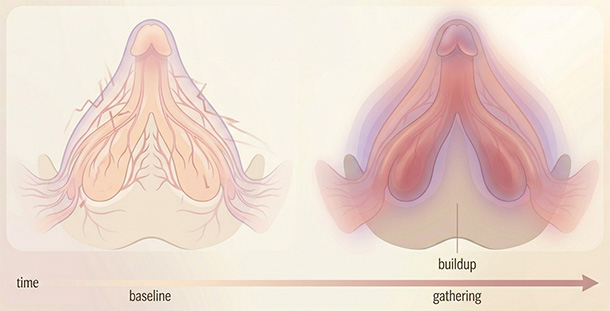
Merck Manual says this very plainly: if someone is not sufficiently aroused, the problem may be better understood as an arousal issue rather than an orgasm disorder. Mayo Clinic adds something a lot of readers need to hear too: penetration or other indirect contact may not be enough, and many women need more direct clitoral stimulation to orgasm.
That does not mean “go harder.”
It means the body may need more erotic build before the touch becomes usable.
For a lot of people, that is the entire shift. The problem is not always the touch itself. It is that the body never got enough runway first, which is often why orgasm can take a long time even when pleasure is clearly happening.
Orgasm usually needs continuity, and self-monitoring quietly breaks it.
One of the most common solo-play problems is not lack of effort. It is too much management.
You feel something promising. Then you start watching it. Stay there. Don’t lose it. Is this working? Is this the angle? Maybe faster. No, slower. Maybe more pressure.
That sounds small. It often is not.
Orgasm is not a reward for trying hard enough. It is a response to the right kind of enough.
For a lot of people, the build weakens the second they switch from sensation to evaluation. Pleasure is still there, but it stops deepening. You do not lose arousal all at once. You leak it out through constant correction.
That is what makes solo play start feeling procedural. The body can still be responsive while performance pressure slowly crowds out pleasure, one tiny adjustment at a time.
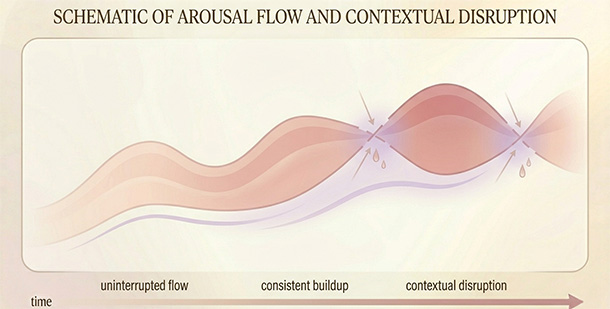
A body that will not tip into orgasm is often a body that never got to stop managing.
You can be touching the right anatomy in the wrong way.
This is the part people miss constantly.
They assume the problem is location. A lot of the time, it is sensation quality.
You can be exactly where you are “supposed” to be and still be using a kind of touch your body does not turn into climax. For some people, the issue is not location at all. It is that the contact lands too exposed, too thin, or too exact, which is often the deeper difference between direct and indirect clitoral stimulation.
It does not feel smaller. It feels less held.
That distinction matters.
Mayo Clinic notes that the type and amount of stimulation needed for orgasm varies widely. Merck Manual is practical here too: it recommends self-stimulation as a way to learn what kind of touch is actually pleasurable and arousing, and notes that adding clitoral stimulation may be all that is needed for some women.
When masturbation is not working, people often add intensity before they question the sensation itself.
That is how a lot of pleasure gets chased right past.
Sometimes the blocker is not erotic at all.
If what used to work suddenly stopped working, I would pay attention.
A new medication. A hormonal shift. Pelvic pain. Vaginal or vulvar dryness. Numbness. A sense that arousal is slower, thinner, or harder to sustain than it used to be. Those are not tiny side notes to brush off with “maybe I’m just in my head.”
Mayo Clinic lists medical conditions, gynecologic surgeries, antidepressants and other medications, alcohol, smoking, and age-related body changes among factors that can interfere with orgasm. Office on Women’s Health notes that lower hormone levels around menopause can slow arousal and make genital tissue drier and thinner, which changes how touch feels.
Pelvic floor tension belongs here too. Cleveland Clinic notes that a hypertonic pelvic floor can affect sexual function and may include pain during sex and inability to achieve orgasm. If your body feels clenched, guarded, or physically resistant rather than simply unresponsive, that is a different problem from not knowing the right technique.
Sometimes the body is not missing pleasure. It is protecting itself from it. That is often what people are feeling when body tension makes pleasure harder even though desire is still there.
This is why “just relax” is such useless advice.
Sometimes there is something to evaluate, not just something to mindset your way through.
What this looks like in real life
Sometimes the clearest explanation is the most ordinary one.
You feel pleasure, but it never gathers. Masturbation feels nice enough to keep doing, but not compelling enough to get swept up in. That often points to arousal that never fully built, even though stimulation was happening.
You keep finding the spot, then somehow losing the feeling. Not because the anatomy moved. Because your attention did. The second you start auditing the experience, the climb gets interrupted.
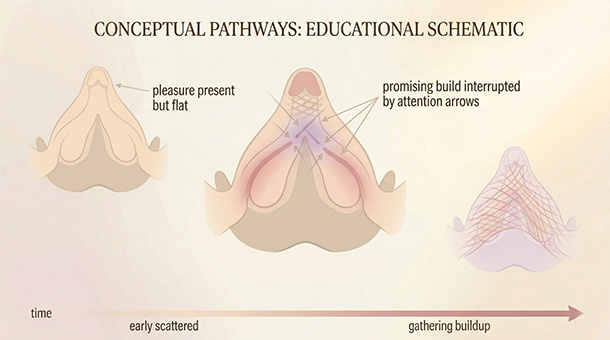
You can make yourself feel something, but the sensation goes flat fast. That often happens when the touch is technically correct but sensorially wrong for your body. The contact is there. The conversion is not.
What used to work now feels distant, dry, muted, or impossible. That is when I would think beyond technique and look at medication changes, hormonal shifts, pain, pelvic floor symptoms, or other body changes that showed up around the same time. Mayo Clinic, Office on Women’s Health, and Cleveland Clinic all outline pathways like these.
You are not missing a secret button. You are usually losing a chain reaction.
When to stop troubleshooting alone
I would bring in a clinician, sexual health specialist, or pelvic floor therapist if any of these are true:
- You used to orgasm and there has been a clear change.
- You are also dealing with pain, dryness, numbness, pelvic pressure, or a clenched pelvic feeling.
- The problem started around a medication change, surgery, menopause, or a major health shift.
- You have never orgasmed, it bothers you, and solo experimentation is not giving you more clarity.
That threshold is not dramatic. It is practical. Mayo Clinic advises talking to a healthcare professional if you are concerned about your ability to orgasm, and Cleveland Clinic recommends evaluation when pelvic pain or sexual function symptoms are present because they often do not resolve on their own.
A better question than “What’s wrong with me?”
People talk about orgasm as if it proves something. That you are sexual enough. Relaxed enough. Skilled enough. In tune enough.
I do not think that lens helps.
Orgasm is not a personality trait. It is not a moral achievement. It is not a test you pass by applying enough effort. It is a body event that depends on timing, stimulation, arousal, attention, chemistry, and physical comfort lining up well enough for the nervous system to let go.
When masturbation is not ending in orgasm, the useful question is not, Why am I failing?
It is, What kind of mismatch is happening here?
That question is less cruel.
It is also much closer to the truth.
Reviewed medical and clinical sources
- Mayo Clinic Staff. Anorgasmia in women – Symptoms and causes. Mayo Clinic. February 29, 2024.
- Mayo Clinic Staff. Anorgasmia in women – Diagnosis and treatment. Mayo Clinic. February 29, 2024.
- Allison Conn, MD. Orgasmic Disorder in Women. Merck Manual Consumer Version.
- Cleveland Clinic. Anorgasmia: Causes, Symptoms, Diagnosis & Treatment. Cleveland Clinic. Last updated January 23, 2023.
- MedlinePlus. Orgasmic dysfunction in women. U.S. National Library of Medicine / MedlinePlus. April 16, 2024.
- Office on Women’s Health. Menopause and sexuality. U.S. Department of Health and Human Services. March 12, 2025.
- Cleveland Clinic. Hypertonic Pelvic Floor: Symptoms, Causes & Treatment. Cleveland Clinic. Last updated April 26, 2022.
Add comment