

 Amie Dawson, Ph.D.
You can get there with a toy in a few minutes. Then you try fingers, and the whole thing turns vague.
It feels good. Then less good. Then too direct, too slippery, too distracting, too much work. You track the spot. You adjust the pressure. You chase the feeling that was just there a second ago.
That doesn’t mean your body is broken.
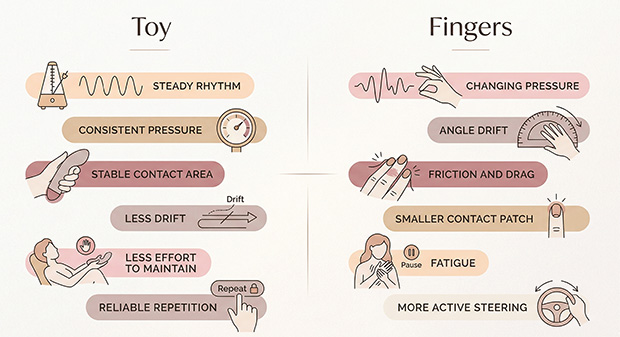
Most of the time, it means the toy is giving your nervous system something your fingers are not giving it yet: a steadier signal, for longer, with fewer accidental changes. That lines up with clinical guidance on orgasm difficulties, which keeps coming back to the same point: many women need steady clitoral stimulation for orgasm, and vibration can help some people get there more reliably.
A toy is boring in exactly the way orgasm often likes
Orgasm usually likes repetition more than creativity.
Fingers are expressive. Orgasm is often picky.
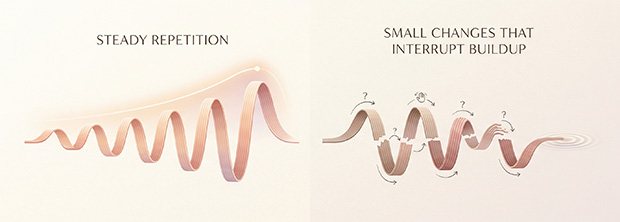
A vibrator can hold the same speed, the same contact patch, the same rhythm, and almost the same angle for minutes at a time. A hand usually can’t. Even a skilled hand drifts a little. The wrist gets tired. The fingertip narrows. The motion speeds up because you feel close. Then the sensation changes right when your body needed it not to.
That is why a toy can feel easier without necessarily feeling better in every way. It isn’t always more erotic. A lot of the time, it is simply more reliable.
And reliability matters.
For plenty of people, that reliability is not only about vibration. It is about contact that stays broad and steady enough to keep building, which is often the real difference between broad and pinpoint clit stimulation.
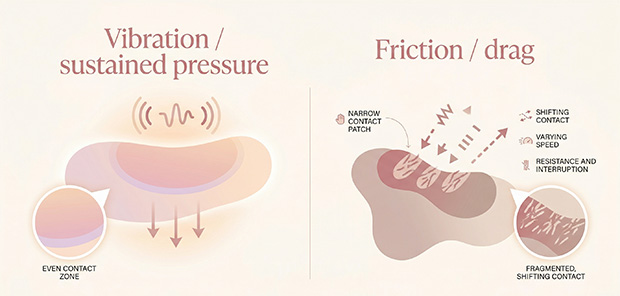
Fingers do not just stimulate. They also drag.
A toy usually creates sensation through vibration, pulsing, or sustained pressure. Fingers can do some of that too, but they also add friction whether you want it or not.
At the right moment, that friction can feel great. At the wrong moment, it is exactly what breaks the spell.
The clitoris is not just a little external nub. It is a larger network of erectile tissue and nerves, with an exposed glans that can feel painful with too much direct pressure. That matters here because a fingertip can feel pokier than people expect. Skin can catch. A nail edge can register even when it is not literally painful. What felt sexy at forty percent arousal can feel scratchy at ninety.
It doesn’t feel weaker. It feels less continuous.
Good is not the same as buildable.
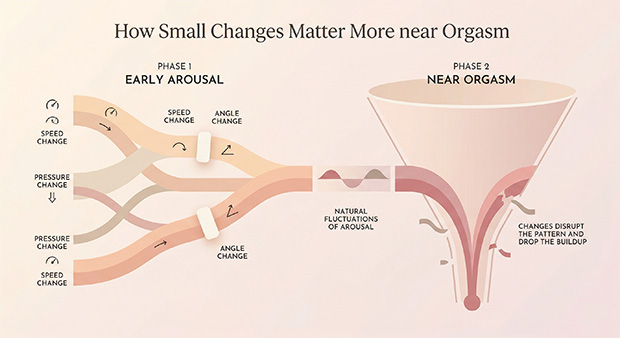
Near orgasm, tiny changes matter more than most people realize
A lot of people assume that if fingers feel good, fingers should eventually get them over the line.
But the last stretch to orgasm is often much less forgiving than the first stretch into arousal. Early on, your body can absorb variation. A slightly different circle. A pause. A small shift in pressure. Close to orgasm, those same changes can pull you out of the groove fast.
That is one reason this feels so confusing. You are turned on. You are enjoying yourself. And yet the sensation will not quite stack high enough to tip.
You are not necessarily losing arousal.
You are losing continuity.
That is often what it feels like when pleasure keeps getting almost-there but never quite lands. The body is not always losing interest. It is doing the same thing people mean when they get close to orgasm and then lose it.
What this usually looks like in real life
These patterns get very obvious once you know what you are looking for:
- You can orgasm quickly with a toy over underwear, but bare fingers on skin feel too sharp or too exposed.
- Circles with two fingers feel great until you get close, then you speed up, narrow the contact, and the pleasure suddenly goes flat.
- A partner hears your breathing change and starts “helping” by moving faster or covering more area. You were close. Then you were not.
- You keep searching for the exact spot instead of staying on the spot that was already working.
- A toy works because it keeps doing one simple thing. Your hand keeps trying to improve it.
That last one gets people all the time.
Sometimes the difference is mental bandwidth
This is not always about anxiety in the dramatic sense. A lot of the time it is simpler than that.
A toy can let you stay inside the feeling because the motor is doing the repetitive work for you. Fingers require more steering. You have to maintain pressure, angle, speed, location, and comfort all at once. That can pull part of your attention out of the sensation and into management.
You can be fully turned on and still lose the thread.
That is a different problem from low desire. It is much closer to what happens when orgasm gets interrupted by distraction, even though the distraction is coming from your own hand needing too much management.
How to make fingers work better
The goal is not to make fingers act like a cheaper vibrator.
The goal is to figure out what the toy is teaching you about your body, then translate that information.
Because of that, the best changes are usually mechanical, not motivational. Directed self-stimulation is part of first-line care for orgasm difficulty for a reason. You are not guessing here. You are learning.
Try this:
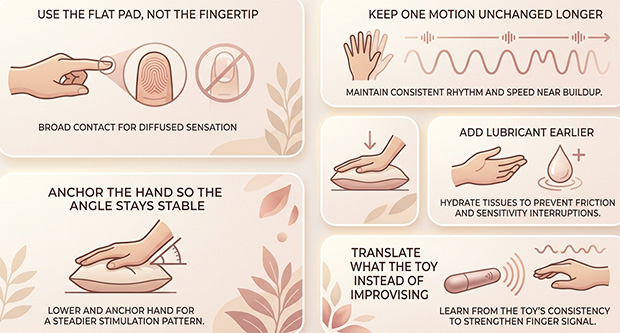
- Use the flat pad of one or two fingers, not the point of a fingertip. Wider contact is often easier to build on.
- Pick one motion and keep it unchanged longer than feels natural. Not ten seconds. More like a full minute.
- Anchor your hand against your pubic bone, thigh, or a pillow so the angle stops drifting.
- Add lubricant earlier. Less drag usually means fewer interruptions.
- Translate, do not replace: notice exactly where and how the toy works, then practice reproducing that area and rhythm with fingers before you are already at the brink, which is often how people find a clitoral stimulation pattern that actually holds.
Many people fail with fingers because they keep improvising.
Improvising is exciting. It is not always effective.
When it may be more than a technique mismatch
Sometimes the answer really is mechanical. Sometimes it is not.
If this is a new change rather than a long-standing pattern, take it seriously. Anorgasmia and orgasm changes can be affected by menopause, SSRIs and other medications, pelvic floor dysfunction, hormonal conditions, nerve issues, multiple sclerosis, stress, and overlapping pain problems. Those are not minor details.
Get help sooner if any of this sounds familiar:
- You used to orgasm this way and suddenly cannot.
- Sensation feels numb, dulled, painful, or strangely absent.
- The change started after a new medication, dose change, surgery, birth, or menopause symptoms.
- You also have pelvic pain, tightness, burning, or trouble relaxing your body.
That is not you overthinking it. That is useful information.
A better way to read what your toy is telling you
A toy is not proof that your body has been spoiled.
It is proof that your body has specifications.
The toy did not create pleasure your fingers are missing. It revealed the conditions your nervous system trusts: this area, this rhythm, this steadiness, this amount of friction, this much drift and no more.
Once you see that, the whole question changes.
Not Why am I like this?
More like, What exactly helps my body stay with pleasure long enough to tip?
That is a kinder question.
It is also the one that gets answers.
Reviewed medical and clinical sources
- Leicestershire Partnership NHS Trust, Department of Medical Psychology. Female orgasmic difficulties. Leicestershire Partnership NHS Trust.
- Cleveland Clinic. Clitoris: Anatomy, Location, Purpose & Conditions. Cleveland Clinic.
- Allison Conn, MD; Kelly R. Hodges, MD; reviewed by Oluwatosin Goje, MD, MSCR. Female Orgasmic Disorder. Merck Manual Professional Edition.
- Cleveland Clinic. Anorgasmia: Causes, Symptoms, Diagnosis & Treatment. Cleveland Clinic.
- Jordan E. Rullo, Tierney Lorenz, Matthew J. Ziegelmann, Laura Meihofer, Debra Herbenick, Stephanie S. Faubion. Genital vibration for sexual function and enhancement: a review of evidence. Sexual and Relationship Therapy.
Add comment