

 Amie Dawson, Ph.D.
You can be turned on and still keep losing the thread.
The touch feels good. Your body is responding. Then your mind slips sideways. A text you forgot to answer. Whether you look tense. Whether you’re taking too long. Whether that sound in the hallway means someone is awake.
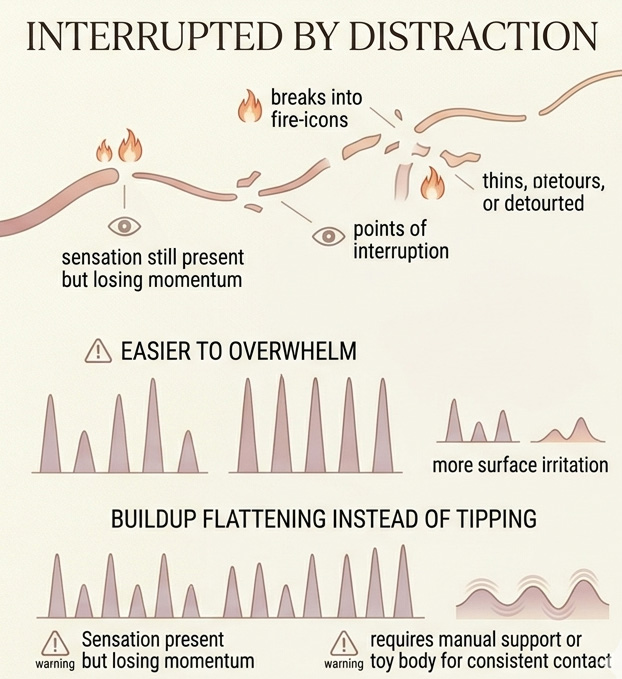
The sensation doesn’t disappear all at once. It thins. The thread breaks.
That matters, because orgasm isn’t only about enough stimulation. It’s also about whether your attention can stay with that stimulation long enough for arousal to build into something bigger. Clinically, sexual problems often overlap across desire, arousal, orgasm, and pain, and they’re treated as real concerns when they’re ongoing and distressing, not as proof that your body is failing.
Orgasm usually needs continuity more than people realize
I think of orgasm as a build that hates interruption.
Not moral interruption. Nervous-system interruption.
You don’t always lose momentum because the touch is wrong. Sometimes you lose it because your attention keeps leaving the room. A 2021 review in Current Sexual Health Reports describes attention as integral to sexual response and notes that reduced attention to sexual stimuli can suppress arousal. In a laboratory study published in The Journal of Sexual Medicine, women with higher chronic stress showed lower genital arousal and more distraction, and distraction was the strongest predictor of the reduced genital response.
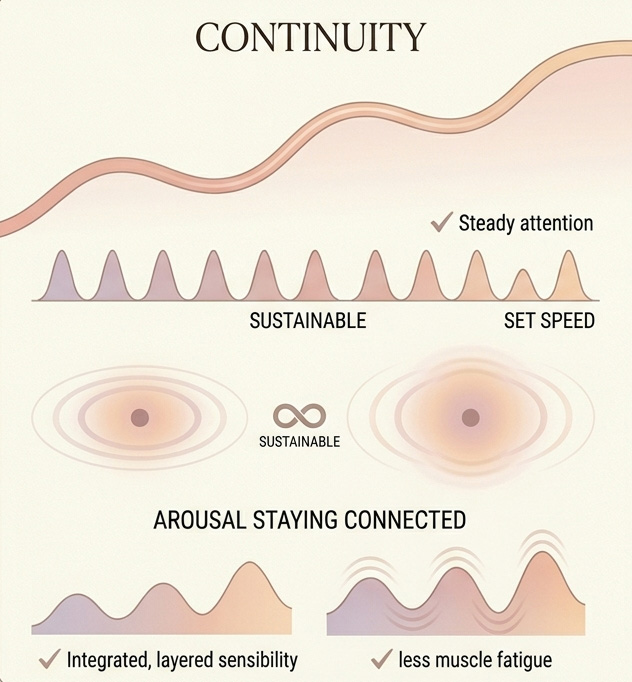
That helps explain a frustratingly familiar experience: you feel interested, engaged, almost there, and yet the build never tips. The body can be responding while the connection keeps shorting out. It’s not always a problem of weak pleasure. Sometimes it’s a problem of broken continuity.
That’s often the same thing people are naming when they feel almost there and then suddenly not there at all. The body may still be aroused, but the buildup keeps getting interrupted in the same way people get close to orgasm and then lose it.
Distraction doesn’t always shut pleasure off.
Often it keeps unplugging it.
“Distracted” isn’t one thing
When I say distracted, I don’t just mean thinking about groceries.
Distraction shows up in a few different costumes. Clinical guidance on female sexual dysfunction lists distraction among the common psychological factors affecting sexual function, and the MSD Manual notes that anxiety, fear, low self-esteem, and worries about vulnerability or loss of control can all shape arousal and orgasm.
- Chore brain: part of you is still in the rest of your day. The dishwasher. The meeting. The childcare plan for tomorrow.
- Mirror brain: you start monitoring your stomach, your face, your sounds, your angle, your orgasm face.
- Partner brain: you keep checking whether your partner is bored, confused, pressured, waiting, or silently grading the experience.
- Alarm brain: some part of you is scanning for pain, interruption, shame, conflict, or emotional risk.
Different source. Same effect.
Your attention is trying to do two jobs at once.
For a lot of people, that second job isn’t neutral. The moment attention starts grading, managing, or watching the experience from the outside, performance pressure starts crowding out pleasure even when nobody is saying anything out loud.
What distraction looks like while it’s happening
It usually doesn’t feel like one huge thought. It feels like ten tiny departures.
You’re using a toy that usually works for you. Then you start checking whether it’s still on the right spot. Whether your wrist is getting tired. Whether you should speed up. Whether you should already be closer by now. Each check is small. None of them feels fatal. But together they pull you just far enough out of the sensation that the build goes flat.
Or you’re with a partner, and half your awareness is on their breathing, their patience, their ego, their next move. You’re not fully inside your own response anymore. You’re partly managing the room.
Or you’re alone, finally, but your nervous system is still running household software. The door is unlocked. The phone might buzz. The baby monitor might crackle. You’re technically private, but not internally off duty.
For many people, the problem isn’t weak pleasure.
It’s interrupted pleasure.
The fix is usually fewer switches, not more effort
Telling yourself to “just focus” usually makes things worse. Now focusing becomes another task, another benchmark, another way to monitor yourself.
What usually helps more is making attention easier.
There’s a reason mindfulness-based approaches show up in sexual medicine and sex therapy. A Mayo Clinic–affiliated study found that higher trait mindfulness was associated with better sexual function, lower sexual distress, and lower odds of female sexual dysfunction. The point isn’t to become spiritually perfect in bed. It’s simpler than that: notice when your attention leaves, and give it a gentle way back.
A few practical moves tend to help:
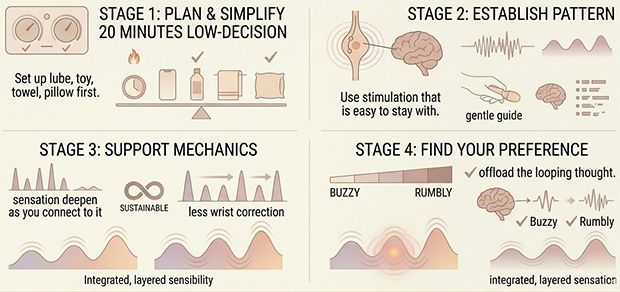
- Make the next 20 minutes low-decision. Pee first. Silence the phone. Lock the door. Put lube, towel, toy, and pillow where you can reach them without breaking rhythm.
- Choose one anchor. The warmth in your pelvis. The pressure on one side of the clitoris. The buzz through fabric. Your exhale. The small rocking motion of your hips.
- Use stimulation that’s easy to stay with. When your mind is busy, steadier and more repetitive sensation is usually easier to follow than stimulation that needs constant correcting.
- Offload the looping thought. If your brain keeps yelling “don’t forget that thing,” jot it down first. Sometimes one note on your phone is enough to stop your mind from guarding it.
You do not need a perfectly silent mind.
You need a mind that can come back.
That’s why steadier, easier-to-follow stimulation often helps more than exciting-but-fussy stimulation on distracted days. The body usually does better with a pattern it can keep tracking, which is often the deeper difference between steady pressure and more movement.
Sometimes distraction is actually protection
This is the part I don’t like to see flattened into productivity advice.
Sometimes your mind is wandering because something in you doesn’t feel settled, safe, or comfortable enough to let go. Clinical sources consistently point to anxiety, depression, relationship strain, trauma history, pain, medication effects, and other medical or psychological factors as contributors to orgasm and arousal problems. Mayo Clinic’s guidance on anorgasmia also notes that stressors, poor body image, past abuse, mental health conditions, and medication effects can all play a role.
So if your mind keeps scanning for pain, for emotional fallout, for whether you owe someone a performance, or for whether sex is about to turn disappointing again, that isn’t random mental weakness. That’s vigilance.
And vigilance is terrible for orgasm.
When that vigilance is living in the body as much as in the mind, the whole experience can start feeling guarded before it feels pleasurable. That’s often the quieter physical layer underneath sessions where body tension makes pleasure harder even though desire is still there.
If that sounds familiar, the solution may not be better concentration. It may be addressing the thing your attention keeps circling: painful penetration, resentment, unresolved shame, trauma, antidepressant side effects, postpartum changes, menopause-related dryness, or plain old exhaustion that has stopped being plain old anything.
When it’s worth getting help
Talk with a clinician if orgasm became harder suddenly, if you also have pain, numbness, dryness, or a major drop in arousal, if a medication change lined up with the problem, or if this has been persistent enough to cause real distress. That’s the standard clinical frame: not “Do you orgasm every time?” but “Is this ongoing, and is it upsetting or disruptive enough that it deserves care?”
A good clinician or certified sex therapist should not treat this like a mystery of willpower.
Because it usually isn’t.
A better way to think about it
I’d stop asking, “Why can’t I focus?”
That question sounds like blame dressed up as curiosity.
The more useful question is: what keeps pulling me out of my body here?
That shift changes the whole story. You stop treating orgasm like a pass-fail test of desire, skill, or femininity. You start seeing it for what it often is: a coordination problem between sensation, attention, and felt safety. That framing follows the attention research and the clinical model that treats female sexual function as biological, psychological, relational, and contextual at the same time.
Your body may not need more effort.
It may need fewer exits.
Reviewed medical and clinical sources
- Allison Conn, MD, and Kelly R. Hodges, MD, “Overview of Female Sexual Function and Dysfunction,” MSD Manual Professional Edition.
- Stephanie S. Faubion, MD, and Jordan E. Rullo, PhD, “Sexual Dysfunction in Women: A Practical Approach,” American Family Physician.
- Sonia Milani, Samantha J. Dawson, and Julia Velten, “Visual Attention and Sexual Function in Women,” Current Sexual Health Reports.
- Lisa Dawn Hamilton, PhD, and Cindy M. Meston, PhD, “Chronic Stress and Sexual Function in Women,” The Journal of Sexual Medicine.
- Richa Sood, Carol L. Kuhle, Jacqueline M. Thielen, Ekta Kapoor, Jennifer A. Vencill, Kristin C. Mara, and Stephanie S. Faubion, “Association of Mindfulness with Female Sexual Dysfunction,” Maturitas.
- Mayo Clinic Staff, “Anorgasmia in Women: Symptoms and Causes,” Mayo Clinic.
- Mayo Clinic Staff, “Female Sexual Dysfunction: Symptoms and Causes,” Mayo Clinic.
Add comment