

 Amie Dawson, Ph.D.
One night it clicks almost immediately. The pressure feels right. The shape makes sense. Your body meets it halfway.
A few days later, the same toy feels thin, irritating, weirdly dull, or just off. You move it around. You lower the setting. You try the old angle. Nothing lands.
That can make you feel like your body is impossible to read.
It isn’t.
The toy did not suddenly become bad. Your body did not suddenly become broken. What changed was the state of the body receiving that stimulation.
The toy is not the whole event
A vibrator does not create sensation in a vacuum. It meets tissue, nerves, blood flow, arousal, muscle tone, lubrication, attention, and mood already in progress.
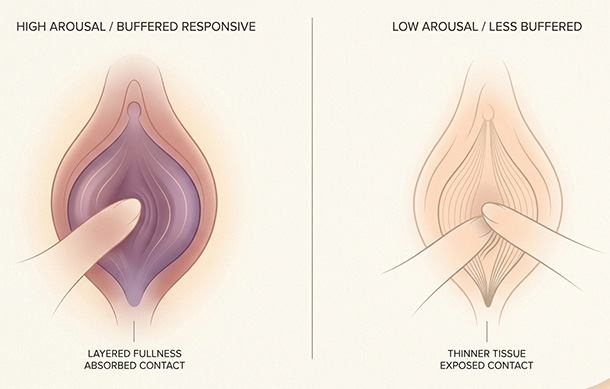
That matters because the clitoris is not a static little button waiting for identical input every time. It is highly sensitive tissue with external and internal structures, and when you are aroused, that tissue changes. It fills with blood. It swells. The surrounding structures become more responsive. The same contact can feel fuller, softer, deeper, or easier to absorb depending on what state you were in before the toy even touched you. Cleveland Clinic’s clitoris guide is useful here because it describes the clitoris as the most sensitive erogenous zone and explains that the visible part is only the outside of a larger structure.
That is why the same setting can feel rich one day and strangely exposed the next.
For a lot of people, that exposed feeling is the whole shift. The stimulation did not suddenly become harsher. It started landing with less cushion, which is often what people are feeling when clitoral stimulation suddenly feels too intense.
It does not feel weaker. It feels less welcome.
Arousal is not one clean switch
A lot of people picture arousal as one dial. You are either turned on or you are not. Real bodies are messier than that.
For women especially, physical genital response and the feeling of “I’m turned on” do not always rise together in perfect sync. A large meta-analysis by Meredith Chivers and colleagues found that agreement between self-reported arousal and genital measures was significantly lower in women than in men. Merck also separates sexual arousal into subjective arousal and physical genital response, which is a useful reminder that the body and the mind do not always signal at the same volume.
So yes, you can want stimulation but have the tissue feel unreceptive. You can also have some genital response without feeling mentally settled enough to enjoy what is happening. In that gap, a toy that usually feels precise can feel annoyingly specific. A toy that usually feels broad can feel vague and unsatisfying.
Same toy. Different alignment.
Sometimes what changed is not desire. It is the body’s buffer
When arousal is building well, there is often more cushion in the experience. More blood flow. More swelling. More sense that the sensation is spreading through an area instead of drilling into one point.
When that buffer is lower, the same toy can feel sharp, papery, overly exposed, or strangely mechanical. You are not imagining that. You are feeling the difference between touch landing into receptive tissue and touch landing into tissue that is less physically prepared for it. Merck notes that reduced genital sensitivity and lubrication can be part of genital arousal changes, especially around hormonal shifts and menopause. NHS and Cleveland Clinic both note that dryness can be linked to lower hormone levels, breastfeeding, and certain medications.
This is one reason a toy can feel amazing after ten minutes of warm-up and totally wrong when used too early.
Not because your standards changed.
Because the landing surface did.
Stress changes sensation quality, not just mood
People often talk about stress as if it only lowers desire. That is too simple.
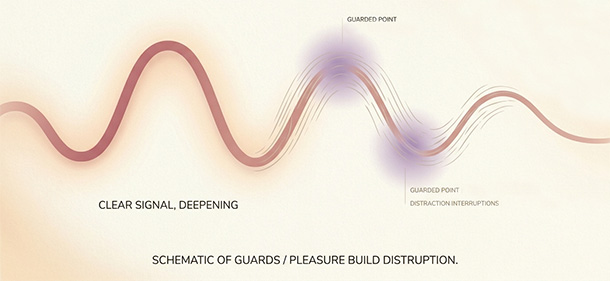
Stress can leave desire partly intact while changing how stimulation is processed. You may still want release. You may still reach for the same toy. But the sensation arrives in a body that is more distracted, more defended, more clenched, or less able to stay with subtle buildup.
In a lab study published in The Journal of Sexual Medicine, women with higher chronic stress showed lower genital arousal and more distraction during erotic stimuli than women with average stress levels, and distraction was the strongest predictor of lower genital arousal. That does not mean every off night is “just stress.” It means your nervous system changes what a sensation feels like, not only whether you are in the mood.
This is why the same toy can feel like a clean signal on one night and like static on another.
The body can still want pleasure while having a much harder time staying with it. That is often the quieter version of what happens when distraction makes orgasm harder, even when the distraction is coming from inside your own nervous system.
Hormones, dryness, and medication changes can quietly rewrite the sensation map
Some shifts are subtle enough that people miss them completely. They only notice the outcome.
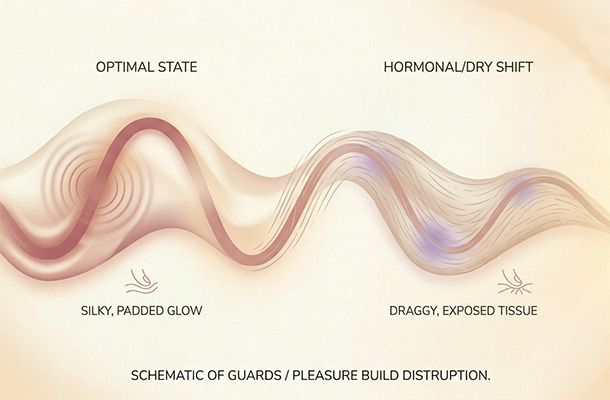
The toy that used to feel silky now feels draggy. The pressure that used to feel delicious now feels too immediate. The contact that usually builds arousal now makes you want to pull away.
Hormonal changes can be part of that picture. Merck notes that arousal and sexual interest can shift with the menstrual cycle, pregnancy, postpartum, and menopause. NHS guidance on vaginal dryness also notes that dryness can happen during pregnancy or breastfeeding, when you are not yet aroused, and with certain medicines including hormonal contraception or antidepressants.
That does not mean every uncomfortable session is a hormone issue. It means body chemistry can change friction, lubrication, swelling, and sensitivity enough that the exact same toy is meeting a different sensory field.
It does not feel smaller. It feels less padded.
Sometimes the tissue is simply more reactive that day
There are days when the vulva feels calm and days when it feels more exposed to friction, touch, seams, pressure, or direct stimulation.
That can happen for ordinary reasons. A long session the day before. A lot of direct contact earlier that day. Tight clothing. A scented product that irritated the area. A pad. A workout. Sex that left the vulva a little rubbed out even if it was wanted and pleasurable.
It can also happen for medical reasons. ACOG notes that the vulva can become more sensitive to irritants, and its patient guidance on vulvodynia describes symptoms such as burning, stinging, irritation, and rawness that may be constant or come and go. Some people feel pain in one spot, including the clitoris or vestibule.
That distinction matters because “not in the mood for this toy today” and “this touch feels raw in a way that seems abnormal” are not the same thing.
Three ordinary nights that explain the whole pattern
Night one: the toy feels easy
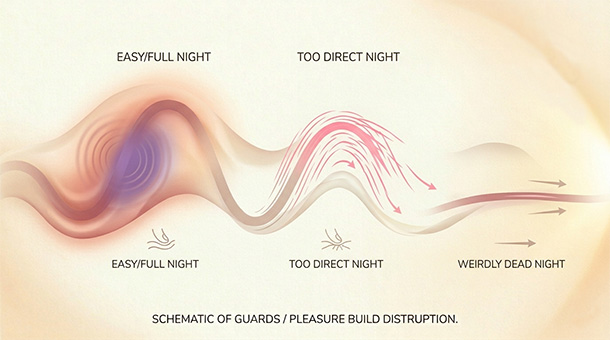
You have been turned on for a while. Maybe not wildly. Just steadily.
Your hips are loose. Your breathing is normal. The tissue feels full. The contact spreads. The toy does not feel like it is hitting one tiny spot. It feels like it is waking up an area.
Night two: the toy feels too direct
You are tired. You want a shortcut. You go straight in with the same pressure that worked last time.
But the tissue is less engorged, you are less lubricated, and your body has not quite shifted into receiving mode yet. Now the toy feels unbuffered. Too exact. Too buzzy. Not sexy.
Night three: the toy feels weirdly dead
You are mentally present enough. The toy is not painful. It just is not landing.
Sometimes that flatness is not about the toy lacking power. It is the same kind of blur people run into when vibrator sensation turns numbing instead of pleasurable because the signal has lost shape.
This is often the most confusing version, because nothing feels obviously wrong. But sometimes the missing piece is not more power. It is a different state of arousal, a different angle, a different kind of contact, or a body that is too distracted to convert stimulation into momentum.
You track the angle. You correct the pressure. You chase the right spot. You notice every little shift.
That is not failure. That is a body giving different information than it gave last time.
What to change before you blame the toy
Before you decide a toy has stopped working for you, change one condition at a time:
- Change timing first. Try it later in arousal, not harder.
- Change texture. Add lube or use it over underwear if direct contact feels too exposed.
- Change pressure source. Let your hand rest more lightly or brace with a pillow so the contact is steadier.
- Change expectation. Use the toy to gather information, not to force the old result.
That last one matters more than people think.
A lot of bad sessions get worse because the moment turns into an investigation. Why is this not working? Why did this work on Tuesday? What is wrong now? That mental posture makes you monitor sensation instead of sink into it.
Once that happens, a mediocre session can turn bad very quickly. The body may still be responsive, but performance pressure starts crowding out sensation one little check-in at a time.
When “wrong” deserves more than troubleshooting
A temporary mismatch is common. Ongoing pain is not something to just push through.
If the sensation keeps feeling raw, burning, stinging, or sharply wrong; if light touch, tampons, tight clothing, or sex have started hurting; or if there has been a clear lasting change after a medication shift, postpartum period, or menopause transition, it is worth getting evaluated. ACOG’s guidance on vulvodynia and persistent vulvar pain makes clear that ongoing vulvar pain is real, and assessment may include looking at irritation, skin conditions, dryness, infection, and pelvic floor dysfunction. NHS guidance on vaginal dryness also advises seeking care if dryness lasts for weeks, affects daily life, or causes bleeding or persistent discomfort.
Not every “wrong” feeling is a preference issue.
Sometimes it is a signal.
The better question is not “Why am I inconsistent?”
It is, “What state is my body in today, and what kind of touch fits that state?”
That is a better question because it stops treating pleasure like a pass-fail test. It turns it into reading.
The goal is not to make your body respond the exact same way every time. Healthy sexual response is often more variable than people expect. The goal is to get better at noticing what today’s body is asking for before you try to make it repeat yesterday.
Consistency sounds reassuring.
Responsiveness is more useful.
Reviewed medical and clinical sources
- Allison Conn, MD, and Kelly R. Hodges, MD. Sexual Interest/Arousal Disorder. Merck Manual Professional Edition.
- Meredith L. Chivers, Michael C. Seto, Martin L. Lalumière, Ellen Laan, and Teresa Grimbos. Agreement of Self-Reported and Genital Measures of Sexual Arousal in Men and Women: A Meta-Analysis. Archives of Sexual Behavior / PubMed.
- Lisa Dawn Hamilton and Cindy M. Meston. Chronic Stress and Sexual Function in Women. The Journal of Sexual Medicine / PubMed.
- Cleveland Clinic. Clitoris: Anatomy, Location, Purpose & Conditions. Cleveland Clinic Health Library.
- NHS. Vaginal Dryness. National Health Service.
- American College of Obstetricians and Gynecologists. Vulvodynia. ACOG.
- American College of Obstetricians and Gynecologists. Persistent Vulvar Pain. ACOG.
- American College of Obstetricians and Gynecologists. Disorders of the Vulva: Common Causes of Vulvar Pain, Burning, and Itching. ACOG.
Add comment