

 Amie Dawson, Ph.D.
You stop for two seconds to adjust the toy, switch hands, move your leg, or catch your breath. The feeling vanishes so fast it feels unfair. What was building now feels far away, and instead of continuing, you are trying to restart.
I do not read that as a body that is broken.
I read it as a body that hates abrupt interruption.
A break is not the same thing as a reset
A lot of people treat arousal like it only counts if stimulation stays perfectly continuous. No pause. No shift. No breath. No adjustment. That is too rigid for real bodies.
NHS guidance on female orgasmic difficulties notes that many women need steady clitoral stimulation to reach orgasm. Cleveland Clinic’s overview of the sexual response cycle also makes clear that arousal and timing vary from person to person. The useful way to hold both ideas at once is this: steady does not mean mechanically uninterrupted every second. It means the erotic thread stays intact.
That is the part that matters.
It was not too little stimulation. It was too sharp an interruption.
For a lot of people, that sharpness is the whole problem. The body can stay aroused through a softer shift, but once contact and attention both drop out at the same time, it starts feeling a lot like distraction getting louder than sensation.
What usually kills arousal is the hard stop
For many people, the real drop happens when too many things stop at once. Touch stops. Movement stops. Breath tightens. Attention leaves the body. The brain starts checking whether orgasm is still possible.
That mental switch matters more than people realize. The NHS leaflet above describes “spectatoring” as watching for orgasm instead of staying inside the experience, and a 2024 meta-analysis found that mindfulness-based cognitive approaches can improve women’s sexual function and reduce sexual distress. That fits what I see here: arousal often drops fastest in the gap between sensation and attention.
The kind of pause that tends to flatten things usually looks like this:
- The toy leaves your body completely and you sit up to stare at buttons.
- Both hands come off at once.
- You hold your breath while waiting to feel “back in it.”
- You start assessing performance instead of noticing sensation.
- The room suddenly feels more practical than erotic.
A good pause does not feel like that.
A good pause feels like a comma, not a period.
Keep one channel open while you pause
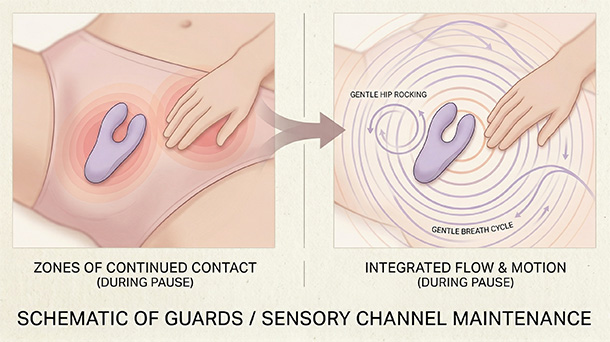
This is the part I most want readers to get. The goal is not to stop everything. The goal is to change one variable while the rest of the erotic scene stays alive.
If direct stimulation needs to pause, keep something going. A hand resting on the vulva. The toy pressed lightly against the mons. Slow hip movement. Thigh pressure. Kissing. Fantasy. A long exhale with your attention still down in the pelvis. I think of this as leaving one light on instead of blacking out the whole room.
That approach lines up with what the clinical sources suggest in different ways: arousal is variable rather than perfectly linear, clitoral sensitivity can increase during the arousal phase, and staying mentally present helps sexual response hold together better.
Five ways to keep the thread alive during a break:
- Rest instead of removing. Lower the toy or hand to a less direct area instead of taking it away completely.
- Keep a body rhythm. Tiny hip rocking or thigh tension can preserve momentum.
- Exhale on purpose. Breath keeps you in the body when your mind wants to jump to analysis.
- Leave one hand behind. Even broad, still contact is different from disappearance.
- Keep the erotic focus running. Stay with sensation, imagery, or anticipation while you adjust.
Break earlier, not later
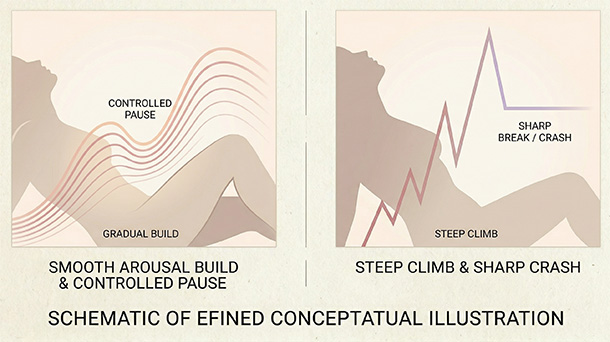
Most people wait too long.
They keep going until the sensation is borderline too much, or the arm is already cramping, or the position is already unsustainable. Then the break becomes an emergency stop. Emergency stops are much more likely to feel like a crash.
Cleveland Clinic notes that the clitoris can become highly sensitive during the arousal phase. That is one reason earlier pauses often work better. You are not trying to kill momentum. You are preventing the kind of overstretched intensity that makes any interruption feel catastrophic.
That is often the missing move. A pause taken one beat earlier can protect the build better than waiting until the contact has already tipped into stimulation that feels too intense.
I think of it this way: breaks work best when they arrive as steering, not rescue.
Take the pause while you still feel connected. Not when you are already flinching.
What this looks like in real life
Theory is nice. Bodies are messier than theory.
When you need to adjust a toy
Do not pull it completely away unless you really have to. Let it rest more broadly against the vulva or mons while you change grip, angle, or settings. Keep breathing. Keep your hips soft. Then bring it back in.

That tiny difference matters. The body reads “lighter and nearby” very differently from “gone.”
For a lot of bodies, that is the whole difference between staying inside the arousal and having to rebuild it from scratch. The signal is still there, just softer and less direct, which is often how a more buffered kind of clitoral stimulation keeps working when full contact would break the thread.
When your hand or arm needs a second
If one hand is tired, keep the other hand somewhere on your body. Press your palm into your thigh, hold your vulva, or keep a slow rocking motion going while you switch. The point is continuity, not heroics.
You do not need to endure discomfort just to prove you were close.
When you are changing position
Position changes kill arousal most often when people fully exit the scene. They sit up. Fix pillows. Untangle cords. Think about logistics. Then they try to come back as if nothing happened. Move more slowly than that. Stay touching yourself. Stay kissing. Stay mentally inside the moment while your body repositions.
The body can handle pauses.
What it resists is disappearance.

If a partner is involved, the pause needs words
A silent pause is easy to misread. Your partner thinks you want them to stop completely. You think they should know you only wanted ten seconds of softer contact. Now the whole thing feels awkward, and awkwardness is not neutral. It changes the body.
The NHS guidance above also stresses honest communication about sexual preferences and feedback. That matters here because “stop” and “less direct” are not the same instruction. “Pause” and “leave my body” are not the same instruction either.

The most useful phrases are usually simple:
- “Stay touching me, just lighter.”
- “Don’t pull away. Rest it there for a second.”
- “Give me ten seconds, then same spot.”
- “Keep kissing me while I adjust.”
That is not overexplaining.
That is precision.
And precision protects arousal.
When a pause problem may be a bigger arousal problem
Sometimes technique is not the whole story. If even tiny, well-handled pauses erase arousal every single time, or getting back into pleasure feels unusually hard, there may be something else tightening the window.

Mayo Clinic notes that sexual response is complex and can be affected by stress, anxiety, relationship strain, lack of privacy, medications, neurological conditions, menopause, and other health factors. The MSD Manual adds that psychological and physical factors often interact, and sexual function problems are usually defined by persistence and distress rather than one-off bad experiences.
That means this is worth a closer look if the pattern is new, persistent, distressing, or tied to pain, numbness, dryness, medication changes, panic, or a major hormonal shift.
Sometimes you do not need better technique.
Sometimes the window is getting wiped out because the body is already more guarded than it looks. That is often the quieter layer underneath sessions where body tension makes pleasure harder to hold onto even though desire is still there.
Sometimes you need better support.
The better way to think about breaks
I would not measure good arousal by whether it can survive nonstop contact with zero interruption. Real pleasure is not a stress test.
I would measure it by whether you can stay connected while adjusting, softening, breathing, or changing course.
That is a much kinder skill.
And a much more useful one.
You do not need a body that never needs a break. You need a way of pausing that still feels like staying.
Reviewed medical and clinical sources
- Department of Medical Psychology, Leicestershire Partnership NHS Trust. Female orgasmic difficulties. NHS patient leaflet.
- Cleveland Clinic. Sexual Response Cycle: Order, Phases & What To Know. Health Library. Updated December 27, 2023.
- Mayo Clinic Staff. Female sexual dysfunction – Symptoms and causes. Mayo Clinic. October 30, 2024.
- MSD Manual Professional Edition. Overview of Female Sexual Function and Dysfunction. Gynecology and Obstetrics.
- Conn A, Hodges KR. Female Orgasmic Disorder. MSD Manual Professional Edition. Reviewed July 2023.
- Çuvadar A, Özcan H. The Effect of Mindfulness-Based Cognitive Therapies on Sexual Function, Sexual Distress, and Depression in Women: A Meta-Analysis Study. International Journal of Sexual Health. 2024;37(1):46-59.
Add comment