

 Amie Dawson, Ph.D.
Sometimes the stimulation is good, but the way you have to hold the toy is not.
Your fingers pinch. Your wrist folds inward. The handle gets slick. You keep correcting the angle by a few millimeters at a time. Then your arm starts to tire before your body does. Instead of staying inside the sensation, you start managing it.
A bad hold turns pleasure into a steering problem.
I see this a lot. People assume the toy is too weak, or their body is too picky, or they are taking too long. Often the real issue is simpler. Their hand is working too hard to keep one kind of contact steady.
And for many bodies, steadiness matters.
When your grip keeps slipping, the contact stops being truly steady even if the toy itself is strong. The toy may still be in roughly the same place, but the pressure changes, the angle changes, the contact spreads out, and the feeling that was building starts slipping.
It does not always feel like less.
Sometimes it feels less exact.
A lot of people read that as toy preference when it is really body geometry. The same vibrator can feel completely different once your body is positioned in a way that stops making the hand compensate.
The right hold doesn’t feel stronger. It feels quieter.
Most people grip harder than they need to.
That sounds small. It isn’t.
A tight grip usually does three annoying things at once. Your hand gets tired faster. The toy starts wobbling in tiny jerky ways. And you end up pressing more than you meant to. What looked like better control turns into jumpier stimulation.
A more comfortable hold is usually broader. Less fingertip pinch, more palm. Less white-knuckle pressure, more letting the handle rest into the base of the fingers. If your hand looks tense, the contact often feels tense too.
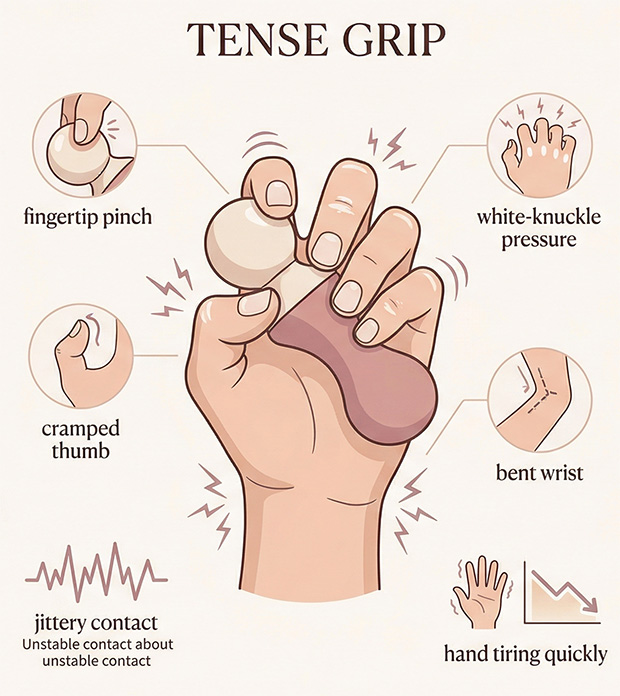
You are not trying to win a tug-of-war with the toy.
You are trying to keep contact calm.
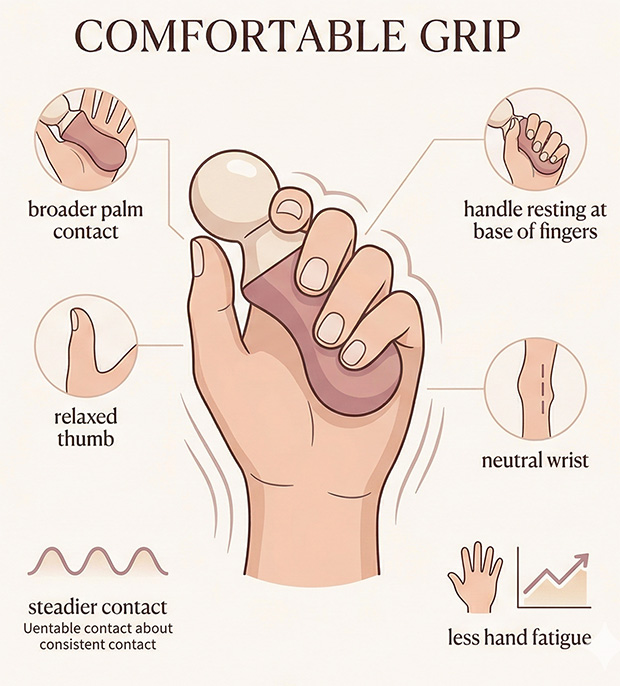
That is especially important because the most sensitive areas often respond better to controlled, readable contact than to extra force. The goal is not maximum pressure. It is contact your body can actually enjoy for more than a few seconds.
Don’t make your wrist do all the aiming
A lot of discomfort starts here.
The toy needs to reach one part of the vulva, so your wrist becomes the hinge. You bend it inward. Or upward. Or hold it half-twisted because that is the only way the head lines up. It works for a minute. Then the strain starts.
Instead of asking your wrist to create the angle, change something bigger.
Bring your pelvis closer to the toy. Roll slightly onto one hip. Bend one knee out. Rotate the toy handle, not just the wrist. Move your whole forearm lower so the toy approaches from the side instead of from above.
Move the target, not just the tool.
That one shift fixes a surprising amount.
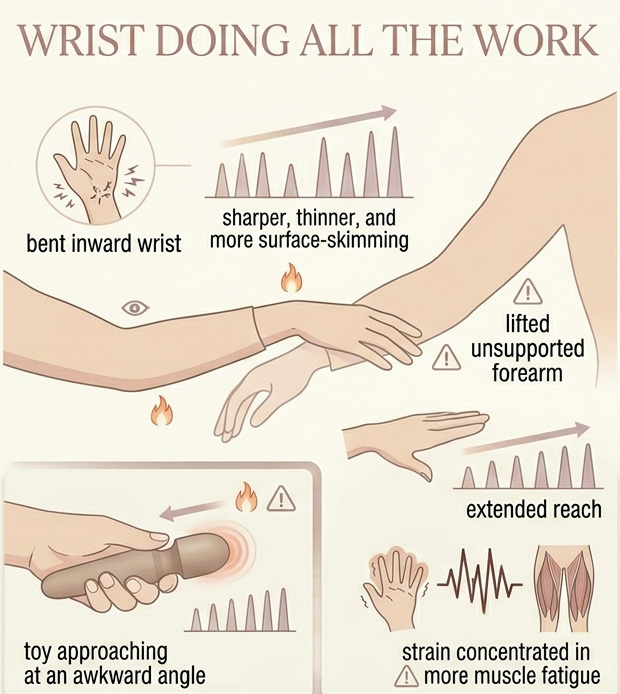
A lot of people think they need better wrist control.
Usually they need a better setup.
A thin slippery handle can ruin a perfectly good toy
Sometimes the sensation is not the problem.
The handle is.
If you have to pinch a narrow bullet like a pencil, or cling to a glossy handle once lube gets involved, your hand has to keep producing friction just to stay in place. That creates effort before pleasure even has a chance to build.
In practice, a few very unsexy fixes help a lot:
- keep lube off the grip area when you can
- a thicker handle is often easier than a skinny one
- a textured surface usually behaves better than a shiny smooth one
- a removable grip sleeve or a clean dry washcloth around the non-active part can make a narrow handle much easier to manage, as long as you do not block vents, buttons, or the charging port
It does not need more power.
It may need more surface.
Support is not cheating
You do not have to suspend the whole toy in midair.
A lot of people hold a vibrator as if only the hand is allowed to do the work. That is where comfort falls apart. If your hand is both carrying the toy and steering it, every small muscle in the grip has to stay switched on.
That is usually the real reason the arm gets tired.
The problem is rarely endurance. It is that one hand is being asked to do two jobs at once:
- hold the toy up
- aim it precisely
That combination burns people out fast, especially if the wrist is bent and the grip is tight.
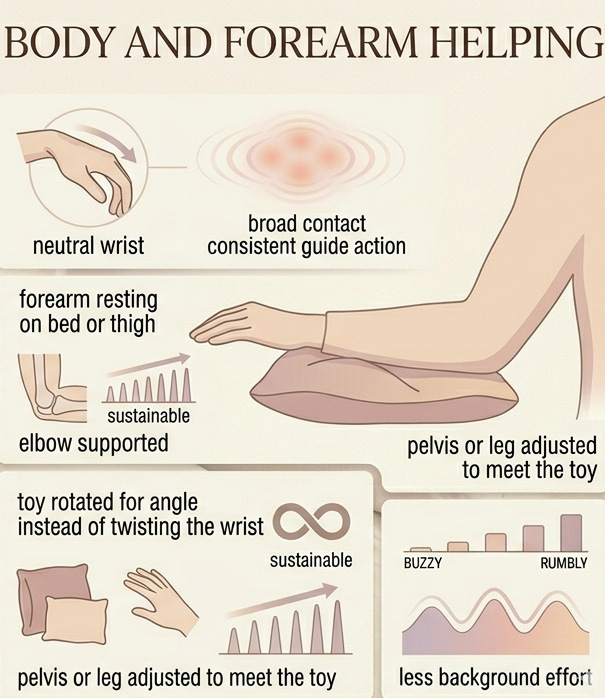
Supported contact is different. You let the heel of your hand rest on your thigh. You brace part of your forearm against the bed. You let the toy body lightly touch the pubic mound, inner thigh, the mattress, or a pillow while the active part stays where you want it.
Now the hand is not doing two jobs.
It is guiding, not carrying.
That usually feels steadier. And steadier usually feels better.
A hovering arm gets tired quickly. A braced arm lasts much longer.
That is not laziness.
It is mechanics.
Use body movement instead of wrist movement
Once the toy is supported, the next fix is to stop asking your wrist to do every tiny correction.
Use your hips. Use your thighs. Use a small tilt of the pelvis.
Those bigger body movements often create better micro-adjustments than frantic hand movement does, because they keep pressure more consistent. Instead of circling the toy around the spot, keep the toy steadier and move your body against it in millimeters.
This matters even more later in a session, when the margin for error gets smaller.
At the start, you may be able to get away with a sloppier angle. Later, when the tissue is more sensitive and your body is more turned on, tiny shifts in pressure or direction matter more. So if the last part always feels the most fragile, that does not mean your body is difficult.
It means the contact needs to get quieter, not busier.
When your arm gets tired before your body does
This is where the second problem usually shows up.
You find something that is finally working, and then your arm starts to fail before your arousal does.
Your wrist shakes a little. Your shoulder creeps up. The toy slides half a centimeter off the spot. Suddenly you are not feeling pleasure anymore. You are managing equipment.
That moment can make it seem like your arousal vanished for no obvious reason.
Often, it didn’t.
Your setup just stopped being sustainable.
That is often the whole reason a session seems to fall apart for no obvious erotic reason. The body was still building, but the signal stopped staying stable enough to hold, which is the same pattern behind getting close to orgasm and then losing it.
If your arm gets tired and the contact starts drifting, the problem may not be desire or stamina at all. It may simply be that the stimulation stopped being steady enough to keep building.
You find the spot. Then your wrist starts negotiating with it.
And once that happens, pleasure gets thinner instead of stronger.
What your fatigue pattern is trying to tell you
Not all tiredness means the same thing.
Where the strain shows up usually tells you what needs changing.
If your hand cramps:
Your grip is probably too tight, or the handle is too narrow and forcing a pinch grip.
If your wrist aches:
The angle is probably off. Straightening the wrist usually helps more than squeezing harder.
If your shoulder burns:
Your elbow is floating. The toy may be close enough, but your arm is still reaching for it.
If your thumb keeps hovering over the buttons and starts cramping:
Set the speed first, then move your thumb off the controls. You do not need a ready position the whole time.
If your fingers tingle or go numb:
Stop. That is not a push-through-it signal.
The body is usually pretty honest here. You do not need to overanalyze it. You just need to notice where the strain shows up first.
Three setups that make comfort much easier
1. Small vibrator in bed: rest the arm, move the pelvis
If you are using a small clitoral vibrator, the common mistake is holding it above the body with the wrist slightly bent, then making constant tiny corrections.
A better setup is to lie on your back or slightly turned to one side, rest your forearm on the mattress, and use a folded towel under the forearm if needed. Then keep the toy mostly stable and make the fine adjustments with your hips.
The difference is immediate.
Your hand stops doing suspension work.
2. Wand vibrator: let the toy lean
Wands tire people out because they are heavier, and because many users hold them away from the body like a microphone.
Do not.
Let part of the head or neck of the toy lean into the body. Rest the handle against the bed, your inner thigh, or a pillow so your hand is guiding, not carrying. If you need more pressure, get it by changing your body angle, not by driving down harder with your wrist.
The best setup is the one where your pelvis does the fine-tuning and your hand mostly supervises.
3. Sofa or reclined chair: anchor the elbow before you start
A reclined seat can be comfortable, but it often makes people tuck the shoulder up and hold the whole arm in space.
Before you even turn the toy on, decide where the elbow goes.
Beside your ribs. On an armrest. On a pillow. Against a folded blanket. Anywhere stable.
If the elbow has no home, the shoulder will eventually take over.
Then pleasure turns into upper-body labor.
The exact discomfort usually points to the fix
This is where the pattern gets easier to read.
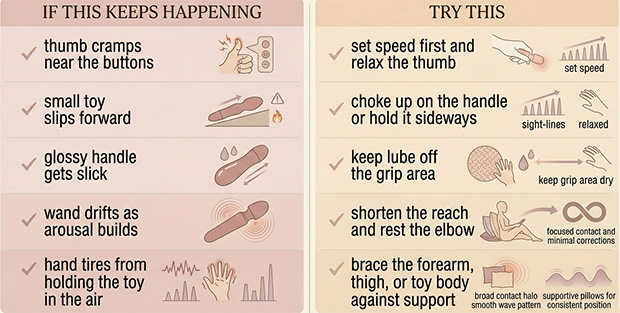
If a small toy keeps slipping forward and stabbing the same spot too directly, stop pinching from the very end. Choke up on the handle a little, or hold it sideways so more of your hand stabilizes it.
If a wand feels fine at first but starts drifting once you get more turned on, shorten the reach. Bring your whole arm closer to your body or let the elbow rest. Do not keep extending the wrist to chase the same spot.
If the contact suddenly feels too sharp near the end, that does not always mean you need less stimulation overall. Often the fix is changing the hold so the pressure gets broader, quieter, or slightly less direct.
It does not feel weaker.
It feels less thin because the hold is no longer forcing all the sensation into one bright little patch. For a lot of bodies, that is the same shift people notice when broader contact works better than pinpoint contact.
It feels less thin.
If the toy works best only when you are bracing hard, pinching hard, or holding one exact impossible angle, the sensation may not be the real problem.
Sometimes the contact only feels usable because the body is overworking to contain it. When that happens, the missing fix is often not more effort but less guarding, which is why body tension can quietly make pleasure harder even when the toy itself is fine.
When this is no longer just a comfort issue
There is a difference between awkward and symptomatic.
Ordinary tiredness usually fades once you change position, loosen your grip, or take a break.
Pain that keeps coming back is different.
If using a vibrator leaves you with burning, aching, stiffness, weakness, tingling, or numbness in the hand or wrist, especially if it keeps happening, think beyond technique. The same goes for symptoms that wake you at night, linger after you stop, or start showing up during other everyday gripping tasks too.
That does not mean every uncomfortable session is a medical problem.
It does mean this is not a grit test.
If the symptoms keep returning, it is worth talking to a clinician, hand specialist, or physical therapist.
Pleasure should ask for attention.
It should not ask for nerve compression.
A more comfortable hold changes more than comfort
People often think of grip as a side issue. Just mechanics. Just hand placement.
It is more central than that.
Your body does not separate sensation from the way sensation is delivered. If the hand is strained, the brain registers strain too. If the contact is jittery, the pleasure often feels jittery. If the hold is calm, the stimulation has a better chance to stay readable.
That is why a better hold can make the same toy feel like a different toy.
Not because your body suddenly changed.
Because the interference dropped.
A lot of people quietly treat vibrator use like a test of endurance. Can I hold the angle. Can I keep the pressure. Can I outlast the fatigue long enough to get there.
That mindset turns the hand into a machine part.
Your body usually responds better when you do the opposite. Less hovering. Less clenching. Less carrying. More support. More bracing. More letting the surface underneath you do some of the work.
Needing that does not mean your body is high-maintenance.
It means your body likes sustainable stimulation better than heroic effort.
Reviewed medical and clinical sources
- NHS / Leicestershire Partnership NHS Trust. Female orgasmic difficulties. Leicestershire Partnership NHS Trust.
- Cleveland Clinic. Sexual Response Cycle: Order, Phases & What To Know. Cleveland Clinic.
- Cleveland Clinic. Clitoris: Anatomy, Location, Purpose & Conditions. Cleveland Clinic.
- American Society for Surgery of the Hand. Gardening Safety: How to Garden Pain-Free. The Hand Society.
- American Academy of Orthopaedic Surgeons. Carpal Tunnel Syndrome. OrthoInfo / AAOS.
- Arthritis Foundation. Self-Help Arthritis Devices. Arthritis Foundation.
- Arthritis Foundation. Ease of Use Child-Resistant Guide. Arthritis Foundation.
- NHS. Repetitive strain injury (RSI). NHS.
- Mayo Clinic. Carpal tunnel syndrome: Diagnosis and treatment. Mayo Clinic.
Add comment