
 Amie Dawson, Ph.D.
You find a position that almost works. Then the toy slips half an inch. Your wrist starts correcting. Your thighs tighten without permission. Something that felt promising starts feeling fussy.
At that point, a lot of people blame the vibrator.
I usually blame the position first.
A bad position does not just feel awkward. It makes good stimulation harder to repeat.
That matters more than most people realize. Solo play is not only about the toy, the setting, or the pressure. Position belongs in that same category. It changes the contact before the toy even turns on.
And for many people, access matters more than fantasy. A position that lets a vibrator stay in the right zone usually matters more than a position that looks sexy but keeps making you readjust.
Sometimes the toy is not missing the spot.
Your body is moving the spot.
A useful position asks less from your body
The best solo-play position is not the one that sounds hottest in theory.
It is the one that lets you stop compensating.
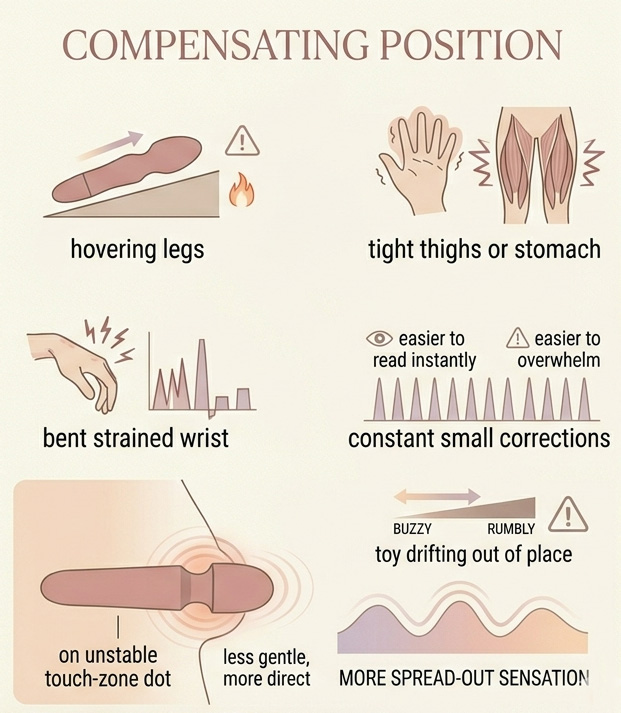
If your wrist is doing tiny rescue missions every few seconds, that is information. If your inner thighs are clamped so hard they start shaking, that is information too. If your stomach keeps tightening, your hips keep drifting, or your hand is doing more work than your pelvis, that is information.
Pleasure usually builds better when fewer parts of your body are secretly doing cleanup.
This is why position matters so much. It changes how much of your attention goes into feeling, and how much goes into holding yourself together long enough to keep feeling.
I think of position as the hidden setting under the toy.
Change the position, and the same vibrator can feel steadier, softer, broader, deeper, or easier to stay with.
For a lot of people, that is the whole shift. The toy did not need more power. It needed a different landing, which is often the deeper difference between broad and pinpoint stimulation.
Support changes sensation, not just comfort
This is the part people often miss.
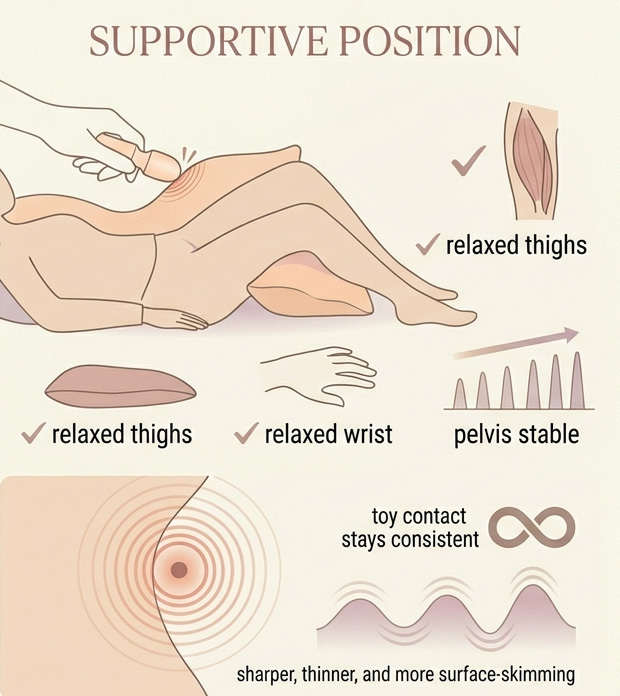
A pillow is not just there to make you comfortable. Support changes angle, access, pressure, and drift.
A pillow under the hips can tilt the pelvis enough to change where a vibrator lands, how flat it sits, and whether pressure spreads out or concentrates on one sharp point. A pillow under the knees can stop the lower back and hips from subtly pulling the pelvis out of place. A pillow behind the back can keep you from collapsing too far backward. A pillow between the knees in side-lying can stop the whole lower body from rolling and taking the toy with it.
That is not cosmetic.
It changes contact.
The same toy can go from pokey to broad. From slippery to anchored. From “I think I’m on the right spot” to “there it is.”
It does not always feel stronger.
Sometimes it feels more reachable.
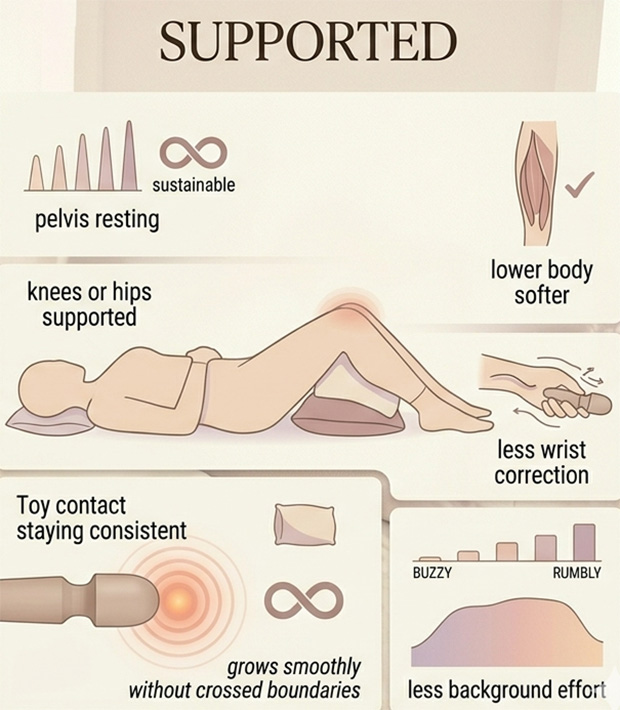
Support also changes what your muscles are doing in the background. If your hips are unsupported, your abdomen may tense to hold position. Your thighs may grip. Your glutes may stay half-engaged. Your wrist may start compensating. Even if you do not notice it consciously, your body can stay occupied with not sinking, not sliding, not over-rotating, and not losing the angle.
That background effort matters.
Sometimes what feels like a sensitivity problem is really a consistency problem.
A pillow can turn a chase into a landing.
If your hand is still doing rescue work every few seconds, support under the body may not be the only missing piece. Sometimes the next improvement is simply holding the vibrator in a way that asks less from your wrist and grip.
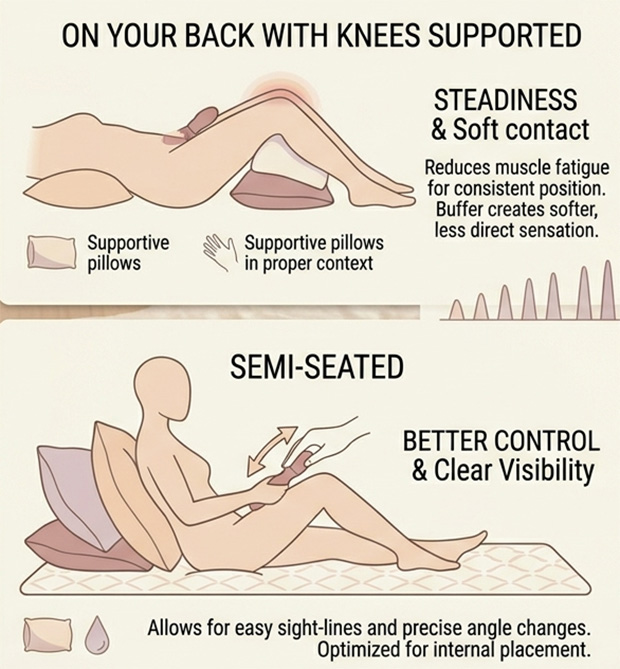
On your back with your knees supported is the best starting position for most people
If I had to name the most reliable starting position for solo play with an external vibrator, this would be it.
Lie on your back. Keep your knees bent. Let them stay relaxed instead of actively holding your legs open. Put support under the knees if needed so nothing is hovering and working.
The point is simple:
nothing should have to hold itself up.
This position works because it reduces drift. A bullet, clitoral vibrator, suction toy, or wand can stay in one useful area without your hips chasing it around the bed. You can make smaller changes. A little more angle. A little less pressure. A slight move to the left.
That is often all you need.
It is especially good if you get close and then lose it because too many things are moving at once. It also makes patterns easier to repeat.
Not glamorous. Very effective.
If your complaint is “I had it, then I kept having to readjust,” start here.
A small support tweak often improves it even more:
- pillow under the knees if your lower back feels tight or your pelvis keeps tucking away
- small pillow under the hips if the toy keeps landing too sharply or you want the surface to sit flatter
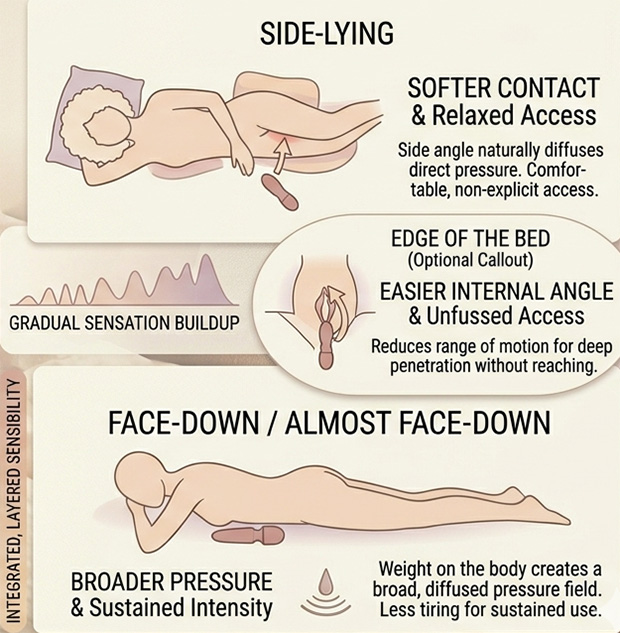
Side-lying is often better when direct contact gets too sharp
Some people do not need more intensity.
They need a different relationship to it.
That is where side-lying shines.
Roll onto your side. Let the top knee come forward a little. Keep the bottom leg long or slightly bent. If your pelvis keeps rolling, put a pillow between the knees. Bring the vibrator in from the front or slightly above instead of straight down.
This changes more than angle.
It changes how force lands.
For a lot of bodies, side-lying takes stimulation that felt too exposed and gives it a layer. Not literal fabric. A body-layer. The contact feels less thin.
That softer side entry is the difference between stimulation that feels usable and stimulation that arrives too exposed. The contact is still clearly clitoral, but it lands more like buffered rather than fully direct clitoral stimulation.
That distinction matters.
Sometimes a vibrator does not feel too strong.
It feels too exact.
Side-lying is especially useful if the first minute feels great and the next minute feels like your clitoris got tired of being singled out. Because your hips are stacked and your legs are not pulled wide, pressure often becomes easier to feather. You can keep the vibrator close without bearing down.
This is also a strong position when you want a slower build instead of a sprint.
It lets pleasure gather.
Not chase.
Half-side recline is the softer version of direct contact
This is the version I would try if flat-on-your-back feels too head-on, but full side-lying feels like too much of a shift.
Roll partly onto one hip and one butt cheek, with your torso still reclined rather than fully on your side. One knee can be bent more than the other. Support your back or outer hip if you keep collapsing.
This small roll changes the approach enough that the toy no longer hits the same place in the same straight-on way.
For some bodies, that is the difference between “too much” and “finally right.”
It is especially useful if one side feels better, if direct contact gets intense too fast, or if you keep backing the toy off because the sensation arrives too hard.
You are not abandoning the spot.
You are approaching it from a kinder angle.
Semi-seated or shallow sit-back is best when you need control
There are moments when lying back is too passive for the kind of adjustment you need.
If you are using a rabbit, an insertable vibrator, or a dual-stimulation toy, being semi-seated often helps more than people expect. Prop yourself up against a headboard, wall, wedge, or firm pillows so your chest is lifted and your pelvis is easy to reach. One or both knees can stay bent. Your legs can be apart, relaxed, or asymmetrical.
This position helps when you need to see what is happening.
That sounds obvious, but it matters. If external contact keeps landing slightly high, or the internal arm of a rabbit never quite sits where you want it, being more upright makes small corrections easier and faster. Your hand approaches from a better angle. Your pelvis can tilt forward or back. Your other hand can join in without everything collapsing.
A shallow sit-back recline is especially good for insertable toys that feel pokey, awkward, or strangely off-angle when you are fully flat. Sometimes lying all the way back makes a curved toy fight your anatomy. A slight recline lets the toy meet your body with less forcing and less wrist drama.
The key is that you are not folding toward the toy.
You are receiving it.
That often makes the whole experience feel less mechanical.
At the edge of the bed fixes a surprising number of internal toy problems
Some internal vibrators are not bad.
They are just being used from a body angle that makes them fight you.
Scoot to the edge of the bed or a firm surface. Let your feet rest on the floor, or keep one foot up and one down. Your hips should feel available, not tucked under. From there, an internal toy often approaches more naturally than it does when you are flat on your back and reaching from above.
This matters most with curved insertables and rabbits.
When your pelvis can tip forward a little, the toy may meet your body with less forcing and less chasing. Depth becomes easier to control. External contact on a rabbit may line up better because the whole toy is not being dragged downward by gravity and a tense hand.
This is a good position if you have ever thought, Why does this toy seem designed for somebody else’s anatomy?
Sometimes the answer is not anatomy.
It is geometry.
Edge-of-bed positioning also works well if you want your free hand available for external touch, lube, or small adjustments without losing the internal angle you just found.
Face-down works when your body wants broader, movement-based contact
This is the position people often discover by accident and then wonder why nobody explained it properly.
Lie face-down or almost face-down. The toy can be under the pelvis, between the thighs, or held so your body weight controls some of the pressure. You are not pressing hard because harder is better. You are letting your body distribute contact more broadly.
For many people, this changes the whole texture of stimulation.
Instead of one exact point being targeted over and over, the vulva gets pressure, vibration, and friction together. The sensation can feel less like tapping a nerve and more like being filled with movement.
It does not feel weaker.
It feels less exposed.
This is a strong option if hand-held stimulation keeps becoming too pinpoint, if you instinctively want to grind rather than hold still, or if your arousal builds better through movement than through static contact.
It can also help if your hand tires out early, because your body starts sharing the job.
One caution: broad pressure is not the same as crushing the toy into yourself. If the feeling gets numb, flatten the pressure, change the angle, or ease off. This position works because it spreads sensation.
Too much force kills that.
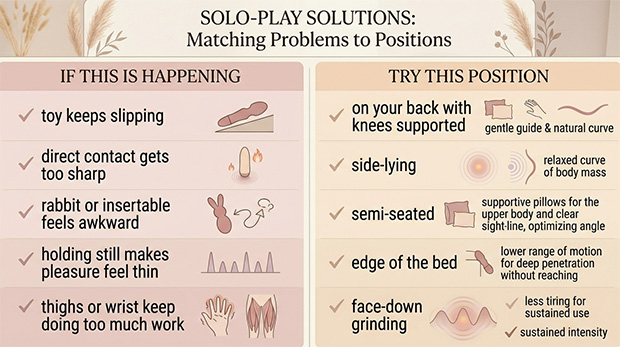
Match the position to the problem, not to the fantasy
This is the part I wish more advice included.
Not a giant menu.
A cleaner match.
If the vibrator feels great for thirty seconds and then too sharp, try side-lying or half-side recline.
If you keep losing the spot and making tiny corrections, try on your back with your knees supported.
If your rabbit or insertable never seems to sit right, try semi-seated, shallow sit-back, or at the edge of the bed.
If holding the toy in one exact place makes pleasure feel thin, try face-down with broader contact and movement.
If your pelvis keeps drifting or your wrist keeps compensating, add support first before you change the toy or the setting.
Those are not personality types.
They are problem-solvers.
What this looks like in real life
Here is where this usually becomes obvious.
You start on your back with a bullet. It works, but your wrist keeps drifting and you keep muttering, “wait, there.” Support your knees more, reduce how much your legs are working, and the spot often stops moving.
You use a clitoral vibrator and get turned on fast, then suddenly everything feels too bright. Roll to your side before you are overstimulated, not after. The same toy may immediately feel more usable.
You keep trying a rabbit flat on the bed and it never seems to hit both places well. Sit up more, use a shallow recline, or move to the edge. The toy may not need replacing.
It may need a different pelvic angle.
You notice you always end up pressing a wand against yourself and rocking anyway. That is not doing it wrong. That is a clue that your body may prefer broader, movement-based contact.
The real preference is not only about toy type. It is about what kind of motion the body can build with once pressure spreads out, which is often what becomes clearer when you compare grinding, rubbing, and tapping.
You are side-lying and the toy keeps meeting you in a slightly different place every time. Put a pillow between the knees and behind your back. Suddenly the whole shape gets quieter, and so does the sensation.
You are flat on your back with no support under the knees. The vibrator feels great for a moment, then too direct, then not direct enough. Add knee support and the pelvis often settles enough that the same toy feels steadier.
A lot of good solo play is just accurate interpretation.
Your body is usually telling you something long before it gives up.
How to test support without turning it into a whole project
You do not need a wedge system or a carefully engineered nest.
Start simple. Test one variable at a time.
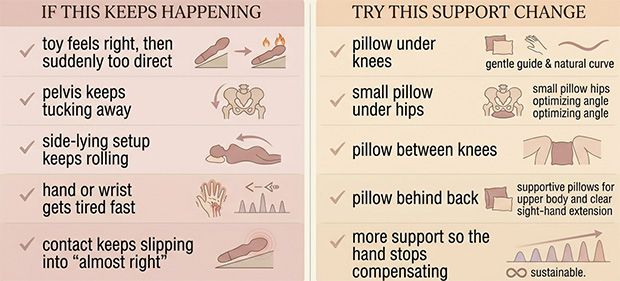
Try one of these:
- under the knees if your lower back feels tight or your pelvis keeps tucking away
- under the hips if you want the toy to sit flatter or reach more easily
- behind the back if you keep collapsing too far backward and losing hand access
- between the knees in side-lying if your pelvis keeps rolling
Give each change a real trial. Not five seconds. Long enough for your body to settle.
Then ask a better question than “Was that hotter?”
Ask:
- Did the contact stay in place more easily?
- Did I stop adjusting so much?
- Did the sensation feel clearer?
- Did my body soften anywhere?
That last question matters.
Sometimes the first sign that support is helping is not more pleasure.
It is less interference.
When a position is wrong, the signs are surprisingly consistent
You do not need to guess forever.
A position is often working against you when:
- your hand is working harder than your pelvis
- the toy keeps slipping into “almost right”
- your thighs, jaw, stomach, or glutes are bracing the whole time
- your wrist is constantly rescuing the angle
- pressing harder makes the sensation thinner, not better
- you feel more busy than turned on
That last one is the one I trust most.
Busy is not the same as engaged.
A position that keeps making you brace, rescue, and correct can leave the whole experience feeling more mechanical than erotic. That is often the quieter physical version of what happens when body tension makes pleasure harder even though the toy itself is fine.
Sometimes the problem is not the position
Positions and support can fix a lot. They can improve steadiness, reduce accidental pressure, and make your body feel less effortful.
They cannot fix pain conditions.
If you keep getting burning, stinging, rawness, involuntary tightening, sharp pain, or deep aching after orgasm, do not treat that like a technique failure. If insertion triggers automatic clenching every time, or soreness lingers well after you stop, it is worth looking beyond positioning.
Support is useful.
It is not magic.
If the setup is good and your body still responds like touch is a threat, that deserves a medical lens. A gynecologist, sexual medicine clinician, or pelvic floor physical therapist can help sort out what is muscular, what is nerve-related, what is hormonal, and what is mechanical.
If your body is saying wrong angle, changing position may help fast.
If your body is saying pain, more persistence is rarely the answer.
The best position is the one that lets the sensation stay true
People often talk about vibrator positions as if they are bedroom poses.
I think that misses the point.
A position is not there to make solo play look a certain way. It is there to let the sensation arrive cleanly enough that your body can actually use it.
That is why the right position can feel oddly emotional. Not because it is dramatic. Because it removes interference. The toy stops slipping. Your body stops bracing. The feeling stops going thin right when it was getting good.
And suddenly the whole experience makes more sense.
Sometimes the most useful thing you can change is not the toy, the speed, or your determination.
It is the shape your body makes around the sensation.
Reviewed Medical and Clinical Sources
- American College of Obstetricians and Gynecologists (ACOG), “Masturbation,” ACOG Women’s Health FAQs.
- National Health Service (NHS), “Anorgasmia (orgasm problems),” NHS.
- Cleveland Clinic, “Pelvic Floor Dysfunction,” Cleveland Clinic.
- Leicestershire Partnership NHS Trust, “Female orgasmic difficulties,” Leicestershire Partnership NHS Trust.
- Cleveland Clinic, “Sexual Response Cycle: Order, Phases & What To Know,” Cleveland Clinic.
- NHS, “Vulvodynia (vulval pain),” NHS.
- NHS, “Vaginismus,” NHS.
- Greater Manchester Mental Health NHS Foundation Trust, “Tackling pain and difficulty with penetrative sex,” Greater Manchester Mental Health NHS Foundation Trust.
Add comment