

 Amie Dawson, Ph.D.
You can be doing everything “right” and still feel the whole thing go strangely flat.
The toy is on the right spot. The pressure should work. You can feel that something is there. But your stomach is tight, your thighs are working, your jaw is clenched, your hand is hovering like it has to perform, and the more you try to hold onto the feeling, the less alive it gets.
I do not think this gets named often enough.
Sometimes the problem is not that your body needs more stimulation. It is that your body is gripping the experience so hard that sensation has less room to move.
Sometimes pleasure is not missing. It is crowded out by effort.
A lot of people picture orgasm problems as a shortage. Not enough touch. Not enough power. Not enough arousal. Not enough skill.
Sometimes that is true.
But sometimes the touch is fine and the body around the touch is the problem. Your breath gets shallow. Your belly hardens. Your glutes squeeze. Your legs brace as if they are helping, even when they are mostly adding noise.
As MedlinePlus explains, sexual response depends on the mind and body working together. Mayo Clinic says something similar in broader terms: arousal and satisfaction are shaped by body, feelings, life stress, beliefs, and relationship context, not one isolated switch.
That matters here because a braced body is doing two jobs at once. It is trying to feel pleasure, and it is trying to control the experience.
Those jobs do not always cooperate.
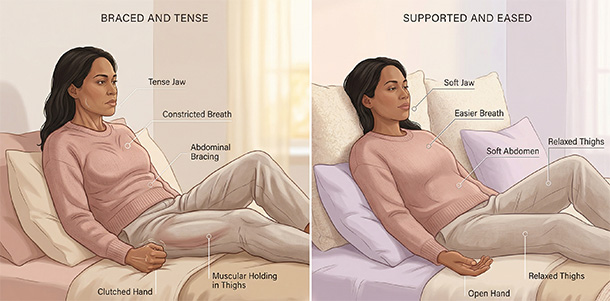
The clench does not always feel like stress
This is why the problem can be hard to spot.
For a lot of people, tension does not feel like panic. It feels like concentration. It feels like “almost there.” It feels like trying to stay locked onto the right angle before it disappears.
You press harder. You squeeze your legs tighter. You stop moving because moving might break it. You hold your breath for three seconds, then five, then longer than you realized.
At first, that can even seem helpful. More squeeze can mean more pressure. More stillness can make a sensation feel more pinned down. For a moment, the whole thing gets sharper.
Then it starts to cost you.
The problem is not that the toy got weaker. Your body got busier.
That busy feeling is often where pleasure starts slipping into management. The body may still be responsive, but performance pressure starts crowding out sensation long before anyone would call it panic.
What was helping the sensation feel focused starts making it feel trapped. It does not feel smaller. It feels less movable.
That difference matters.
A lot of people are not under-stimulated in that moment.
They are over-holding.
Your pelvic floor is part of this, even when you are not thinking about it
When I talk about body tension, I do not just mean shoulders and thighs. I also mean the muscles at the base of the pelvis.
Those muscles help support bladder, bowel, and sexual function. When they stay too tight and do not relax well, that can show up as pelvic pain, pain during or after sex, urinary or bowel symptoms, and difficulty reaching orgasm. The Cleveland Clinic’s overview of hypertonic pelvic floor describes exactly that pattern, and a 2021 review indexed in PubMed found that women with overactive pelvic floor symptoms report lower arousal and satisfaction and more difficulty reaching orgasm.
This does not mean every orgasm struggle is a pelvic floor disorder.
It does mean the pelvis is not just passive scenery while pleasure happens somewhere else.
If your body is clenching through stimulation, the pelvic floor may be joining that clench. Sometimes subtly. Sometimes enough that the body starts reading intense sensation as something to guard against instead of something to open into.
And once guarding enters the picture, pleasure often gets thinner, sharper, or more fragile.
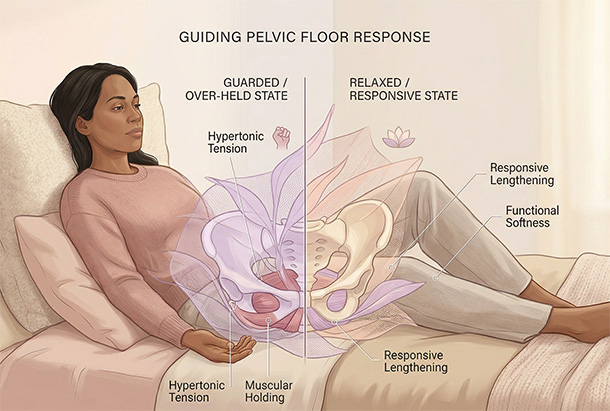
What this looks like in real life
Sometimes readers know this instantly once they see it on the page.
You are using a vibrator and it starts well. Then the feeling begins to drift. Instead of changing the angle or softening the rest of your body, you pin the toy harder into the same place. Your abs tighten. Your toes curl. Ten seconds later, it feels duller, so you increase the power again.
You are not losing the spot.
You are losing space.
Or maybe you can only get close when your thighs are squeezed together so hard that the whole sensation feels narrow and urgent. It works, but only inside a very small window. The second you soften your legs, shift your hips, or breathe more fully, the build collapses. What looked like “my body only likes it this way” is sometimes “my body only knows how to hold onto it this way.”
That is the whole trap. The build can seem to depend on a very narrow kind of gripping because the moment the body softens, it loses the line of it, which is often what people are feeling when they get close to orgasm and then lose it.
There is another version people often miss because they think it belongs in a different category. You reach for penetration with a finger or toy, and your whole pelvis flinches before you have consciously decided anything. When tightening happens on attempted insertion and feels automatic, it may be more than nervousness. NHS guidance on vaginismus describes the vaginal muscles tightening on their own, sometimes causing burning or stinging pain, and an AAFP clinical review lists pelvic floor dysfunction and vaginismus among real causes of sexual pain.
This is why “just relax” is such useless advice.
Some tension is chosen. Some is learned. Some is automatic. Some is pain prevention. Some is habit.
All of it feels physical.
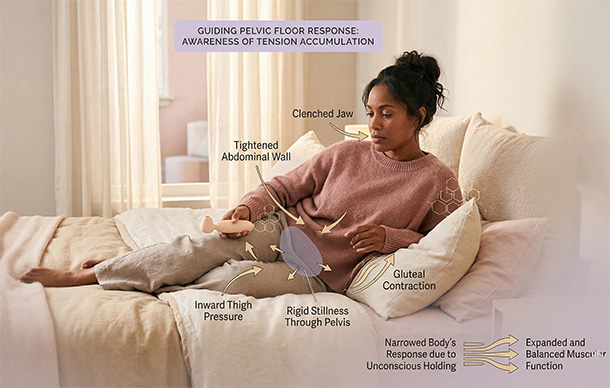
The answer is not to go limp. It is to stop wasting effort.
I am not telling you to melt into the mattress and become passive.
A lot of bodies like firm pressure. A lot of people orgasm with strong leg tension, pelvic engagement, or a very deliberate kind of stillness. The point is not to erase effort. The point is to notice when effort has stopped helping.
What usually works better is not less sensation.
It is cleaner sensation.
Sometimes the sensation is not failing because it is too weak. It is failing because effort has made it too concentrated and too defended to build with, which is often the turn people are describing when clitoral stimulation starts feeling too intense even though the setup has not changed much.
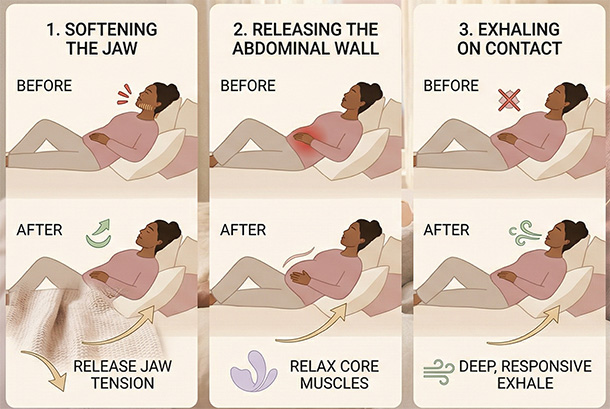
Here are the body changes I would test first:
- Let one area soften before you increase intensity. Jaw, belly, toes, glutes. Pick one. You do not need a full-body reset to change the experience.
- Exhale when you make contact or add pressure. Not later. Right then. It interrupts the reflex to brace.
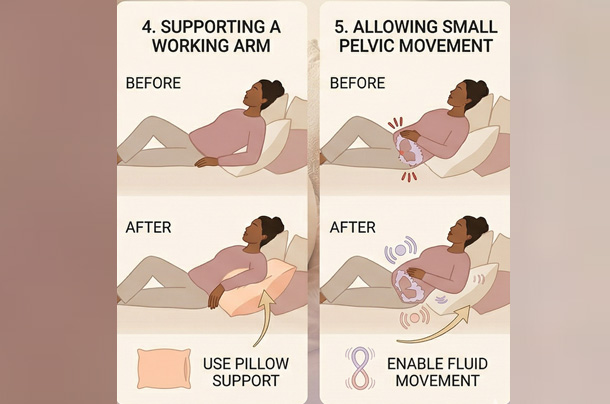
- Support the body part that is working. If your wrist, shoulder, hips, or thighs are hovering, they are spending energy you could be feeling.
- Back off by 10%, not 50%. Sometimes what feels like needing more intensity is really needing less effort around the same intensity.
- Let the pelvis move a little. Tiny movement often brings sensation back when rigid stillness has made it feel pinned and thin.
What I want readers to hear is this: softer does not always mean better, but supported usually does.
That difference matters more than people think. A body that is not hovering and compensating so hard can often keep the signal steadier, which is why better support and positioning can change the whole feel of a session without changing the toy at all.
That is a different thing.
When tension is a clue, not just a technique issue
If body tension shows up occasionally, this may just be a mechanics problem. You may need better support, more breath, less hovering, less urgency.
If it keeps showing up with pain, burning, stinging, aching after sex, trouble inserting a finger, toy, or tampon, or bladder and bowel symptoms, I would treat that as a health clue, not a personal failing. The Cleveland Clinic notes that hypertonic pelvic floor can affect sex, urination, bowel movements, and orgasm, while the AAFP review points to pelvic floor dysfunction as one of the real conditions clinicians assess when sex is painful.
That does not mean something is seriously wrong.
It means the body may need care, not more force.
And if attempted penetration makes your muscles tighten on their own, that automatic reaction deserves to be taken seriously. NHS guidance is very clear that this kind of tightening can happen outside conscious control and can be treated.
The more useful question
A lot of people ask, “What else should I do?”
Sometimes that is the wrong question.
A more useful one is: What am I holding right now?
My breath. My thighs. My stomach. My jaw. My urgency. My need to make this work before the feeling disappears.
Because pleasure is not only about adding the right thing.
Sometimes it gets better when the body stops treating sensation like something it has to brace for.
That is often the more useful read. The body is not always asking for more stimulation. Sometimes it is asking for a kind of contact that feels less abrupt and less defended against.
The body is not always asking for more.
Sometimes it is asking for less to carry.
Reviewed medical and clinical sources
- MedlinePlus. Orgasmic dysfunction in women. U.S. National Library of Medicine / MedlinePlus.
- Mayo Clinic Staff. Female sexual dysfunction: Symptoms and causes. Mayo Clinic.
- Cleveland Clinic. Hypertonic Pelvic Floor: Symptoms, Causes & Treatment. Cleveland Clinic.
- Padoa A, McLean L, Morin M, Vandyken C. “The Overactive Pelvic Floor (OPF) and Sexual Dysfunction” Part 1: Pathophysiology of OPF and Its Impact on the Sexual Response. Sexual Medicine Reviews. Indexed via PubMed.
- Hill DA, Taylor CA. Dyspareunia in Women. American Family Physician. American Academy of Family Physicians.
- NHS. Vaginismus. National Health Service.
Add comment