

 Amie Dawson, Ph.D.
Why Performance Pressure Kills Pleasure
You can be turned on and still feel like you are taking a test.
Part of you is inside the moment. The other part is tracking time, checking progress, wondering whether this should have happened already. You notice the angle. You correct the pressure. You try to stay relaxed. Then you notice that you are trying to stay relaxed, which makes you work even harder.
That split is where pleasure starts to thin out.
I do not think wanting orgasm is the problem. Wanting it is normal. Focusing on pleasure, taking your time, learning your body, being determined to figure things out, none of that is wrong. The backfire happens later, when effort stops being helpful and turns into supervision.
At that point, you are still in the experience.
But now you are also standing next to it with a clipboard.
When pleasure becomes proof
I think of performance pressure as the moment pleasure stops being an experience and starts being proof.
Proof that your body works. Proof that your partner is good in bed. Proof that the toy was worth it. Proof that you are attracted enough, responsive enough, relaxed enough, normal enough.
That is why this is not just a partner-sex problem, and not just an orgasm problem. It can happen during solo play too, the second your body starts feeling like something you need to make happen on command.
The pressure can be obvious.
I need to come.
Often it is quieter than that.
This usually works. Why is it not working now?
I should be closer by now.
They are trying so hard. I do not want them to feel bad.
What is wrong with me tonight?
That is the trap.
The second you start grading the experience, you stop fully having it.
For a lot of people, that is the whole shift. The body can still be turned on, but attention keeps stepping outside the sensation, which is often the quieter reason it gets hard to orgasm when you’re distracted.
Your mind can be in the room while your attention leaves your body
Arousal usually needs immersion.
Not perfect technique. Not constant correction. Immersion.
Pleasure does not like being watched over your own shoulder. Once your attention keeps leaving sensation to ask, Am I close? Is this working? Should I go harder? Should I change the angle? Why did that feel weaker?, the experience often gets thinner. Not gone. Just thinner. Less whole. Less absorbing.
The touch may not even change much.
Your relationship to the touch does.
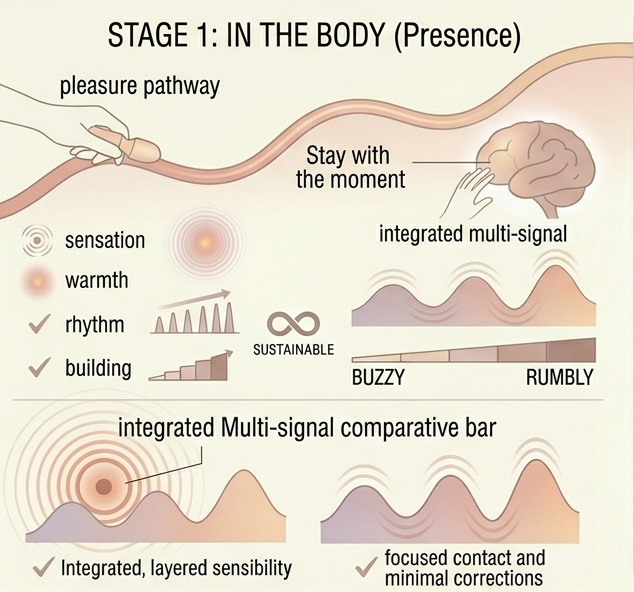
You may still be turned on. You may still be wet, sensitive, mentally engaged. But the part of you that was sinking into the feeling has been replaced by a part that is monitoring performance.
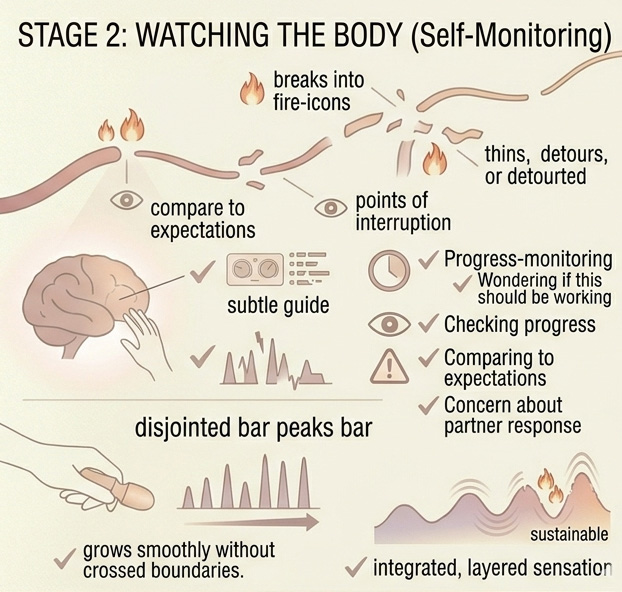
That is why people can say, very honestly, “It felt good, but I could not get there.”
Not numb. Not disconnected.
Just never fully dropped into it.
Pressure often arrives disguised as love
Performance pressure is not always ego.
A lot of the time, it is caretaking.
You want your partner to feel wanted. You do not want them to think they are bad at this. You do not want the moment to turn into a postmortem. So instead of staying with your own sensations, you start managing the emotional climate in the room.
That management costs something.
You begin editing your reactions. Maybe you exaggerate how close you are. Maybe you keep going past the point where your body wanted a change. Maybe you say “almost” because it feels kinder than saying “not like this.”
Now you are doing two jobs at once: trying to feel pleasure and trying to protect someone from what your body is doing.
Those jobs do not mix well.
This is also why constant check-ins can backfire. “Are you close?” “Did that do it?” “Do you want me to go faster?” The questions are kind. The effect is not always kind. Every status check can pull you out of sensation and back into reporting mode.
Trying harder does not always look intense
Sometimes trying harder looks obvious. Faster. Harder. More pressure. More urgency.
Just as often, it looks careful.
It looks like changing positions too soon because the last twenty seconds were not “progressive” enough. It looks like increasing toy power every time sensation levels out for a moment. It looks like silently grading yourself for how aroused you should be by now. It looks like trying to engineer the perfect orgasm instead of staying with a pretty good feeling long enough for it to deepen.
That is why this pattern is easy to miss.
It often feels responsible. Attentive. Smart.
But arousal is not always helped by smarter management. Sometimes it is flattened by it.
Bodies are not machines with one reliable setting. One slow night is not a verdict. One plateau is not a defect report. One missed orgasm is not evidence that something is broken.
Performance pressure hates that reality.
It treats normal variation like failure.
What this looks like in actual life
Picture solo play with a toy that usually works. You start with confidence. A few minutes pass. You are enjoying it, but you are not as close as you expected. Instead of staying steady, you begin making executive decisions. Harder. Faster. Stronger setting. Different angle. Less patience. More judgment. Soon the whole thing feels like troubleshooting.
Or picture partnered sex where you start giving very detailed live corrections. There is nothing wrong with communication. Sometimes it is exactly what helps. But there is a difference between guidance and rescue. “A little more to the left” is guidance. Trying to solve the whole orgasm in real time because you can feel yourself losing confidence is rescue.
Another version is even quieter. You get close, notice that you are close, and immediately tighten around the goal. Okay, this is it. Do not lose it. Keep going. No, exactly like that. Then the sensation slips.
Not because you failed.
That is often the exact point where almost-orgasm turns into lost orgasm. The build did not disappear for no reason. It got interrupted by the moment you started supervising it, which is the same pattern behind getting close to orgasm and then losing it.
Because the moment became an assignment.
And then there is the shadow audience version. You had trouble orgasming before. Maybe after stress. Maybe with a past partner. Maybe after a medication change. Now every sexual experience contains an invisible panel of old disappointments. You are not just having this moment. You are also trying to redeem the last ten.
That is a heavy thing to ask of your nervous system.
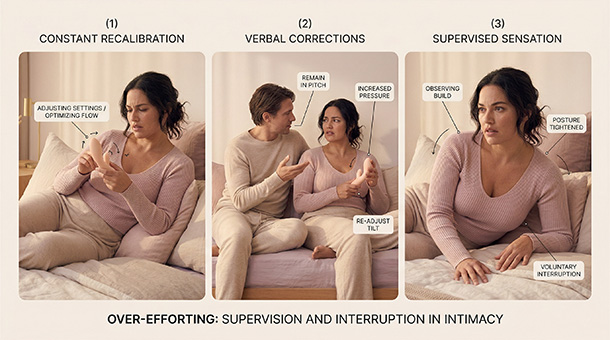
A few signs performance pressure is running the show:
- You stop asking, “Does this feel good?” and start asking, “Is this enough?”
- You keep switching technique before your body has had time to settle into one sensation.
- You treat every lull or plateau like proof something is going wrong.
- You start performing closeness instead of feeling it.
- You escalate automatically, even when the current level still feels good.
- Relief would feel almost as good as orgasm.
That last one catches a lot of people.
Sometimes the biggest sign of pressure is not desperation for pleasure. It is desperation for the moment to be over.
The way out is not more effort but less evaluation
I hate “just relax” as advice.
It is vague. It is patronizing. And when someone already feels stuck, it gives them one more thing to fail at.
What helps is not passivity.
It is reducing interference.
The goal is not to manufacture the perfect response. It is to make it easier for sensation to become the main event again. That usually means lowering the sense of consequence. Not forcing yourself to care less. Making the moment less loaded.
A few shifts help.
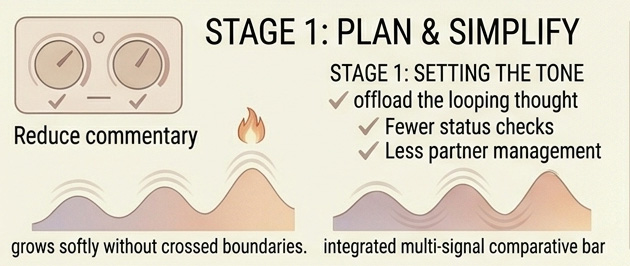
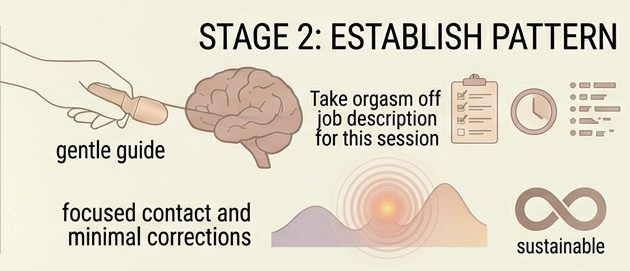
First, reduce commentary. If you are with a partner, fewer status checks. More steadiness. Less surveillance dressed up as support.
Second, remove orgasm as the proof of success for that session. Not forever. Just for now. A sexual experience can still be erotic, connected, relieving, satisfying, and worth having without ending in climax.
For some people, that is the first moment the body stops treating the whole session like a pass-fail event. Pleasure often gets easier once you start exploring it without turning it into a test.
Third, start with what feels familiar, not what feels ambitious. Pressure loves novelty when novelty can function as a rescue mission. Usually that backfires.
Fourth, say the real thing sooner. “I want less talking and more steadiness.” “Do not check if I am close.” “I need this to feel like exploration, not like a goal.” Clear language cuts guesswork, and guesswork feeds pressure.
Fifth, make the goal smaller for a while. Not have an orgasm. Not even get close. Just stay with one genuinely good sensation long enough to see what happens when you do not keep evaluating it.
That could mean ninety seconds of no changes.
That could mean one pressure level and no negotiation every ten seconds.
That could mean replacing Am I close? with Is this still pleasant enough to continue?
Small shift. Big difference.
The body often responds better when it is allowed to continue than when it is constantly asked to prove it is continuing.
Sometimes pressure is only part of the story
Pressure is real.
It is not the only explanation.
If orgasm suddenly became much harder, or pleasure changed in a way that feels new and persistent, zoom out. Sometimes the bigger issue is pain. Or dryness. Or pelvic floor tension. Or medication effects. Or menopause-related changes. Or depression. Or anxiety. Or trauma. Or a relationship problem. Or a body issue that has nothing to do with mindset.
So if you are dealing with pain, marked numbness, dryness, a major shift after starting a medication, or a change that arrived out of nowhere and stayed, do not force yourself to solve it with psychology alone.
Sometimes trying less will not fix it, because effort was never the real problem.
When the issue is physical rather than evaluative, pushing through usually only adds more guarding. That is often the layer underneath sessions where body tension makes pleasure harder even though desire is still there.
That is not failure.
It is context.
A different way to think about orgasm
I would stop treating orgasm like a verdict.
That frame poisons a lot of otherwise good experiences.
Orgasm is not a gold star for doing stimulation correctly. It is not proof that your partner succeeded. It is not proof that your desire was real enough or your body was cooperative enough.
It is a response.
You can support a response. You can make room for it. You can learn the conditions that help it happen more often.
But the moment pleasure becomes a performance review, the room gets tighter. Your mind gets louder. Your body gets less willing to let go.
Pleasure is more like sleep than like a sprint.
You can invite it. You can support it. You cannot bully it into arriving on schedule.
And orgasm is not a report card.
It is what sometimes happens when your body no longer feels watched.
The better question
A lot of people approach orgasm like a locked door: more effort, better odds.
Sometimes that works. Often, at first, it does.
But orgasm is not always a door you force open. Very often, it is something you stop interrupting.
So this is the question I would keep:
Not How do I make my body do this?
But At what point do I leave the feeling and start supervising it?
Because that moment is usually the pivot.
And once you can recognize it, you can change it.
Reviewed medical and clinical sources
- Cleveland Clinic, “How To Overcome Sexual Performance Anxiety,” Cleveland Clinic Health Essentials.
- MSD Manual Professional Edition, “Overview of Female Sexual Function and Dysfunction,” MSD Manual.
- Mayo Clinic Staff, “Anorgasmia in Women: Symptoms and Causes,” Mayo Clinic.
- MedlinePlus Medical Encyclopedia, “Orgasmic Dysfunction in Women,” U.S. National Library of Medicine / MedlinePlus.
- Brotto LA, Atallah S, Carvalho J, Gordon E, Pascoal PM, Reda M, Stephenson KR, Tavares I, “Psychological and Interpersonal Dimensions of Sexual Function and Dysfunction: Recommendations From the Fifth International Consultation on Sexual Medicine (ICSM 2024),” Sexual Medicine Reviews.
- Çuvadar A, Özcan H, “The Effect of Mindfulness-Based Cognitive Therapies on Sexual Function, Sexual Distress, and Depression in Women: A Meta-Analysis Study,” Journal of Sex & Marital Therapy / PMC.
Add comment