

 Amie Dawson, Ph.D.
You start touching yourself, and within a minute there is already a scoreboard in the room.
Not a real one. The mental kind.
Is this working? Am I close? Why did that feel better last week? Should I switch? Should I push harder? Shouldn’t I be further along by now?
That is the moment pleasure quietly stops being an experience and starts becoming an evaluation.
I think this happens to a lot of smart people for one simple reason: once you care about understanding your body, it gets very easy to slip from listening to it into auditing it. You are no longer inside the sensation. You are standing outside it, checking whether it is progressing correctly.
And arousal does not like being audited.
For a lot of people, that auditing is the exact moment pleasure starts turning into a performance problem. The body may still be responsive, but performance pressure starts crowding out sensation before anything looks obviously wrong from the outside.
A test wants proof. Pleasure gives feedback.
I want to make one distinction early, because it matters.
There is nothing wrong with being intentional. There is nothing wrong with wanting orgasm. There is nothing wrong with trying to learn what works for your body. The problem is not structure.
The problem is pass-fail thinking.
A test assumes there is one right move, one correct pace, one expected timeline, and one outcome that proves the session worked. Real pleasure is looser than that. It gives signals, shifts, openings, plateaus, surges, turn-offs, surprises. It is not random. But it is not obedient either.
A test asks, Did I get the result?
Pleasure asks, What changed when I did that?
Those are not the same question.
The difference matters because test mode makes you impatient with information that is not dramatic enough. A softer response feels like no response. A pause feels like regression. A promising sensation that does not lead straight to orgasm feels like wasted time.
It is not wasted.
It is feedback your body is already giving you.
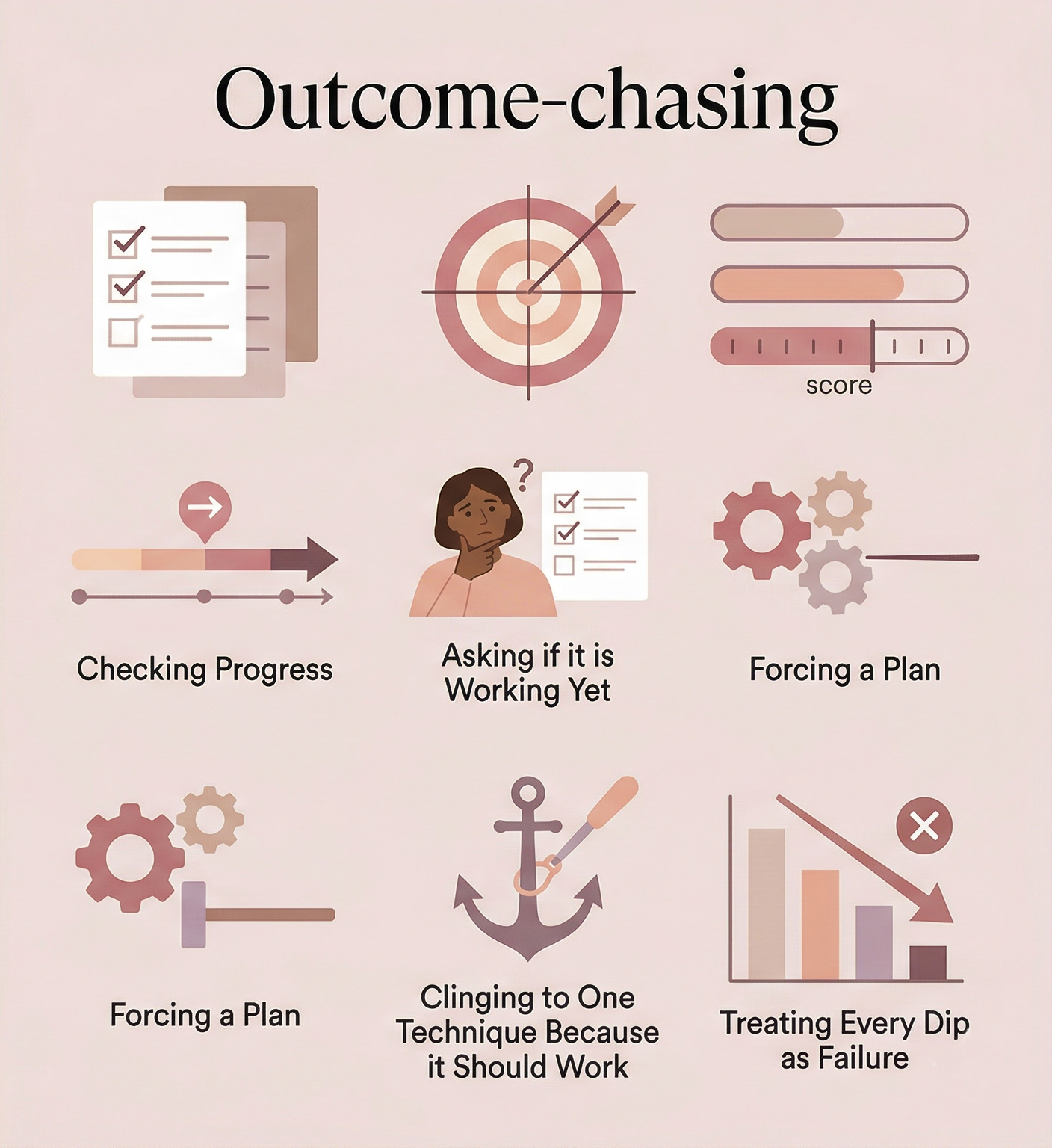
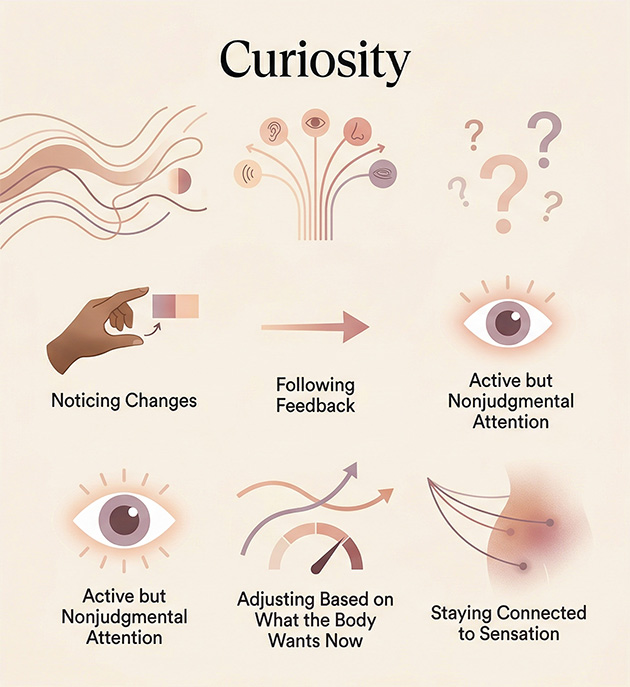
The moment you start grading the session, you leave the session
You can feel this shift in real time.
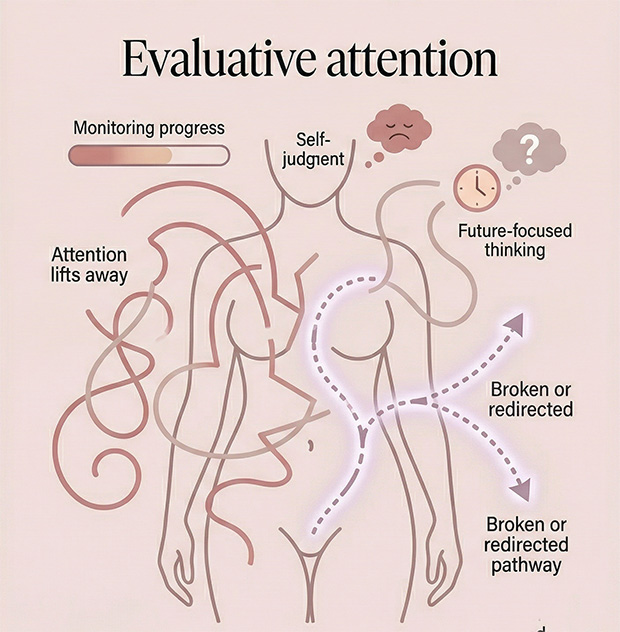
The touch has not necessarily changed. The setting has not necessarily changed. But your attention has. Instead of following sensation, you are now supervising it. Instead of letting pleasure build, you are checking whether it is building fast enough.
That is why a session can start warm and alive, then suddenly feel flat, effortful, or strangely thin.
Not because your body failed.
Because your mind stepped in with a clipboard.
This is the part a lot of people miss. The experience can still feel good on some level. You may still be aroused. You may still be engaged. But once your attention keeps jumping from sensation to evaluation, pleasure often stops deepening the way it was about to.
You are still in the moment.
But now you are also monitoring it from above.
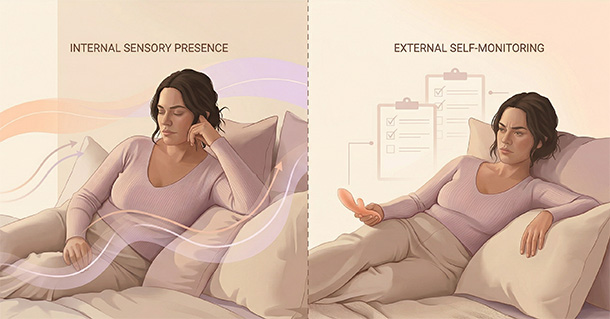
Your body is not giving the same answer every minute
A test mindset only works if the system being tested is stable.
Bodies are not.
What feels good early can feel too direct later. What felt vague at first can suddenly become exactly right. The same pressure, same toy, same angle, same hand can land differently once arousal shifts.
That does not mean you lost the right spot.
It means the body changed under your hand.
This is one of the most important things readers can learn: a changing response is not an unreliable response. It is a responsive one.
The body that wants steady pressure early may want lighter contact later. The body that liked motion may suddenly want stillness. The body that liked direct touch may need fabric, a hand buffer, or a wider contact area once sensitivity climbs.
It is not inconsistent.
It is alive.
Test mode hates that reality. It wants steady output and clean proof. So the second the response changes, it starts asking whether something is going wrong.
Often nothing is going wrong.
Your body is just no longer asking the same question it was asking three minutes ago.
That is often the moment people assume they lost the right move, when what really changed was the stage of arousal. The body may still want the same general area, but a different rhythm or pressure than it wanted a minute ago.
Why curiosity works better than chasing an outcome
This is the cleanest reframe I know.
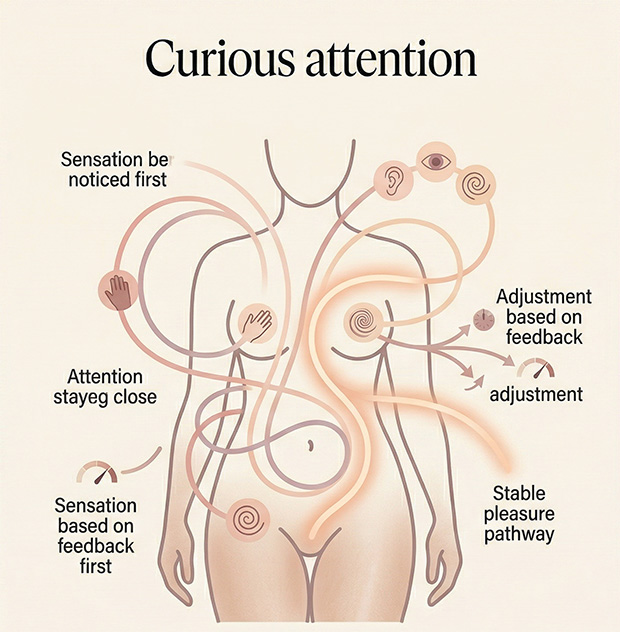
Curiosity keeps you in the experience.
Outcome-chasing pulls you out of it.
Chasing an outcome makes you check too early. Is it building? Am I getting there? Should I speed up? Should I stay exactly here? How long has it been? The moment those questions take over, one part of you is still touching, moving, breathing. The other part is hovering above the experience, judging it in real time.
Curiosity sounds different.
What happens if I stay here a little longer?
Does my body want more pressure or more buffer?
Is this getting fuller, flatter, or thinner?
Do I want to continue, pause, soften, or widen the contact?
Curiosity does not remove intention. It gives intention a better job.
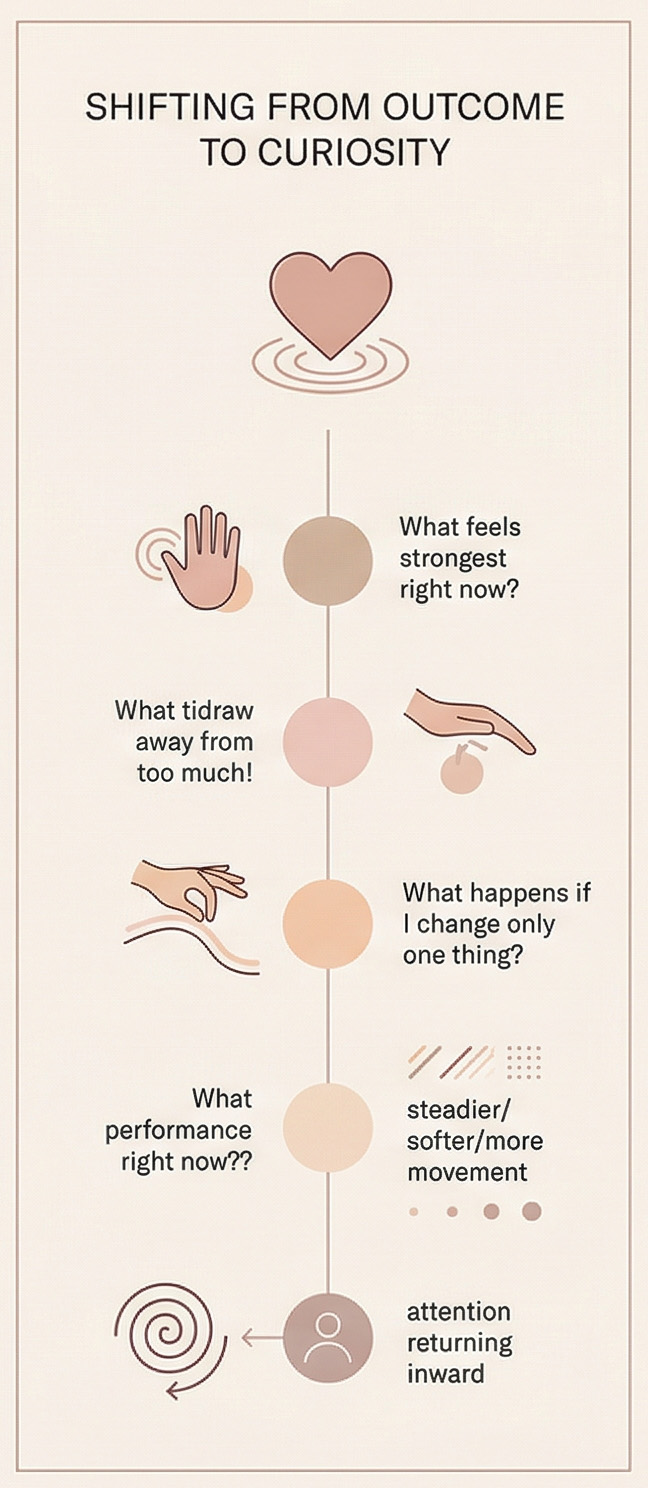
Instead of demanding a result, it follows a pattern. Instead of trying to force the moment to prove itself, it lets the moment reveal something.
That is why curiosity is often more useful than effort. It keeps your attention inside the body long enough for the body to answer honestly.
What test mode looks like in real life
Sometimes this pattern is obvious. More often, it is quiet.
You use a vibrator and move to the strongest setting too early because you want a clearer result. Then your vulva starts feeling muted, over-alert, or vaguely irritated, and you assume your body is hard to please.
You try fingers, feel something promising, and then abandon it after fifteen seconds because it has not proven itself yet. So you never stay with one sensation long enough to learn its arc.
You are with a partner and half your attention is outside your body, monitoring whether you seem responsive enough, whether orgasm should be happening by now, whether changing angles will look awkward, whether the whole thing is becoming disappointing.
You keep correcting.
You keep chasing.
You keep checking.
And the checking becomes the main event.
Once that happens, the experience can still feel good and still keep failing to deepen. That is often the quieter version of what happens when orgasm gets interrupted by distraction, even though the distraction is coming from your own running commentary.
One of the cruelest parts of this pattern is that it can make decent pleasure feel like failure. You may have had warmth, engagement, arousal, useful information, even real enjoyment. But because there was no dramatic endpoint, the whole experience gets filed as didn’t work.
That is test logic.
Not body logic.
You do not need less intention. You need a different kind.
The answer is not to become vague, passive, or endlessly go with the flow. Most people need more clarity than that, not less.
What helps is structure without a grade.
Try building an exploration session around one question only. Not five. One.
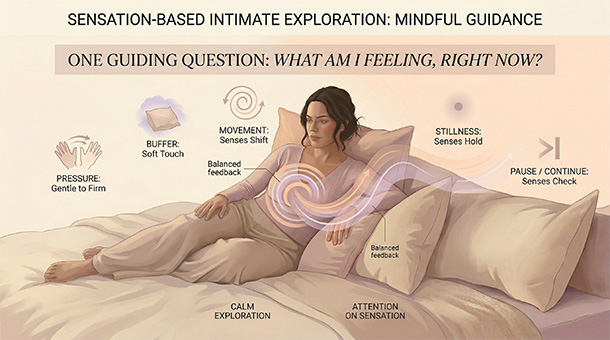
Maybe the question is whether lighter pressure helps you stay aroused longer. Maybe it is whether a hand over underwear feels better than direct contact tonight. Maybe it is whether stillness builds more than rubbing when you are already very turned on.
That gives you direction without turning the whole session into an exam.
Then replace result questions with sensation questions:
- Does my body want more pressure or more buffer?
- Does this feel better with movement or stillness?
- Is the sensation getting fuller, flatter, or thinner?
- Do I want to continue, pause, or soften?
- Does this feel promising enough to stay with a little longer?
Notice what these questions do. They keep you inside the body. They do not demand proof. They invite response.
That is the shift.
Not less attention.
Better attention.
A useful session can end with more clarity, not more climax
I think this matters especially for people who have spent months or years feeling like they should know by now.
That belief creates a strange urgency. Every session has to justify itself. Every toy has to deliver a verdict. Every promising sensation has to turn into orgasm or it gets dismissed.
But pleasure skills usually do not build that way.
They build through pattern recognition. Through noticing. Through enough repetition that the body stops feeling like a problem to solve and starts feeling legible.
A good exploration session does not need to end with orgasm to be successful.
Sometimes success is much simpler than that.
You learned that broad pressure keeps you engaged longer.
You learned that direct contact is good for twenty seconds and then turns too sharp.
You learned that your body opens when you stop switching techniques every few breaths.
You learned that once you start chasing the result, the sensation starts thinning out.
That is not a consolation prize.
That is how sexual fluency is built.
It usually does not come from pushing harder for a clearer result. It comes from noticing patterns often enough that what kind of stimulation you like stops feeling mysterious and starts feeling readable.
You are not trying to prove your body can respond.
You are trying to notice how it responds today.
When to stop troubleshooting alone
Not every difficulty around pleasure is a mindset problem.
Sometimes the issue is pain. Or dryness. Or pelvic floor tension. Or medication effects. Or menopause-related changes. Or trauma. Or depression. Or a sudden shift in sensation that has nothing to do with attention style.
That means it is worth getting real support when:
- pleasure suddenly changes in a way that feels new and persistent
- touch becomes painful, sharply aversive, or distressing
- orgasm becomes much harder after a medication, illness, surgery, postpartum change, or menopause transition
- you notice fear, shutdown, pelvic tightening, or trauma-related reactions showing up consistently
Needing help does not mean you failed the lesson.
It means this may not be a lesson problem.
Sometimes the most self-respecting move is to stop privately optimizing and let a good clinician help you sort out what is actually going on.
The real shift
A test is built to produce certainty.
Bodies rarely do that on command.
What they can give you is something better: language. Not verbal language. Sensation language. The kind you learn slowly, until you can tell the difference between numb and overwhelmed, between softer and less effective, between not aroused yet and not liking this at all.
That is the shift I would want any reader to leave with.
Not, How do I make myself pass?
But, How do I become easier for myself to read?
Because once pleasure stops being a verdict, it becomes much easier to hear.
Reviewed medical and clinical sources
- Mayo Clinic Staff, “Anorgasmia in women: Symptoms and causes,” Mayo Clinic.
- Cleveland Clinic, “Sexual Response Cycle: Order, Phases & What To Know,” Cleveland Clinic.
- MedlinePlus Medical Encyclopedia, “Orgasmic dysfunction in women,” U.S. National Library of Medicine / MedlinePlus.
- Stanley E. Althof, “Psychological and interpersonal dimensions of sexual function and dysfunction in women: An update,” Translational Andrology and Urology.
- David L. Rowland and Gene Moyle, “Remediation Strategies for Performance Anxiety across Sex, Sport and Stage: Identifying Common Approaches and a Unified Cognitive Model,” International Journal of Environmental Research and Public Health.
- Richa Sood, Carol L. Kuhle, Stephanie S. Faubion, et al., “Association of mindfulness with female sexual dysfunction,” Sexual Medicine.
- Parish SJ, Hahn SR, Goldstein SW, et al., “Process of Care for the Identification of Sexual Concerns and Problems in Women,” Mayo Clinic Proceedings / International Society for the Study of Women’s Sexual Health (ISSWSH).
Add comment