

 Amie Dawson, Ph.D.
You start with something that feels promising.
Then, because it seems to be working, you keep doing it. Same spot. Same speed. Usually a little harder. Usually a little faster.
And then the feeling slips.
Not because you lost the right area. Not because your body suddenly stopped cooperating. Often, it is because the move that worked sixty seconds ago is no longer the move your body wants now.
A good pattern can fail simply because it outlived its moment.
Your body does not want one fixed setting from start to finish
This is the part a lot of people never get told.
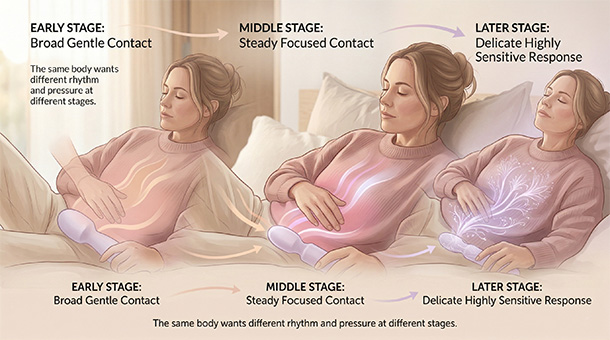
Arousal changes what your body can use.
The contact that feels grounding at the beginning may feel too blunt later. The rhythm that feels exciting early may start scattering the build once you are closer. The pressure that finally made the sensation readable can become too much once the tissue gets more sensitive.
So when people say, “I found the right move, then lost it,” I usually do not think they imagined it.
I think the move was right for that phase.
Then the phase changed.
That is why “I found something good, so I should intensify it” backfires so often. Early on, the body may need help noticing sensation. Later, it may need help holding sensation. Those are not the same job.
Pleasure often drops not when you miss the spot, but when you outpace your own arousal.
Rhythm usually needs attention before pressure does
When progress slows down, most people change the wrong thing first.
They press harder.
They speed up.
They add more flourish, more range, more drama.
Very often, rhythm was the real issue.
Once your body starts organizing around a sensation, predictability matters. Not boring predictability. Stable predictability. Something your nervous system can keep following without having to reorient every few seconds.
So if a pattern feels good but not quite enough, the first question is usually not, Should I add more?
It is, Should I make this steadier?
That can mean:
- slower circles instead of quick ones
- shorter strokes instead of wider ones
- less variation, not more
- repeating the same rhythm cleanly instead of improvising every few seconds
Sometimes the body is not asking for intensity.
It is asking for a pattern it can trust.
For a lot of people, that is the whole shift. The body is not waiting for more excitement. It is waiting for a stimulation pattern it can actually keep following long enough to build.

Pressure works better as a sequence than as a constant
Pressure is not just about how much force feels good.
It is about when that force arrives.
Too much pressure too early can feel like being pressed before the body has somewhere to put the sensation. The contact registers, but it does not spread. It can feel blunt. Or irritating. Or weirdly dead.
Later, a little more pressure can help because it anchors the touch. It stops the sensation from skittering across the surface. It gives the body something to build against.
Then, near orgasm, the story can split.
Some people need the pressure to stay exactly the same. Others need it backed off slightly, because the clitoris has become so sensitive that harder stops feeling useful and starts feeling too bright, too sharp, or too concentrated.
That is why “harder” is such an unreliable final move.
It does not always fail because it is too much.
Sometimes it fails because it is too late.
By that point, more pressure can stop feeling helpful and start feeling too exposed for the stage of arousal you are already in. That is often the turn people are describing when clitoral stimulation suddenly feels too intense even though the session had been working a moment earlier.
The problem is often not what you are doing, but what you do next
This is the distinction that makes the whole article work.
You may already be using the right area. The right toy. The right general technique.
But your body may now want a different next step.
Not a full reset.
Not a brand-new method.
Just a cleaner adjustment.
A lot of bad mid-build decisions happen because people think the answer has to be bigger. In reality, the best adjustment is often smaller:
- same area, steadier rhythm
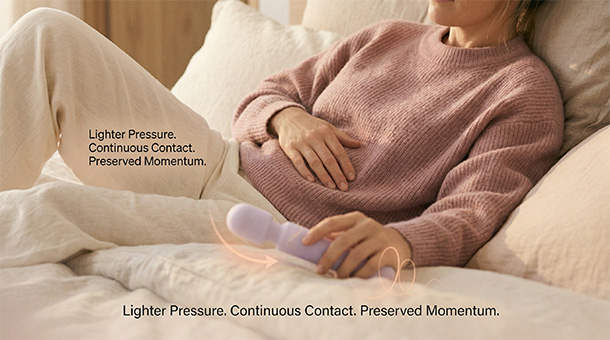
- same rhythm, lighter pressure
- same contact point, shorter movement
- same pressure, less direct angle
- same build, smaller correction
You are not trying to reinvent the session.
You are trying not to interrupt it.
What this looks like in real life
You get close, then lose it the second you speed up
This is one of the most common patterns.
You feel the build. You panic a little. You start moving faster because faster seems like the obvious route to orgasm.
Then the sensation scatters.
That is often what “losing it” feels like in practice. The build did not disappear for no reason. It got interrupted right at the point where the body needed continuity more than escalation.
What usually works better here is not acceleration. It is commitment.
Keep the same general pressure. Reduce the drama in the motion. Make the movement smaller, more even, and slightly slower than your instinct wants. If orgasm was building, your body already had a direction.
It did not need a new one.
It starts feeling sharp, so you pull away completely
Sometimes the right adjustment is smaller than that.
If a sensation turns too sharp, you may not need to stop. You may need to lighten pressure slightly, shift a few millimeters off the most intense point, or keep the same rhythm through a less direct angle.
That kind of change often preserves the build.
Full withdrawal usually breaks it.
The difference is tiny on the body. It feels huge in the moment.
You keep changing methods every few seconds and nothing gets a chance to work
This usually feels like active problem-solving.
In practice, it becomes constant interruption.
Different angle. Different speed. Different grip. Different pressure. Then a pause. Then a restart.
You are not giving sensation time to gather.
A lot of people think they are being responsive here. Often they are being impatient.
A lot of sessions go sideways there. The body is still trying to organize around one useful line of pleasure, and the hand starts managing it too aggressively, which is often how performance pressure creeps into solo touch without looking dramatic at all.
You notice every little shift.
Your body notices them too.
Change one variable, not the whole experience
This is the simplest rule I know for mid-build troubleshooting.
If you want better results, stop making five adjustments at once.
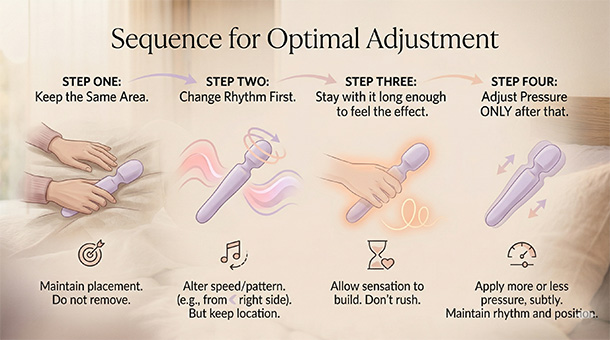
Use this order instead:
- Keep the same area.
- Change rhythm first.
- Stay with that change long enough to feel the effect.
- Only then adjust pressure.
That order works because it tells you what actually helped.
A practical way to think about it is this:
- if sensation feels scattered, simplify rhythm
- if sensation feels skiddy, add a little anchoring pressure
- if sensation feels sharp, keep rhythm and reduce pressure
- if sensation feels flat, pause briefly and restart at a lower gear instead of bulldozing forward
You are not looking for one magic setting.
You are learning the order your body likes things in.
What a good adjustment usually feels like
A good adjustment does not always feel more intense.
Usually it feels more usable.
That is the standard I trust most.
The build starts feeling smoother, not louder. You stop having to rescue the sensation every few seconds. The contact becomes easier to follow. Your body leans in instead of hovering over it.
That is when I know the change was right.
Not because it created fireworks instantly.
Because it stopped breaking the line of pleasure that was already there.
Sometimes pressure is the wrong dial entirely
Sometimes people keep adjusting rhythm and pressure when the real problem is somewhere else.
If the sensation feels dry, draggy, or irritating, more pressure will usually make it worse. If your body is bracing, clenching, or pulling away, rhythm tweaks may not fix much until the body feels safer and less defended. If the area feels numb, unreachable, or suddenly different across every method, that is not always a technique issue either.
So if better rhythm and pressure do not help much, ask a better question:
Is this really a rhythm problem?
Or is it friction, dryness, guarding, pain, medication effects, hormonal change, pelvic floor tension, or something else that deserves care instead of better technique?
Sometimes the most skillful response is not a better hand movement.
It is a better question.
The deeper shift
Most people are taught to look for the right spot, the right toy, the right pressure, the right trick.
But better pleasure is often less about finding the right thing than learning the right sequence.
When to stay steady.
When to simplify.
When to anchor.
When to back off without abandoning the build.
That is a different way of paying attention.
Not: How do I make this happen faster?
But: What does my body want next?
That question usually gets better answers.
Reviewed medical and clinical sources
- Mayo Clinic Staff. Anorgasmia in women – Symptoms and causes.
- Cleveland Clinic. Sexual Response Cycle: Order, Phases & What To Know.
- Allison Conn, MD, and Kelly R. Hodges, MD. Female Orgasmic Disorder. Merck Manual Professional Edition.
- Mayo Clinic Staff. Female sexual dysfunction – Diagnosis and treatment.
- Mayo Clinic Staff. Viagra for women: Does it exist?.
Add comment