

 Amie Dawson, Ph.D.
Why a G-Spot Toy May Feel Good Even Without Orgasm
You use a curved toy and something is clearly happening.
Your body opens. The pressure lands. There is warmth, fullness, maybe that strange almost-pee feeling, maybe the sense that you want more of exactly that angle. You stay with it and wait for the big finish people keep promising. Sometimes it never comes.
I think this is one of the most misunderstood things about G-spot toys: they can be genuinely pleasurable even when they do not take you over the edge.
Internal pleasure often feels like buildup, not a finish
A lot of people expect a G-spot toy to work like a button. Press here, climax there. Internal pleasure often does not arrive that way.
It can feel deep instead of sharp. Diffuse instead of pinpoint. Less like a spike, more like pressure that gathers and thickens. The Merck Manual notes that the amount and type of stimulation needed for orgasm varies widely from person to person, and Cleveland Clinic’s anatomy guidance also points out that vaginal penetration can stimulate the clitoris through the vaginal wall.
That matters, because a G-spot toy may be doing something very real even when it is not producing a clean, unmistakable orgasm. It may be building arousal. It may be making your pelvis feel heavy and engaged. It may be adding the kind of internal pressure that makes other touch feel better later.
It does not feel absent. It only feels unfinished if orgasm was the only result you were taught to count.
For a lot of people, that is exactly why internal pleasure makes more sense once they stop hunting for a dramatic endpoint and start exploring G-spot sensation without pressure to prove itself immediately.
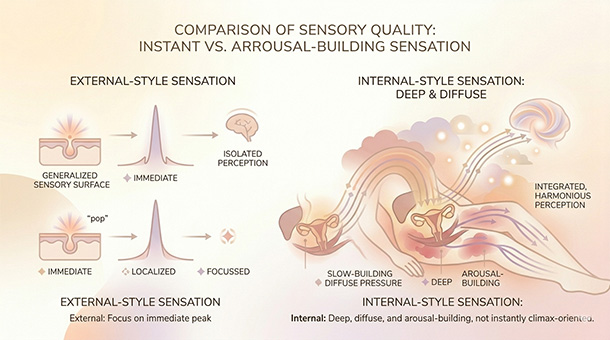
For many bodies, this is not a button. It is a neighborhood.
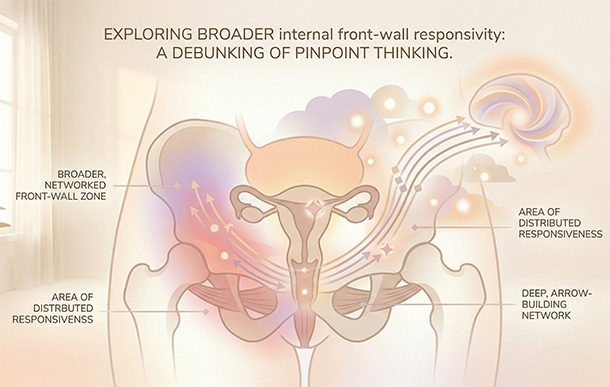
Cleveland Clinic notes that pressure on the urethral sponge near the front vaginal wall can feel pleasurable for some people and that this area is sometimes called the “G-spot.” At the same time, Cleveland Clinic’s clitoris overview explains that the clitoris is not just the small external glans people can see; it has internal structures that extend around the vagina. A 2021 systematic review in Sexual Medicine found that a single, clearly proven G-spot structure has not been established, and described the ongoing shift toward thinking in terms of a broader clitourethrovaginal complex rather than one tiny anatomical target.
That helps explain why internal toys can feel good in a way that is hard to classify. You may not be stimulating one precise orgasm switch. You may be creating pressure across a responsive front-wall region, nearby erectile tissue, the internal clitoral network, and the surrounding pelvic muscles all at once. No wonder the sensation can feel rich, promising, and difficult to label.
Sometimes the body is not separating that feeling into neat categories because the experience is already pulling in more than one line of sensation at once. That is often the point where blended stimulation starts to feel like one fuller response instead of two separate things happening side by side.
And no wonder it can feel amazing one night, intriguing another night, and flat on a third.
Your body can resolve without a definite orgasm
This is the part I wish more people knew.
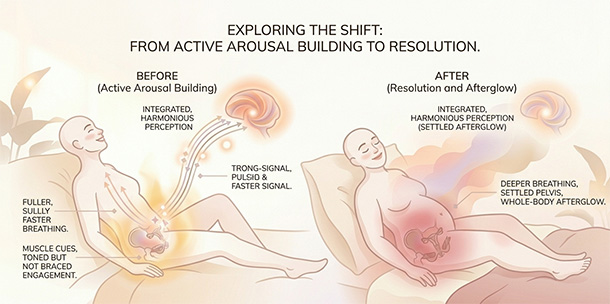
The body can have a satisfying release without a clear, cinematic climax. The MSD Manual notes that many women experience a sense of well-being and relaxation without any definite orgasm, and that resolution can happen slowly after highly arousing sexual activity even when orgasm does not occur. Merck also notes that some women never reach orgasm and still consider sexual activity satisfying.
So yes, a G-spot toy may leave you feeling looser, sleepier, softer, fuller, or pleasantly wrung out without delivering that obvious peak. Your breathing slows. Your pelvis feels heavy. Your body loses the urgent edge and drops into a kind of afterglow.
Arousal does not always break like a wave. Sometimes it softens and spreads.
That is still a sexual response. It is still real.
Why this gets mislabeled as failure
A lot of people were handed a bad script.
The old idea that there are two distinct hierarchies of orgasm, with internal or “vaginal” orgasm framed as a kind of upgraded version, has done real damage. The 2021 systematic review on the G-spot explicitly notes that these ideas have put pressure on women who cannot achieve a so-called vaginal orgasm. Merck’s guidance also makes an important clinical distinction: lack of orgasm becomes a disorder only when it causes distress, not simply because orgasm did not happen in the way someone expected.
The problem is not always the sensation. Sometimes it is the scoreboard.
Once the body is being graded for whether this “counts,” a lot of real pleasure starts reading like failure. That is the same trap people fall into when pleasure turns into a test instead of an experience.
If a G-spot toy makes you feel turned on, internally engaged, wetter, more responsive, more present in your body, or more receptive to other kinds of touch, that is not nothing. That is not a failed attempt waiting to be redeemed by orgasm. That is a form of pleasure doing exactly what pleasure often does: changing the state of your body.
What this looks like in real life
Here is what this experience can actually look like:
- You use a curved toy and feel a strong, steady pressure behind the front vaginal wall. Your body keeps wanting that angle, but orgasm only happens if you add clitoral touch. That does not make the internal part less real. For a lot of bodies, it simply means the internal pressure adds depth while the clitoral contact keeps the signal clear, which is often how blended stimulation actually works in practice.
- You do not climax at all, yet when you stop, your pelvis feels loose and heavy and your vulva feels fuller, warmer, and more awake than before.
- The toy gives you that odd almost-pee sensation for a minute, then it turns into a deep wanting-more feeling rather than a finish.
- You never get a sharp peak from internal stimulation alone, but it makes your entire arousal pattern richer and makes external stimulation feel much better right after.
All of those count. They also fit with what the clinical sources describe: internal sensation can be pleasurable, variable, and connected to a wider sexual response than orgasm alone.
When “pressure” is actually discomfort
That said, not every intense internal sensation is good sensation.
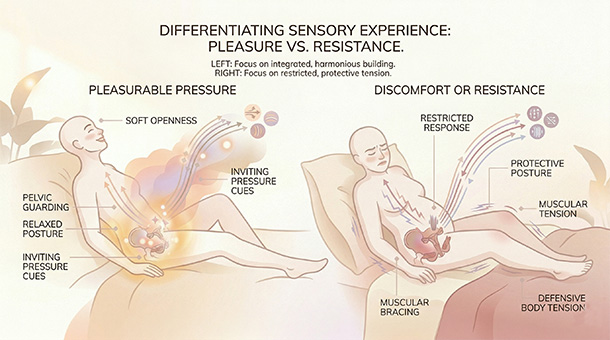
If what you feel is burning, scraping, stinging, sharp pelvic pain, a hard muscle clamp, or discomfort that gets worse the longer you continue, do not romanticize it into “maybe this is just G-spot stimulation.” Cleveland Clinic notes that vaginal dryness can cause discomfort and pain during sex, and that not being sexually aroused can contribute to dryness. Its guidance on dyspareunia and vaginismus also makes clear that pain, muscle tightening, burning, and penetration-related distress can reflect treatable issues rather than something you should push through. The NHS likewise notes that vaginismus can cause burning or stinging pain when something is inserted.
A G-spot toy should not require gritted teeth. It should not feel like you are forcing your body to “unlock.”
Good internal pressure usually invites you deeper into the experience. Pain makes you brace against it.
That difference matters.
The better question to ask
I would ask a different question than “Did it make me orgasm?”
Ask: did my body want to stay there? Did the sensation deepen arousal? Did I feel more open, more engaged, more responsive, more in my body? Did it add something I want again?
Those are not consolation prizes. They are useful answers.
A G-spot toy does not have to produce a dramatic finish to be doing something valuable. Sometimes its job is orgasm. Sometimes its job is buildup. Sometimes its job is to add fullness to external play. Sometimes its job is simply to show you that internal pleasure can be meaningful before it is conclusive.
Not every good sexual experience ends in a finish.
Some end in recognition.
Reviewed medical and clinical sources
- Cleveland Clinic. Clitoris: Anatomy, Location, Purpose & Conditions. Cleveland Clinic.
- Cleveland Clinic. Vulva: Location, Anatomy, Function, Conditions & Care. Cleveland Clinic.
- Merck Manual Consumer Version. Orgasmic Disorder in Women. Merck Manual.
- MSD Manual Professional Edition. Overview of Female Sexual Function and Dysfunction. MSD Manual.
- Vieira-Baptista P, Lima-Silva J, Preti M, Xavier J, Vendeira P, Stockdale CK. G-spot: Fact or Fiction?: A Systematic Review. Sexual Medicine. 2021;9:100435.
- Cleveland Clinic. Vaginal Dryness: Causes, Symptoms & Treatment. Cleveland Clinic.
- Cleveland Clinic. Dyspareunia (Painful Intercourse): Causes & Treatment. Cleveland Clinic.
- Cleveland Clinic. Vaginismus: Causes, Symptoms, Diagnosis & Treatment. Cleveland Clinic.
- NHS. Vaginismus. National Health Service.
Add comment