

 Amie Dawson, Ph.D.
You have the clitoral part going. It is working. Then you add something internal and one of two things happens: the whole sensation opens up, or it goes confusingly dull.
That is the maddening part.
The same combination that feels flat one day can feel huge the next. When people talk about blended stimulation, they are usually trying to name that shift.
What I want to say right away is this: blended stimulation usually does not feel like two separate pleasures happening side by side.
It feels like one sensation gaining another dimension.
The body is less divided than the internet makes it sound
When I say “blended,” I do not mean the clitoris on one side and the vagina on the other, as if they are two disconnected pleasure systems that occasionally cooperate.
They are not.
The clitoris is much more than the small external glans people usually picture. Anatomical research describes it as a larger, multiplanar structure with erectile bodies and close relationships to the urethra and vagina, which helps explain why internal and external sensation can overlap instead of feeling cleanly separate. Reviews of the clitourethrovaginal complex make a similar point: for some bodies, the anterior vaginal wall, urethral area, and clitoral structures function as a connected erotic zone during penetration.
That matters because it changes the question.
You are not trying to make two unrelated things happen at once. You are trying to notice when two kinds of input start talking to each other.
That is exactly why the experience stops fitting into neat either-or labels. The sensation may still feel clearly clitoral, but it starts carrying some of the depth people are usually trying to name when they compare clitoral and G-spot pleasure.
The outside gives the edge. The inside gives the weight.
For many people, external stimulation gives the pleasure its sharpness. Its clarity. Its exact target.
Internal stimulation changes the texture.
Instead of feeling like a bright point, pleasure starts to feel wider. Heavier. More rooted in the pelvis. Sometimes the orgasm does not feel stronger so much as less thin.
That distinction matters.
A 2023 mixed-methods study on women’s orgasm descriptions captured this beautifully: simultaneous clitoral and vaginal stimulation was often harder to separate into neat categories, and mixed experiences were often described as fuller, longer, deeper, or more intense than clitoral stimulation alone.
So when readers tell me, “It did not feel like a separate internal orgasm, it just felt bigger,” I think that is often exactly the point.
Not different in a tidy textbook way. Different in spread.
Some people also feel more pelvic involvement during that build. Less sensation pinned to one tiny spot, more of a gathering through the whole lower body. Oxford University Hospitals’ psychosexual therapy guidance notes that pelvic floor muscles contribute to arousal, lubrication, and orgasm intensity, which helps explain why some orgasms feel more distributed through the pelvis rather than located only at the clitoral glans.
Why the internal part can feel like nothing, pressure, or suddenly everything
This is where people start doubting themselves.
They add internal touch and feel almost nothing. Or they feel fullness but not pleasure. Or they feel that annoying need-to-pee sensation and assume they are doing it wrong.
Usually, that is not failure.
It is timing.
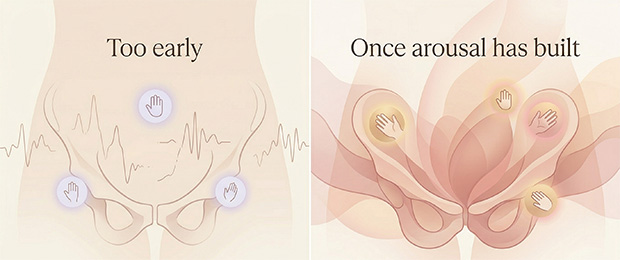
Before enough arousal is there, internal stimulation can register as pressure, friction, or distraction. Once the body is more engorged, lubricated, and neurologically online, the same contact can stop feeling merely present and start feeling meaningful. Mayo Clinic’s patient guidance on orgasm difficulty makes the core clinical point very plainly: vaginal penetration stimulates the clitoris indirectly, but that may not be enough for orgasm, and the type and amount of stimulation needed varies from person to person and from one time to the next.
This is one of the most useful lines I can give you:
Internal touch often feels best when it joins arousal, not when it is expected to create it from scratch.
That is often the whole difference between internal touch feeling merely present and internal touch feeling meaningful. For a lot of bodies, the missing piece is not more effort but exploring that internal pleasure without pressure to produce a result too early.
There is also a simpler physical truth here. If internal touch has started to feel dry, sore, burning, or wrong, that is not something to override with more effort. NHS guidance lists lack of arousal, menopause, breastfeeding, certain medicines, and other medical or hormonal factors among real causes of vaginal dryness and discomfort during sex, and the North American Menopause Society and ISSWSH note that dryness and pain can significantly affect sexual pleasure and intimacy.
Three real-life versions of the blend
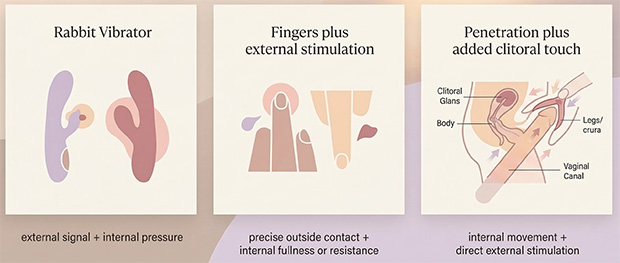
A rabbit toy is the easiest example to picture. The external arm keeps the clitoris in the conversation while the shaft adds internal pressure. When it works, the shaft is not always the star. Sometimes it feels more like the thing that gives the clitoral pleasure somewhere to land.
That is blended stimulation in one sentence:
The outside keeps the signal clear. The inside gives it body.
Another version is fingers plus external stimulation. For some bodies, that combination works best when each input has a different job instead of both chasing the same target. That is usually the practical difference between a blend that opens up and one that starts feeling crowded, which is exactly what matters when combining fingers and a vibrator.
Then there is partnered penetration with added clitoral touch. This is the situation that confuses the most people because it can feel ordinary one moment and suddenly vivid the next. Research on women’s orgasm during intercourse found that reports change substantially when concurrent clitoral stimulation is counted explicitly; orgasm is more likely when clitoral stimulation is part of intercourse than when penetration is unassisted.
That does not mean everyone needs the same combination.
It means the combination changes the experience enough that pretending it is all one thing makes the whole conversation less honest.
Why people get confused about what kind of orgasm they had
Because labels start breaking down right when the sensation starts getting interesting.
You finish and think: was that clitoral? Was that internal? Was that both? Did one trigger the other? Did they merge halfway through?
That uncertainty is common. A 2023 qualitative study found that women often described simultaneous clitoral and vaginal stimulation as hard to differentiate cleanly at all, which is one reason people come away from a strong orgasm feeling strangely unable to categorize it.
I do not think that confusion means you missed some magical body truth.
I think it often means the sensation crossed a line where neat categories stopped being useful.
The internet loves bins.
Bodies do not.
Blended is not the advanced version of pleasure
I want to say this plainly because a lot of damage gets done here.
Blended stimulation is not the graduate-level orgasm.
It is not the more evolved one. It is not the more legitimate one. It is not the prize you get after you outgrow external pleasure.
For a lot of people, the most useful thing is dropping the hierarchy altogether. External pleasure is not a preliminary step toward something more legitimate, which is the same correction behind why some people prefer external stimulation to internal in the first place.
Mayo Clinic notes that many women need direct clitoral stimulation to reach orgasm, and NHS psychosexual guidance says it is very normal not to experience orgasm from penetrative sex alone.
So if external stimulation is what works best for you, that is not a beginner setting.
That is data.
Useful, body-level, reality-based data.
Blended pleasure matters only if it feels good to you. Not because it sounds more impressive. Not because a partner is excited by the idea. Not because culture still keeps trying to crown internal orgasm as the more legitimate one.
A better way to think about it
The better question is not, “Can I unlock the right kind of orgasm?”
It is this:
What happens when my body gets focus and depth at the same time?
For some people, that answer is immediate and electric. For others, it is slower, heavier, more wave-like. For plenty of people, it is interesting but not better.
That is fine.
Because once you stop treating blended stimulation like a prize, you can finally notice what it actually is: not a more evolved form of pleasure, but a different shape of sensation.
And when it works, it usually does not feel like your body split into two.
It feels like more of you got included.
The sources below are the medical and clinical references reviewed for this piece.
Reviewed medical and clinical sources
- O’Connell HE, Sanjeevan KV, Hutson JM. Anatomy of the clitoris. Journal of Urology / PubMed.
- Jannini EA, Buisson O, Rubio-Casillas A. Beyond the G-spot: clitourethrovaginal complex anatomy in female orgasm. Nature Reviews Urology / PubMed.
- Mayo Clinic Staff. Anorgasmia in women: Symptoms and causes.
- Shirazi T, Renfro KJ, Lloyd E, Wallen K. Women’s Experience of Orgasm During Intercourse: Question Semantics Affect Women’s Reports and Men’s Estimates of Orgasm Occurrence. Archives of Sexual Behavior / PubMed.
- Weitkamp K, Wehrli FSV. Women’s Experiences of Different Types of Orgasms—A Call for Pleasure Literacy?. PMC / Taylor & Francis.
- NHS. Vaginal dryness. National Health Service.
- Faubion SS, Larkin LC, Stuenkel CA, et al. The 2020 Genitourinary Syndrome of Menopause Position Statement of The North American Menopause Society. Menopause / ISSWSH and NAMS.
- University Hospitals Bristol and Weston NHS Foundation Trust. Psychosexual service.
- Oxford University Hospitals NHS Foundation Trust. Pelvic Floor Awareness for Psychosexual Therapy for Women.
Add comment