

 Amie Dawson, Ph.D.
You slide a finger in. You angle upward. You wait for something obvious to happen.
Instead, you feel almost nothing. Or something vague. Or a sensation so unromantic you immediately start wondering whether you just found your bladder.
That is where a lot of people get stuck. Not because their body is broken, but because internal pleasure is often introduced like a treasure hunt, as if there is one hidden button, one correct response, and one gold-star ending if you do it right.
Stop treating it like a secret switch
I think this is the most helpful place to begin: you are not failing a scavenger hunt inside your own body.
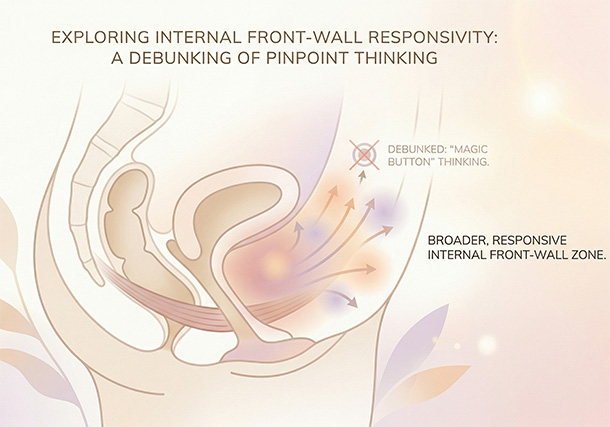
The “G-spot” has been talked about for decades as if it were a clearly defined anatomical target, but the medical literature is much messier than pop sex advice makes it sound. A 2021 systematic review in Sexual Medicine found that studies did not agree on whether a distinct G-spot structure exists, or on its exact location, size, or nature. At the same time, clinical anatomy sources still recognize that pressure on the front vaginal wall can feel distinctly pleasurable for some people, often in connection with the urethral sponge and surrounding erectile tissues.
That matters because it changes the assignment.
You are not trying to prove a myth true or false. You are exploring whether your body enjoys pressure, rubbing, or curved contact along that internal front-wall area.
A lot of people go looking for a button.
What they meet instead is a region.
Internal sensation is often quiet until you are genuinely aroused
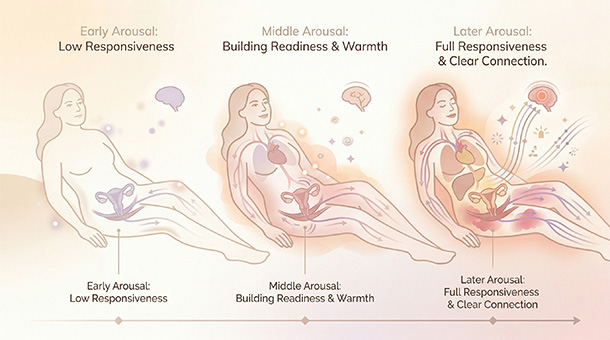
This is another reason people put themselves under pressure too fast: they start internal exploration before their body is giving them much to work with.
Mayo Clinic notes that orgasm is highly variable and that the type and amount of stimulation needed can differ not only from person to person, but from one encounter to the next. The same overview also notes that vaginal penetration may indirectly stimulate the clitoris, but many women still need direct clitoral stimulation to reach orgasm. In other words, internal touch does not have to do all the work by itself, and it often does not.
So if internal play feels blank when you are only mildly turned on, that does not automatically mean, “I do not have a G-spot.”
It may mean you are checking for a response before the system is online.
For a lot of people, that is the whole mismatch. The body is not refusing internal pleasure. It just has not built enough erotic context yet for that kind of pressure to mean much, which is often why it helps to build arousal before bringing in more targeted stimulation.
For many bodies, external arousal comes first. Blood flow builds. Tissues swell. Attention narrows. What felt neutral ten minutes earlier starts to feel textured, connected, alive. Cleveland Clinic’s anatomy guidance reflects that broader picture too: the clitoris is not just the small external glans, and its internal structures extend around the vagina.
This is why cold, clinical testing usually goes nowhere.
Pleasure does not like being interrogated.
The sensation is often more pressure-based than spark-based
One reason internal exploration confuses people is that they are waiting for the wrong kind of signal.
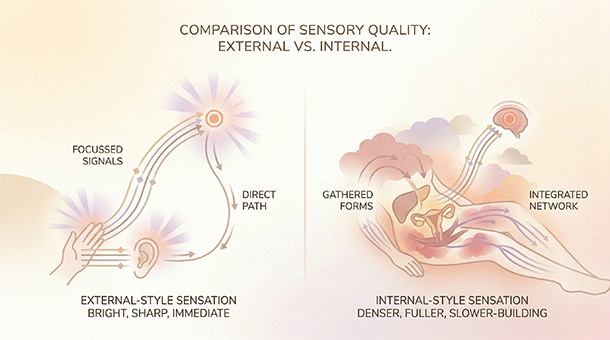
If your reference point is clitoral pleasure, especially direct clitoral pleasure, you may be expecting something bright, immediate, and unmistakably erotic. Internal front-wall stimulation often does not announce itself that way.
It can feel denser than that. Slower. More diffuse.
Sometimes the first useful shift is not “oh wow.” It is “wait, that feels different.”
It does not feel smaller. It feels less thin.
That is the distinction I wish more people were given.
Internal pleasure often makes more sense once you stop expecting it to feel like a deeper version of clitoral pleasure and let it be its own kind of sensation. That is often the clearest practical difference between clitoral and G-spot pleasure.
And yes, sometimes the first pass feels odd. Even ambiguous. Because the area people mean when they talk about the G-spot sits along the front vaginal wall near structures involved in urinary sensation and sexual response, it is not unusual for early exploration to feel mixed or unclear before it feels erotic. Clinical descriptions of the vulva and urethral sponge reflect that overlap in anatomy.
Use a curious method, not a determined one
The worst mindset for this is: Tonight I am going to make this happen.
That is usually the moment the whole experience turns from listening into proving. For a lot of people, internal exploration gets much easier once it stops feeling like a session that has to pass some hidden test.
That mindset turns every second into evaluation. Too high. Too low. Too much. Too little. Is this it? Was that it? Why is nothing happening yet?
Try this instead.
A low-pressure way to explore
- Start when you are already aroused, not when you are neutral and trying to manufacture a result.
- Use plenty of lube, because dryness can make internal touch feel scratchy, flat, or falsely irritating.
- Begin with external stimulation first, then add one finger or a curved toy rather than switching abruptly to internal-only focus.
- Explore the front vaginal wall with slow, firm, curved contact instead of frantic poking.
- Stop the session while you still feel curious, not after you have turned it into a personal referendum.
That last one matters more than people think.
Good information is still a good session.
If you learn that you like external touch plus internal pressure, that is useful. If you learn that a fuller toy shape works better than a narrow finger, that is useful. If you learn that internal play feels best once you are highly aroused and absolutely not before, that is useful.
Orgasm is not the only valid proof that something was real.
What this looks like in actual life
Theory is easy. Bodies are not.
Here are three very ordinary versions of this experience.
1. You try it too early and everything feels bland
You are curious, so you go straight in. Technically you are “doing the technique,” but your body has not caught up. Nothing feels especially good. Nothing feels especially bad. It is just there.
That is not a verdict.
It is often just bad timing.
2. You find one angle that suddenly feels more substantial
Not explosive. Not mystical. Just more gripping. More like your body starts paying attention from the inside instead of merely tolerating contact.
That is often the moment worth staying with.
3. Internal touch only becomes clearly pleasurable when the clitoris stays involved
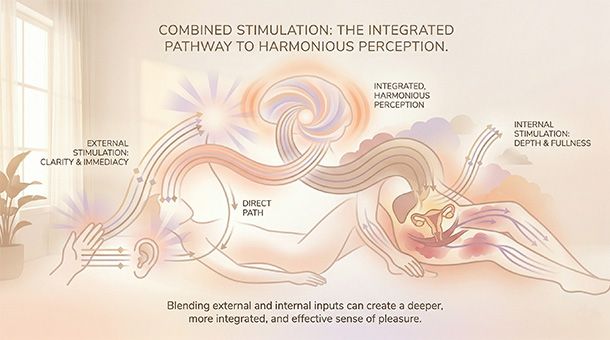
That is not a lesser version of internal pleasure. It is often the shape that works best for real bodies, which is exactly what blended stimulation actually feels like when one source of contact gives the signal clarity and the other gives it depth.
This is incredibly common, and it fits what we know clinically about orgasm variability and the role of clitoral stimulation for many women. Some of the strongest orgasms may come from combined inputs rather than from isolating one source and forcing it to carry the whole experience.
If that is you, there is nothing lesser about it. Nothing “less real.”
Sometimes the body likes harmony more than purity.
What to count as progress
A lot of people miss progress because they are only measuring climax.
I would count any of these as meaningful:
- you found a motion that feels more promising than random searching
- you noticed a shift from neutral pressure to warm, engaging pressure
- you learned that slower contact works better than faster contact
- you realized external stimulation keeps your body open and receptive
- you stopped before frustration turned the whole thing numb
That is not lowering the bar.
That is using a better bar.
When exploration becomes less performative, sensation usually gets easier to hear.
When pressure is a signal to stop, not push harder
There is a difference between new sensation and bad sensation. Do not reward yourself for ignoring it.
Back off if you notice:
- sharp pain
- burning or lingering irritation
- your body bracing against penetration
- strong urgency, discomfort, or pressure that stays unpleasant
- a pattern of internal play feeling impossible, painful, or emotionally distressing
Mayo Clinic notes that orgasm difficulties can be influenced by many things beyond technique, including stress, anxiety, relationship factors, medications such as SSRIs, pain, dryness, and involuntary tightening such as vaginismus. Cleveland Clinic also notes that hypertonic pelvic floor can affect sexual function and cause pain with sex or difficulty achieving orgasm.
That means “keep trying harder” is sometimes the wrong advice.
Sometimes the right next step is more lube. Sometimes it is more arousal. Sometimes it is a different toy shape. Sometimes it is pelvic floor support or a conversation with a clinician.
The better goal
I do not think the most useful ending to this kind of exploration is, “I found my G-spot.”
That phrase sounds neat. It sounds conclusive. It sounds like you passed.
But bodies are usually less binary than that.
A much better ending is this: I know more now. I know whether I like internal pressure at all. I know whether I need external stimulation with it. I know whether the sensation builds slowly or not for me. I know whether this is something I want occasionally, often, or never.
That is real knowledge. That is real progress.
Pleasure is not a pass-fail test.
It is a feedback system.
Reviewed medical and clinical sources
- Pedro Vieira-Baptista, Joana Lima-Silva, Mario Preti, Joana Xavier, Pedro Vendeira, Colleen K. Stockdale. G-spot: Fact or Fiction?: A Systematic Review.
- Clitoris: Anatomy, Location, Purpose & Conditions. Cleveland Clinic. Last updated January 26, 2026.
- Vulva: Location, Anatomy, Function, Conditions & Care. Cleveland Clinic. Last updated November 9, 2023.
- Anorgasmia in Women: Symptoms and Causes. Mayo Clinic. February 29, 2024.
- Female Sexual Dysfunction: Diagnosis and Treatment. Mayo Clinic. October 30, 2024.
- Hypertonic Pelvic Floor: Symptoms, Causes & Treatment. Cleveland Clinic. Last updated April 26, 2022.
Add comment