
 Amie Dawson, Ph.D.
You do that quick test a lot of people do and almost nobody talks about.
You turn the toy on for one second. You freeze. You picture the wall. The hallway. The person in the next room. You are not wondering whether sound waves are logarithmic. You are wondering whether you can stay in your body if you feel overheard.
That is the real question here.
Most people are not trying to solve an engineering problem. They are trying to figure out whether this vibrator will feel private enough to let their arousal keep going.
A decibel number is not the whole story
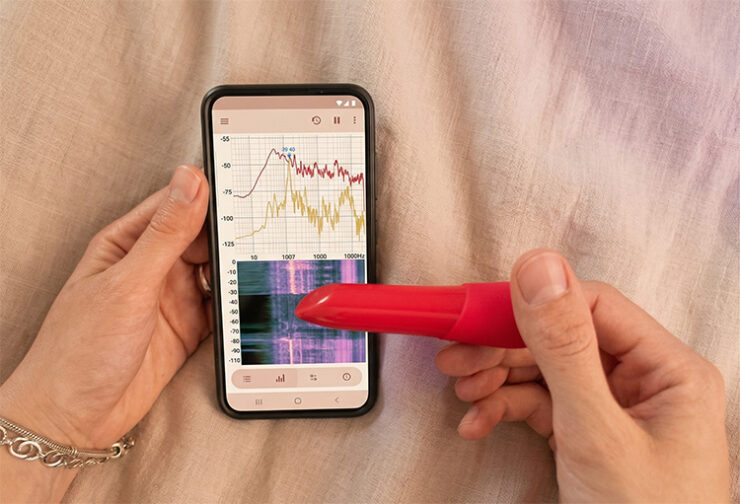
When I think about vibrator noise, I split it into three separate questions.
How loud is the motor in the air.
How much vibration gets dumped into whatever the toy is touching.
And how noticeable that sound becomes once distance, walls, and room acoustics get involved.
That matters because a single dB number can look small and still feel meaningfully different. The National Institute on Deafness and Other Communication Disorders explains that sound is measured on a logarithmic scale, not a simple linear one. A 10 dB increase is ten times more intense and is heard as roughly twice as loud. NIDCD also notes that A-weighted decibels, or dBA, better reflect how human ears respond to sound, including pitch.
So when one toy seems only “a little louder” on paper, it may not feel a little louder at all.
It may feel like it moved into a different category.
This is why two toys can both be called “quiet” and still land very differently in real life.
One has a low, soft hum you barely notice. The other has a thinner, more obvious whine that slices right through the room.
It does not feel louder because the number is wildly different. It feels louder because it is harder to ignore.
That is often the same difference people are trying to describe when they compare rumbly and buzzy vibrators. A softer hum can disappear into the background much more easily than a thinner, higher-pitched whine, even when the raw volume is not wildly different.
Why the same vibrator sounds different on a bed than in your hand
A vibrator can be discreet in the air and obvious through a bed frame.
It is not just volume. It is contact.
If you hold a toy loosely in your hand, you are mostly hearing the motor itself. The second that same toy presses into a wooden headboard, a hollow nightstand, a metal frame, or even a thin mattress sitting on slats, the sound changes. Now the surface starts participating. Now the room is helping.
What your ear hears is motor noise. What your room hears is motor noise plus whatever the room decides to join in with.
That principle is not imaginary. In NIOSH field research on workplace noise, transmitted vibration and structural ringing are recognized sources of extra sound, including lower-frequency noise spreading into surrounding floors and structures. A bedroom toy is obviously not industrial machinery, but the underlying idea is the same: vibration does not always stay politely inside the object that made it.
That is why a toy can sound fine in your palm and suddenly sound ridiculous on a nightstand.
Not because the motor changed.
Because the setup did.
That is also why grip and hand position matter more than people think. Sometimes the fastest fix is not a new toy, but holding the vibrator in a way that transfers less vibration into the room in the first place.
Why “whisper quiet” is often a weak promise
A decibel number without a testing setup tells you less than it looks like.
Distance matters. Surface matters. Speed setting matters. Even the room matters. A measurement taken a few inches from a toy in open air is not the same as a measurement taken a foot away while the toy is pressed into soft bedding. Those numbers are not enemies. They are just not twins.
This is where marketing gets slippery.
“Whisper quiet” sounds precise. It is not. It is mood language.
Quiet is not a spec. It is a situation.
If a product page throws around “whisper quiet” without telling you distance, setting, or test conditions, that is already useful information. It helps to know how to read a vibrator product page without getting misled before a vague noise claim starts sounding more concrete than it is.
So if a product page says 45 dB or 50 dB and tells you nothing else, I would not treat that number as fake. I would treat it as incomplete.
The useful question is not “Is this quiet?”
The useful question is “Quiet compared to what, measured how, and while touching what?”
What discreet actually sounds like in real life
Here is the part people usually need more than they need a chart: discretion is environmental.
The same vibrator can feel almost invisible in one room and suddenly feel impossible in another.
Picture three very ordinary situations.
You are using a toy in a carpeted bedroom, on a solid mattress, away from the wall, with the toy cushioned by your body. That setup often sounds softer than people fear because less vibration is being handed off to hard surfaces.
Now change one thing. The bed is pushed against a shared wall, the frame is light, and the toy or your hand keeps nudging the headboard. Suddenly the sound has an object to travel through. The motor itself may not be much louder. The room is.
Or picture a hotel bathroom. Hard tile. Hollow vanity. Door gap. Lots of reflective surfaces. Even a moderate toy can sound sharper there because nothing in the room is helping absorb the sound.
That is why I do not trust the phrase “roommate safe” unless somebody explains the room.
The hearing science on distance helps make this easier to picture. NIDCD lists normal conversation at about 60 to 70 dBA. NIOSH notes that exposure risk changes with distance, and in open space the sound level drops by about 6 dB each time you double your distance from the source. NIOSH also uses a simple rule of thumb: if noise makes you raise your voice to speak to someone at arm’s length, you may be in hazardous territory.
Most vibrators people call “too loud” are not power-tool loud.
They feel loud because they are distinctive, repetitive, and happening at exactly the wrong hour.
That distinction matters.
A sound does not have to be medically dangerous to feel socially huge.
That is the part people often underestimate. Sometimes the toy is not too loud in any absolute sense. It just makes the body start listening for interruption, which is very close to how performance pressure kills pleasure once attention leaves sensation and starts policing the room.
The hearing-risk question is usually the wrong one
A lot of readers quietly ask a second question under the first one: if this sounds loud to me, is it actually bad for my hearing?
Usually, that is not the main risk.
NIDCD says sounds at or below 70 dBA are unlikely to cause hearing loss even after long exposure, while long or repeated exposure at or above 85 dBA can cause hearing loss. It also emphasizes that risk depends on loudness, closeness, and duration together, not loudness alone. WHO’s safe-listening work around personal audio devices is built around cumulative exposure over many hours per week, not short, intermittent bursts of mechanical sound.
So for most adults, the practical issue with vibrator noise is privacy, not hearing damage, unless someone is doing something unusual like holding a very loud device close to the ear for extended periods. That last part is an inference from the hearing guidance, not a vibrator-specific clinical rule.
That does not mean the sound cannot ruin the moment.
It can.
For some people, noise does not just register as noise. It pulls them into self-monitoring. They start listening instead of feeling. They track every change in pitch. They wait for the floorboard, the hallway step, the possible interruption.
A toy can be physically strong enough and still fail because it keeps your attention outside your body.
The fastest ways to make a vibrator less noticeable
This is the part I wish more people heard sooner: the room often matters more than the toy.
Before you replace the vibrator, change the setup.
- Test the room, not just the toy. Turn it on where you actually use it, then step outside the door for ten seconds.
- Break contact with hard surfaces. Move away from headboards, bed frames, nightstands, windowsills, and hollow furniture.
- Add a buffer. A folded towel, pillow, or simply changing your hand position can stop vibration from transferring into the room.
- Try one notch lower before you give up. A small drop in power can cut perceived noise more than it cuts useful sensation.
- Watch the patterns. Sharp stop-start pulses often rattle furniture more than a steady hum. That is one more reason the plain setting often wins. A toy that keeps changing rhythm can feel louder in the room and more distracting in the body, which is exactly where modes, patterns, and settings stop being a gimmick question and start becoming a noise question too.
Small changes. Big payoff.
Sometimes the fix is not “buy the quietest toy on the internet.”
Sometimes the fix is “stop using it on a resonant surface at midnight.”
What to care about when noise really matters to you
If discretion is high on your list, I would care about sound in this order:
First, whether the toy transfers vibration into surfaces.
Second, whether its pitch is soft or piercing.
Third, whether the company gives you any meaningful context for its noise claim.
The raw dB number comes after that.
Because the hardest sound to hide is not always the loudest one. It is the one that turns into a recognizable buzz through furniture, walls, or silence.
It does not feel bigger. It feels less containable.
That is why the best solution is sometimes environmental, not technical. Moving away from resonant surfaces, changing your position, or cushioning the contact point can matter more than chasing the mythical silent toy, especially if privacy is part of what lets your body actually stay with the sensation.
The real answer
So how loud are vibrators really?
Usually less dramatic than your most anxious brain predicts. Often more situational than product pages suggest. And sometimes loud enough to matter, not because they are dangerous, but because privacy is part of arousal for a lot of people.
That is real.
It is not prudish. It is not silly. If feeling overheard makes your body pull back, then quiet is not a luxury feature for you. It is functional.
But I would not confuse “quiet” with “better.”
Some quiet toys are weak. Some stronger toys have a little motor sound and are absolutely worth it. Some people would rather have a low hum that gets them there than a silent toy that feels like almost nothing.
The right question is not whether a vibrator is silent.
Nothing mechanical is.
The right question is whether the sound works in the life you actually have.
Quiet is not a virtue.
It is a fit.
Reviewed medical and clinical sources
- National Institute on Deafness and Other Communication Disorders. How is Sound Measured? NIDCD, updated April 28, 2025.
- National Institute on Deafness and Other Communication Disorders. Noise-Induced Hearing Loss (NIHL). NIDCD, updated April 16, 2025.
- National Institute for Occupational Safety and Health. Understand Noise Exposure. Centers for Disease Control and Prevention, January 31, 2024.
- National Institute for Occupational Safety and Health. Noise Myths Debunked – Fact and Fiction Behind all the Cicada Buzz. Centers for Disease Control and Prevention, July 20, 2021.
- Scott E. Brueck, Judith Eisenberg, Edward Zechmann, William J. Murphy, Edward Krieg, and Thais C. Morata. Evaluation of Noise Exposures and Hearing Loss at a Forging Company. NIOSH Health Hazard Evaluation Report No. 2007-0225-3386, December 2022.
- World Health Organization. Safe Listening Devices and Systems: A WHO-ITU Standard. World Health Organization, September 18, 2019.
Add comment