
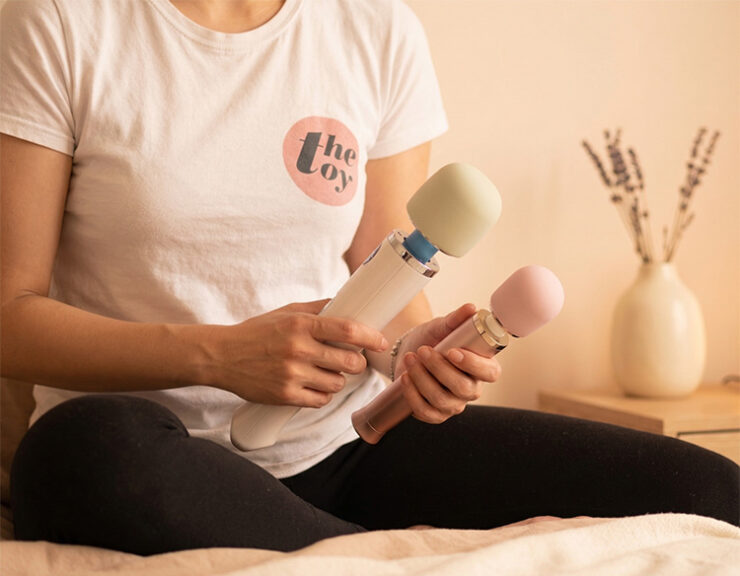
 Amie Dawson, Ph.D.
You buy a vibrator because everyone says it is powerful. It absolutely is. But on your body it feels thin, scratchy, weirdly annoying, or like all the sensation is happening on the surface while your arousal never really catches up.
Then you try another toy. Sometimes it is quieter. Sometimes it is technically less intense. And somehow it feels better almost immediately.
That is usually not a desire problem.
A lot of the time, it is a vibration-quality problem.
I see this confusion constantly. People assume the issue is their body, their mood, their sensitivity, or their ability to orgasm. Very often, the missing variable is simpler than that.
It is vibration character.
“Rumbly” and “buzzy” are not the same kind of stimulation
These are not formal medical terms.
They are body-language terms.
They are still useful.
When I say buzzy, I mean the vibration feels brighter, sharper, more surface-heavy, more skin-level. It can feel crisp and immediate. Sometimes that is exciting. Sometimes it feels like fizz, static, or a thin electric shimmer right where the toy touches.
When I say rumbly, I mean the vibration feels fuller, heavier, more spread out, less scratchy. Not necessarily weaker.
Less thin.
Instead of feeling like the toy is vibrating against you, it can feel like some of the tissue is moving with it.
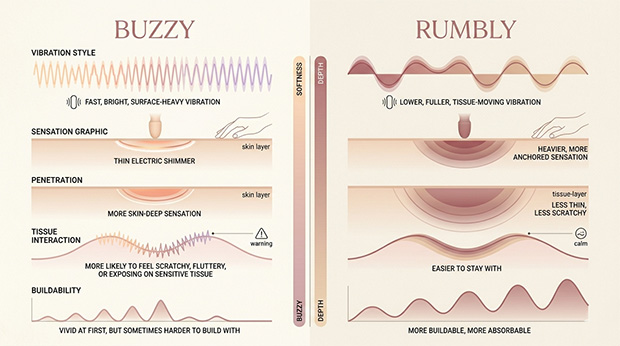
That is the difference many people are trying to name when they say one toy feels “cheap” and another feels “deep,” even if they do not have the vocabulary for it yet.
Your body can actually tell the difference
When I say this difference is real, I do not mean real in a poetic way. I mean physiologically real.
The body detects vibration through touch receptors. Human clitoral tissue also contains specialized sensory structures involved in mechanosensation. That does not mean every rumbly toy maps neatly onto one receptor and every buzzy toy onto another. Real motors are messier than that. Toys vary by speed, amplitude, motor design, contact area, and how they interact with flesh.
But the shorthand still points to something real.
Your body can tell the difference between vibration that feels more surface-forward and vibration that feels more distributed through pressure and tissue movement.
When people say a toy feels “deep,” they usually do not mean it is reaching some secret chamber inside them.
They mean more of them is moving with it.
Why this matters so much on the clitoris
This is not a minor detail.
For many women, clitoral stimulation is the main route to orgasm. That means the kind of clitoral stimulation matters, not just the fact that some stimulation is happening.
A buzzy toy on one tiny point and a rumbly toy spread through slightly broader tissue are not interchangeable experiences. They may both count as clitoral stimulation, but they do not ask the same thing from your nervous system.
For some bodies, direct sharp contact feels electric in the wrong way. Too exposed. Too exact. Too on top of the nerves.
For others, broad pressure feels pleasant but vague, and they need a clearer, brighter, more focused signal to actually build arousal.
Same anatomy.
Different response.
That is also why some people end up preferring indirect clitoral stimulation over direct contact. It is not a weaker route to pleasure. It is often just a cleaner match for the kind of signal their body can stay with.
That is why “just use a vibrator” is lazy advice. A vibrator is not one sensation. It is a whole category of tools with very different motor signatures.
Strong and satisfying are not the same thing
Marketing loves the word powerful.
Bodies do not always agree.
A toy can be very strong and still feel unsatisfying. A toy can be moderate and feel incredible. Power tells you how much output a motor has. Character tells you how your body reads that output.
That difference is huge.
Some vibrations feel like they are doing a lot to you. Others feel like they are actually building pleasure in you.
Those are not the same experience.
A lot of people hear “rumbly” and assume it means stronger. Not necessarily. A rumbly toy can feel gentler in a good way because the sensation is less thin and less scratchy. A buzzy toy can feel more intense in a technical sense while being less satisfying in practice.
Steady stimulation matters for orgasm. But steady does not just mean the motor stays on. It also means the sensation is something your nervous system can actually stay with instead of constantly negotiating against.
What buzzy usually feels like
Buzzy is not automatically bad.
For some people, it feels alive. Crisp. Immediate. Efficient.
This is often the person who wants to find the spot and stay on it. The person who likes fast feedback. The person who gets impatient with broader stimulation because it feels pleasant but not decisive.
A good buzzy toy can feel thrilling.
A bad one can feel like your clit is being informed, very energetically, that a motor exists.
Buzzy becomes a problem when the body wants more cushion, more spread, or more pressure through surrounding tissue. That is when the vibration starts feeling skin-deep instead of erotic. You keep adjusting. You keep trying to make it work. The sensation is obvious, but the pleasure stays strangely flat.
That is often the beginning of what people describe as a toy feeling numbing, even when it is technically doing plenty. If that pattern sounds familiar, it helps to know what to do when a vibrator feels numbing instead of pleasurable.
What rumbly usually feels like
Rumbly often feels easier to stay with.
Not broader in contact area.
Broader in effect.
A rumbly motor can feel more anchored, more whole, more like it has weight behind it. Instead of tickling the surface, it can feel like it gives your arousal something solid to organize around. People often describe this as fuller, warmer, heavier, deeper, or more satisfying.
Again, “deeper” does not mean anatomical depth.
It means sensory depth.
This is often the person who likes pressure. The person who presses the toy into the labia or pubic mound instead of hovering over one tiny spot. The person who likes a toy through underwear. The person who wants the sensation to build instead of ping.
The wrong vibration can make you feel chased.
The right one makes you feel met.
It is also why some bodies do unexpectedly well with a toy over underwear for softer stimulation. The point is not to mute pleasure. It is to turn a sharp signal into one the body can actually receive.
The fastest way to recognize the difference in your own body
You usually do not need to become a mini engineer to figure this out. You just need to notice what keeps happening.
If you keep turning a toy down not because it is too strong, but because it starts feeling scratchy after twenty seconds, that often points to too much buzz for that area.
If pressing harder makes the sensation better instead of worse, that often points to wanting more rumble, more tissue contact, or more buffer.
If a toy feels best through underwear, over the labia, through the clitoral hood, or slightly beside the glans rather than directly on it, that often points to wanting less sharpness and more spread.
If broad vibration feels nice but never quite tips into orgasm, and you keep chasing one exact point, that often points to liking brighter, more focused stimulation.
Notice the pattern, not the brand name.
Your body is giving better information than most product pages.
The same toy can feel buzzy one day and useful the next
This part surprises people, but it matters.
A vibration does not live in the motor alone. It lives in the interaction between the motor and your body.
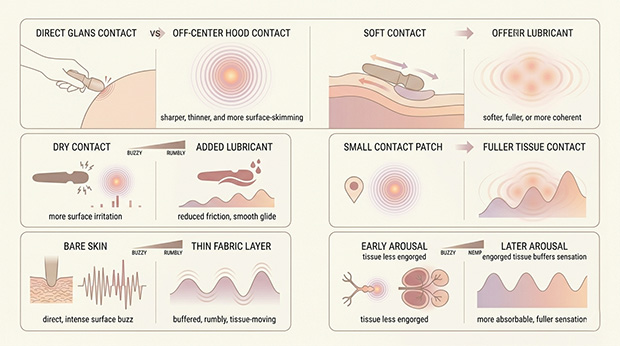
Move a toy from directly on the glans to the side of the clitoral hood, and the same motor may suddenly stop feeling sharp. Add lube, and friction changes. Put a thin layer of underwear between toy and body, and the signal may become softer and more coherent. Press into the pubic mound or outer labia, and more tissue moves, which can make the same toy feel richer.
Arousal changes it too.
A motor that feels too exposed early on may feel excellent once the tissue is more engorged. Another toy may feel luxurious at first and oddly dull later, when your body wants more definition.
So when someone says a toy is “definitely buzzy” or “definitely rumbly,” I always soften that claim a little.
They are describing an interaction.
Not a law of physics.
That is the same reason the same toy can feel amazing one day and wrong the next. The motor may not have changed at all. The body it is meeting has.
Why a toy can feel amazing at first and annoying a minute later
Arousal changes sensation. The same toy can feel vague at first, then suddenly click. Or feel perfect right up until orgasm and then become unbearable in one second.
That is not inconsistency.
That is physiology.
There is another reason this happens too. Touch receptors respond strongly to changing input, not just endless sameness. So a vibration can feel vivid at first and then start feeling empty, irritating, or strangely backgrounded if the signal is not one your body likes in that spot.
This is also why people sometimes panic and assume they have desensitized themselves permanently.
Usually, that is not what is happening.
Temporary dulling after orgasm or after a lot of friction can happen. Changing the type of stimulation, the pressure, the placement, or taking a pause usually changes the whole experience quickly.
So if a buzzy toy starts feeling like too much skin-noise, do not jump straight to “I broke my nerves.”
Usually, you did not.
Usually, your body is asking for a different quality of contact.
If the missing piece has been hard to name, it helps to think in terms of pinpoint versus broad stimulation. A lot of “rumbly versus buzzy” confusion is really the body reacting to how narrowly or widely the signal lands.
What this looks like in real life
Picture three people.
One uses a tiny bullet and keeps pulling it away every few seconds. She is not under-aroused. She is bracing. The sensation is too exposed, too exact, too top-layer. She may need more rumble, more pressure through surrounding tissue, more buffer, or all three.
Another says every toy feels “fine,” but nothing quite tips into orgasm. Then she tries a more focused, brighter motor and finally gets the missing clarity. She did not need more patience. She needed a sharper signal.
A third says the best part is when the toy is not directly on the clit at all, but slightly off to one side, with firm pressure through surrounding tissue. That is a classic sign the body likes stimulation filtered through flesh, not delivered like a pinpoint tap on an exposed nerve cluster.
The wrong vibration can make you think you are hard to please when you are actually easy to please in a more specific way.
That is a very different story.
A two-minute test tells you more than most reviews
You do not need a spreadsheet for this. You need contrast.
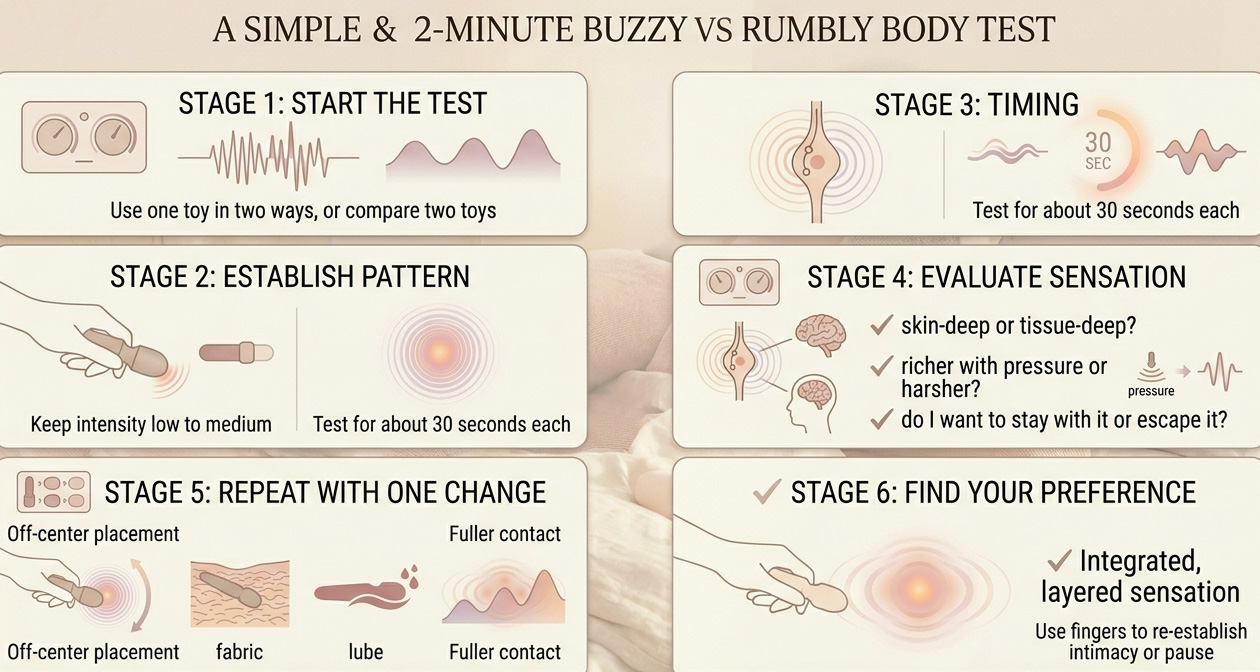
Try this:
- Use one toy in two different placements, or compare two toys for about thirty seconds each.
- Keep the intensity low to medium. Do not chase orgasm yet.
- Ask four questions: Does this feel skin-deep or more tissue-deep? Does more pressure make it richer or harsher? Do I want to stay with it or escape it? Does my body soften into it or start negotiating with it?
- Then change one variable only: placement, pressure, fabric, or lube.
- And do not underestimate pressure. Sometimes pressure is what turns the same motor from scratchy to satisfying, even before you switch toys.
That last part matters.
A lot of people do not actually hate vibration.
They hate one delivery style.
So which one is better?
Neither.
That is not me dodging the question. It is the real answer.
Rumbly is not automatically advanced. Buzzy is not automatically cheap. Strong is not automatically rumbly. Expensive is not automatically satisfying.
What matters is the match between the motor and the way your body likes to receive touch.
If direct contact feels raw, rumbly will often make more sense.
If broad contact feels vague, buzzy may be exactly what you needed.
If you like both depending on mood, placement, arousal level, or toy category, that is normal too.
Bodies are not inconsistent just because they have more than one good setting.
When it is not just a preference issue
Temporary reduced sensation right after orgasm can happen. So can a short-lived dulling after lots of friction.
But ongoing numbness is different.
If sensation changes suddenly, lingers, or comes with pain, tingling, pins and needles, itch, or burning, do not file it under “maybe I just need a better toy.”
That deserves a medical look.
The same goes for persistent pain with touch, sharp changes in clitoral sensation, or a feeling that the area no longer responds the way it normally does. A vibrator mismatch can explain a lot. It cannot explain everything.
The reframe that matters most
A lot of people judge their body by the first vibrator that did not work.
I think that is backwards.
A vibrator is not a truth serum. It is a tool with a motor. If that motor gives you the wrong kind of sensation, it can convince you that you are numb when you are not numb, too sensitive when you are not too sensitive, or difficult when your nervous system is simply asking for a different texture of input.
So this is the question I would keep:
What kind of vibration does my body actually recognize as pleasure?
That is a better question than “Why don’t I like vibrators?”
It is more accurate. More useful. Kinder too.
Because pleasure is not a volume contest.
It is a matching problem.
Reviewed medical and clinical sources
- Mayo Clinic Staff. Anorgasmia in Women — Diagnosis and Treatment. Mayo Clinic. Updated February 29, 2024.
- Bajwa H, Al Khalili Y. Physiology, Vibratory Sense. StatPearls Publishing / NCBI Bookshelf. Updated 2026.
- Piccinin MA, et al. Histology, Meissner Corpuscle. StatPearls Publishing / NCBI Bookshelf. Updated 2023.
- Cobo R, Martín-Cruces J, García-Piqueras J, Feito J, García-Suárez O, Vega JA. Glans clitoris innervation: PIEZO2 and sexual mechanosensitivity. Journal of Anatomy. 2021.
- Gruenwald I, Lowenstein L, Gartman I, Vardi Y. Physiological Changes in Female Genital Sensation During Sexual Stimulation. The Journal of Sexual Medicine. 2007.
- Rullo JE, Lorenz T, Ziegelmann MJ, Meihofer L, Herbenick D, Faubion SS. Genital Vibration for Sexual Function and Enhancement: Best Practice Recommendations for Choosing and Safely Using a Vibrator. Sexual and Relationship Therapy. 2021.
- MedlinePlus. Sexual Problems in Women. U.S. National Library of Medicine. Reviewed March 25, 2024.
Add comment