

 Amie Dawson, Ph.D.
You finally have privacy, and somehow that makes it worse.
The room is quiet. Your hand feels too noticeable. The sheets sound loud. You become aware of your stomach, your breathing, your face, the position of your legs. You are not even deep into anything yet, and already part of you is watching the whole scene from outside.
That is the feeling a lot of people mean when they say exploring pleasure feels awkward.
Not broken. Not cold. Not incapable.
Awkward.
Awkward is often just self-awareness arriving before pleasure does
A lot of people expect sexual exploration to feel intuitive right away. As if desire should switch on, the body should answer, and everything after that should unfold naturally.
Real life is messier.
Sometimes your body is curious, but your mind is still standing back with its arms crossed. Sometimes you want to explore, but you also feel faintly embarrassed by the fact that you are a person with a body doing this at all. Sometimes nothing is wrong except that the moment feels too exposed.
Awkward is often just self-awareness arriving before pleasure does.
That matters, because it changes the question. The question stops being, “Why am I bad at this?” and becomes, “What would make me feel less observed?”
That watched feeling is strongest before the body has learned what counts as even slightly promising, which is why not knowing what feels good yet can feel so much more awkward than it sounds.
What makes it awkward is not lack of desire. It is split attention
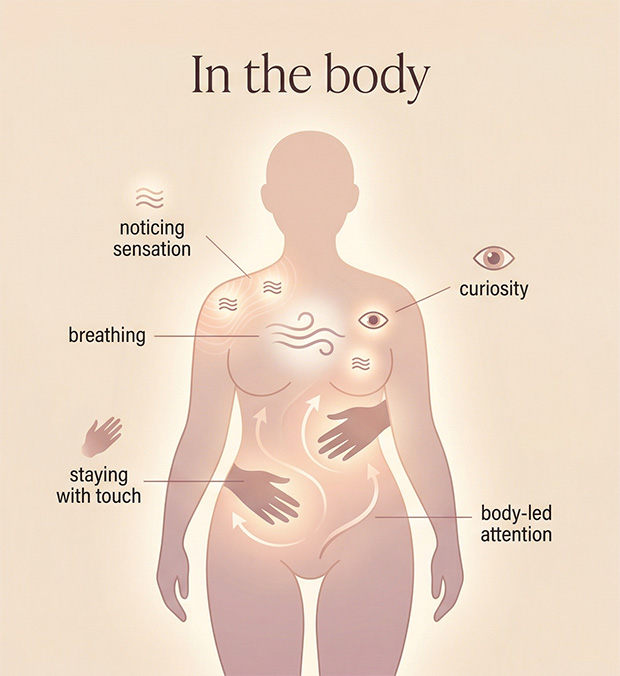
Pleasure needs attention. Not perfect focus. Just enough of it.
When half your mind is tracking whether you look weird, whether you are taking too long, whether your thighs are in an unflattering position, whether you are “doing it right,” sensation has less room to build. You are trying to do something intimate while half of your brain is standing in the doorway with a clipboard.
Clinical guidance lines up with that experience. Cleveland Clinic notes that sexual performance anxiety can involve fear, embarrassment, body-image worries, past disappointments, and general stress, all of which can interfere with sexual interest and pleasure. Research on self-focused attention in women also found that experimentally increasing self-awareness disrupted sexual arousal responses, which helps explain why intense self-monitoring can make a body feel harder to read.
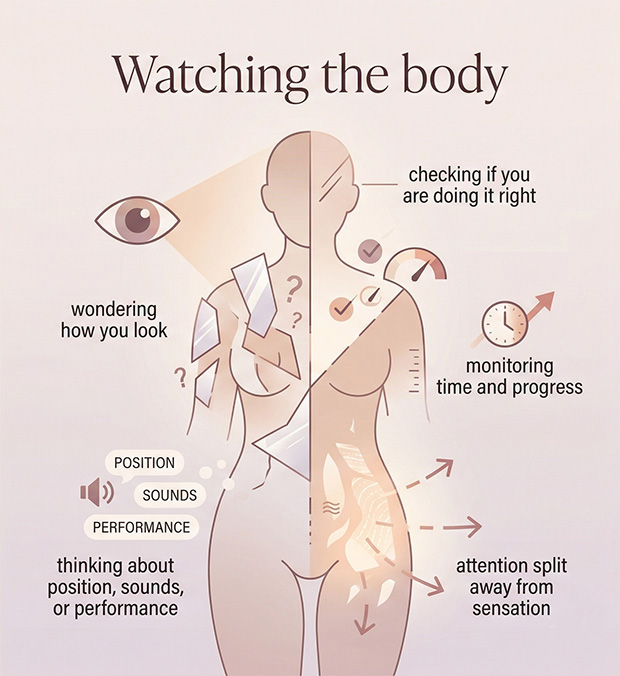
This is also why “just relax” is such useless advice. It treats awkwardness like a personality flaw. Usually it is an attention problem.
A lot of what feels like awkwardness is really attention leaving the body before sensation has enough time to organize, which is the same trap behind why it can be hard to orgasm when you’re distracted.
And attention can be shaped.
Make it smaller than “sex” and it usually gets easier
One of the fastest ways to make exploration feel awkward is to frame it like a full sexual event.
Music. Mood. Goal. Pressure. A feeling that something meaningful should happen.
For a lot of people, that setup is too big too early.
Pleasure usually gets clearer when the performance gets smaller.
You do not need to undress completely. You do not need to use a toy on day one. You do not need to aim for orgasm. You do not need to “get into the right mindset” first. In fact, starting smaller often works better because the nervous system has less to manage.
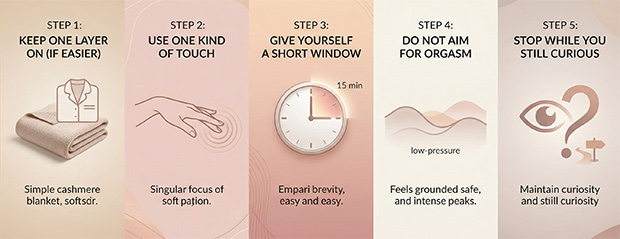
Try making the first few explorations more like sensory check-ins than sexual performances:
- keep one layer of clothing on if that feels less exposed
- use one kind of touch instead of changing things every ten seconds
- give yourself a short window instead of an open-ended session
- stop while you still feel curious, not after you feel frustrated
That smaller frame helps for another reason. NHS guidance on female orgasmic difficulties notes that many women need steady clitoral stimulation rather than penetration alone for orgasm, which means pleasure often depends on specific kinds of touch and enough time for the body to register them. If your first attempts do not feel instantly obvious, that is not unusual.
It does not mean your body is silent.
It often means the signal is still faint, and you are learning how to hear it.
Early exploration should be easy to interpret, not impressive
Many people make the first attempts too complicated.
They try direct touch when they are not ready for that much intensity. They switch positions too fast. They add penetration because they think they should. They keep escalating because nothing feels dramatic enough yet. Then the whole thing starts to feel technical, forced, or weirdly disappointing.
Early exploration works better when each experiment gives you a readable answer.
Not “Did I orgasm?”
Something simpler.
Did that feel neutral, pleasant, too sharp, too exposed, too numb, too distracting, too intense, or quietly promising?
That is useful information.
Some sessions are not for climax. They are for translation.
A softer, less judgmental style of attention seems to matter here. A 2024 systematic review found evidence that mindfulness-based interventions can help with some sexual problems, especially around arousal and desire, and a large clinic-based study found that higher trait mindfulness was linked to better sexual function and lower sexual distress in women. The point is not that you need to meditate before touching yourself. The point is that nonjudgmental attention helps bodies become easier to read.
So keep the experiment simple. One area. One level of pressure. One pace. Long enough to notice something real.
You are not auditioning. You are collecting data from your own body.
What this can look like in actual life
Not ideal life.
Actual life.
The covered start
You are under a blanket. Underwear stays on. One hand just rests over the vulva for a minute instead of moving right away.
This can be surprisingly useful because it lowers the feeling of exposure. The body gets a chance to settle before you ask it to perform. Sometimes the first meaningful sensation is not arousal. It is relief.
The low-demand check-in
You lie on your side with a pillow between your knees or thighs. No goal. No attempt to make anything happen.
You notice whether pressure feels comforting, blank, irritating, or interesting. That sounds almost too small to count.
It counts.
For some bodies, pleasure does not begin with a spark. It begins with less guarding.
The broad-pressure experiment
Instead of hunting for a precise spot, you use the flat of your hand over the whole area, with slow, steady pressure.
You are not chasing a perfect sensation. You are noticing whether broader contact feels safer, warmer, or easier to stay with. Sometimes the body answers better when it is not being asked such a narrow question.
For a lot of people, that is the first real clue. The body may not want a tiny exact target yet. It may want contact that feels wider, quieter, and easier to stay with, which is often the practical difference behind broad versus pinpoint stimulation.
The stop-before-it-turns-into-work session
You explore for a few minutes, notice one thing that felt better than expected, and stop there.
Not because you failed.
Because ending while something still feels alive teaches your brain that exploration does not have to end in irritation, numbness, or disappointment. It can end in interest. That matters more than people realize.
If awkwardness keeps turning into pain, bracing, or dread, that is different
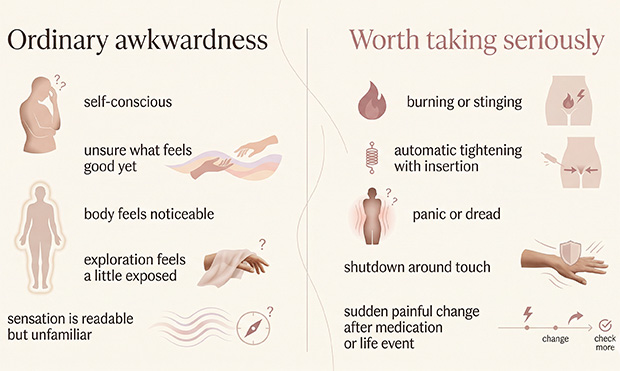
There is ordinary awkwardness, and then there is a body that feels like it is protecting itself.
Once the whole experience starts showing up as clenching, guarding, or automatic shutdown, it often stops being a confidence issue and starts looking much more like body tension making pleasure harder.
If touch burns. If insertion makes you clamp down. If your stomach drops the moment anything goes near the vaginal opening. If you feel fear rather than embarrassment. Do not treat that like a confidence problem.
NHS guidance on vaginismus describes it as an automatic tightening reaction, not something you choose or “cause” by being bad at sex. The same guidance notes that it can happen with fingers, toys, tampons, or penetration attempts and that it is treatable. Merck Manual’s overview of female sexual dysfunction also notes that anxiety, shame, prior negative experiences, fear of pain, and pain conditions can all interact with desire, arousal, orgasm, and penetration.
That means “push through it” is often the wrong move.
Get support if you notice:
- repeated burning, stinging, or sharp pain
- automatic tightening with insertion attempts
- panic, dread, or shutdown around sexual touch
- a sudden change after starting or changing medication
Those are not signs that you need more discipline. They are signs to take your body seriously.
The goal is not to look natural while you learn
This is the part I wish more people heard earlier.
You do not need to become instantly confident before pleasure is allowed to happen. Confidence is not the entry fee. Familiarity usually comes first.
That is true in almost every intimate skill we learn. At the beginning, the movements feel noticeable. The silence feels loud. The body feels like something you are handling instead of inhabiting. Then, gradually, the editing softens.
You stop narrating every second.
You stop grading every response.
That is often the moment your body becomes easier to hear. Pleasure usually gets clearer once exploration stops feeling like a test you have to pass.
You stop demanding a clear result from every touch.
And somewhere in that quieter space, your body starts sounding more like itself.
Not polished. Not pornographic. Not effortlessly sexy.
Just more legible.
Awkwardness is not proof that pleasure is far away.
Very often, it is the first sound pleasure makes when it is still learning your name.
Reviewed medical and clinical sources
- Leicestershire Partnership NHS Trust. Female orgasmic difficulties. Leicestershire Partnership NHS Trust.
- Cleveland Clinic Health Essentials. How To Overcome Sexual Performance Anxiety. Cleveland Clinic. Published September 30, 2024.
- Amaia Miren Ciaurriz Larraz, Alejandro Villena Moya, Carlos Chiclana Actis. Mindfulness-based intervention and sexuality: a systematic review. Trends in Psychiatry and Psychotherapy. 2024.
- Allison Conn, MD; Kelly R. Hodges, MD. Overview of Female Sexual Function and Dysfunction. Merck Manual Professional Edition. Reviewed/Revised July 2023; modified January 2026.
- Richa Sood, Carol L. Kuhle, Jacqueline M. Thielen, Ekta Kapoor, Jennifer A. Vencill, Kristin C. Mara, Stephanie S. Faubion. Association of mindfulness with female sexual dysfunction. Maturitas. 2022.
- NHS. Vaginismus. NHS. Page last reviewed May 13, 2024.
Add comment