
 Amie Dawson, Ph.D.
You start on low. Too little. You click again. Better. Then the toy suddenly revs, drops, pulses, pauses, and does something that felt clever in the product demo but terrible on your body.
Now you are not getting closer. You are troubleshooting.
I see this mistake all the time: people assume they need to figure out all the modes when what they actually need is to understand one thing first.
A vibrator setting does not just change strength.
It changes rhythm, predictability, and how often your body has to adjust.
That matters more than most marketing admits.
When a mode feels bad, it is often because it keeps interrupting the build
When I explain vibrator settings, I start here: your body does not experience a mode as a feature. It experiences it as a pattern of touch over time. A steady setting says, “stay here.” A pulsing one says, “here, gone, here again.” A wave says, “closer, farther, closer, farther.”
Once you feel settings that way, they make a lot more sense.
That is especially true for clitoral stimulation. The clitoris is not just a tiny external spot. It is a larger erectile structure, and the glans is extremely sensitive. So when a toy keeps spiking or re-landing, the issue may not be “too strong” in a simple sense. It may feel too abrupt, too exposed, too unbuffered.
Sometimes the toy is not overwhelming because it is powerful.
It is overwhelming because it keeps starting over.
That is often the hidden reason clitoral stimulation starts feeling too intense. The issue is not always raw power. Sometimes it is the feeling of the sensation re-landing before the body has had time to settle into it.
The boring setting is often the one that actually works
A lot of people assume the best mode will be the most sophisticated one. In practice, the mode that gets used most is often the plain continuous setting.
There is a reason for that. Most women need steady clitoral stimulation for orgasm, and penetration alone often does not provide enough of it. That is the core insight most mode guides miss: for many bodies, consistency is not a fallback. It is the thing that lets orgasm happen in the first place.
This is why a pattern can feel exciting at minute one and infuriating at minute seven.
At the beginning, novelty can wake the body up. Later, novelty can break concentration. You get close, the toy drops, and your body has to climb the same hill again. You are not under-responsive. You may just be losing momentum every six seconds.
The problem is not that the toy is weak.
The problem is that it keeps changing the sentence before your body can finish reading it.
That is also why some people get close and then lose it. The body was building. The toy just kept interrupting the part that needed to stay consistent.
A pulse is not just softer. It is a series of restarts
Most vibrator patterns are doing one of four jobs. Once you know that, the button panel stops feeling mysterious.
- Continuous: best when you want stability, buildup, and a clean path to orgasm.
- Pulse: can feel gentler if constant contact is too sharp, but at higher power it can also feel poky because each hit lands fresh.
- Wave or ramp: often good for warm-up, teasing, or staying just below the edge. Often terrible when you are already close.
- Stop-start or random: useful for variety, edging, and playful distraction. Bad when your body wants something reliable.
Here is the distinction I wish more people understood: a pulse mode does not simply reduce intensity. It changes the texture of the sensation.
It does not feel weaker.
It feels interrupted.
For some people, that interruption is helpful. The pause takes the edge off and makes direct contact feel less relentless. For others, the pause is the whole problem. The exact same pulse pattern can feel relieving on one body and irritating on another.
What looks advanced on the box can feel interruptive on the body.
In practice, this is often less about strength than about a change in rhythm or pressure. Small timing shifts can matter as much as the power level once your body has started organizing around one kind of contact.
Stop auditioning every mode like there will be a winner at the end
Scrolling through ten settings in thirty seconds is one of the fastest ways to learn nothing.
Guidance on orgasm difficulties often recommends directed masturbation and self-stimulation first, because it helps you learn your own response before you add more moving parts. That logic matters here. If you keep changing every variable at once, you are not really testing a setting. You are creating chaos and calling it experimentation.
So this is the cleanest way to test modes:
- Keep the same placement first. Do not change angle, pressure, and setting all at once.
- Start with steady continuous stimulation. Stay there long enough to actually register it.
- Change one thing at a time. Power or pattern. Not both.
- Once a setting helps you build, stop scrolling. Curiosity is useful. Constant comparison is not.
That sounds obvious. In real life, people rarely do it.
They chase the better mode right when their body is finally adapting to the current one.
Sometimes the most useful next move is not a new pattern at all, but more time on the one that has started to register. A lot of early “nothing yet” moments are really about giving the sensation time to become legible before you judge it.
What this looks like in real life
Picture a small bullet on the clitoral glans. Direct, high, steady contact feels like too much nerve all at once. That does not automatically mean the body needs less stimulation. It may just need the contact to land a little less directly, which is why direct and indirect stimulation can feel so different even at the same setting.
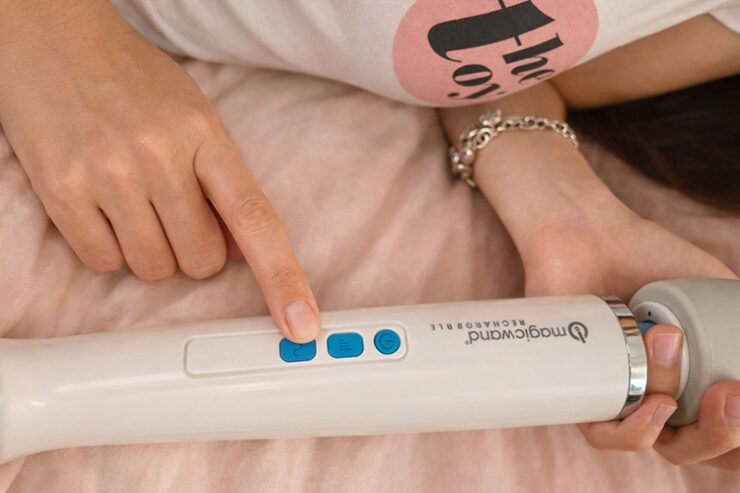
Now picture a wand. Broad head. Bigger contact patch. You keep turning it up because it feels dull at first. Then two minutes later it is suddenly too much. That usually means you did not need a dramatic pattern. You needed more time on one stable setting so the sensation could spread and deepen.
Or imagine this one, because it is incredibly common: you are close, then the mode drops into a wave pattern right before orgasm. Everything that was lining up goes slack. You are still turned on, but the thread broke.
Switch to steady before that point. Earlier than you think.
During partner sex, I would make the same point even more bluntly: pick the mode before things get intense. Do not hold a strategy meeting with the button panel mid-build.
A good setting should reduce decision-making, not create more of it.
Sometimes the setting is not the problem
There is a limit to what better settings can solve.
Orgasm difficulties and sexual response can be affected by medications, hormonal changes, pain, dryness, life-stage changes, stress, depression, nerve issues, pelvic floor tension, and simple mismatch between the speed of the stimulation and the speed of the arousal.
So if a toy that used to feel great now feels flat, irritating, or ineffective across every setting, do not assume you suddenly need stronger vibration. If every mode feels wrong, or if direct touch has become painful, the problem may not be the button panel at all.
More settings are not a treatment for pain.
If discomfort keeps showing up across modes, it helps to separate a frustrating pattern from pain a vibrator may be causing or worsening. Those are not the same problem, and they do not call for the same response.
More button pressing is not a solution to a body that is asking a different question.
The best mode is the one you stop noticing as a mode
That is the real shift.
Once you understand settings as different ways of delivering touch, the whole thing gets simpler. You stop treating the toy like a puzzle you have to solve correctly. You start treating it like a tool that either supports your arousal or interrupts it.
The best mode is rarely the most impressive one.
It is the one that lets your body stop translating and start responding.
Reviewed Medical and Clinical Sources
- Leicestershire Partnership NHS Trust, Department of Medical Psychology. Female Orgasmic Difficulties.
- Cleveland Clinic. Clitoris: Anatomy, Location, Purpose & Conditions.
- Mayo Clinic Staff. Anorgasmia in Women: Symptoms and Causes.
- Mayo Clinic Staff. Anorgasmia in Women: Diagnosis and Treatment.
- Conn A, Hodges KR. Female Orgasmic Disorder. MSD Manual Professional Edition.
Add comment