
 Amie Dawson, Ph.D.
I clicked the Tango X to its second speed and waited for the deep rumble that half a decade of glowing reviews had promised me. What I felt first was my hand going fuzzy.
Not the polite background hum you ignore after thirty seconds. A full, insistent pulse traveling through the silicone grip and straight into my fingers — 0.30 mm of displacement in the handle, which is the highest handle vibration I’ve measured on any bullet vibrator, at any intensity level, across every compact vibe in my testing collection. The tip? It was sitting at 0.09 mm. My grip was absorbing more than three times the physical movement my body was receiving.
Nobody tells you this part. The Tango X has earned its reputation as one of the deepest-toned bullets on the market, and I’ll show you the measurements that prove which parts of that reputation are real. But the full picture involves a motor personality that’s more complicated than “rumbly powerhouse,” a rigid plastic tip that transmits absolutely everything the motor produces — smooth or otherwise — and a handle that buzzes hard enough to reshape how you need to hold the thing before it’ll show you what it can actually do.
Understanding these quirks, knowing where the sweet spot hides, and learning why pressing changes everything is the difference between dismissing the Tango X as overhyped and recognizing that it does something genuinely specific that most bullets don’t.
Quick read: The Tango X is not the smoothest, strongest, or most comfortable bullet. It is a very specific low-frequency precision tool — and it only makes sense if your body likes firm, focused contact.
The short version

| Design: |  (4.0 / 5) (4.0 / 5) |
| Comfort: |  (2.0 / 5) (2.0 / 5) |
| Power: | (4.0 / 5) |
| Experience: | (4.0 / 5) |
| Controls: |  (5.0 / 5) (5.0 / 5) |
| Value: | (4.0 / 5) |
Tango X is a tiny, hard-tipped power bullet that can deliver fast, pinpoint orgasms, but it’ll buzz your hand to death if you don’t press it just right.
You can buy this bullet toy here:
Price: ~$79 | Key alternative: Lovense Ambi (~$49) — more raw power, app control, softer silicone tip, deeper tissue displacement, but a higher-pitched vibration tone
Sensation profile: Low-pitched, texturally complex vibration delivered through rigid plastic with zero cushioning. The base note is deep, but the harmonics add edge. Focused. Firm. Precise. Not smoothly enveloping.
Buy it if your body responds to low-frequency focused stimulation delivered with firm contact, and you want a bullet slim enough to tuck between bodies during sex.
Skip it if you need a smooth intensity ramp, can’t tolerate high handle vibration, or prefer stimulation that buffers and spreads rather than points and pushes.
The buying decision: choose the Tango X for low-pitched precision. Skip it if hand comfort, softness, ramp control, or broader contact matters more.
Marketing vs. Reality Score: 61 / 100
Verdict: The precision is earned. The power pitch isn’t.
The page’s strongest claim — “devastating accuracy” — is the one testing actually supports. The rigid tip and lipstick geometry deliver genuinely precise clitoral placement, and the silicone grip, waterproofing, battery life, and three-button control claims all hold up in practice. Where the copy starts writing checks the motor can’t cash: the emotional heart of the sales pitch is “more power” and “body-shaking vibrations,” but the Tango X measured slightly weaker at maximum than the original Tango it replaces, and a 38-gram bullet peaking at 0.16 mm tip displacement doesn’t shake bodies — it stimulates them with moderate depth and a harmonically textured rumble the marketing never mentions. “Whisper quiet” overstates a motor that rattles audibly when held loosely, and the page says nothing about the highest handle vibration transfer I’ve measured on any bullet — the single most defining characteristic of actually holding and using this toy.
Reader translation: We-Vibe is right about the precision. It overstates the power and leaves out the hand buzz, which is the thing you will notice first.
What’s in the box
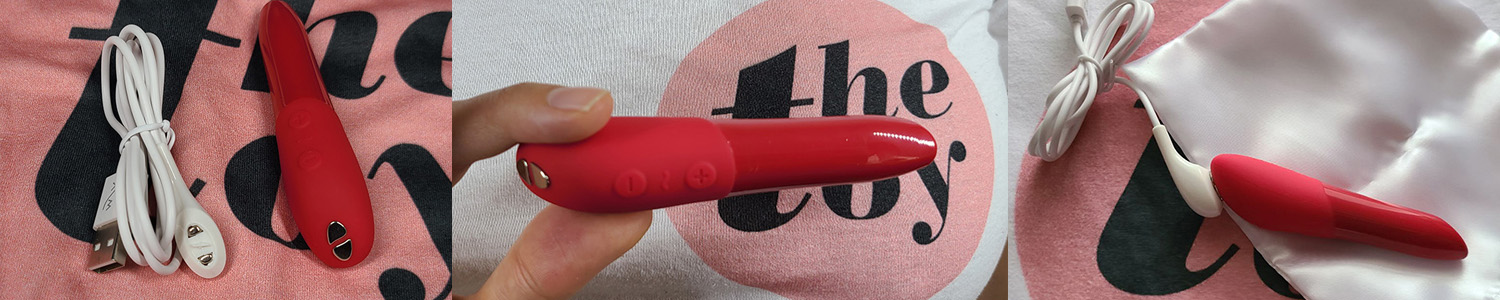
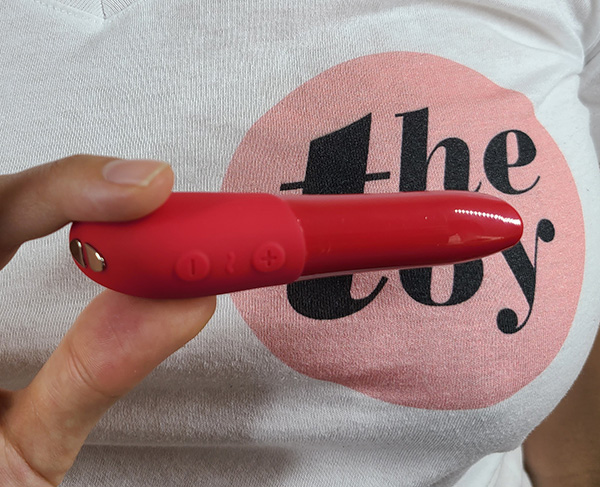
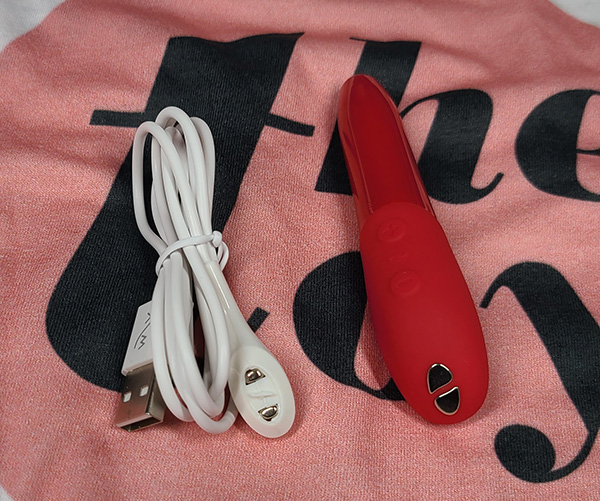
The Tango X is a 10.2 cm, 38-gram bullet vibrator with a hard ABS plastic tip and a silicone-coated handle. Eight steady intensity levels, six vibration patterns, three raised control buttons: + (power up), – (power down), ~ (pattern cycling). IPX7 waterproof. Magnetic USB charging takes roughly 90 minutes from empty to full. Battery life runs about 95–105 minutes on the highest setting and over two hours at moderate speeds. Ships with the charging cable, a satin storage pouch, a quickstart guide, and a small lubricant sample. Available in midnight blue or cherry red. Two-year manufacturer warranty.
This is the updated version of the original We-Vibe Tango, now discontinued. The X adds: 8 speeds instead of 4, a silicone grip section, three-button controls, stronger magnetic charging, a travel lock, and roughly 30% longer battery life.

What the vibration actually does to your body
The “rumbliest bullet” — what that means and what it doesn’t
The Tango X operates at approximately 50 Hz at its median — an uncommonly low fundamental frequency for a motor this small. That’s the primary basis for the “rumbliest bullet” label, and it’s genuine. Compared to bullets running in the 70–100 Hz range, the Tango X’s vibration cycle is noticeably slower, and most nervous systems register that slower cycle as deeper, weightier, more full-bodied. There’s solid research showing that preferred clitoral stimulation varies enormously from person to person — pressure, location, pattern, directness — but as a broad tendency, many people report preferring vibrations that feel “deeper” rather than surface-buzzy. The Tango X’s low fundamental puts it in that preferred territory.
But frequency only tells you the pitch of the vibration. It doesn’t tell you the texture, the harmonic cleanliness, or how deep the energy actually travels into tissue.
When I put the Tango X on the oscilloscope, the waveforms came back jagged and asymmetric across most speeds — the signature of a motor producing significant upper harmonic content on top of its low fundamental. My power and harmonics analysis scored the Tango X at 2.4 for deep rumble energy and 5.1 for sharp/buzzy character, with a deep-versus-sharp balance of 4.8. For context: the Lovense Ambi — a bullet most people assume is buzzier — scores 7.0 on deep rumble and 10.0 on balance. The Ambi delivers nearly three times more deep-frequency energy with a far cleaner waveform.
Against your skin, what this means is: the Tango X’s vibration has a low-pitched tone your body recognizes as deep, but the texture layered on that tone is grainy rather than smooth. Each vibration pulse arrives with definition and a slight mechanical edge, not as a seamless wave that pools into tissue. Some bodies find that texture engaging — more present, more alive, more like stimulation with a heartbeat. Other bodies, especially at higher sensitivity or during longer sessions, will eventually register the harmonic roughness as gritty or irritating, particularly at the top speeds where the waveform picks up more harmonic artifacts.
The common shorthand — “Tango X is rumbly” — captures the tone. It misses the texture. This matters because a body that craves smooth, deep, enveloping vibration may find the Tango X unexpectedly edgy despite its low frequency. A body that wants vibration with definition and assertiveness will feel exactly served.
The Tango X is low-frequency, but that does not make it smooth
My lab read: The Tango X earns part of its reputation. Around 50 Hz, it has one of the lowest fundamental frequencies I’ve measured in a bullet. But the oscilloscope showed jagged, asymmetric waveforms across most speeds, and the deep-versus-sharp balance landed at 4.8.
That means “rumbly” is only half the truth. The pitch is low, but the texture is not silky. There is harmonic grit sitting on top of that low base note, and the hard plastic tip transmits it without softening anything.
Why this matters in a body: If your body loves firm, defined, bass-heavy contact, the Tango X can feel unusually satisfying. If you need smooth, enveloping rumble, it may feel sharper and more mechanical than the hype prepares you for.
What the hard plastic transmits
The tip measures Shore A 99 — rigid ABS plastic, no compression, no give. The shape your eyes see is the shape your tissue gets, and that has two consequences running simultaneously.
Precision is exceptional. The lipstick-angled tip has a flat face for slightly broader contact and a beveled edge for tighter targeting, and rotating between them produces a clear, immediate shift in sensation. The geometry holds under pressure instead of deforming the way soft silicone does. If your body responds to knowing exactly where stimulation lands, this material serves that beautifully.
But the material also filters nothing from the motor. Every harmonic artifact, every asymmetric peak in the waveform reaches your nerve endings at full fidelity. Silicone-tipped bullets — the Ambi at Shore A 54, the Touch X at Shore A 24 — absorb some of that harmonic texture and soften the contact edges. The Tango X doesn’t buffer. If the motor is producing clean, weighted vibration at a given speed, you feel the full benefit. If it’s producing grit, you feel that too, unedited. The material is radically honest.
This matters if: you love direct contact and hate muffled silicone. It also matters if hard, unfiltered vibration makes you numb or irritated quickly.
That is also why hard plastic and softer silicone can feel like two completely different languages even when the motor underneath them is similar. The difference is not just comfort. It is how much of the vibration gets through unfiltered, which is the whole issue in soft versus firm vibrators.
The clitoral complex extends well beyond the visible glans, with internal structures — the clitoral body, crura, vestibular bulbs — that respond to vibration transmitted through tissue. How much energy reaches those deeper structures depends largely on displacement: the physical distance the tip travels per vibration cycle. The Tango X’s tip displacement ranges from 0.08 mm at the lowest speed to 0.16 mm at maximum. That’s moderate. Enough to push past the skin surface, but it won’t reach as deep into the clitoral body as the Ambi’s 0.36 mm peak or even the Touch X’s 0.19 mm through its broader, softer head. The Tango X’s depth signature comes more from its low frequency — the perceptual weight of each slower cycle — than from raw tissue displacement. It feels and sounds deep. The energy that actually travels into the internal structures is mid-range, and a body accustomed to high-displacement rumble from a different toy may notice the difference.
Plain-English tradeoff: the Tango X sounds and feels low, but it does not push as deeply into tissue as higher-displacement bullets like the Ambi.
How the speeds actually progress
The Tango X’s intensity ramp scores 3 out of 10 on my linearity index. For reference, the Lovense Ambi and Exomoon score 10 via their apps, and the LELO Lily 3 scores 8. A linearity of 3 means the jumps between speeds are uneven, occasionally dramatic, and sometimes counterintuitive — what feels like one intensity at the tip may register as a completely different intensity in the handle.
Speeds 1–2 are warm-up. The tip delivers light, present vibration — clearly there, but not yet doing sustained work on most bodies. Through underwear at speed 2, the flat face against the clitoral hood gives a low, steady pulse that’s pleasant for the opening minute of a session. But the handle at speed 2 is where the ramp reveals its personality: that 0.30 mm displacement spike means your grip hand is vibrating three times harder than the contact point. This is the setting that teaches you — forcefully — that the Tango X needs to be pressed against something, not dangled in the air. Firm body contact absorbs the handle energy and lets the tip’s character come through.
Speeds 3 and 4 are where the Tango X hides its best trick. Speed 3 delivers 7/14/0.12 at the tip (acceleration, velocity, displacement) with 10/25/0.25 at the handle. Speed 4 delivers the exact same tip output — 7/14/0.12 — but the handle drops to 10/16/0.12. Identical clitoral stimulation, dramatically less hand rattle. This appears to be an RPM that resonates less with the plastic casing, so less motor energy escapes into the grip. In practice, speed 4 is the setting where I stopped noticing I was holding a vibrator and started noticing what was happening in my body. The vibration at the tip felt controlled, directed, and workable — an intensity that builds arousal without rushing it, that lets you settle into sensation rather than chasing it. If you try the Tango X and click right past speed 4 on your way to maximum, you may miss the best thing this bullet does.
Speed 4 gives you speed 3’s tip output with far less hand punishment
My lab read: Speed 3 and speed 4 deliver the same tip output: 7 m/s² acceleration, 14 mm/s velocity, and 0.12mm displacement. But the handle changes dramatically. Speed 3 sends 0.25mm into the grip. Speed 4 drops that to 0.12mm.
That makes speed 4 the hidden sweet spot. It is not more powerful at the contact point, but it is cleaner to hold. Less vibration escapes into your hand, so the stimulation feels more directed.
Why this matters in a body: You get the same clitoral signal with far less finger rattle. That means steadier placement, less distraction, and more room to actually feel the low-frequency precision the Tango X is known for.
Speed 5 lurches. Handle acceleration doubles from 10 to 20. Handle velocity jumps from 16 to 30. The tip increases modestly. The gap between 4 and 5 is the single biggest step change in the ramp, and it doesn’t feel like a half-step up — it feels like a gear shift. If you’re building toward climax at speed 4 and need just a little more, the jump to 5 may overshoot the range you were in.
Speed 6 steadies. This is the rare speed where tip and handle displacement equalize at 0.14, creating a more directed, less chaotic feel than speed 5. Strong, purposeful, and less hand-aggressive. Speed 7 is full power: 20/27/0.16 at the tip, nearly double the acceleration of speed 6. Through Shore A 99 plastic, this is fast, bright, assertive stimulation. One tester who needs strong vibrations called it “the first setting on this tiny thing that made me stop and pay attention.” A tester with higher clitoral sensitivity tried it once and went back to speed 4. Both reactions make complete sense given the motor data.
If this intensity feels sharp or ‘unusable,’ it’s likely because the stimulation is hitting the nerve trunk too hard. I’ve written a full guide on why your anatomy is a tree, not a target to help you troubleshoot this specific sensation.
Practical translation: full power is not automatically the “best” Tango X. For many bodies, the top speeds add sharpness faster than they add pleasure.
The hand that holds it
I built a hand fatigue index across every bullet in my testing collection because the question of “how much does this thing vibrate my fingers” matters more for session comfort than almost anything else about a bullet — and almost nobody measures it.
| Bullet | Peak Handle Vibration (accel / velocity / displacement) | Hand Fatigue Index (0–10) |
|---|---|---|
| We-Vibe Tango X | 22 / 38 / 0.30 | 10.0 |
| Lovense Exomoon | 22 / 36 / 0.24 | 8.8 |
| Lovense Ambi | 13 / 17 / 0.12 | 4.1 |
| Le Wand Bullet | 9 / 12 / 0.06 | 2.2 |
| We-Vibe Touch X | 7 / 13 / 0.06 | 2.1 |
| LELO Lily 3 | 3 / 9 / 0.09 | 1.9 |
| Le Wand Deux | 3.5 / 3.5 / 0.01 | 0.1 |
The Tango X’s handle buzz is not a comfort issue — it changes the whole toy
My lab read: At speed 2, the Tango X sends 0.30mm of displacement into the handle and only 0.09mm into the tip. That means your grip is absorbing more than three times the physical movement your body is receiving. Across my bullet set, it also has the highest Hand Fatigue Index: 10.0.
This is not a small ergonomic complaint. It is a performance problem you feel before the toy has a chance to prove itself. The motor is doing work, but too much of that work is happening in your fingers.
Why this matters in a body: Hand buzz steals attention. It makes your grip less precise, makes longer sessions harder, and can make the tip feel weaker than the motor sounds. If your fingers go numb before your body gets anywhere, that is not you being fussy. That is the toy leaking energy into the wrong place.
The Le Wand Bullet, at 2.2, lets you forget your hand is involved. The Tango X, at 10.0, makes your fingers part of the experience whether you want them there or not. At mid-range speeds — where handle displacement spikes to 0.25–0.30 — a session beyond ten minutes starts testing your grip comfort. The tingling doesn’t stay in the fingertips; it creeps toward the palm and settles in. If you have joint sensitivity, reduced grip strength, or any tendency toward hand fatigue, this isn’t a footnote to skim past.
If your hands tire easily, that is not a side note to shrug off. It changes whether a bullet stays usable long enough to matter, which is exactly the kind of thing I mean in the vibrator accessibility checklist.
The workaround is real and effective: firm body contact. When the tip presses into tissue, the body absorbs a significant share of the handle energy and the rattle drops. Wedging the Tango X into underwear elastic, between bodies during sex, or against a stable surface eliminates the handle problem almost entirely. The Tango X genuinely performs better when it’s held against something than when it’s suspended in the air. A lot of first-time users pick this up, hover it lightly against their skin, feel the hand buzz and the thin-seeming tip, and decide it’s been oversold.
It hasn’t. You’re just holding it the way it doesn’t want to be held. Press.
This is the technique that changes the toy: hover it and your hand gets the motor. Press it into tissue and your body gets more of the signal.
What I noticed during actual use
Alone, finding the sweet spot
I started the way I suspect most people start — speed 1, bare skin, light hold, curious. At that intensity and that grip, I felt more motor hum in my hand than against my body. Speed 2 made my fingers buzz hard enough that my reflex was to back off. Instead, I pressed the flat face of the tip firmly against the left side of my clitoral hood and held it there. The handle calmed. The tip sensation sharpened into something lower, steadier, more insistent — the weighted quality the Tango X is known for, finally arriving through the tissue instead of scattering through my hand and the surrounding air.
Speed 3 increased the tip output noticeably, but the handle crept back. When I reached speed 4 — the setting where the tip matches speed 3 but the handle drops — something clicked into place. The vibration felt directed and workable. My fingers quieted. I stayed at speed 4 for most of the session, occasionally rotating the tip from flat face to beveled edge, which tightened the sensation enough to feel like a half-step up in intensity without touching the controls. It was the kind of stimulation that lets your attention sink into what’s building rather than monitoring the tool that’s building it. The orgasm came after six or seven minutes — focused, tight, with a clarity that matched the tip’s precision.
What caught me: the same speed 4 felt different ten minutes later when I went for a second round already aroused. The tissue was swollen, the nerve endings more responsive, and the same 0.12 mm displacement that had felt “just right” now felt more forceful. I backed down to speed 3, and the handle rattle bothered me less this time because arousal had shifted my attention threshold. The Tango X felt like a different toy in a different body state, which is exactly what the research on arousal-dependent sensitivity predicts — and worth knowing before you lock in a “best speed” after a single session.
That is also why “best setting” advice ages so badly. The same toy can feel perfect, pointless, or suddenly too much depending on where your tissue and arousal level are that day, which is the whole point of why the same toy can feel amazing one day and wrong the next.
Use lesson: don’t marry one Tango X speed. Start with speed 4, then adjust by arousal state, pressure, fabric, and contact angle.
Between bodies
The Tango X measures 6.5 cm in girth — barely over 2 cm in diameter — with a rigid, tapered shape. This makes it one of the easiest bullets to fit between two bodies during penetration, and one of the few where the profile actually stays useful rather than getting in the way. In missionary, I angled the tip against my clit with the handle resting against my partner’s lower abdomen, and it held position without much correction. He described the vibration transfer as a low, pleasant background hum through my body — present but not distracting, enough to register without changing his own sensation.
The rigid tip is a genuine advantage in this context: it maintains its contact geometry in the tight space between two bodies instead of deforming the way a soft silicone bullet would. But it’s also less forgiving during movement. If the angle shifts and the hard edge catches against the pubic bone rather than soft tissue, you feel the rigid corner immediately. Slower, more deliberate rhythm during penetration suits the Tango X better than anything vigorous — it rewards intentional positioning, not scrambling.
Noise in practice
The Tango X sounds like a textured hum, not a high-pitched whine. My pitch annoyance analysis rated it 3 out of 10, which means the motor’s voice is low enough in frequency to blend into ambient room noise rather than cutting through it the way a buzzy, thin-sounding motor does. At 43 dB on the highest setting, it’s not the quietest bullet I’ve tested — the Touch X and Lily 3 are softer — but the sound profile is dominated by a broadband hum that disappears under a blanket or behind a closed door more gracefully than the raw decibel number suggests.
The catch: when the Tango X is held loosely or hovering, the hard casing picks up a rattling quality that’s more noticeable than the motor hum itself. Press it to your body and the rattle vanishes. This is another dimension of the same design truth: the Tango X rewards contact and penalizes air gaps, in vibration delivery and in noise.

The controls: the upgrade that actually matters
The three-button layout is one of the strongest design choices on the Tango X and, for many users upgrading from the original, may be the single most meaningful improvement. The original Tango used one button to cycle through every intensity and every pattern sequentially. Overshoot your speed? Cycle the entire list to return. Accidentally land on a pattern? Keep pressing until you loop back to steady vibration. The Tango X separates power up, power down, and pattern cycling into three distinct buttons, so you can step backward in intensity without a full loop and access patterns only when you deliberately want them.
The buttons are raised enough to find by touch in the dark and firm enough to feel like a clear press. In practice, though, the gap between them is tight — roughly 3 mm — and with wet or lubricated hands, I hit the pattern button accidentally twice across several sessions. Not catastrophic, but each time it happened it snapped my concentration at exactly the moment I didn’t want it broken. The flat side of my thumb works more reliably than the tip of my finger; I learned to use the pad for control and the nail for emergency retreat.
One legitimate frustration worth knowing: the Tango X doesn’t remember your last setting. Power off and it resets to speed 1. If you pause to reposition, take a break, or shift how you’re holding it, you’re clicking through multiple levels to get back. The Le Wand Bullet holds its last setting if this is a dealbreaker for you.
Where it falls short
The Tango X’s flaws all come from the same personality: firm, focused, low-pitched, and unfiltered. That can be exactly right — or too rigid, too buzzy in the hand, and too uneven in the ramp.
The intensity ramp isn’t smooth. Speeds 3 and 4 deliver identical tip output. The jump from 4 to 5 is the largest single step in the ramp. If your body needs to sit in a narrow intensity band during arousal buildup — which is more common than people assume, especially for anyone whose sensitivity shifts from day to day — the Tango X may skip right past the zone you need.
Heat builds. Multiple users report the hard plastic tip warming noticeably after five to eight minutes on higher settings. I noticed it too — not painful, but present enough to register as a change. Sealed rigid-body bullets don’t dissipate heat efficiently, and the Tango X is no exception. Some bodies welcome gentle warmth. Others find it distracting once they notice it. If you tend toward longer sessions on high power, this will eventually become part of the experience.
The original Tango was stronger at maximum. Multiple independent testers confirmed the X tops out slightly lower than the discontinued original. If you were a max-power user of the old Tango and relied on that ceiling, the X is a step backward at the very top of the range — even though it’s better in nearly every other respect.
Hard plastic is polarizing and there’s no option for a softer sleeve. Shore A 99 against sensitized genital tissue feels precise and clean to some bodies and sharp and unforgiving to others. You don’t get to split the difference.
What I love
- The 50 Hz fundamental is genuinely rare in a bullet this size, and the weighted, low-pitched quality of the vibration is something most competitors can’t match
- Speed 4 exists — same tip stimulation as speed 3, dramatically less hand rattle, and nobody talks about it
- Three-button controls that let you step backward in power without a punishing full cycle
- The slim rigid profile tucks between bodies during sex better than anything soft or wide
- Battery life that outlasts most sessions without a thought
What I don’t love
- My hand buzzes harder than my body at mid-range speeds, and it took conscious effort and technique to solve
- The speed ramp lurches where it should climb — the gap between 4 and 5 is too wide, and the plateau between 3 and 4 wastes a step
- No setting memory, so every restart means clicking from the bottom
- Waveform grit at higher speeds adds a textural edge that sensitive bodies will register and may not enjoy over time
- No softer tip option for bodies that need a buffer between motor and nerve
How it compares
We-Vibe Touch X — the most important fork in the road
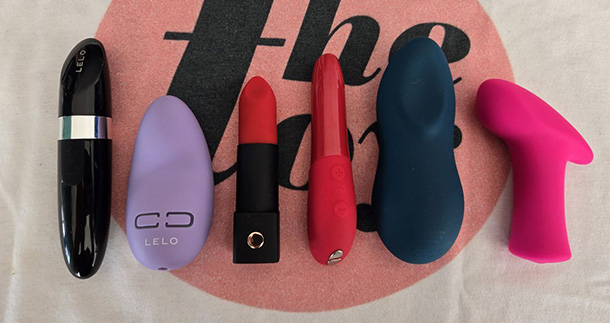
If you’re choosing between the Tango X and the Touch X, you’re deciding between two opposite philosophies of clitoral stimulation.
| Tango X | Touch X | |
|---|---|---|
| Tip material | Hard plastic, Shore A 99 | Soft silicone, Shore A 24 |
| Max tip displacement | 0.16 mm | 0.19 mm |
| Deep rumble score | 2.4 | 4.2 |
| Hand fatigue index | 10.0 | 2.1 |
| Weight | 38 g | 84 g |
| Profile during sex | Slim, rigid, stays in place | Broader, softer, more grinding-friendly |
The Touch X pushes nearly twice the deep rumble energy through a tip soft enough to spread the sensation across a wider area and forgive imperfect positioning. It’s less than a quarter of the hand fatigue. It’s the bullet for people who want to press and grind rather than point and aim, and for bodies that need material cushioning between the motor and their nerve endings. It’s also larger, heavier, and less suited to the tight fit between bodies where the Tango X excels.
If you want something you can park against your body and relax into, the Touch X does that better. If you need a slim precision tool you can aim during partnered sex, the Tango X earns its design.
If your body usually opens to pressure you can relax into rather than aim like a laser, the fuller read is in my We-Vibe Touch X review. It is the clearest contrast I know to what the Tango X is doing here.
Quick choice: Touch X if you want soft, broad, low-fatigue contact. Tango X if you want slim, firm, focused placement between bodies.
Lovense Ambi — the comparison the data complicated
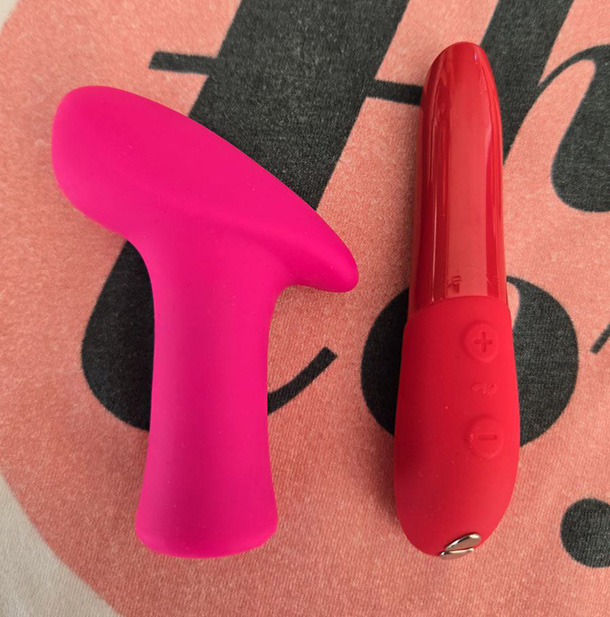
The Ambi costs $30 less than the Tango X and outperforms it by the numbers on several dimensions: a power index of 10.0 versus 5.2, deep rumble of 7.0 versus 2.4, maximum tip displacement of 0.36 mm versus 0.16, linearity of 10 (via app) versus 3, and hand fatigue of 4.1 versus 10.0. The Ambi also offers full app control for micro-step intensity adjustment and long-distance partnered play. On paper, the Ambi wins almost every category while costing less.
So why consider the Tango X at all? Because the Ambi’s fundamental frequency sits around 72 Hz versus the Tango X’s 50 Hz, and that difference in base pitch registers clearly against sensitive tissue. Some bodies specifically respond to the slower vibration cycle — it reads as heavier, more planted, more “inside the body” even when the actual tissue displacement is lower. The rigid tip adds a placement precision the Ambi’s softer silicone can’t match. If your nervous system locks onto low frequency and firm contact, the Tango X delivers a quality the Ambi doesn’t replicate, regardless of the Ambi’s advantages everywhere else. If you want more power, smoother control, less hand fatigue, and more features for less money — and you don’t specifically need that 50 Hz tone — the Ambi is very hard to argue against.
If what you care about is the tradeoff between raw output, app control, and a much cleaner deep-frequency profile, my Lovense Ambi review gets into why the Ambi keeps beating more famous bullets on the bench even when its base pitch reads higher on the body.
Upgrading from the original Tango
The X improves battery life by roughly 30%, adds a silicone grip that eliminates the original’s slippery-plastic problem, replaces single-button cycling with three-button controls, strengthens the magnetic charging connection, and adds a travel lock. The tradeoff is slightly less power at maximum. If your original still works and you only use it at full speed, the upgrade may disappoint at the ceiling. If the original’s battery has been dying on you — one of the most common complaints over the years — or the single-button interface drives you to distraction, the X earns the switch on ergonomics and battery alone.
Price and value
At $79, the Tango X sits at the premium end of bullet pricing. What does the money actually get you?
It buys the lowest vibration frequency in the bullet category, a rigid-tip precision profile that fits between bodies during sex better than nearly any competitor, genuinely excellent three-button controls, a two-year warranty (double the industry standard), reliable waterproofing, and battery life that comfortably outlasts most sessions. Those are real, tangible engineering achievements.
What it doesn’t buy: the strongest motor (Ambi wins), the deepest tissue displacement (Ambi wins), the smoothest intensity ramp (any app-controlled bullet wins), the quietest operation (Touch X and Lily 3 win), or the most comfortable grip across a long session (most competitors win, because most competitors don’t vibrate the handle this hard).
The premium is for frequency character, precision fit, and build confidence — not for raw performance superiority. The Lovense Ambi costs $49 and delivers more power, more control, and less hand fatigue. If those specific qualities — the low tone, the slim rigid geometry, the We-Vibe ecosystem and warranty — match what your body needs, $79 is defensible. If you’re buying a bullet for general performance and flexibility, the Ambi delivers more for less.

Who I’d recommend it to
People whose bodies respond specifically to lower-frequency vibration — the slower, weightier cycle — rather than raw displacement or overall power. People who use a bullet primarily during partnered penetration, where the slim, rigid profile is a real advantage that softer competitors can’t replicate. People upgrading from the original Tango who want better controls and battery without switching ecosystems. People who like precise placement with firm contact and find broader, softer contact surfaces too diffuse to stay mentally engaged.
Who should probably look elsewhere
If you need a graduated, predictable intensity ramp, the Tango X’s non-linear speed progression will frustrate you, and the Lovense Ambi or Exomoon with app control will give you the micro-step escalation you’re missing. If hand fatigue is a concern for comfort or accessibility reasons, the Touch X or Le Wand Bullet are dramatically easier to hold across a full session. If you have higher clitoral sensitivity and find hard materials sharp against aroused tissue, the Touch X at Shore A 24 will be substantially kinder. If you want the most effective bullet for the money without a specific need for low frequency, the Ambi is a better-performing, less expensive, more versatile choice.
Tips I learned from testing
- Start at speed 4. The first three settings are warm-up for most bodies, and speed 4 delivers the best tip-to-handle ratio in the entire ramp. Start there, work down if you need softer, up if you need more.
- Press into your body before you judge the vibration. The motor character transforms when the tip meets firm contact. Handle rattle drops, the low-frequency base comes forward, the surface grit recedes. This toy rewards pressure — light hovering wastes it.
- Rotate before you click up. Shifting from the flat face to the beveled edge changes contact geometry enough that your body may read it as a half-step increase in intensity without changing motor output. It’s the granularity the ramp doesn’t otherwise provide.
- Use fabric as a filter. One layer of cotton between Shore A 99 plastic and your clitoral glans softens the directness substantially. Good for the opening minutes, or on days your sensitivity is running higher.
- Water-based lube only on the hard plastic tip. Silicone-based lube can degrade the silicone handle over time. Keep the handle dry for grip; a drop of water-based lube on the rigid portion helps it glide without catching on dry tissue.
- Clean the magnetic contacts monthly. A dry cloth across the two metal discs at the base prevents the charging issues some users report over time. Five seconds of maintenance, potential months of avoided frustration.
This is one of those small technique shifts that sounds underwhelming until it solves the whole toy. One thin layer can take the edge off rigid contact without killing the signal, which is exactly why using a toy over underwear for softer stimulation works so well for sensitive days.
Living with it
Charging: The magnetic cable snaps to two contact points at the base. The connection is stronger and more stable than the original Tango’s, and it uses We-Vibe’s standardized cable — if you own other We-Vibe products, one cable works across the lineup. A white LED blinks during charging and holds steady when full. Charge time is about 90 minutes.
Battery consistency: Power delivery stayed steady across full sessions in my testing — no perceptible vibration drop before the low-battery indicator appeared. At moderate speeds, you’ll get well over two hours per charge.
Travel lock: Hold + and – for two seconds to engage. The same to unlock. It works, and I figured it out without the manual, which puts it ahead of a few competitors that require three-button sequences and a degree of patience I don’t always have when I’m packing a bag.
Cleaning: Non-porous ABS plastic and silicone, no seams that trap residue, no texture grooves. Warm water and mild soap, thirty seconds, done. One of the simplest toys I own to clean and one of the few where I’ve never found mystery residue hiding somewhere.
Durability note: Several Amazon reviewers report charging failure or motor death within 8–12 months of regular use. Others report years of daily use without issues, which points to quality control variation rather than a systemic design flaw. The two-year warranty covers defects with proof of purchase, and I’d recommend buying from We-Vibe directly or from an authorized retailer like Lovehoney to keep the warranty process straightforward if you need it.
Final note
The Tango X’s reputation as the “rumbliest bullet” is both earned and incomplete. The fundamental frequency is genuinely low, and through rigid plastic, that low frequency arrives at your body with a directness softer bullets can’t match. But the motor’s waveform carries texture, the ramp is uneven, the handle vibrates harder than the tip at several speeds, and the hard material amplifies every characteristic of the vibration without editing. It’s a bullet with a specific motor personality, and the experience depends entirely on whether your body connects with that personality or finds it abrasive.
What I keep returning to is the speed 4 discovery — the setting where the data shows identical tip output to speed 3 but the handle quiets, where the vibration stops scattering into the grip and starts arriving at the tissue with focus. Most users will probably click right past it on their way to maximum. They may not realize the sweet spot was already there. The Tango X taught me something that applies beyond this single toy: the best setting on a vibrator isn’t always the strongest one. It’s the one where the motor, the material, and the body are working together instead of against each other, where you can stop managing the tool and start listening to the sensation.
If low-frequency focused stimulation through a firm, precise contact surface is what your body reaches for — and you’re willing to learn the grip pressure and positioning the design asks for — the Tango X does something most bullets genuinely don’t. If you’re unsure, or you want more forgiveness in material and ramp, the Touch X and the Ambi are both excellent and easier to start with. The Tango X isn’t the bullet for everyone. It might be the only bullet for you.
Final shortcut: choose the Tango X if you want low-frequency precision in a slim, hard-tipped bullet. Skip it if you want soft contact, smoother ramping, less hand buzz, or more power for the money.
| Design: | (4.0 / 5) |
| Comfort: | (2.0 / 5) |
| Power: | (4.0 / 5) |
| Experience: | (4.0 / 5) |
| Controls: | (5.0 / 5) |
| Value: | (4.0 / 5) |
Tango X is a tiny, hard-tipped power bullet that can deliver fast, pinpoint orgasms, but it’ll buzz your hand to death if you don’t press it just right.
You can buy this bullet toy here:
What to read next
If this review made you realize how much the numbers behind a bullet can change what your body actually feels, read how we test bullet vibrators. That is where I break down what I am measuring when I talk about handle vibration, displacement, harmonic texture, pressure transfer, and why two bullets that sound similar on a product page can land so differently on the body.
If you already know you want a bullet but are still trying to figure out which kind of bullet fits your body best, go to my best bullet vibrators guide. That is the bigger map — the bullets that feel broader, softer, sharper, deeper, steadier, more forgiving, or more exact — so you can place the Tango X in context instead of guessing from hype alone.
Sources reviewed
- Herbenick, D., et al. “Women’s Experiences With Genital Touching, Sexual Pleasure, and Orgasm: Results From a U.S. Probability Sample of Women Ages 18 to 94.” Journal of Sex & Marital Therapy, 2018.
- O’Connell, H.E., et al. “Anatomy of the Clitoris.” The Journal of Urology, 2005.
- Puppo, V., and Puppo, G. “Anatomy of Sex: Revision of the New Anatomical Terms Used for the Clitoris and the Female Orgasm by Sexologists.” Clinical Anatomy, 2015.
If you are still unsure whether the Tango X fits the way your body likes stimulation, leave me a comment below. Questions about sensitivity, hand fatigue, partnered use, comparisons, or weird little “does this happen to anyone else?” moments are exactly where the most useful conversation usually starts.
Add comment