
The first thirty seconds rewired my brain.
The first time I turned on the Doxy Die Cast, I flinched. Not the subtle oh-that’s-strong kind—the involuntary dropped-it-on-the-duvet-and-stared-at-it kind. At its lowest setting. The very first click.
That was the moment I realized every other wand I’d tested had been whispering. The Doxy Die Cast walks through the door and doesn’t introduce itself—it announces.
Here’s what I can tell you after months of testing, vibrometer data on 16 different wand vibrators, conversations with multiple testers, and more orgasms than my spreadsheet was designed to handle: the Doxy Die Cast delivers some of the most intense vibrations available in any wand. It also weighs more than a bottle of wine, gets buzzy at higher power, has a quality control history that makes me bite my lip, and costs $215.
Whether that combination excites you or concerns you will determine everything. So I’m going to walk you through every honest detail—the jaw-dropping, the disappointing, and the stuff Doxy’s marketing page conveniently forgets to mention.
Quick Verdict: Should You Buy the Doxy Die Cast?

| Power: | (5.0 / 5) |

| Noise: | (3.5 / 5) |
| Material: | (4.0 / 5) |
| Price: | (3.0 / 5) |
| Ease Of Use: | (2.5 / 5) |
A heavy, corded, metal-bodied wand with exceptional low-speed rumble and extreme intensity. Best for power lovers who want weighted pressure, not a light or beginner-friendly wand.
You can buy this product from:
Buy the Doxy Die Cast if you want one of the most intense, body-heavy wand experiences available—and you already know softer vibrators leave you bored. This is not a cute starter wand. It is a 25.8 oz (730g), corded, metal-bodied powerhouse that feels deep, heavy, and almost absurdly commanding on its lower settings.
Skip it if you need light, cordless, waterproof, beginner-friendly, or wrist-friendly. The lowest setting is already stronger than many vibrators at full power, the top settings get buzzier, and the weight can turn from luxurious to exhausting fast if you have to hold it in the air.
Sensation profile: deep, cushioned, pressure-heavy rumble on the first two settings; sharper, faster, more surface-level intensity as you climb higher. The magic is not at maximum power. For me, it lives in that low-speed thud where the soft head, heavy body, and 1.3mm amplitude all sink in together.
Biggest flaw: the physical demand. This wand asks a lot from your wrist, your positions, your storage space, and your patience with the cord. The mixed reliability record also makes the $215 price harder to swallow than it should be.
Closest competitors: the Magic Wand Rechargeable is the better all-around pick for most people because it is cordless, cheaper, rumblier at high power, and easier to live with. The Lovense Domi 2 is the smarter choice if you want serious power that actually fits between bodies.
Is it worth it? Yes—but only for the right person. If you crave weighted pressure, deep low-speed rumble, and the kind of intensity that makes most toys feel polite, the Doxy Die Cast can feel irreplaceable. If you want the safest recommendation, buy the Magic Wand Rechargeable. If you want the wand that made me flinch on setting one and still earned a permanent spot on my nightstand, this is the one.
What Is the Doxy Die Cast, Exactly?
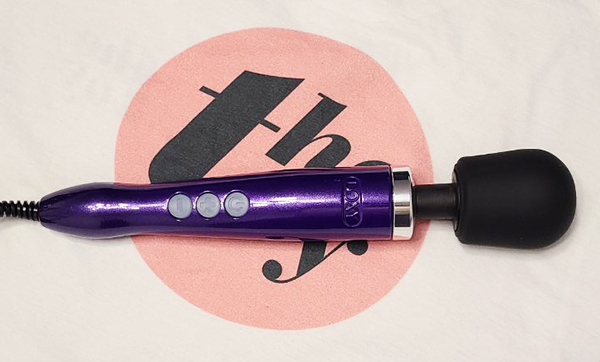
For anyone just entering the wand world: the Doxy Die Cast is a full-sized, plug-in wand vibrator from British company Doxy. It’s the premium upgrade to their original plastic-bodied wand, built with a die-cast aluminum-titanium alloy body that fundamentally changes how vibration reaches your body.
The hard numbers:
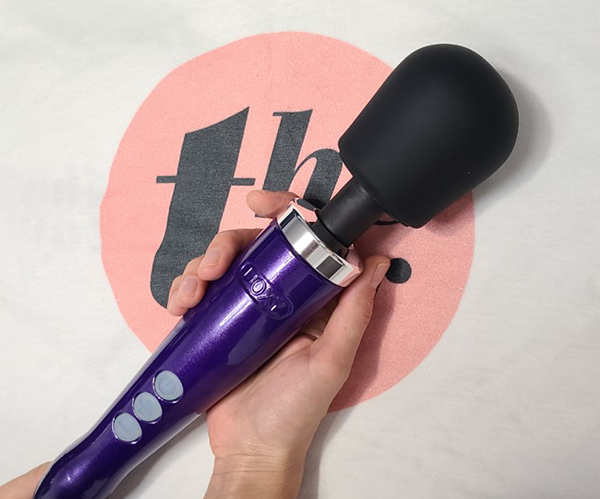
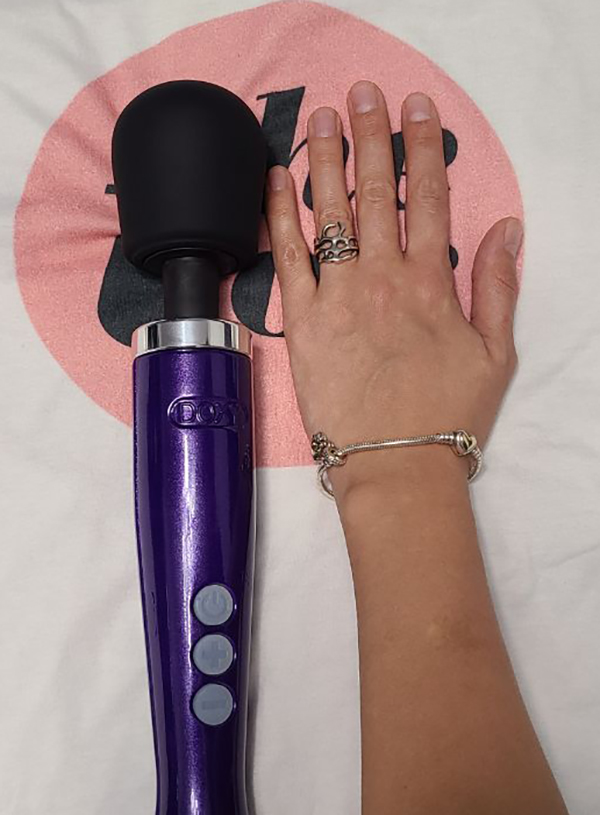
- Length: 13.4 inches (34 cm)—longer than most forearms
- Weight: 25.8 oz (730g) on my scale—the heaviest wand I’ve tested
- Head circumference: 7.9 inches (20 cm)
- Handle length: 9.4 inches (24 cm)
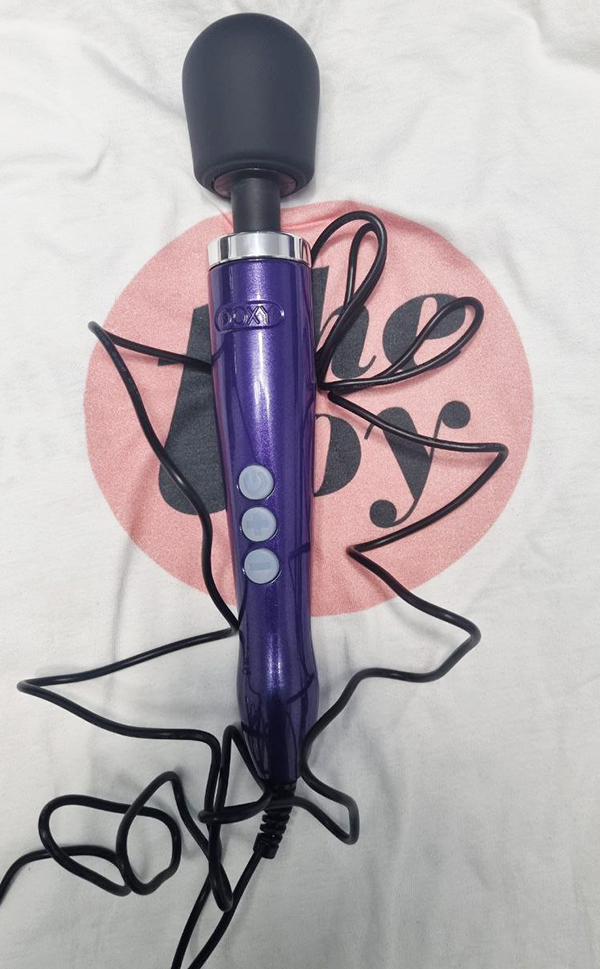
- Power source: Corded, 10-foot (3-meter) cable
- Speed range: 3,000–9,000 RPM across 7 speed steps
- Head material: Medical-grade silicone, Shore A softness of 18 (very soft)
- Body material: Die-cast aluminum-titanium alloy
- Neck flexibility: 35 degrees
- Waterproof: Absolutely not
- App control: No
Die casting is an expensive manufacturing process, and the result isn’t just cosmetic. That heavy alloy body acts as a vibration anchor—the motor can push energy forward into the head instead of wasting it shaking a lightweight shell. It’s the same motor as the Doxy Original, but the Original’s Power Index scores a 6. The Die Cast scores a 9. Same engine, dramatically different vehicle.
I could feel that difference before I had the language for it: less hollow chatter in the handle, more weight landing through the head.
This matters if: you want pressure that sinks in instead of a wand that shakes your hand and skims the surface.
Quick note: Don’t confuse this with the Doxy Die Cast 3, a smaller model that’s significantly less powerful and buzzier. If someone says “Doxy Die Cast” in a recommendation, they almost certainly mean this full-sized version.
Power: The Reputation Is Real (With Caveats)
If your current vibrator makes you think “is this thing even on?”—this section is for you.
I measured the Doxy Die Cast on a vibrometer alongside 15 other wand vibrators. The numbers reveal something more interesting than just “it’s powerful.”
At the lowest setting, it produces 40 m/s² of acceleration with a vibration amplitude of 1.3mm. That amplitude is the highest starting measurement of any wand I’ve tested. The Magic Wand Rechargeable starts at 1.0mm. The We-Vibe Wand 2 starts at 0.8mm. Against your body, that means the head is making deep, sweeping movements from the very first setting. You feel it spreading through tissue, not just vibrating across the surface.
At the highest setting, acceleration climbs to 130 m/s², but amplitude drops to 0.46mm. The head moves faster but shorter—tighter, more frantic oscillations. Still brutally powerful, but the character of that power changes completely. More on that in the rumble section.
On paper, that looks like “more power”; on my body, it felt narrower, faster, and less plush than the lower settings.
This feels like: the top speeds get sharper and more prickly, not simply deeper or better.
So is it actually the most powerful wand? Here’s where I give you the answer nobody else does. My vibrometer shows the Magic Wand Plus (180 m/s²) and Magic Wand Rechargeable (187 m/s²) measuring higher peak acceleration. Raw motor output at maximum, the Magic Wands technically edge it out. But—and this is a significant but—the Doxy Die Cast’s 25.8-ounce die-cast body means those vibrations land differently. The mass drives them into your body with a thudding physical authority that lighter wands can’t replicate. Multiple independent testers and review sources rate the Die Cast as the most intense wand they’ve experienced. My vibrometer captures motor output; your body captures the complete physics of motor-plus-weight-plus-head-softness. And your body will probably agree with the consensus.
On my Power Index (1–10), the Doxy Die Cast scores a 9. Only the Magic Wand Plus and Magic Wand Rechargeable score higher at 10.
The exponential ramping curve is the gotcha. Power doesn’t build evenly between levels—it escalates. The first two settings feel manageable. Warm. Inviting. Then the third setting takes a noticeable leap, and by the fourth or fifth, you’re in territory that made one tester gasp and yank it away reflexively. That exponential jump makes finding your perfect middle intensity harder than it should be. If you like to slowly ride the edge, the seven speed steps with this kind of curve give you less fine-tuning room than, say, the Magic Wand Rechargeable (which has a similar curve but slightly more breathing space in the middle).
This matters if: your body likes slow build-up; one click can move from pleasant to too much.
About those “seven speeds”: Doxy claims “continuous progression.” Reality: each button press jumps 1,000 RPM. If 4,000 RPM is too gentle and 5,000 RPM pushes you over, there’s no 4,500 to split the difference. You hold the button to scroll faster through levels, but you can’t land between them.
This is where the controls started to annoy me, because my body wanted half-steps the toy simply does not offer.
Skip this if: you need tiny half-steps to stay on the edge without tipping into overstimulation.
Here’s the thing that reframed everything for me. I spend roughly 90% of my time on the first two settings. The lowest is already more powerful than the highest setting on most non-wand vibrators. The second setting is already stronger than my favorite G-spot vibes at full blast. And the rumble at those levels is gorgeous. The extreme upper settings exist for people who need them—and some truly do—but the Die Cast’s moderate power is where I found something I didn’t know I was looking for.
One reviewer who typically takes 25 minutes to orgasm with a bullet vibrator reported finishing in under five. Another described coming in seconds on the highest setting—then needing to stop entirely from overstimulation. A tester with chronic conditions said the Die Cast was the first toy that made orgasm feel accessible on her terms, not something her body had to fight for.
The tradeoff: If you want a wand with more precisely graded moderate settings, the Magic Wand Rechargeable or We-Vibe Wand 2 give you more room to breathe in the mid-range. If absolute peak intensity is the priority above all else, the Die Cast competes with the best.
Rumble vs. Buzz: The Die Cast’s Split Personality
If you’ve ever used a vibrator that felt “numbing” or “surface-level,” this section explains why—and how the Die Cast handles it.
Quick primer: rumbly vibrations are lower-frequency, deeper movements that penetrate tissue and tend to feel pleasurable over longer periods. Buzzy vibrations are high-frequency surface sensations—intense but often numbing. Most experienced users strongly prefer rumble. All wands get buzzier as power increases—that’s physics. The question is how much.
The Doxy Die Cast has a genuine dual nature here.
Low settings (3,000–4,000 RPM): Beautifully rumbly. My frequency measurements show a ratio of 0.42 at the lowest setting—solidly low-frequency. The acoustic character is a low hum, the kind you feel as much as hear. That massive 1.3mm amplitude means the vibrations are reaching into you. This is the Die Cast at its most seductive, and where I spend almost all my time. Deep Rumble Index: 7 out of 10.
High settings (7,000–9,000 RPM): The frequency ratio climbs to 1.0. Amplitude drops from 1.3mm to 0.46mm—a 65% decrease. The acoustic character shifts from low hum to mid-mechanical buzz. It’s not the harsh, whiny buzz of cheap motors—harmonically, the Die Cast stays clean at every level, no rattling or jittering—but the deep rumble disappears and you’re left with brute-force surface intensity. Several testers called the upper levels “too buzzy to enjoy.” Others with lower sensitivity handled them fine.
Why does the amplitude drop so dramatically? When the motor spins faster, the weighted head can’t maintain those big sweeping movements. It oscillates more rapidly but in a tighter arc. Compare this to the Magic Wand Rechargeable, where amplitude actually increases from 1.0mm to 1.3mm at peak—it maintains deep strokes even when pushing hard. That’s why the MWR stays rumblier at maximum intensity.
I could feel this shift before I saw it in the data: the low settings spread; the high settings sharpen.
This matters if: you want max power to still feel deep; this wand becomes more surface-focused as speed rises.
What this means for your body: If you’re buying the Die Cast for its first two or three levels—and based on tester feedback and my own sessions, most people will—you’ll experience deep, luxurious rumble the entire time. If you’re buying it to live at 9,000 RPM, the sensation is powerful but distinctly buzzier. Neither experience is wrong. But knowing which you’re signing up for matters.
If you need rumble at all power levels, the Magic Wand Rechargeable (Deep Rumble Index: 9), Lovense Domi 2 (Deep Rumble Index: 8), or Lovehoney Desire (Deep Rumble Index: 8) maintain deeper vibrations across their full range. If you want near-Die Cast intensity with less buzz, the BMS PalmPower Extreme is less buzzy at peak power and nearly as strong.
One detail worth highlighting: the Die Cast’s harmonic consistency is clean at every level. No rattling. No chaotic micro-jitter. Clean vibration is soothing, controllable, and less likely to cause numbness over time. Even when the Die Cast gets buzzy up high, it buzzes smoothly—and that matters more than most spec sheets acknowledge.
In use, that clean buzz mattered because the higher settings felt intense, not messy.
This feels like: smoother buzz, less scratchy chaos; still intense, but less like static on your skin.
The Weight Question: Your New Best Friend or Your Wrist’s Worst Enemy
This section is for anyone hovering between “ooh, luxurious” and “wait, can I actually hold that?”
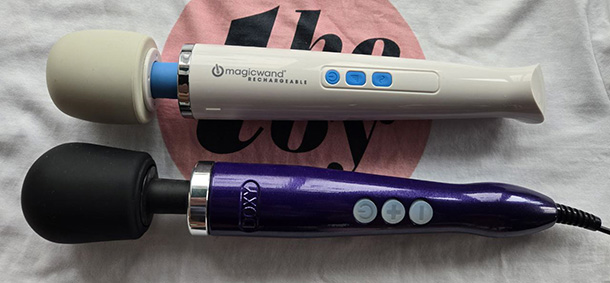
At 25.8 oz (730g), the Die Cast outweighs every wand in my collection. The Magic Wand Rechargeable comes next at 21.2 oz (600g). The compact Lovense Domi 2 is just 10.2 oz (290g)—less than half the weight.
This was not just a spreadsheet problem; I felt it in my forearm before the session was over.
My Hand Fatigue Index rates the Die Cast a 10 out of 10. Highest fatigue score of any wand tested. That score factors in the heavy front-loaded body, the 9.4-inch handle creating leverage against your wrist, the 130 m/s² high-setting acceleration fighting your grip, and that broad head creating drag. After 15 minutes of active maneuvering, my forearm burns. After 20, I’m repositioning my entire body partly just to rest my hand.
And yet—this weight is also the Die Cast’s secret weapon.
This matters if: you use toys in positions where your hand has to hover; the weight will show up fast.
When you’re lying on your back, the wand practically holds itself. Rest the head between your legs, let go, and the mass presses it into your body with deep, effortless pressure. No death-gripping the handle. No wrist gymnastics. No leveraging your arm at awkward angles to maintain contact. Just gravity and 25.8 ounces doing exactly what you want. In missionary position with a partner, the weight naturally pushes vibrations deeper without either of you lifting a finger.
You’ll enjoy this if: you like firm pressure but hate gripping hard; the wand can rest into you instead of needing a tight hold.
The silicone head softness amplifies this. At Shore A 18, the head is extraordinarily soft—softer than the We-Vibe Wand 2 (Shore A 13 is softer, but the Die Cast’s mass compresses that 18 to feel incredibly plush under pressure), and dramatically softer than the Magic Wand Rechargeable (Shore A 39) or Le Wand (Shore A 48). The head molds to your body’s contours instead of pressing a rigid dome against you. Combined with the weight, the sensation is cushioned, enveloping, and—I know this word gets thrown around carelessly—genuinely comforting.
This feels like: a soft, heavy cushion pressing in, not a hard dome poking one sensitive point.
Energy stays where it belongs. The Die Cast is forward-focused: vibration projects into the head and into your body, not backward into the handle. Some cheaper wands “back-bleed,” shaking your hand more than stimulating anything useful. The Die Cast avoids this, though at higher settings you’ll still feel vibration in the grip simply because of the sheer force involved.
I noticed this most in my hand: the grip never became the main event.
The neck flexes 35 degrees—enough to adapt to body curves, rigid enough to transmit vibration efficiently. It reduces shock transfer to your wrist compared to a completely stiff neck design.
Body Compatibility Index: 2 out of 10. I’m not going to soften this. That’s the lowest score in my entire comparison set. The Die Cast’s size, weight, and cord mean it physically does not suit every body type, hand size, or use scenario. Smaller hands will struggle to grip the wide handle. Anyone with carpal tunnel, arthritis, or limited wrist mobility should seriously consider alternatives. If you need to hold the wand in the air or at angles for extended periods—it will exhaust you.
This is the score I would take seriously if your hands, wrists, positions, or patience are picky.
Skip this if: your best positions require lifting, angling, or holding a toy away from the bed for more than a few minutes.
One tester with limited mobility noted that the weight was actually beneficial for her—she could position the wand and let the mass do the work, eliminating the constant muscular effort lighter wands require. Doxy themselves suggest the weight makes it “great for positioning for a hands-free experience or those with restricted mobility.” There’s truth to that, depending on which limitations you’re working with. You know your body; trust what it tells you.
If the weight concerns you: The Lovense Domi 2 (Body Compatibility Index: 9) delivers serious power in a package less than half this weight. The Le Wand (Body Compatibility Index: 10) is the most universally accommodating wand I’ve tested. Either is a legitimate choice—not a consolation prize.
If the weight intrigues you: The first time you lie back and let the Die Cast settle between your legs without gripping the handle, you’ll understand why people get evangelical about this particular wand.
Solo Sessions: What Months of Testing Actually Looked Like
I could list features all day. But you want to know what it’s like. Here’s where I spent my time with this wand.
The weeknight default. Propped on pillows, back in bed, wand resting between my legs over a layer of underwear. Lowest setting humming. The weight holds the head in place without my hand doing anything meaningful. The 10-foot cord runs from the nightstand outlet to mid-bed with slack to spare. Many sessions, I start here, stay here, finish here. The deep 1.3mm amplitude rumble through fabric is all I need.
Over clothing for slow warmup. Jeans. Leggings. Underwear and a blanket. The Die Cast punches through all of it. This isn’t a toy that needs direct skin contact to register—the power and the broad 7.9-inch head mean you’re stimulating your entire vulva simultaneously through whatever you’re wearing. I’ve used this as a deliberate foreplay strategy: building arousal over 10-15 minutes through layers before removing anything. The distributed sensation engages more nerve endings at once than any pinpoint vibrator can, and it’s part of why wand orgasms often feel bigger than clitoral-only stimulation.
Paired with a penetrative toy. The Die Cast against the clit while using a firm internal toy is a combination that has restructured my understanding of what’s possible in a solo session. The vibrations travel through tissue so effectively that you can feel them through the vaginal wall when an internal toy is in place. One reviewer described being so thoroughly aroused by the wand that she escalated to progressively larger internal toys within 20 minutes—something that usually takes her much longer to be ready for. Coordinating two toys when one weighs nearly two pounds requires some logistics. Propping the wand handle between your thighs or on a pillow next to your hip gives your other hand freedom.
The hidden pulsation mode. Doxy barely advertises this, and I discovered it embarrassingly late—months into testing, after another reviewer tipped me off. Here’s how: turn the wand off completely. Then press and hold the power button for 2-3 seconds. A pulsating ramp mode engages—it escalates from minimum to maximum power and back down in waves. Use plus/minus to adjust the ramp speed. Turn it off and on normally (quick press) to return to steady vibration. It’s pleasant for warming up and gives a different buildup rhythm. I prefer steady vibration for the finish, but the ramp mode has become part of my warmup routine.
The pillow trick that changed everything. I wedged the handle between a firm pillow and the mattress while lying on my stomach. The pillow pins the wand, my body weight presses the head where I need it. Zero hand fatigue. Zero grip. I can stay in this position for as long as I want without my forearm staging a rebellion. This single discovery turned the Die Cast from a toy I loved but had to take breaks with into one I could use for extended, completely relaxed sessions.
Sitting in a chair at the desk. The 9.4-inch handle reaches between legs from either direction. The weight works against you here—you’re holding it at an angle rather than letting gravity help. Serviceable for a quick session (under 10 minutes), but my wrist taps out after that. Not its best use case.
Thermal behavior: After 10 continuous minutes at maximum power, the head temperature rose from 61.9°F (16.6°C) to 68.2°F (20.1°C)—only a 6.3°F increase. Compare to the LELO Smart Wand 2, which rose 15.3°F in the same test, or the Mantric at 12.8°F. The Die Cast’s metal body acts as a heat sink, and no battery means no internal heat buildup. It warms slightly—never gets hot. Long sessions don’t become uncomfortable from temperature.
In actual use, the important part is simple: the head never started feeling hot or distracting during longer sessions.
This matters if: you run long sessions and hate toys that get warm enough to pull your attention away.
Vibration decay: zero. Corded means consistent. Power at minute one and minute forty-five is identical. No slow fade, no battery-induced throttling, no gradual weakening that sabotages a building orgasm right at the worst possible moment. If you’ve ever had a rechargeable vibrator die on you at the edge—this problem doesn’t exist here.
Partnered Use: Can a 13-Inch Corded Wand Fit Between Two Bodies?
Yes. With choreography.
Modified missionary: The Die Cast’s weight becomes an asset. Place the head against the vulva, wand resting between your bodies, and the mass holds it in position while both of you stay focused on each other. The broad head means millimeter precision isn’t necessary—”anywhere in the general neighborhood” provides more than enough stimulation. One tester’s partner said he could feel the vibrations traveling through her body and into his, which he found surprisingly arousing.
Spooning: One of the more comfortable partnered positions for this wand. Reach between your legs from behind, rest the base of the handle on the mattress to support the weight. The long handle actually helps here—it gives you leverage while the bed bears the load.
Doggystyle: The most challenging position. You’re supporting the wand’s weight with one arm while on hands and knees. The handle-on-mattress trick works if you find the right angle, but it takes experimentation. Hand fatigue sets in faster here than in any other position.
Cowgirl: Requires leaning back slightly to fit the head between bodies. One tester leaned back about 30 degrees and held the wand with one hand while her partner held her hip. Not seamless, but the intensity justified the effort.
On a partner’s body: Multiple testers report the Die Cast feels incredible against a penis shaft, against the perineum, across the balls. The broad, soft head and deep vibrations translate well to any external anatomy. One tester pressed the Die Cast against the outer shell of a Fleshlight while his partner used it, and the vibrations transmitted through the entire toy. Another partner described the sensation as feeling the vibrations “through his entire pelvis.”
The cord factor: You’ll want to route the cord before things get heated. Behind the pillow, along the mattress edge—somewhere neither of you will roll onto it during position changes. In months of partnered testing, neither I nor my partners have actually tripped on it, but it requires a moment of awareness that cordless wands don’t ask for.
If partnered use is your primary goal, the Lovense Domi 2 (10.2 oz, compact, app-controlled) or BMS PalmPower Extreme (angled head, lighter, waterproof) will tuck between bodies with dramatically less effort. They sacrifice the Die Cast’s weight-driven pressure and that massive starting amplitude—but they go places the Die Cast physically can’t reach. (Our guide to using a wand vibrator during partnered sex covers position-specific strategies for both large and compact wands.)
Hands-Free With Mounts and Attachments
With the Liberator Axis: The handle slides in horizontally, tilting the wand slightly upward. The Die Cast’s thick handle stays wedged firmly—no wobble, no slipping. You lie across the mount on your stomach and straddle the head. The large head naturally contacts the clit without precise body positioning. The weight that causes hand fatigue becomes irrelevant when the mount is doing the holding.
With the Liberator Wanda: Holds the wand mostly upright for straddling. Kneel or lean forward onto elbows and knees. The Die Cast’s head sits at excellent height in this position, and the slight lip where the head meets the neck creates a focused ridge for more direct pressure.
Standard wand attachments fit. The 7.9-inch head circumference is close enough to the Magic Wand’s that G-spot, anal, prostate, penis, and dual-stimulation attachments designed for the Magic Wand are compatible. Every attachment I’ve cross-tested fits both wands.
I didn’t have to hunt for Doxy-specific attachments; the Magic Wand-sized ones I already had fit cleanly.
Noise: What Your Roommates Will (and Won’t) Hear
Lowest setting: 47 dB at 1 foot—a low hum, like a quiet refrigerator. Behind a closed door: 32 dB. Your roommate will not hear this. A partner in the next room will not hear this.
Highest setting: 65 dB at 1 foot—normal conversation volume, except this conversation is happening between your legs. Behind a closed door: 35 dB. One tester’s partner confirmed he could hear the vibrations through the wall at maximum.
The acoustic character changes with speed. Low power produces a low hum—discreet, calming. High power shifts to a mid-mechanical buzz. Crucially, the Die Cast never develops the high-pitched whine that the Magic Wand Plus does at full power (the Magic Wand Plus reaches 65 dB with a rattly-to-high-pitched acoustic character). The Die Cast’s buzz stays in the midrange—less anxiety-inducing.
Practical translation:
- Settings 1-2: Inaudible behind a closed bedroom door
- Settings 3+: Audible in a silent house, fully masked by music or a box fan
- Maximum power with music playing: Inaudible from the next room
I would treat the first two settings as roommate-safe; anything above that depends on how quiet the house is.
If total stealth matters at every power level, the Le Wand (42-44 dB) or LELO Smart Wand 2 (42-50 dB) are meaningfully quieter. But at this level of power, silence is a fantasy—the Die Cast is in line with physics.
Build Quality: The Part Where I Get Uncomfortable
I genuinely wish I could skip this section. The Die Cast is a beautiful object, and using it feels premium. But I owe you the full picture.
What’s excellent: The aluminum-titanium body feels luxurious in a way plastic wands never approach. The metallic finishes—particularly the purple, the hot pink limited edition, and the sparkly white—are stunning in person. Multiple testers independently noted that stock photos make the colors look flat, but in real life, the white has multidimensional purple and green reflects, and the hot pink practically glows. The LED-backlit buttons are responsive. The silicone head feels secure (on my unit). The cord feels sturdy. When the Die Cast works, it feels like a $215 product.
What’s concerning: Customer feedback is genuinely split.
My unit feels solid, which makes the split feedback harder to dismiss, not easier.
Long-term success stories:
“I have the die cast and they have lasted with heavy use for 3 years going on 4!” “I’ve had mine for 2+ years.” “My last Doxy lasted three years, good value for money!”
Failures within months:
“We are on our third in a year. Luckily Lovehoney keeps swapping them without issue.” “We have gone through three of these now… they seem to last about a year then they completely give up.” “Very powerful wand however it’s broken in under two weeks. Metal ring has come away.” “I’ve used this about 15 times. I’ve had to fix it 8 times. The head snaps off like it is designed to.”
One reviewer conducted a poll among their audience: more than half of Doxy owners who responded reported problems. Another power user went through six Die Casts in five years and specifically noted: “There’s been no engineering iteration that took feedback from multi-orgasmic people or people who require heavy pressure.”
Known recurring issues:
- Silicone head spinning or detaching
- Metal neck ring loosening (held on by adhesive—on a wand that vibrates at 9,000 RPM)
- Motor losing power over time
- Buttons behaving erratically
- One tester’s ring came loose in under two months, revealing only adhesive underneath—no mechanical fastener
A pattern: Users who apply heavy pressure, run long sessions, or mount the wand in positions that stress the neck seem to experience more failures. Lighter, shorter-duration use appears more forgiving.
This matters if: you press hard, use mounts, or run long sessions; those habits may stress the neck more.
Doxy’s customer service is consistently praised. They replace products, provide fixes, and handle warranty claims well. But spending $215 on something and then needing to email customer support shouldn’t be a routine part of the ownership experience. One reviewer’s line stuck with me: “If you’re paying almost $300 for a vibrator, your experience should be perfect.”
One more transparency note. Doxy’s instruction manual (a QR code card, not printed) describes the head as “medical grade PVC” despite every marketing page calling it silicone. The manual also advises that silicone lube is safe—which is incorrect for silicone toys. Based on texture, feel, and years of handling silicone products, I fully believe the head is silicone. But the fact that Doxy’s own documentation contradicts their marketing page is sloppy at best. At this price point, “sloppy” shouldn’t be in the vocabulary.
My practical recommendation: Purchase through a retailer with a generous return policy—Lovehoney offers store credit returns. Test thoroughly during the warranty period (1 year standard, 2 years if registered with Doxy). If you’re a heavy-pressure, long-session user, go in eyes-open about the durability risks.
The Cord: Trade-Offs Worth Understanding
Why the cord is actually good:
- Unlimited session length—it has never, will never die mid-orgasm
- Zero vibration decay—same intensity at minute one and minute forty-five
- Always ready. No “forgot to charge it” disappointment
- No battery heat during use
- Motor runs at full potential without battery-preserving throttling
The cord bothered me less during use than during setup, cleaning, and storage.
Why the cord can be frustrating:
- Must be within 10 feet of an outlet
- Needs routing so nobody tangles during position changes
- Cleaning means unplugging and carrying the cord to the bathroom
- Not remotely travel-friendly (power brick adds bulk)
- Not usable near water
A quirk that will annoy you repeatedly: Unplug the Die Cast (which you will, for cleaning or travel), and it forgets its last speed setting. Plug it back in, hit power, and it fires up at medium intensity (~6,000 RPM)—not minimum. Every. Single. Time. I’ve started reflexively clicking the minus button twice before pressing power. It took several startling jolts to develop that reflex. If you don’t unplug it, it remembers your last speed—helpful for mid-session lube pauses, alarming when you left it at 8,000 RPM last night and power it on the next day expecting something gentler.
International note: The power supply includes swappable plug adapters for UK, EU, US, and AU outlets. Only low voltage travels through the cord into the wand. World travelers can use it anywhere—assuming they’re willing to pack a 13-inch wand and a power brick. (One tester reported leaving extra shoes at home to fit the Die Cast in her weekend bag. Priorities.)
If cordless is non-negotiable, the Doxy Die Cast 3R exists but is markedly weaker and buzzier—I strongly prefer the full-sized Die Cast in every way except portability. The BMS PalmPower Extreme, Magic Wand Rechargeable, or We-Vibe Wand 2 are better cordless alternatives with comparable intensity.
How the Doxy Die Cast Compares
vs. Magic Wand Rechargeable
| Doxy Die Cast | Magic Wand Rechargeable | |
|---|---|---|
| Power Index | 9/10 | 10/10 |
| Deep Rumble Index | 7/10 | 9/10 |
| Weight | 25.8 oz (730g) | 21.2 oz (600g) |
| Hand Fatigue | 10/10 | 9/10 |
| Body Compatibility | 2/10 | 5/10 |
| Noise at max | 65 dB | 54 dB |
| Head softness | Shore A 18 | Shore A 39 |
| Power source | Corded | Cordless |
| Price | ~$215 | ~$130 |
The short version: The Magic Wand Rechargeable is rumblier across its full range, quieter at maximum, lighter, cordless, and $85 cheaper. It maintains vibration amplitude better at high power. For most people, it’s the better all-around wand. The Die Cast counters with a dramatically softer head, heavier natural pressure, higher starting amplitude, and a weighted sensation that lighter wands fundamentally cannot reproduce. If the Magic Wand already satisfies you, the Die Cast is a lateral move with trade-offs. If you’ve tried the Magic Wand and still want more—specifically more physical heft, more cushion, more low-end rumble at moderate power—the Die Cast delivers something the Magic Wand doesn’t.
This is the comparison I kept coming back to, because the Magic Wand Rechargeable is easier to recommend and the Die Cast is harder to replace.
vs. BMS PalmPower Extreme
The PalmPower Extreme is nearly as powerful as the Die Cast but stays less buzzy at peak, is waterproof (IPX7), cordless, significantly lighter, and costs roughly $100-130. Its angled head makes partnered positioning dramatically easier. If raw power in a practical, versatile package is the goal, the PalmPower Extreme is probably the smarter buy. The Die Cast wins on starting amplitude, head softness, and the weighted pressure experience—but those are niche advantages at a premium price.
vs. Doxy Original
Same motor, plastic body, 19.8 oz (560g). Power Index: 6 compared to the Die Cast’s 9. Deep Rumble: 5 vs. 7. The lighter body means the motor wastes more energy shaking the chassis instead of driving vibration into the head. If you’re choosing between Doxy wands, the Die Cast justifies the premium. The Original Doxy doesn’t extract enough from the motor to compete.
Switching between them made the metal body feel like the whole point of the upgrade.
vs. Lovense Domi 2
The Domi 2 weighs 10.2 oz (290g), fits between bodies effortlessly, has app control for long-distance play, and costs around $100. Power Index: 8. Deep Rumble Index: 8. Body Compatibility Index: 9. It’s the practical power wand—serious intensity in a package that goes anywhere and works in any position. The Die Cast offers a physically different experience: heavier, broader, more commanding. These aren’t competitors in the traditional sense—they’re different tools for different desires.
Tips, Tricks, and Hard-Won Mistakes
Start over fabric. Underwear, leggings, a thin blanket. Even setting one can overwhelm sensitive anatomy on direct contact. You can always strip layers as arousal builds. I still use fabric most sessions by choice—the power is that generous.
Water-based lube on the silicone head if you go skin-to-skin. The soft silicone has noticeable drag against dry skin, and friction builds over time in a not-pleasant way. A few drops eliminates this. Never use silicone-based lube—it can bond with the silicone surface and permanently damage the head.
Route the cord before your session. Two seconds behind the pillow saves mid-session wrestling. Especially important during partnered use.
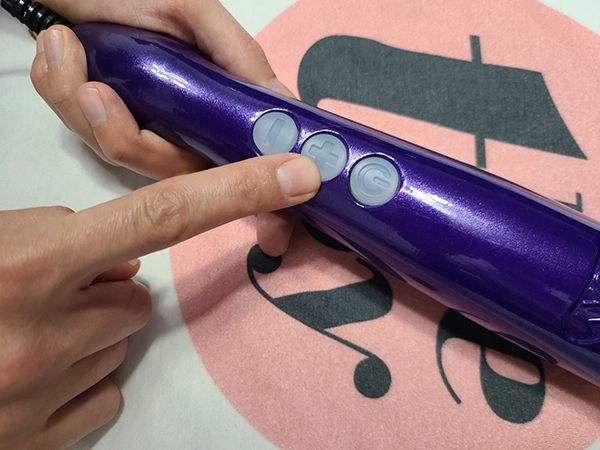
Memorize the button layout. Three buttons, LED-lit blue. The center button is plus (increase power)—not the power button, despite where your thumb naturally lands. I hit the wrong button for weeks. The icons are hard to read in dim lighting, so eventually your fingers just learn.
Try the pulsation mode. Wand off → hold power button 2-3 seconds → escalating pulse engages. Plus/minus controls ramp speed. Quick power press to return to steady vibration. It’s a warmup gem that Doxy almost never mentions in marketing.
The pillow mount for solo hands-free: Wedge the handle between a firm pillow and the mattress, lie on your stomach. Pillow holds the wand, body weight controls pressure. This method gave my wrist its life back and extended sessions from 15 minutes to as long as I wanted.
Cleaning without drowning it. The silicone head cap removes for washing. The wand body is NOT waterproof. Remove the head cap, wash it separately with warm water and mild antibacterial soap, dry it completely before reattaching. Wipe the body with a damp cloth only. Some testers carefully rinse just the attached head under gentle water while keeping the body dry—it’s worked so far, but Doxy explicitly discourages it and you’re accepting risk.
If the metal ring comes loose: A small amount of strong adhesive re-seats it. Doesn’t affect function, but it rattles and it’s annoying for $215. If the silicone head starts spinning, contact Doxy’s support—they handle replacements.
Check the head before gifting. One reviewer specifically warned: if buying as a gift, power it on and test the head stability before wrapping it. QC issues are easier to resolve before a special occasion than during one.
Who Should Buy the Doxy Die Cast
✅ You want extreme vibration intensity in a wand and you’ve outgrown weaker options
✅ You crave deep, weighted pressure against your body without gripping effort
✅ You primarily use wands solo and on your back, where gravity does the work
✅ You plan to use wand attachments—full compatibility with the standard large-head selection
✅ You want reliable, unlimited power with zero battery anxiety
✅ You live on the first 2-3 settings and value deep rumble at moderate intensity
✅ Premium materials and stunning aesthetics genuinely matter to you—and you can afford the price without stretching your budget thin
Who Should Skip It
❌ You have wrist issues, carpal tunnel, arthritis, or limited hand strength—the Hand Fatigue Index of 10/10 is the real deal
❌ You need a compact wand that tucks between bodies during sex—Body Compatibility Index of 2/10 tells the honest story
❌ You’re exploring vibrators for the first time—the lowest setting here is more powerful than many vibrators’ maximum
❌ You want deep rumble at every power level—the top settings get buzzy, and the Magic Wand Rechargeable handles that better
❌ You need waterproof—this wand is not splash-resistant, shower-friendly, or anything close
❌ You’re stretching your budget—the Magic Wand Plus ($70) or BMS PalmPower Extreme ($100-130) deliver comparable intensity at dramatically lower cost, and reliability concerns feel less consequential at a lower price point
❌ You need cordless—10 feet is generous, but it’s still a tether
❌ Product reliability anxiety would undermine your enjoyment—the QC track record is genuinely mixed
Final Verdict
The Doxy Die Cast is not the best wand vibrator for the widest audience. It’s the most commanding wand for a specific one.
Power Index: 9. Deep Rumble Index: 7. Hand Fatigue: 10. Body Compatibility: 2. Those numbers are an honest portrait: extraordinary capability in a physically demanding package with real trade-offs.
What surprised me wasn’t the raw power—I expected that from the hype. What caught me off guard was falling in love with the first two settings. The deep, cushioned, gravity-assisted rumble at moderate intensity made me understand why some people describe their wand as irreplaceable. There’s a quality to those lower levels—the 1.3mm amplitude, the low-frequency hum, the soft Shore A 18 head conforming to my body while the weight holds everything in place—that I haven’t found in any other wand. Several testers said the same thing, unprompted. The Die Cast’s moderate settings are where the real magic lives.
What concerned me was the gap between the product’s premium price and its inconsistent reliability track record. A die-cast metal vibrator selling for $215 should not have adhesive-mounted neck rings. It should not have a manual that contradicts its marketing materials. Doxy’s customer service is genuinely excellent—but needing excellent customer service is not the same thing as not needing it at all.
What I’d tell someone considering this purchase: If you can comfortably afford it and you’re drawn to the weighted, rumbly, moderate-power experience, the Doxy Die Cast is extraordinary. Buy it through a retailer with a good return policy. Test it thoroughly within the warranty window. Accept that you’ll probably never use the top three settings—and that the bottom two are worth every dollar for the right person.
If the Die Cast isn’t your match: Start with the Magic Wand Rechargeable for the best all-around wand experience. Try the BMS PalmPower Extreme for near-Die Cast intensity without the weight and cord. Choose the Lovense Domi 2 if you want serious power that goes anywhere and fits between any two bodies. None of those are consolation prizes—they’re the right tool for a different set of priorities.
The Doxy Die Cast earned its permanent spot on my nightstand. It hasn’t earned a recommendation I’d give to everyone. And I think that distinction is the most useful thing I can offer you.

| Power: | (5.0 / 5) |
| Noise: | (3.5 / 5) |
| Material: | (4.0 / 5) |
| Price: | (3.0 / 5) |
| Ease Of Use: | (2.5 / 5) |
A heavy, corded, metal-bodied wand with exceptional low-speed rumble and extreme intensity. Best for power lovers who want weighted pressure, not a light or beginner-friendly wand.
You can buy this product from:
(5.0 / 5)
(3.5 / 5)
(4.0 / 5)
(3.0 / 5)
(2.5 / 5)


Add comment