

 Amie Dawson, Ph.D.
You keep hearing these as two clean categories, as if your body should know the answer instantly. But when you try to describe what you actually feel, the words get slippery. One kind of touch seems bright, obvious, almost easy to recognize. The other can feel deeper, stranger, slower to make sense.
When I explain this difference, I start here:
Clitoral pleasure often feels like finding a specific surface.
G-spot pleasure often feels like finding the right depth.
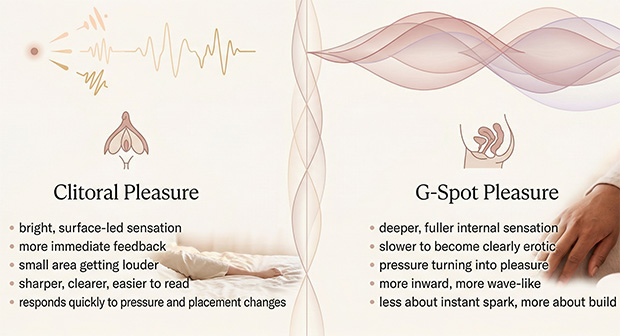
That is the simplest version.
Not shallow versus meaningful. Not basic versus advanced. Just different.
Clitoral pleasure usually feels like a small area getting louder
For a lot of people with vulvas, clitoral pleasure is the easier sensation to read. It tends to announce itself faster. You touch, rub, press, pulse, or vibrate, and your body gives you clearer feedback: yes, too much, not enough, wrong angle, right spot.
Part of that is anatomy. The visible clitoral glans is external, highly sensitive, and easy to contact directly, even though it is only one part of a larger structure that extends internally around the vagina. Part of it is also practical. NHS guidance on female orgasmic difficulties notes that most women need steady clitoral stimulation to reach orgasm, and that penetration on its own often does not provide enough of that steady contact.
That matters because clitoral pleasure often feels immediate in a very particular way. You are not just feeling turned on. You are feeling a small area become more alive, more demanding, more exact.
A few millimeters can matter.
A little too much pressure can flip pleasure into irritation.
A tiny change can make the whole thing click.
Research on women’s subjective orgasm experiences found that clitoral orgasms were more often described as sharper, easier, and more controllable than vaginal orgasms. That language tracks closely with what many readers already know in their body but have never seen named plainly.
Clitoral arousal usually says yes or no quickly.
G-spot pleasure usually feels like pressure turning into pleasure
G-spot pleasure gets misunderstood partly because it does not always arrive with the same kind of signal.
Cleveland Clinic describes the G-spot as a pleasurable area for some people near the front vaginal wall, associated with the urethral sponge. At the same time, review papers on the clitoral-vaginal debate argue that sensations in this region likely involve nearby internal clitoral structures and surrounding tissues, not some totally separate magic button hidden inside the vagina.
That helps explain why G-spot pleasure can feel so different.
Usually, it feels less like spark and more like pressure. Less like a pinpoint and more like fullness. Less like an immediate pop of sensation and more like something gathering itself under the surface.
For some bodies, the first few seconds do not even feel especially erotic. They feel like contact. Weight. Drag. An internal rub that only becomes sexy when the pressure is right and the body has enough time to answer it.
This is where people often quit too early.
They expect instant fireworks. What they get is a slow internal build.
And slow does not mean weak.
The 2023 International Journal of Sexual Health study found that women who distinguished vaginal orgasms from clitoral ones more often described vaginal orgasms as deeper, wilder, more pulsating, and more extending through the body. That does not prove every person will experience them that way. It does show that the sensory difference many people talk about is not imaginary or trivial.
It is not less real because it is quieter at first.
For a lot of people, that quieter beginning is exactly why internal pleasure gets dismissed too fast. It often helps to approach it as something you are learning to read rather than something that has to prove itself immediately, which is the whole shift behind exploring G-spot pleasure without pressure.
One usually answers to steadiness. The other often answers to angle
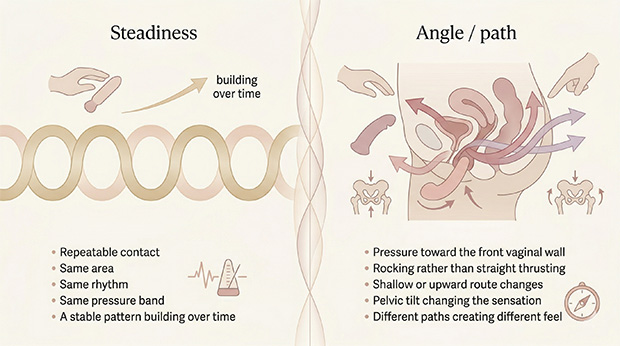
This is the practical difference I wish more people were told.
Clitoral pleasure often depends on consistency. Internal pleasure often depends on path.
With clitoral stimulation, the body often wants a repeatable pattern. Same area. Same pressure band. Same rhythm. Once you find it, staying there usually helps.
Internal pleasure is often more positional. A small change in hip tilt can change everything. So can whether the touch presses forward instead of straight in. So can whether the motion stays shallow, presses upward, rocks in place, or combines internal contact with clitoral contact at the same time.
That is not just bedroom folklore. A large 2021 U.S. study in PLOS One found that many women make penetration more pleasurable by changing pelvic angle, using rocking rather than simple in-and-out thrusting, keeping stimulation shallower near the entrance, or pairing penetration with simultaneous clitoral stimulation. In other words, internal pleasure often changes because the route through the body changes.
Clitoral pleasure usually asks for steadiness.
G-spot pleasure often asks for angle.
That line explains a lot of disappointment.
If you treat internal pleasure like external pleasure and just add more force, you can miss what it is actually asking for.
Two scenes you can actually picture
Picture the first scene. You are using a small vibrator on the clitoris. Within seconds, you know whether it is too direct, too buzzy, too weak, or exactly right. Your attention narrows. You track a small area. You notice every little shift.
It feels precise.
Now picture the second. You are using fingers or a curved toy internally, with pressure toward the front wall. The sensation may not arrive as one clean point. It may feel like a deeper swell. A thicker internal friction. A sense that the body wants the contact held and shaped, not chased.
It feels negotiated.
That difference matters because it changes how you interpret the experience. Clitoral pleasure often feels like finding something. G-spot pleasure often feels like letting something build.
One is usually clearer sooner.
The other may ask for more trust before it becomes legible.
I also think this is why the phrase “orgasm from penetration alone” confuses so many people. The visible act may be penetration, but the pleasurable mechanics are often more complicated than that. NHS guidance on orgasm, anatomy reviews of the clitoris, and population-level data on penetration techniques all point in the same direction: what people call internal pleasure is often shaped by clitoral structures, shallower contact, pelvic angle, rocking, or some form of clitoral pairing happening at the same time.
So when someone says, “I like penetration,” that can mean several different things.
And sometimes what they mean is not orgasm at all, but a kind of internal pressure or fullness that feels worth having on its own. That distinction matters because a G-spot toy can feel good even without orgasm and still be doing something real in the body.
Depth is only one part of the story.
The line blurs because your body is not divided into neat categories
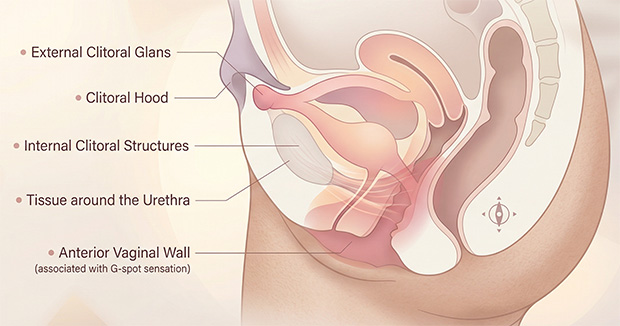
This is the part that usually brings relief.
The visible clitoris is not the whole clitoris. Cleveland Clinic’s anatomy review explains that the internal clitoral structures extend around the vagina, and Rachel Pauls’ review in Clinical Anatomy describes the clitoris as central to orgasmic response while noting that vaginal erotic sensation has to be understood in light of that broader anatomy. James Pfaus and colleagues make a similar argument: women can experience orgasm from multiple sensory sources, including the external glans and internal regions around the so-called G-spot.
So when I say clitoral and G-spot pleasure feel different, I am talking about felt experience, not a hard border between two rival systems.
These are sensation labels. Helpful ones. But still labels.
The mistake is turning them into a hierarchy. As if clitoral pleasure is the beginner version and G-spot pleasure is the advanced course. Or as if internal pleasure counts more because it sounds deeper, rarer, or more impressive.
Bodies do not care about that ranking.
A precise surface response is not lesser. A deep internal response is not more evolved. They are different ways pleasure can organize itself in the body.
Sometimes your body wants something bright and exact.
Sometimes it wants something fuller and more inward.
Sometimes it wants both.
That is often the moment categories stop being very useful. The body may still be able to feel what is sharper, what is deeper, what is more internal, what is more external, but the actual experience starts to resemble one fuller sensation with more than one dimension instead of two separate pleasures running side by side.
You do not need to force your body to fit the myth.
You need better words for what it is already saying.
Reviewed medical and clinical sources
- Leicestershire Partnership NHS Trust. Female Orgasmic Difficulties.
- Clitoris: Anatomy, Location, Purpose & Conditions. Cleveland Clinic Health Library.
- Vulva: Location, Anatomy, Function, Conditions & Care. Cleveland Clinic Health Library.
- Pauls RN. Anatomy of the clitoris and the female sexual response. Clinical Anatomy. 2015.
- Pfaus JG, Quintana GR, Mac Cionnaith C, Parada M. The whole versus the sum of some of the parts: toward resolving the apparent controversy of clitoral versus vaginal orgasms. Socioaffective Neuroscience & Psychology. 2016.
- Weitkamp K, Wehrli FSV. Women’s Experiences of Different Types of Orgasms—A Call for Pleasure Literacy?. International Journal of Sexual Health. 2023.
- Hensel DJ, von Hippel CD, Lapage CC, Perkins RH. Women’s techniques for making vaginal penetration more pleasurable: Results from a nationally representative study of adult women in the United States. PLOS One. 2021.
Add comment