

 Amie Dawson, Ph.D.
You turn the vibrator on because you want to feel something. Instead it feels too abrupt. Too bright. Too present. You keep adjusting the angle, waiting for your body to catch up, and the whole thing starts to feel less sexy and more like troubleshooting.
I see this mistake all the time.
The toy is not always the problem. Sometimes it is simply arriving before your body has changed state.
A lot of what gets called a “too strong” toy is really just intensity arriving before the rest of the body can use it. That is often the quieter difference between a session that builds and one that tips into overstimulation almost immediately.
When the vibrator feels too loud, too early
A vibrator can add intensity fast. That is exactly why it works so well once arousal is already moving.
It is much less graceful at creating arousal from absolute zero.
Before arousal builds, vibration can feel like contact without context. Not pleasurable. Not terrible, necessarily. Just disconnected in a very specific way. You notice the buzz, but not the pull. You feel stimulation, but not momentum.
A vibrator is an amplifier, not a starter motor.
That is not just a pretty line. It is a body reality. As the Cleveland Clinic’s overview of the sexual response cycle notes, arousal involves increased genital blood flow, clitoral swelling, and, for many people with vaginas, more wetness. And the timing of those changes can vary a lot. In other words, your body may need a runway before strong sensation feels good.
That runway matters.
Because when arousal is already building, vibration feels less like impact and more like momentum.
Arousal does not always come first
A lot of people wait to feel clearly turned on before they touch themselves. That sounds logical. It is also one reason some people stay stuck.
For many women and people with vulvas, desire is not always the first event. The MSD Manual puts it plainly: many women access desire responsively, meaning stimulation, excitement, and physical arousal can come first, and desire builds as the experience becomes rewarding.
That changes the whole approach.
Your job is not to wait for a full green light from nowhere. Your job is to give arousal something to attach to.
Sometimes that starts with fantasy. Sometimes it starts with privacy. Sometimes it starts with your own hand resting somewhere non-demanding on your body until you feel yourself arrive. That still counts.
If you have ever thought, I wanted release, but my body did not seem interested yet, this is often what is happening. The interest is not missing. It is unfinished.
Build arousal in layers, not in one jump
The best warm-up before a vibrator is rarely “more intensity.”
It is better sequencing.
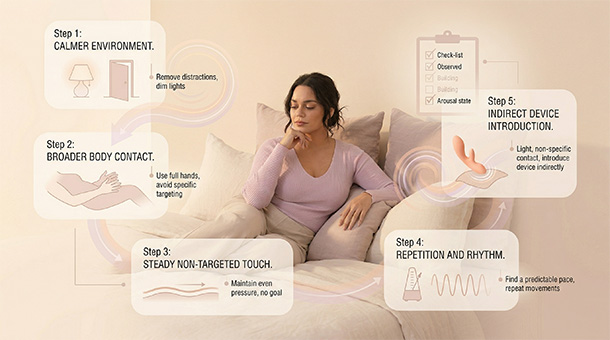
I like this five-step build:
- Make it easier to stay present. Close the door. Adjust the room. Put your phone away. Give yourself one less reason to split your attention. Sometimes the first part of arousal is not more touch at all. It is simply removing one more exit from the room, which is why distraction can make orgasm harder even when desire is there.
- Start with bigger, less reactive areas. Chest, stomach, hips, inner thighs, butt, lower belly. Let your body feel touched before it feels targeted.
- Use steady contact before precise contact. A palm resting on the vulva, a hand between the legs, slow pressure through underwear, or a small amount of lube with broad touch often works better than immediate pinpoint stimulation.
- Let repetition do the work. Do not keep switching techniques every few seconds. Arousal often needs rhythm before it wants intensity.
- Bring the vibrator in indirectly first. Outer labia, mons pubis, beside the clitoris, or over underwear can let the sensation land without shock. That first bit of distance is the whole point. The sensation is still clearly clitoral, but it lands more like indirect rather than fully direct stimulation, which is often much easier to open to.
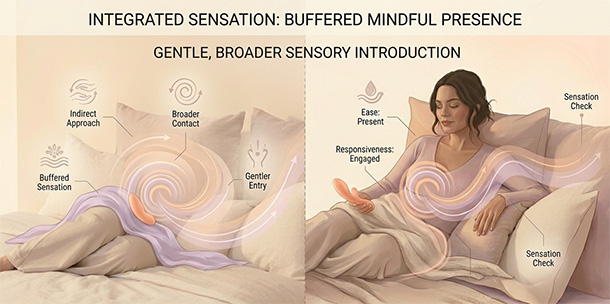
That sequence lines up with clinical guidance better than most people realize. An NHS patient leaflet on female orgasmic difficulties notes that most women need steady clitoral stimulation for orgasm, that relaxation matters, and that being really aroused before more direct sexual stimulation makes a difference.
This is the part many people rush past.
They go straight to the place they hope will respond, instead of warming the whole system that allows it to respond.
What “ready” actually feels like in real life
A lot of readers ask me the same thing: How do I know when I am actually ready for the vibrator?
Usually not by some dramatic wave of lust.
It is subtler than that.
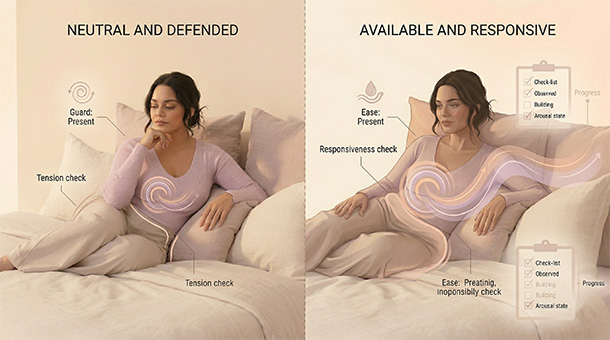
You may notice that your body stops feeling neutral and starts feeling relevant. Skin that felt like background starts feeling like part of the experience. Your pelvis softens a little. Your breathing stops sounding like task mode. You stop hunting for the exact right spot quite so desperately.
That shift is important.
When arousal is building, you do not just feel more sensation. You feel less defended against sensation.
That is easy to miss, but it changes everything. For a lot of people, the toy starts working better not because the body suddenly wanted more power, but because it finally stopped bracing so hard against the contact, which is often the quieter layer underneath why body tension can make pleasure harder.
For some people, there is more wetness. For others, there is more fullness, warmth, or a sense that the area feels awake. Cleveland Clinic notes that arousal can involve genital blood flow, clitoral swelling, and vaginal wetness, but bodies vary in how obvious those signs are. Wetness can help. It is not a pass-fail test.
One of the clearest signs is this: the vibrator starts to feel like something you want more of, not something you are trying to tolerate long enough to get somewhere.
That is readiness.
Three warm-up scenarios you can actually picture
You are stressed, tired, and mostly want relief
This is the classic “I want the orgasm, but I am not turned on yet” night.
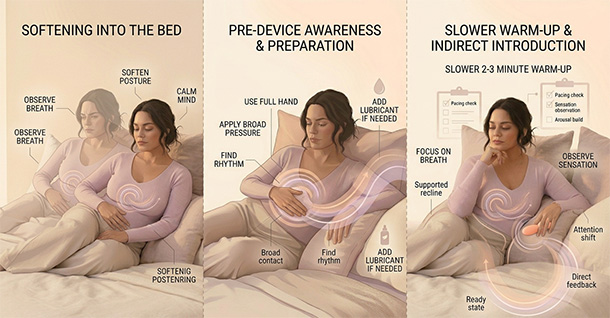
Do not start at your clitoris. Start by getting out of survival posture. Unclench your jaw. Let your knees fall open. Put one hand on your lower stomach and one between your thighs. Stay there longer than feels efficient. Then add touch to inner thighs or outer labia before you even think about the toy.
The first win is not orgasm.
The first win is that your body stops feeling guarded.
You feel interested in theory, but not much in your body
This is when people often assume they need a stronger setting.
Usually they need more bridge.
Try lube before the toy enters the picture. Use your hand first. Broad pressure is often better than quick rubbing here. Once you feel even a little pull toward more contact, bring in the vibrator on the outer vulva or beside the clitoris, not directly on top of it.
It does not feel weaker.
It feels less thin.
That distinction matters.
You always go straight to the vibrator and end up chasing the feeling
You track the angle. You correct the pressure. You chase the right spot. You notice every little shift.
That is usually not a power problem.
It is a sequencing problem.
Give yourself two or three minutes where the goal is only to build wanting. No direct clitoral buzz yet. Let your hand, your breath, your fantasy, or a slow body scan create a little appetite first. Then bring the toy in when your body is already leaning toward it.
The difference can be immediate. Same toy. Same body. Different entry point.
When this is not a warm-up problem
Sometimes the right answer is not “build more arousal.”
Sometimes the right answer is “something changed, and it is worth looking at.”
If touch has become newly painful, if dryness is persistent, if arousal dropped off sharply after a medication change, or if you feel like your body stopped responding in a way that is unusual for you, do not reduce the whole thing to technique. The Mayo Clinic notes that sexual response is complex and shaped by physical, emotional, relational, and life factors. It also notes that treatment often needs more than one approach.
That includes very practical medical factors. Mayo Clinic guidance on low sex drive in women notes that clinicians may look at vaginal dryness, pain-triggering spots, medication side effects including some SSRIs, and broader health issues when sexual response changes.
And if sex or masturbation is painful, that matters. Mayo Clinic’s guidance on painful intercourse notes that not enough lubrication, low arousal, certain medicines, pelvic floor tightening, and other medical issues can all contribute to pain.
Pain is not something you are supposed to “warm up through.”
If the problem is pain, sudden numbness, or a real change in response, let that be data.
Not a verdict on your body.
I think this is the most useful way to frame the whole subject: a vibrator should meet arousal, not replace it.
You do not need to prove you are turned on enough. You do not need to manufacture lust on command. You only need to help your body cross the distance between neutral and available.
Once that happens, the toy stops feeling like an intruder.
It feels like timing.
Reviewed medical and clinical sources
- Mayo Clinic Staff. Women’s sexual health: Talking about your sexual needs. Mayo Clinic.
- Mayo Clinic Staff. Female sexual dysfunction — Symptoms and causes. Mayo Clinic.
- Mayo Clinic Staff. Female sexual dysfunction — Diagnosis and treatment. Mayo Clinic.
- Mayo Clinic Staff. Low sex drive in women — Diagnosis and treatment. Mayo Clinic.
- Mayo Clinic Staff. Painful intercourse (dyspareunia) — Symptoms and causes. Mayo Clinic.
- Mayo Clinic Staff. Painful intercourse (dyspareunia) — Diagnosis and treatment. Mayo Clinic.
- Overview of Female Sexual Function and Dysfunction. MSD Manual Professional Edition.
- Leicester’s Hospitals, Department of Medical Psychology. Female orgasmic difficulties. NHS patient information leaflet.
Add comment