
 Amie Dawson, Ph.D.
You turn it on. You try the spot everyone talks about. And your whole body reacts like the toy skipped past pleasure and went straight to alarm.
So you start negotiating with yourself. Lighter. Softer. Different angle. Move it. Stop it. Try again. You pay closer and closer attention, and somehow that makes everything feel even louder.
If that is your pattern, I do not read it as failure. I read it as a body that notices contact fast, sharply, and with very little margin for error.
That changes the strategy.
A lot of vibrator advice assumes the main problem is not enough intensity. For very sensitive bodies, that is often wrong. The problem is usually not that your body wants less sensation.
It wants less sharpness.
For some bodies, direct contact does not feel stronger. It feels thinner. More exposed. More unbuffered.
That is often the real difference between direct and indirect clitoral stimulation. A sensitive body does not always need less sensation. It often needs the sensation to arrive through a little more tissue.
That is why the usual advice can go so wrong. “Just put it right on the clitoris” works beautifully for some people. For others, it feels like too much electricity on exposed skin.
Both can be true.
The goal is not to tolerate more
When someone tells me they are very sensitive, I do not think, needs more courage. I think, needs more control.
That is the shift that matters.
A tiny, direct contact point on a very alert area can feel harsh even on low power. A broader, softer contact can feel much easier to enjoy even when the motor itself is not much weaker. That is why “just turn it down” often does not fix it. The body is not objecting only to intensity. It is objecting to how concentrated the sensation is.
So the job is not to force yourself to handle more.
The job is to make the sensation land better.
Once you approach it that way, everything gets simpler. You stop treating sensitivity like a flaw to override. You start treating it like useful information about the route your pleasure wants.
Start beside the most sensitive place, not on it
This is the mistake I see over and over.
People go straight to the most obvious clitoral spot, hold the toy there, and assume that if it feels bad, vibrators just are not for them.
But a vibrator does not have to go directly onto the most exposed part of the clitoris to count. In fact, for very sensitive users, that is often the worst place to begin.
Start next to it.
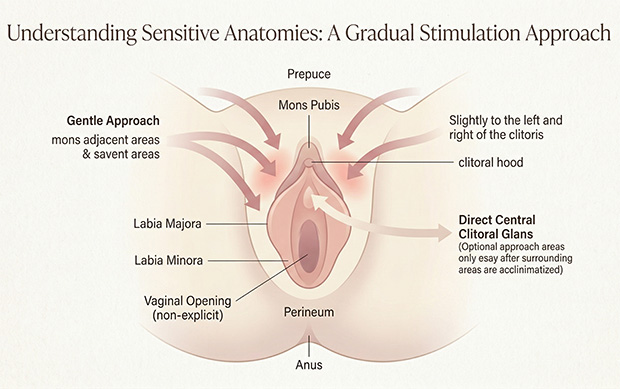
That might mean over the clitoral hood. On one side of it. Across the labia. Slightly higher on the mons. Even through underwear first. Let the sensation spread before you let it concentrate.
You are not missing the spot.
You are preparing it.
For a lot of very sensitive users, that preparation is exactly why using a toy over underwear can feel so much better at the start. The point is not to mute the pleasure. It is to give the body a gentler way to begin reading it.
A lot of “I’m too sensitive for vibrators” is really “I’m starting too close, too soon.”
The same setting that feels abrasive at minute one can feel delicious at minute ten. Arousal changes blood flow, lubrication, tissue fullness, and how the nervous system interprets touch. Sometimes “too intense” and “not enough” are only a few millimeters apart.
Sometimes they are only five minutes apart.
So give your body another route in. Start with your hand. Start with fantasy. Start with warmth, pressure, kissing, or slow external touch before the vibrator gets anywhere near the center of the action.
Choose contact shape, not just intensity
If you are very sensitive, toy shape matters more than people admit.
A small, hard, sharply focused head can make the sensation feel piercing even on a low setting. A broader silicone surface often spreads the same general energy across more tissue, which can feel easier to stay with. It does not necessarily feel weaker. It feels less thin.
That is often the hidden divide between broad and pinpoint stimulation. What seems more exact on paper can feel harsher in practice, while a wider contact patch gives the body more room to stay open.
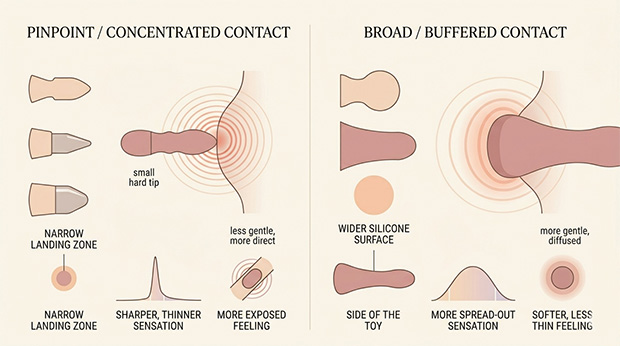
That difference is huge.
Sometimes the right vibrator for a sensitive body is not the weakest one. It is the one that touches you in a wider, softer way.
And if you already own a toy that feels too sharp, do not assume you need to give up on vibrators. First ask a more useful question:
Is this toy giving me pinpoint contact when my body wants buffered contact?
That buffer can come from the toy shape itself. It can also come from your body and technique.
Try the side of the toy instead of the tip. Let only one edge catch the area instead of planting the whole thing flat. Use the clitoral hood, labia, fabric, or even your fingers as a filter between the vibration and your most reactive spot.
Pleasure that arrives through a buffer still counts.
Reduce drag before you reduce power
Sometimes what feels like too much vibration is not actually too much vibration.
It is too much friction.
This is common when the tissue is dry, a little irritated, hormonally thinner, or simply not as lubricated as the rest of your body wants to be that day. In that case, lowering the setting may help a little. Adding slip often helps more.
If the contact feels scratchy, hot, draggy, or weirdly abrasive, do not assume the motor is the whole problem.
More slip. Less grab.
That is usually the moment when using lubricant with a vibrator changes the whole experience. Sometimes the toy is not too strong at all. The surface just has too much drag mixed into it.
That one change can make the exact same vibrator feel gentler without making it feel dull.
And this matters beyond menopause, though hormones absolutely can shift the sensory landscape. Dryness, irritation, tissue thinning, and reduced lubrication can all make sexual touch feel harsher than it used to. If your body has changed after birth, surgery, medication changes, chemotherapy, menopause symptoms, or a major hormonal shift, that context matters.
Burning is not the same as intensity.
That distinction is important.
If something feels intense in a good way, your body usually still feels open to it. If it feels hot, raw, stingy, or increasingly irritated, that is a different category.
Do not try to out-brave the wrong sensation.
Build a ramp, not a dare
Very sensitive bodies often do better with passes than with one long hold.
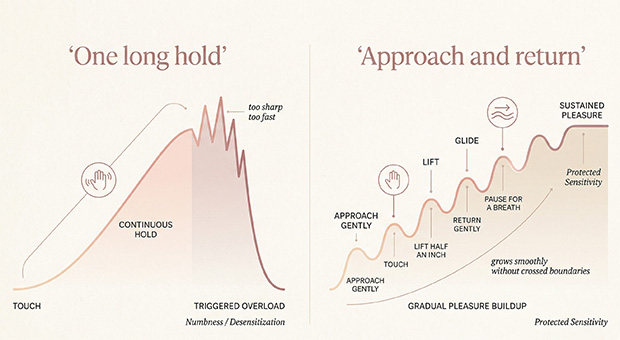
That means approach, back off, approach again.
Touch. Lift half an inch. Return.
Glide across. Pause for a breath. Come back.
You are not losing progress. You are giving your nervous system time to absorb sensation before it starts bracing against it.
That tiny lift is often what keeps the experience pleasurable instead of tipping it into overload.
This is also why I usually prefer steady, low vibration over jumpy patterns at the start. A lot of patterns keep surprising the body. Sensitive bodies often do better when the sensation is predictable.
That is one reason the plain steady setting so often beats the clever one. It helps to understand how modes and patterns change the texture of stimulation before you assume more variation will make the body happier.
The goal is not to prove you can take more.
The goal is to make less feel better.
The method I would use
If I were helping a very sensitive person troubleshoot vibrator use, this is the sequence I would start with:
- Start off-center: inner thigh, mons pubis, outer labia, clitoral hood, or even over underwear.
- Use the lowest steady setting first, not a pattern that keeps startling you.
- Keep the toy moving or hovering instead of parking it in one place.
- Use a buffer on purpose: fabric, extra lube, the hood, the labia, or your fingers between the toy and your body.
- Let the side or edge of the toy make contact instead of the most concentrated point.
- Move closer only when your body wants more, not because you think you should be able to handle it.
That last part is the real skill.
A lot of people override their body right there. They move to direct contact because it seems like the correct next step. But for some bodies, indirect contact is not a warm-up on the way to the real thing.
It is the real thing.
What this looks like in real life
Very sensitive users do not all struggle in the same way. The fix depends on how the sensation goes wrong.
If it feels too sharp immediately:
Start one or two centimeters away from the clitoral glans. Stay there for a minute. Let your body warm into the feeling. Drift closer in slow arcs instead of moving straight onto the center.
If it feels good for a few seconds and then suddenly becomes too much:
Do not wait until you want to yank the toy away. Use shorter passes from the beginning. Think teasing, not drilling. Ten seconds on. Tiny lift. Back down.
If even the lowest setting feels sharp:
The problem may be exposure more than power. Add fabric. Use the hood. Angle the toy so the vibration washes across the area instead of striking it directly. Or place two fingers over the spot and let the toy vibrate through your hand first.
If it starts to feel numb or irritating fast:
That does not always mean the toy is too powerful. Sometimes it means the contact has stayed too local, too exposed, or too repetitive for too long. It helps to know what to do when vibrators feel numbing instead of pleasurable before you mistake that reaction for failure.
You may be staying too local for too long. Broaden the contact area. Move from side to side. Give the nerves variation in location without turning the whole thing into chaos.
If only one exact angle works and everything else feels wrong:
Stop chasing that angle like it is a code you have to crack. Anchor your wrist or forearm with a pillow so the contact stays steadier. Sensitive bodies often dislike constant micro-adjustments more than they dislike vibration itself.
If it feels more like burning than pleasure:
That is the point where this stops sounding like ordinary sensitivity and starts sounding like discomfort your body does not want to negotiate with. It helps to separate a sharp preference mismatch from pain a vibrator may be causing or worsening, because those are not the same signal.
Stop there. Friction, dryness, irritation, product sensitivity, vulvar skin issues, hormonal tissue change, or a pain condition may be part of the story. That is not a push-through moment.
When sensitivity needs a medical lens
Sometimes high sensitivity is just preference.
Sometimes it is a clue.
A vibrator technique issue usually sounds like this:
“I can enjoy some touch, but I need it softer, wider, slower, more indirect, or better lubricated.”
A medical issue starts sounding different.
If light touch feels painful, if burning or stinging lingers after you stop, if tampons hurt, if tight clothes or underwear hurt, if pelvic exams hurt, if you have ongoing itching or irritation, or if the whole area suddenly feels very different than usual, it is time to stop troubleshooting alone.
That can point toward things like vulvodynia, vestibulodynia, clitoral pain, irritation, infection, pelvic floor guarding, dermatologic issues, or hormonal tissue change.
And one more piece matters here: when pain has been happening for a while, the pelvic floor can join in. The body starts anticipating discomfort. Muscles tighten. Touch gets read as threat faster than it should.
That is often part of why body tension makes pleasure harder to receive. The body is not being dramatic. It is trying to protect you before the sensation has even had a chance to prove itself safe.
Pushing through pain rarely trains pleasure.
It trains flinch.
So get checked sooner rather than later if:
- light touch, tampons, underwear, or toys can hurt
- burning or stinging lingers after contact stops
- dryness, itching, irritation, or recurrent infections keep showing up
- your response to touch changed sharply after birth, surgery, menopause symptoms, medication changes, or another hormonal shift
A good clinician can help sort out whether you are dealing with simple sensitivity, irritation, vulvodynia, vestibulodynia, pelvic floor tension, hormonal changes, or some mix of several things.
A sensitive body is not a bad candidate for pleasure
It is easy to think your body is the problem when the loudest advice is all about more power, more pressure, more direct contact.
But some bodies do not want more.
They want smarter.
A sensitive body is often a high-resolution body. It notices everything. The trick is not to shut that sensitivity down. It is to stop throwing the harshest version of sensation at it first.
Once you do that, the whole question changes.
Not: Can I handle a vibrator?
Something much more useful:
What kind of contact does my body open to?
That question tends to lead somewhere better.
Reviewed Medical and Clinical Sources
- Leicestershire Partnership NHS Trust. Female orgasmic difficulties.
- NHS. Vulvodynia (vulval pain).
- Cleveland Clinic. Vestibulodynia: Causes, Symptoms & Treatment.
- The Menopause Society. MenoNotes: Genitourinary Syndrome of Menopause.
- The NAMS 2020 GSM Position Statement Editorial Panel. The 2020 genitourinary syndrome of menopause position statement of The North American Menopause Society.
- Imperial College Healthcare NHS Trust. Overactive pelvic floor.
- Bradford Teaching Hospitals NHS Foundation Trust. Vulval Care Advice Sheet.
Add comment