

 Amie Dawson, Ph.D.
You can orgasm with a partner and then, alone, everything goes strangely flat.
You know your body works. You have proof. But when you try to get there by yourself, the heat fades, the build never quite catches, or the whole thing starts to feel like a task. You touch the places that should work. You repeat what usually feels good. Nothing lands the same way.
That can feel oddly embarrassing. Like you need someone else to unlock something you should be able to do on your own.
Usually, that is not what is happening.
This is not a contradiction. It is a pattern.
Orgasm problems can be situational. They can show up in one context and not another, with one kind of stimulation and not another, with one partner and not by yourself. That matters more than people think.
Because “I can orgasm with a partner but not alone” does not mean your body is broken. It means your orgasm may depend on conditions that are present during partnered sex and missing during solo sex.
Some bodies do not need more force.
They need more than one thing happening at once in a way that makes arousal feel fuller, easier to follow, and easier to trust. For some people, that is the deeper difference between one narrow source of stimulation and blended stimulation that feels more complete.
They need more context.
A partner may be giving your body more than one thing at once
A lot of people imagine orgasm as finding the right spot and pressing the right way for long enough. Sometimes it is that simple. Very often it is not.
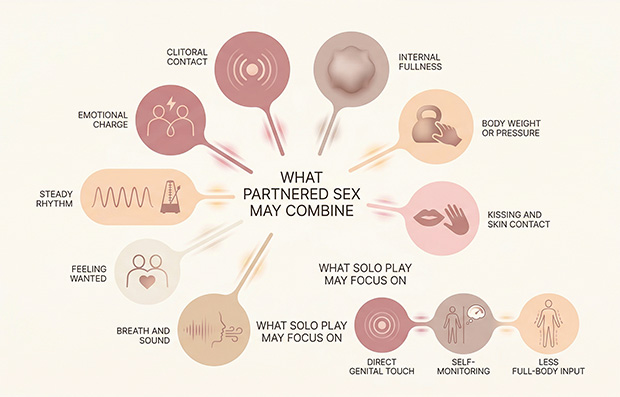
In partnered sex, the body is often responding to a combination. Steady clitoral stimulation. Internal fullness. Thigh pressure. Rocking instead of thrusting. Skin contact. Breath. Sound. Being held. Feeling wanted. The fact that you are not the only person generating the whole moment.
That is one reason orgasm during partnered sex can be easier than people expect and solo orgasm can be harder than it looks. Research on orgasm during intercourse keeps pointing in the same direction: orgasm often happens more reliably when clitoral stimulation is part of the picture, and not as an isolated little afterthought either. It is the layering that matters.
That combination can include:
- clitoral contact plus internal fullness
- steady rhythm plus body weight
- genital touch plus kissing, breath, sound, and skin contact
- arousal from being wanted plus touch that keeps building instead of resetting
It is easy to miss this when you try to recreate the experience alone. You may copy the fingertip but not the thigh pressure. Not the hip angle. Not the feeling of being held down a little. Not the fact that your whole body was already lit up before anyone touched your clitoris.
It is not the same input.
It only looks like it from the outside.
For some people, orgasm works better in receive-mode
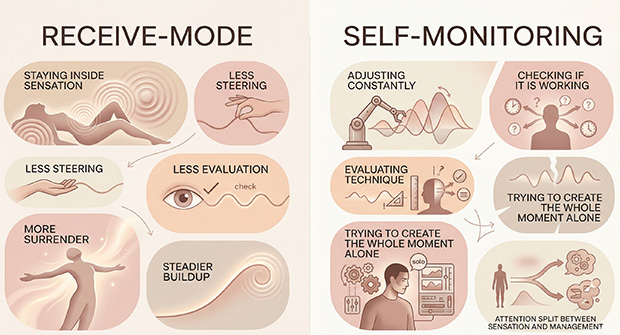
Alone, you are often doing three jobs at once. You are creating the sensation, monitoring whether it is working, and deciding what to change next.
That split matters.
Clinical guidance on orgasm difficulty often comes back to the same problem from different angles: anxiety, monitoring, pressure, and “spectatoring” can all pull attention out of sensation. In plain language, orgasm usually gets harder when you are half inside the experience and half managing it.
With a partner, especially a good one, you may be more able to stay in receive-mode. You are not setting the pace every second. You are not switching hands. You are not checking whether you are doing it right. You are not adjusting your own angle every ten seconds like you are troubleshooting a machine.
Alone, you become performer and audience at the same time.
For a lot of people, that split is enough to thin the whole experience out. The body may still be responsive, but performance pressure starts crowding out sensation long before anyone would call it anxiety.
For some nervous systems, that alone is enough to make everything feel flatter.
Sometimes the missing ingredient is erotic context, not technique
This is the part people dismiss because it sounds less concrete. But sometimes it is the real answer.
A partner may be bringing anticipation, emotional charge, vulnerability, praise, power dynamics, novelty, eye contact, surrender, or the simple bodily fact of not being the only person in the room generating the scene. Relationship factors, emotional closeness, and communication can all shape orgasm. That does not mean your orgasm is imaginary or “all in your head.”
It means your brain is one of your sex organs.
For some people, partnered sex creates enough arousal before direct stimulation even starts that orgasm becomes reachable. Solo play skips that runway. You go straight to genital touch while the rest of you is still emotionally standing in the kitchen.
No wonder it feels flat.
Sometimes the problem is not your technique at all. It is that the body never got enough runway before you asked it to finish, which is often the hidden reason orgasm takes a long time sometimes even when pleasure is clearly there.
What this looks like in real life
Sometimes this gets clearer the second you stop talking about it in abstract terms.
You orgasm during oral, but not alone.
Maybe it is not just the tongue. Maybe it is tongue plus your thighs tightening, plus someone holding you open, plus the fact that you do not have to guide anything.
You orgasm during penetration with a partner, but not from solo penetration.
That may not be about penetration by itself. It may be rocking, pubic bone pressure, the base rubbing your clitoris, or the fact that your arousal was already high before penetration started. Research and patient guidance both support that broader picture.
You orgasm when your partner uses their hand, but not when you use your own.
That might be angle. Or stamina. Or the tiny variations another person naturally creates. Or the fact that you can stop managing and just feel.
You orgasm more easily when there is both external and internal stimulation.
Some women describe simultaneous clitoral and vaginal stimulation as fuller, more intense, and more complete than clitoral stimulation alone.
It does not necessarily feel bigger.
It feels more complete.
Do not copy the person. Copy the conditions.
This is the shift that helps.
If your body orgasms more easily with a partner, do not ask, “Why can’t I do it alone?” Ask, “What conditions does my orgasm seem to use?”
That question gives you somewhere real to go.
Here is where I would start:
- Recreate the pressure map. If partnered orgasm involves thigh squeeze, pelvic rocking, mattress pressure, or body weight, add those back in instead of focusing only on the clitoris.
- Make solo play more receiving and less managing. Prop yourself up. Support your arm. Use a position that lets you stay still longer. Reduce how much you have to steer.
- Build the erotic part first. Fantasy, audio, memory, reading, mirrors, breath, or slow full-body touch can matter more than going straight for the right spot.
- Add one more channel of sensation. If partnered sex works because it is layered, try external touch plus internal fullness, or clitoral touch plus pressure through underwear or a pillow.
- Stay with one good thing longer. A lot of solo sessions fall apart because the body was starting to lock into something useful and then got interrupted by improvement attempts. That is often what becomes clearer when you learn the stimulation pattern your body actually follows instead of changing course too early.
Directed masturbation is treated as a legitimate first-line approach for orgasm difficulties for a reason. It reframes solo orgasm as something you can learn, not a talent you either naturally have or do not.
The goal is not to prove you can do it without help.
The goal is to understand what your body is actually responding to.
When this is worth bringing to a clinician
Sometimes this pattern is just your pattern. And that is fine.
But if solo orgasm used to be possible and now is not, or if orgasm changes arrived with pain, numbness, pelvic floor issues, menopause, surgery, trauma, depression, anxiety, or a medication change, that deserves a proper conversation. Orgasm difficulties can involve physical, psychological, relationship, and medication-related factors, including SSRIs and conditions like multiple sclerosis.
Especially if the mismatch is making you feel ashamed.
Especially if it is starting to turn sex into a performance review.
A different way to see this
People are taught to think of solo orgasm as the basic version and partnered orgasm as the upgraded one.
For many bodies, that is backwards.
Sometimes partnered orgasm is easier because it is more supported, more layered, more emotionally charged, and less self-conscious. Sometimes solo orgasm is harder because it asks you to generate the entire structure yourself.
That does not make your pleasure less mature. It does not make your body dependent. It does not mean you are missing a skill everybody else somehow learned.
It may simply mean your orgasm is collaborative.
And collaborative does not mean less yours.
Reviewed medical and clinical sources
- Leicestershire Partnership NHS Trust, Department of Medical Psychology. Female orgasmic difficulties. NHS patient guidance.
- Mayo Clinic Staff. Anorgasmia in women: Symptoms and causes. Mayo Clinic.
- Conn A, Hodges KR; reviewed by Goje O. Female Orgasmic Disorder. Merck Manual Professional Edition. Revised July 2023.
- Shirazi T, Renfro KJ, Lloyd E, Wallen K. Women’s Experience of Orgasm During Intercourse: Question Semantics Affect Women’s Reports and Men’s Estimates of Orgasm Occurrence. Archives of Sexual Behavior. 2018.
- Marchand E. Psychological and Behavioral Treatment of Female Orgasmic Disorder. Sexual Medicine Reviews. 2021.
- Weitkamp K, et al. Women’s Experiences of Different Types of Orgasms—A Call for Pleasure Literacy? Sexual Medicine. 2023.
- Cleveland Clinic. Anorgasmia: Causes, Symptoms, Diagnosis & Treatment. Cleveland Clinic.
Add comment