

 Amie Dawson, Ph.D.
You feel a rush of wetness and your whole body changes tracks. Not because the sensation was bad, but because your mind gets there first: Wait. Was that pee? Was that supposed to happen? Should I be trying to do that again?
That interruption is the story for a lot of people.
The first time it happens, plenty of women don’t read it as a sexual response. They read it as confusion. Shock. Embarrassment. A quick, cold fear that something has gone wrong or escaped. A recent Swedish cross-sectional study found exactly that kind of split reaction: for many, the event itself wasn’t necessarily negative, but the first interpretation of it often was.
The first useful distinction: female ejaculation and squirting aren’t the same thing
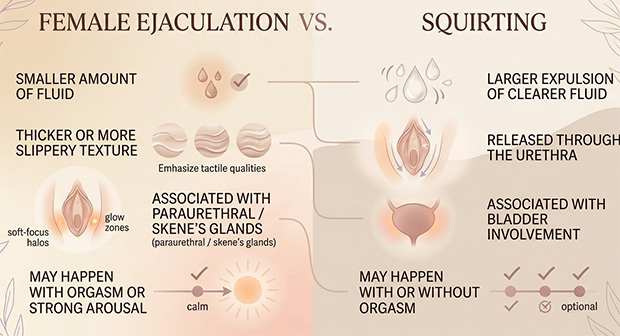
People use the words interchangeably all the time. In the body, that blurs something important.
The cleaner anatomical frame is this: female ejaculation usually refers to a smaller amount of thicker, milky or slippery fluid associated with the paraurethral tissues, often called the Skene’s glands. Squirting usually refers to a larger expulsion of clearer fluid released through the urethra, with bladder involvement. Major reviews separate those two phenomena even while acknowledging that they can happen together in the same sexual event.
That’s part of why people come away thinking they should be able to label the experience neatly when the body didn’t deliver it neatly at all. One person describes a small release. Another describes a gush. Another says it felt like both. All of those reports can fit the current literature.
That overlap is one reason this topic gets mangled so badly in popular sex talk. The categories sound crisp. Real bodies aren’t.
For a lot of people, the more honest frame is closer to how orgasm categories blur more than people expect. The body doesn’t always divide its own responses into tidy boxes just because the internet wants labels.
Female ejaculation isn’t just “a lot of wetness.” Squirting isn’t simply the same event turned up louder.
They overlap culturally. They don’t fully overlap anatomically.
A wet spot isn’t evidence that the sex worked
This is where porn has done real damage.
It took one possible body response and turned it into a scorecard. As if visible fluid is proof that the arousal was deep enough, the orgasm was strong enough, the partner was skilled enough, the whole encounter passed some invisible exam. That’s nonsense, and it has made a lot of people feel defective for no reason.
Fluid expulsion is not a required part of orgasm. It isn’t even a typical part of orgasm for most women in the clinical literature. Guidance on orgasm difficulty keeps coming back to a much less cinematic reality: many women need steady clitoral stimulation to orgasm at all, and whether fluid shows up tells you very little about the quality of that orgasm.
It doesn’t mean the orgasm was weak.
It doesn’t mean your body missed the final step.
And it definitely doesn’t mean somebody else has access to a more advanced version of pleasure while you’re stuck in the demo mode.
For some people, fluid release happens near orgasm. For some, it happens without orgasm. The Swedish study matters here because it breaks the lazy equation that squirting = climax. For many participants the two were linked. Not for all.
That’s a much better fit for real bodies anyway. Sexual response is messy. It doesn’t owe anybody a clean little arrow chart.
Why the buildup gets misread so easily
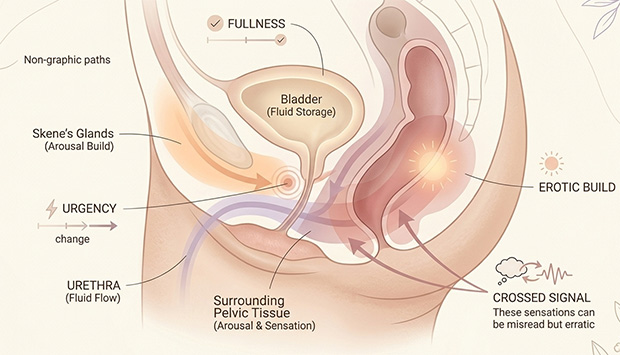
The sensation right before fluid release often feels awkward to describe because it is awkward to feel. Pressure. Fullness. A rising internal urge that feels sexual and urinary-adjacent at the same time. Not elegant. Not poetic. Just confusing enough to make you stop.
That confusion makes anatomical sense. The tissues involved sit around the urethral area, and larger squirting events appear to involve the bladder. The Skene’s glands are also located on either side of the urethra and may release fluid during arousal or orgasm. So yes, the body can produce a signal that feels erotic, urgent, and vaguely like peeing all at once. That crossed-wire quality is built into the geography.
So a lot of people do the same thing at the same moment. They tense their thighs. Pull back. Clench. Stop touching themselves or stop a partner because the sensation suddenly feels like a loss of control rather than a rise in arousal.
And then the whole thing vanishes.
For a lot of people, that is the exact moment the body stops feeling erotic and starts feeling supervised. The sensation didn’t necessarily fade on its own. It got interrupted by management. That is the same trap sitting under why performance pressure kills pleasure more generally.
Sometimes the response is less mysterious than it feels. Your body wasn’t necessarily malfunctioning. It just hit a signal your mind has been trained to treat as a warning.
The best way to explore it is to stop trying to force a headline moment
Pressure wrecks this fast.
Once the whole experience becomes Can I make it happen again?, your attention usually narrows in exactly the wrong way. You stop following arousal and start monitoring signs. You wait for the pressure cue like you’re trying to catch a train. You judge every build. You push on the same area because it worked once. That mindset makes the body harder to read, not easier.
That’s why it helps to explore pleasure without turning it into a test. The goal isn’t to manufacture one dramatic result on command. The goal is to get less interrupted by your own supervision.
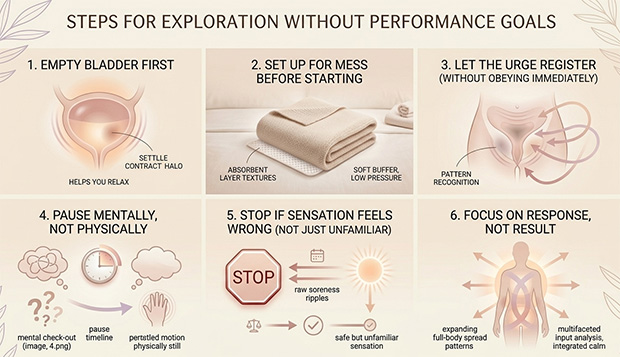
I think the most useful shift is this: explore the response, not the result.
A few practical ways to do that:
- Empty your bladder first if that helps you relax. Not because it guarantees squirting, but because less anxiety gives the body more room to stay curious.
- Set up for mess before you start. A folded towel or absorbent pad does more for your nervous system than a thousand pep talks.
- When that pressure cue shows up, let it register without physically bolting. You don’t need to push. You also don’t need to slam the brakes.
- Use the kind of stimulation that already works for your body. Chasing urethral-adjacent pressure with the wrong touch usually just creates irritation and frustration.
- And stop if your body feels confused in a bad way, not a charged way. Those are different states, and pretending they’re the same is how people turn exploration into a grim little assignment.
That last point matters more than people think.
There is a difference between intense and unfamiliar and wrong for me right now. The body usually tells you which one it is if you aren’t busy trying to produce proof.
And no, you don’t need a special kind of orgasm, a special kind of anatomy, or some hidden squirting talent the internet keeps pretending is a superpower. You need enough safety to notice what your body is actually doing.
Three moments readers usually recognize immediately
1. The “I ruined it because I thought I was about to pee” moment
You’re close. There is a sudden pressure change. You stop hard because you are sure the next second is going to be urine. The orgasm collapses, or the whole build goes flat.
That pattern is common. The body may have been moving toward a real response, but the moment got cut off by a misread cue. It’s often the same interruption pattern people mean when they get close to orgasm and then lose it.
2. The “that actually felt good, and now I’m embarrassed” moment
Fluid comes out. It may even feel hot, relieving, intense, or deeply releasing. Then you see the towel, or the sheets, or your partner’s face, and your nervous system switches tracks from arousal to self-consciousness.
The experience didn’t suddenly become bad. It became social.
3. The “I liked it once and now I feel weirdly obligated to repeat it” moment
Something happened during one session that felt memorable. Next time, instead of following arousal, you start chasing the same outcome as if you are supposed to prove you can still do it.
That chase flattens pleasure fast. The Swedish study is helpful here too: many women described ejaculation or squirting positively, but a substantial share had also wanted to avoid it at some point because it felt too wet, too uncertain, or too loaded with insecurity about what the fluid was.
You’re allowed to want it, not want it, enjoy it, avoid it, feel proud of it, feel neutral about it, or feel mixed. All of those responses are real.
Sometimes it’s a sexual response. Sometimes it deserves a medical conversation
Not every fluid event during sex belongs in the same bucket.
Fluid release during arousal can be physiological. It can also overlap with urinary incontinence, especially if leakage happens reliably with penetration or orgasm and doesn’t feel tied to pleasure in a way that makes sense to you. The line between normal sexual fluid expulsion and a urinary issue can get blurry enough that guessing isn’t always helpful.
Talk to a clinician if:
- fluid leakage happens outside sexual arousal too
- it comes with burning, pain, recurrent urinary symptoms, or pelvic pain
- the smell, color, or overall feel seems off to you
- you’ve developed painful sex, painful urination, cloudy or bloody urine, or new urinary incontinence
- or the whole experience feels distressing enough that you keep bracing before anything has even started
This is especially worth checking if the change is new.
A response you don’t understand can still be normal. Pain is the part I wouldn’t wave away. And if the whole pattern keeps coming with clenching, guarding, or a sense that your body is bracing before you consciously choose anything, that often points less to a fluid mystery and more to body tension getting in the way of pleasure.
What matters more than whether it happens
I don’t think the most useful question is, Can I squirt?
I think the more useful question is, What does my body do when I stop grading it?
For some people, the answer includes ejaculation. For some, it includes squirting. For some, it includes neither, and the pleasure is still deep, physical, and completely real. The clinical guidance around orgasm problems keeps circling back to the same boring truth from different angles: reliable pleasure is usually about the kind of stimulation, the level of arousal, and the conditions around the experience. Not about producing one dramatic visual proof that the internet decided to worship.
You are not missing a secret level of sex because the bed stayed dry.
You are learning your body in its own language. Most people do much better once they stop demanding subtitles.
Reviewed medical and clinical sources
- Pastor Z, Chmel R. Female ejaculation and squirting as similar but completely different phenomena: A narrative review of current research. Clinical Anatomy. 2022.
- Rodriguez FD, Camacho A, Bordes SJ, Gardner B, Levin RJ, Tubbs RS. Female ejaculation: An update on anatomy, history, and controversies. Clinical Anatomy. 2021.
- Salama S, Boitrelle F, Gauquelin A, Malagrida L, Thiounn N, Desvaux P. Nature and origin of “squirting” in female sexuality. Journal of Sexual Medicine. 2015.
- Påfs J, Wahlberg A, Fugl-Meyer KS, Ziaei S. Women’s experiences of female ejaculation and/or squirting: a Swedish cross-sectional study. Sex Med. 2024.
- Cleveland Clinic. Skene’s Gland: Function, Location, Secretion & Conditions. Updated 2022.
- International Continence Society. Coital Urinary Incontinence. Accessed April 10, 2026.
- Leicester Partnership NHS Trust. Female orgasmic difficulties. NHS patient guidance.
- Pastor Z. Female Ejaculation Orgasm vs. Coital Incontinence: A Systematic Review. Journal of Sexual Medicine. 2013.
Add comment