

 Amie Dawson, Ph.D.
You try internal stimulation because it sounds like the more advanced kind. You angle the toy. You curl your fingers. You wait for that deep, unmistakable response people talk about.
Instead, you get pressure. Maybe fullness. Maybe the annoying sense that you need to pee. Maybe nothing at all.
Then you move back outside, and your body wakes up.
That pattern is more common than a lot of people realize. It does not mean you are missing a spot. It does not mean your body is “too clitoral.” It usually means your body responds more clearly to external input than to internal pressure.
External stimulation often feels better for one simple reason: it is easier to read
The clitoris is not just the small external part people can see, but the visible glans still matters a lot here. It is highly sensitive, and it is easier to target directly or indirectly than the internal parts of the clitoral network that sit around the vaginal canal. Cleveland Clinic’s anatomy guidance notes that the clitoris has both external and internal structures, and that vaginal penetration can stimulate it through the vaginal wall, which already tells you something useful: internal pleasure is often more indirect.
For many bodies, internal stimulation does not feel deeper. It feels less exact.
External touch gives faster feedback. Your body can answer immediately: yes, there, softer, lighter, stay there. Internal stimulation often gives a blurrier signal. The area is less visually obvious, the angle matters more, and a small shift in depth or pressure can change the sensation from erotic to distracting.
That matters more than people think.
Pleasure builds better when your body can recognize the signal quickly.
For a lot of people, that clearer feedback is the whole reason external pleasure feels easier to build with than deeper internal stimulation, especially before arousal has fully gathered. That is often the most practical difference between clitoral and G-spot pleasure.
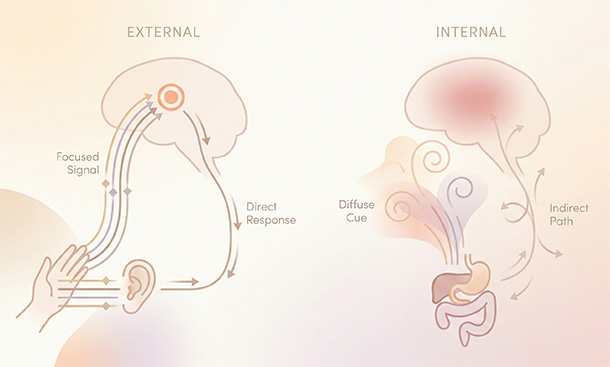
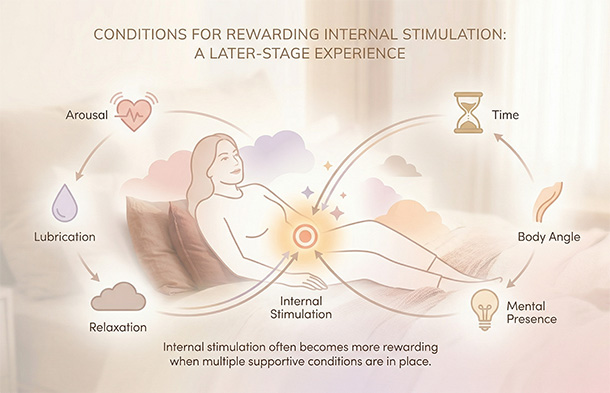
Internal stimulation often asks for more conditions to be right
Some people love internal stimulation. Some love it only when they are already very aroused. Some like it best as part of blended stimulation, not by itself.
A 2023 qualitative study on women’s orgasm experiences found that people who described vaginal or blended orgasms often called them deeper, fuller, or more diffuse than clitoral orgasms, but they also described them as harder to reach and more dependent on the right position, the right kind of stimulation, enough time, and not being stuck in their head.
That tracks with what many readers feel in practice. External stimulation may work earlier in arousal. Internal stimulation may only start feeling distinctly erotic after enough blood flow, lubrication, relaxation, and mental drop-in have already happened.
So if internal touch feels flat at the beginning, that does not automatically mean you dislike it forever.
It may mean your body treats it as a late-stage sensation, not an opening move.
For some people, that is the whole reframe. Internal pleasure is not failing. It is just arriving too early to mean much yet, which is usually why it helps to explore G-spot pleasure without pressure to make it perform before the body is ready.
A lot of people prefer external because it is simply the more reliable route to orgasm
MedlinePlus says it plainly: most women require clitoral stimulation to reach orgasm.
That is not a fringe opinion. In a U.S. probability sample of women ages 18 to 94, only 18.4% said intercourse alone was sufficient for orgasm. In the same study, 36.6% said clitoral stimulation was necessary during intercourse, and another 36% said orgasm felt better when the clitoris was stimulated during intercourse.
Another study found the same pattern from a different angle: women reported orgasm much more often during intercourse when concurrent clitoral stimulation was present than when it was absent.
This is why external stimulation can feel less mysterious. It stays the anchor even when people later enjoy internal touch too. The outside gives the body the clearest line to follow, and the inside only starts feeling good once it has something to join, which is often the real shape of blended stimulation.
What feels most erotic is not always what sounds most impressive.
Sometimes internal does not feel neutral. It feels bad
This is the part people often skip over.
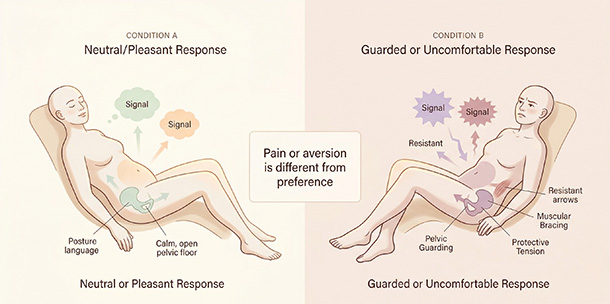
There is a big difference between “I do not prefer internal stimulation” and “internal stimulation feels burning, sharp, tight, scary, or impossible.” The second group is not just a preference issue.
Merck Manual notes that pain with penetration can involve burning, sharp, or cramping pain, involuntary tightening of the muscles around the vaginal opening, and difficulty with arousal and orgasm alongside the pain. It also notes that inadequate lubrication, dryness, pelvic muscle tension, and a history of painful sex can feed that cycle.
NHS guidance on vaginismus makes another important point: some people can still get aroused and enjoy other kinds of sexual contact even while penetration triggers automatic tightening and pain.
That means an external preference can sometimes be a straightforward erotic preference.
And sometimes it is a smart workaround your body developed because penetration has been uncomfortable, under-lubricated, rushed, or associated with fear.
Mayo Clinic also notes that anxiety, stress, fear of pain, and low arousal can contribute to painful intercourse, partly because pelvic floor muscles tend to tighten in response.
If internal stimulation consistently feels painful, stinging, burning, or impossible, that is not a sign to push harder. It is a sign to get curious and, if needed, get clinical help.
What this looks like in real life
Sometimes the difference is not philosophical. It is painfully practical.
- You use a toy internally and keep adjusting the angle because you can feel something, but not enough to stay with it. Then you place a vibrator externally and your body answers within seconds.
- Penetration with a partner feels intimate and emotionally good, but not especially orgasmic until a hand or toy is added outside.
- Internal stimulation feels promising for about ten seconds, then turns into pressure you have to mentally manage instead of pleasure you can sink into.
- You can enjoy external touch, oral, or vibration, but the moment anything approaches penetration, your body braces before you even choose to.
Those are not all the same experience.
But they all tell you something useful.
A lot of people are not bad at internal pleasure. They are trying to force fireworks out of a kind of touch their body reads as pressure.
The problem is often the hierarchy, not the preference
People absorb a quiet ranking system early. External is beginner. Internal is advanced. Penetration is more “real.” If you orgasm from outside, that counts, but somehow counts less.
The body does not care about that hierarchy.
The body cares about signal quality.
That is why internal pleasure does not have to outrank external pleasure to count. For some people, internal stimulation is interesting, grounding, or worth having without being the fastest route to orgasm at all, which is exactly why a G-spot toy can feel good even without orgasm.
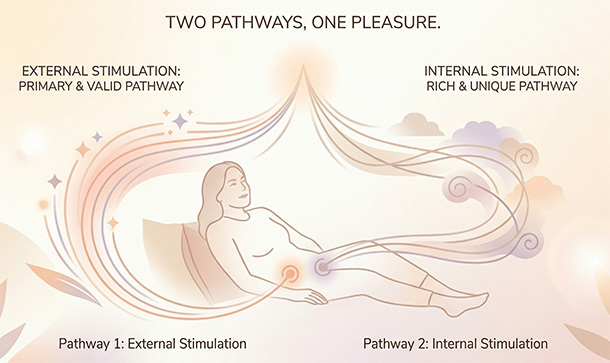
External stimulation is not a consolation prize. It is not the kiddie pool of pleasure. For many people, it is the primary route because it is the most precise, the most repeatable, and the least dependent on perfect timing.
And even for people who eventually enjoy internal or blended stimulation, external often remains the anchor.
Not the backup plan.
The anchor.
Preference is information
You do not need to convert your body into liking internal stimulation just because culture gave it better branding.
You also do not need to lock yourself into a permanent identity around it. Preferences can stay stable for years. They can also shift with arousal, age, hormones, pelvic floor health, stress, trust, or the kind of touch you are using.
But none of that changes the main point.
If external stimulation is what makes your body feel awake, specific, and genuinely turned on, believe that.
Pleasure is not more valid because it happens farther inside you.
Reviewed medical and clinical sources
- Debby Herbenick, Tsung-Chieh Jane Fu, Jennifer Arter, Stephanie A. Sanders, Brian Dodge. “Women’s Experiences With Genital Touching, Sexual Pleasure, and Orgasm: Results From a U.S. Probability Sample of Women Ages 18 to 94.” Journal of Sex & Marital Therapy, 2018.
- MedlinePlus Medical Encyclopedia. “Orgasmic dysfunction in women.” U.S. National Library of Medicine, updated 2024.
- Cleveland Clinic. “Clitoris: Anatomy, Location, Purpose & Conditions.” Medically reviewed, updated 2026.
- MSD Manual Consumer Version. “Genito-Pelvic Pain/Penetration Disorder.” Reviewed 2023.
- NHS. “Vaginismus.” National Health Service, accessed 2026.
- Mayo Clinic Staff. “Painful intercourse (dyspareunia): Symptoms and causes.” Mayo Clinic, updated 2024.
- Talia N. Shirazi, Nicholas P. Renfro, Elizabeth R. Wallen, David M. Puts. “Women’s Experience of Orgasm During Intercourse: Question Semantics Affect Women’s Reports and Men’s Estimates of Orgasm Occurrence.” Archives of Sexual Behavior, 2018.
- Kathrin Weitkamp, et al. “Women’s Experiences of Different Types of Orgasms—A Call for Pleasure Literacy?” Sexes, 2023.
Add comment