
 Amie Dawson, Ph.D.
You buy a toy that is supposed to be “for inside,” and then spend the whole session adjusting angle, depth, and pressure like you are trying to tune a weak radio station. Or you try something external and pull it away after two seconds because the contact feels too naked, too sharp, too immediate.
That does not mean your body is difficult.
It usually means the toy is speaking the wrong sensory language.
The real difference is contact point, not sophistication
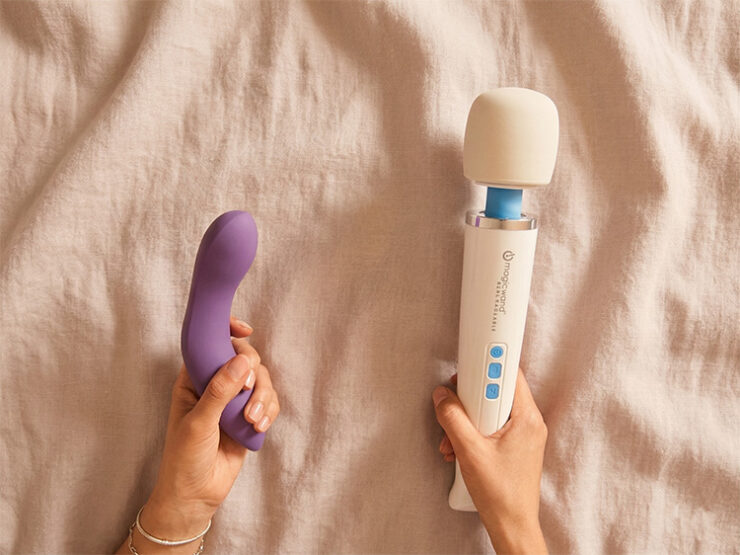
I think this is the cleanest way to say it: an external vibrator is designed to stimulate the outside of the genitals, usually the vulva and clitoris. An internal vibrator is designed to be inserted, usually into the vagina, so the main sensation happens inside the body.
That sounds obvious. It is not.
A lot of people quietly treat internal toys like the more advanced option, as if external toys are step one and insertable toys are where “real” sexual confidence begins. I do not buy that for a second.
External is not the kiddie pool. Internal is not graduate school.
They are different routes into arousal. That is all.
For a lot of people, the real shift comes when they stop treating internal toys as an upgrade and start noticing why external stimulation feels more natural on their body. Preference is not a lower stage of pleasure.
External toys often feel more reliable because they go straight to where orgasm commonly builds
This is the part people deserve to hear earlier. A lot of women need steady clitoral stimulation for orgasm, and penetration by itself often does not provide enough of it.
That one clinical point explains a ridiculous amount of private confusion.
If an external vibrator works better for you, that does not mean you are missing some deeper, more mature form of pleasure. It may simply mean the toy is going straight to the kind of stimulation your body uses most effectively.
And external does not always mean hard, direct contact right on the clitoral glans. The clitoris is not just the small visible tip. It is a larger internal structure made of erectile tissue and nerves, and too much direct pressure on the glans can feel painful.
That is why one person loves pinpoint contact and another immediately flinches.
Some bodies do not want more intensity. They want more cushion.
That is often the hidden difference between direct and indirect clitoral stimulation. A body can want clear external stimulation without wanting the most exposed version of it.
For some people, an external toy works best beside the clitoris, over the hood, or even over the mons pubis instead of directly on the most sensitive point. That is not “using it wrong.” It is often the smarter read of what the body is actually asking for.
Internal toys create fullness, pressure, and internal movement
Internal vibrators usually do not feel like an external toy moved inward. They feel like a different category of sensation.
Inside the body, the feeling is often more about fullness, pressure, pulsing, rocking, or a deep internal buzz than about one bright, unmistakable point of contact.
Inside can feel hot, close, and promising without ever becoming a clear yes.
That is not a flaw. It is just a different sensory profile.
For some people, that profile is exactly the appeal. They like the feeling of something inside them. They like stretch. They like being filled. They like the way internal movement changes their breathing, their pelvic floor, and their sense of being occupied from the inside. The pleasure is less “there, right there” and more low in the pelvis, slower to organize, sometimes more immersive than obvious.
For others, internal vibration feels erotic but not decisive. They enjoy it, but it does not finish the job on its own.
That also makes sense.
So if you like penetration and still need the orgasm to happen elsewhere, there is nothing contradictory about that. For a lot of people, that is simply the difference between clitoral and G-spot pleasure. One can make the experience feel fuller while the other still provides the clearest route to orgasm.
When one category feels bad, the reason is usually mechanical, not mysterious
When an external toy feels wrong, the problem is often how exposed the contact feels.
That is why a toy can feel like too much before you are fully turned on. Not because you are overly delicate. Because arousal changes how contact lands.
You are not rejecting pleasure.
You are rejecting the wrong kind of entry.
When an internal toy feels wrong, the common problems are different. The body may tighten automatically. The tissue may be too dry. The angle may be off. The toy may be pressing where you do not actually want pressure. Or your body may simply not treat insertion as the main route into pleasure, even if you like the idea of it in theory.
So if anything going in makes your body brace, burn, or shut down, do not treat that as a technique problem you are supposed to push through.
Pain is information.
If penetration keeps tipping into discomfort, it helps to separate ordinary mismatch from pain a vibrator may be causing or worsening. Those are not the same problem, and they should not be treated like one.
A lot of people keep trying to force themselves into liking internal toys when the more honest answer is simpler: right now, their body prefers outside touch. Or slower buildup. Or more lube. Or less pressure to perform.
What this looks like in real life
The definitions get much clearer once you picture actual bodies using actual toys.
Scenario one: You like orgasms that build fast and clearly. You want a sensation you can locate immediately. You notice tiny changes in angle. Penetration can feel pleasant, but once you are close, you do not want your body guessing.
That person often prefers external vibration.
Scenario two: You love the feeling of being filled. You enjoy thrusting, rocking, or bearing down slightly against a toy. The pleasure feels lower, deeper, and more immersive. Orgasm may still need extra clitoral stimulation, but the internal part is what makes the whole experience feel sexual.
That person often likes internal vibration, with or without something external.
Scenario three: Direct clitoral contact feels too raw. Not bad exactly. Just unshielded.
That person may still prefer an external toy, but only if the contact is broader, softer, or slightly indirect.
That is usually a sign the body may prefer broad stimulation over pinpoint contact. The issue is often not external touch itself, but how narrowly it lands.
Scenario four: You keep buying insertable toys because you think you are supposed to want them, but every session turns into fiddling. More depth. Less depth. Curved side. Flat side. Nothing is terrible. Nothing really clicks.
That is often a sign that internal stimulation is not your main driver, even if you like it in theory.
There is one more important point here. A lot of bodies do not ultimately want external or internal. They want both.
When that combination clicks, it helps to have language for what blended stimulation actually feels like. A toy outside can provide the clarity. A toy inside can provide the fullness. One gives the sentence its meaning. The other gives it texture.
Stop treating this like a hierarchy
I think the most useful reframe is this: external and internal vibrators are not competing for the title of best.
They answer different questions.
External asks, Where does your body want stimulation to begin?
Internal asks, What does it want to hold, press against, or open around?
Those are not the same question.
If your body comes alive from outside contact, believe it. If you love internal sensation but still need something on the clitoris, believe that too. If insertion makes you tense, stop reading that tension as failure. Read it as data.
A good toy does not prove that you are sexually evolved.
It makes your body feel less like a puzzle and more like a place you can actually live in.
Reviewed medical and clinical sources
- Leicestershire Partnership NHS Trust. Female Orgasmic Difficulties.
- Cleveland Clinic. Clitoris: Anatomy, Location, Purpose & Conditions.
- Cleveland Clinic. Vulva: Location, Anatomy, Function, Conditions & Care.
- Cleveland Clinic. Vagina: Anatomy, Function, Conditions & Care.
- MSD Manual Professional Edition. Female Orgasmic Disorder.
- NHS. Vaginismus.
- Merck Manual Consumer Version. Genito-Pelvic Pain/Penetration Disorder.
Add comment