
 Amie Dawson, Ph.D.
I’ve lost count of how many people have told me they “just don’t respond to bullets.” They describe the same loop every time: turn it on, first few settings do nothing, click up twice, and suddenly the vibration has jumped from barely-there to already-harsh. Now they’re chasing an orgasm against a motor that’s outpaced their arousal, their hand is buzzing, and they’re half-numb at the contact point. They conclude their body is difficult.
Usually the body isn’t the problem. Usually it’s the spacing — the distance between intensity levels and whether each step gives the tissue time to register before the next one arrives.
The Lily 3 doesn’t win with power — it wins with spacing
My lab read: The Lily 3 is not a power bullet. Its Power Index is 4.3/10, and its max displacement tops out at 0.15mm. But its linearity score is 8/10, which means the intensity range fills in smoothly instead of jumping from decorative to too much.
That changes the whole toy. Speed 2 is already useful. Speeds 3 and 4 build without making the tissue recalibrate. Speed 5 was where most of my sessions lived. The Lily 3 does not overpower the body into response. It gives the body enough steps to follow.
Why this matters in a body: If other bullets have made you feel like your arousal is too slow, the real issue may have been pacing. A smoother ramp lets sensation gather instead of forcing you to leap from warm-up to overload.
The LELO Lily 3 has the smoothest, most evenly spaced intensity ramp I’ve measured in a compact vibrator. Not the strongest motor. Not the deepest vibration. But when I first used it, something happened that almost never happens with bullets: I didn’t have to skip past three dead settings to find the real starting line. Speed 2 was already doing something on my body. And from there, each step up felt like the toy was following my arousal instead of sprinting ahead of it. I wasn’t expecting that from a pretty LELO pebble that looks more like a lifestyle accessory than a serious tool — and I especially wasn’t expecting it from a motor that, on paper, sits squarely in the middle of the pack.
Quick read: The Lily 3 is not the bullet I’d choose for raw force. It is the bullet I’d choose when the problem has been pacing — too little, then suddenly too much.
Quick verdict
| Design: |  (5.0 / 5) (5.0 / 5) |
| Comfort: |  (4.0 / 5) (4.0 / 5) |
| Power: |  (3.0 / 5) (3.0 / 5) |
| Experience: | (4.0 / 5) |
| Controls: | (3.0 / 5) |
| Value: |  (2.0 / 5) (2.0 / 5) |
The LELO Lily 3 is a quiet, low-fatigue compact vibrator with the smoothest intensity ramp I’ve measured — best for gradual arousal, not deep power.
You can buy this product from:
Buy if: Your body builds gradually, other bullets jump from nothing to too-much, you need genuine quiet, or hand fatigue has been cutting your sessions short.
Skip if: You need deep, tissue-penetrating power, prefer tight pinpoint precision, or want a cushioned silicone contact surface.
Price: $109 MSRP (overpriced), frequently ~$76 on sale (competitive). We-Vibe Tango X: ~$80.
Sensation profile: Broad, surface-forward, hum-dominant with moderate depth. Vibration pools across the contact area instead of drilling into one point. Forgiving placement. Clean waveform through the mid-range. Very low hand fatigue. Best suited to gradual arousal building rather than quick, high-intensity climax.
Best for: Sensitive-to-moderate bodies, slow-build arousal patterns, shared-wall living, and anyone whose fingers go numb before their body gets where it’s going.
The buying decision: choose the Lily 3 for control, quiet, and hand comfort. Skip it if your body needs depth, cushion, or a harder push toward climax.
Marketing vs. Reality Score: 68/100
Verdict: Mostly honest, strategically vague where it matters most
Why: LELO’s product page gets the identity right — this really is a compact, travel-friendly, waterproof clitoral vibrator with a smooth ergonomic shape, and those claims hold up cleanly in testing. The IPX7 waterproofing is genuine. The battery life matches. The travel-lock works. The shape does tuck against the body well. Where the score drops is in the sensation framing and the scope.
The page calls LILY 3 an “upgraded and more powerful version” of earlier Lilys and says it “fits your body like a glove” — but in testing, the power index lands at a middling 4.3/10, and the hard ABS plastic body (Shore A 99) doesn’t conform to anything. It sits on the body; it doesn’t fit around it. Calling the settings a range from “a teasing murmur to a satisfying pulse” is fair for the low end but quietly oversells the top — the maximum displacement of 0.15 mm keeps stimulation at the surface, and users acclimated to wands or higher-displacement bullets won’t find the upper settings satisfying.
The listed max noise of 60 dB is technically a ceiling spec, not a real-world claim, but it’s misleading by omission — the toy actually maxes at 27 dB in testing, which is dramatically quieter and a genuine selling point LELO undersells. The biggest gap is scope discipline: the page never clarifies that this is a mid-power, surface-forward vibrator best suited to sensitive-to-moderate users, letting the word “powerful” do work it can’t support for everyone who reads it.
Reader translation: LELO should sell this as refined, quiet, and gradual — not powerful. The Lily 3’s strength is control, not force.
What you’re working with
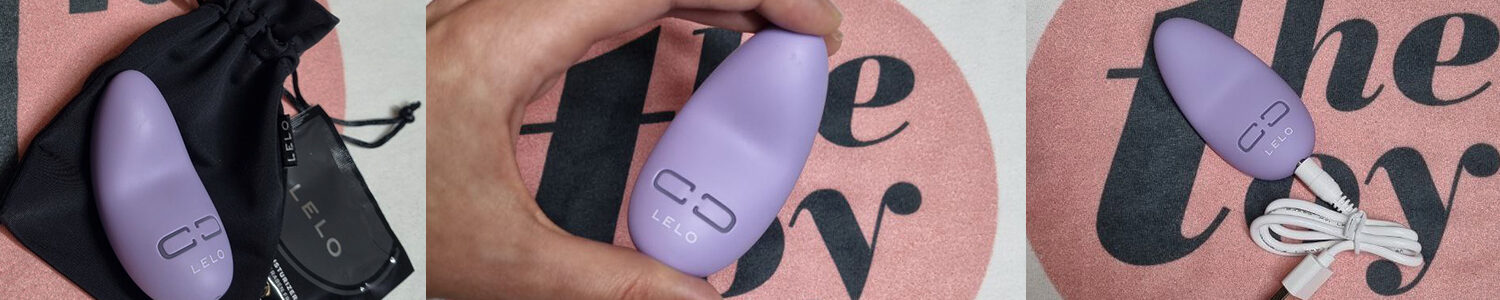
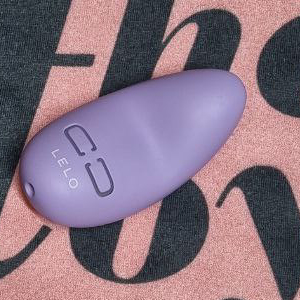
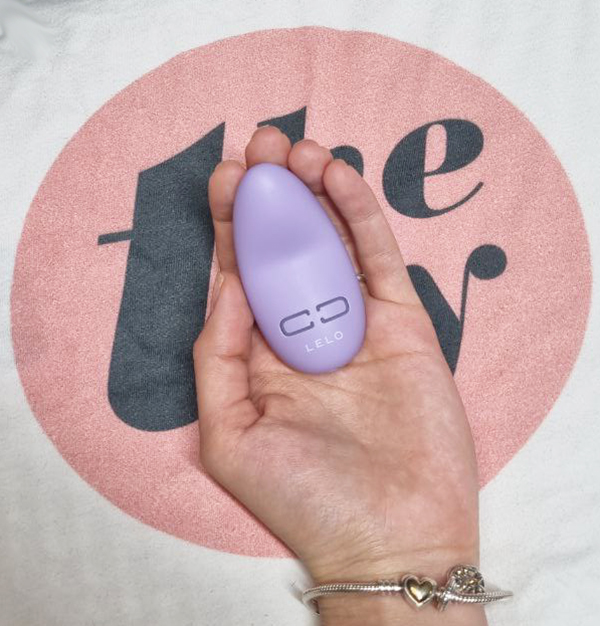
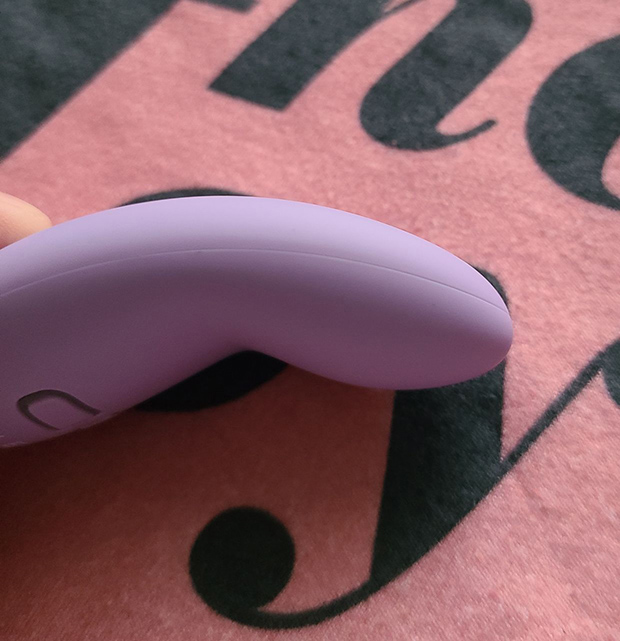
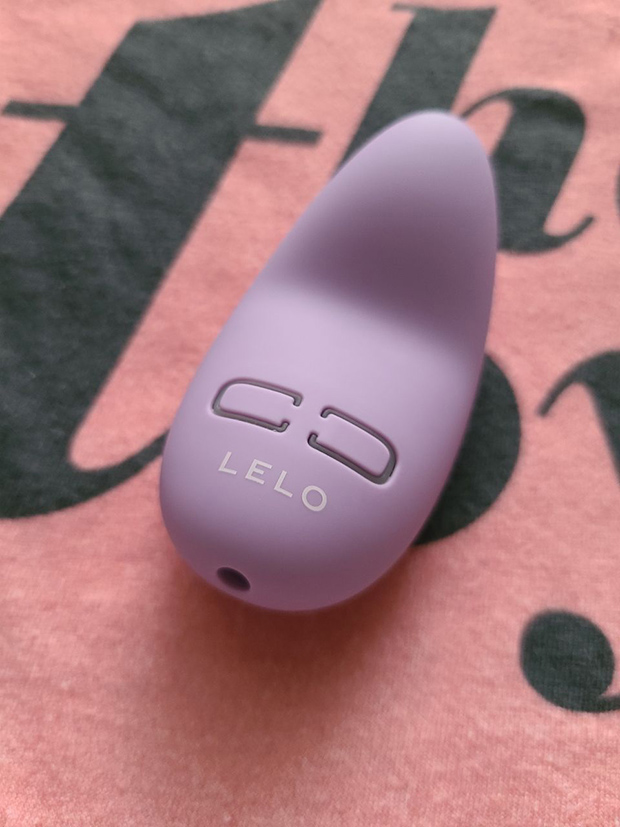
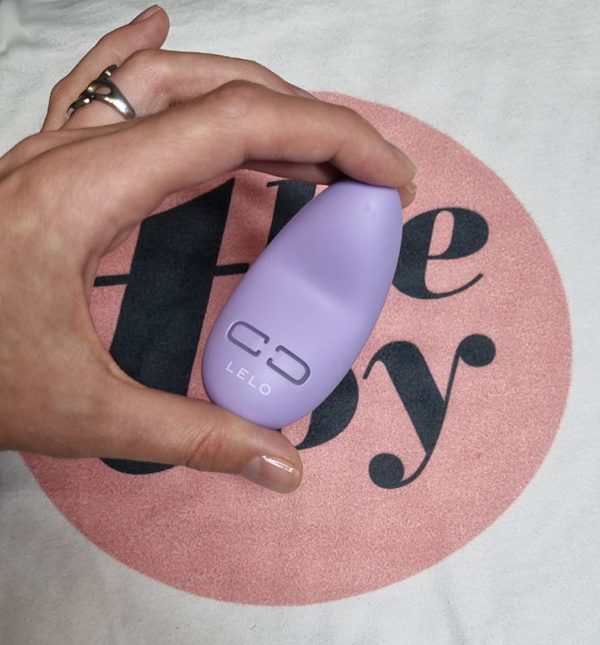
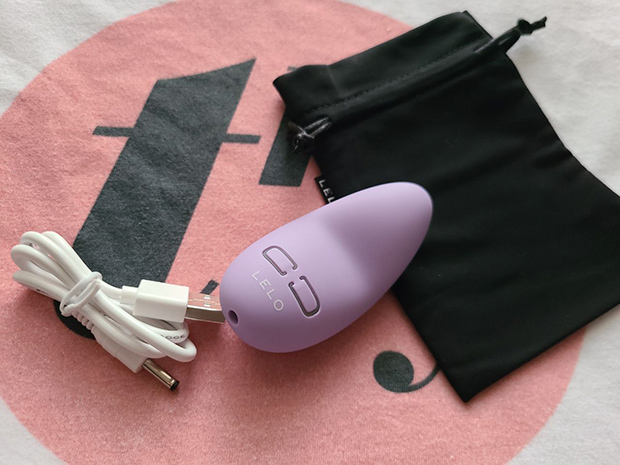
Curved, pebble-shaped external vibrator — hard ABS plastic body (Shore A 99, completely rigid) with a smooth silicone coating. 43 grams, about 8.5 cm long. The banana-like curve angles the broad, rounded tip toward the body naturally. Two buttons on the back: right for increase, left for decrease. Hold either to sweep through intensity continuously. Double-press right for patterns. USB plug-in charging, ~2 hours in for ~2 hours of play. IPX7 waterproof. Travel lock (both buttons held 5 seconds). Comes in dark plum, polar green, or calm lavender with a satin storage pouch, charging cable, warranty card, and lube sample. One-year warranty.
How the Lily 3 feels in the body, setting by setting
The measurements tell a specific story about this motor, and it’s worth translating carefully because the Lily 3’s numbers explain exactly why it feels the way it does — and who it will work for.
The overall vibration character: My testing puts the Lily 3’s deep-to-sharp balance at 6.5 out of 10, meaning it leans toward depth over surface buzz, but doesn’t fully commit to either. The deep rumble score is 3.3 — moderate — and the sharp/buzzy score is 4.2. In body terms, this is a vibrator that hums more than it chatters. It won’t feel like a heavy, pelvic-floor-filling rumble the way a wand or a high-displacement bullet does. But it also won’t feel like that thin, electric, skin-only buzzing that makes some bodies go numb in two minutes. It sits in a clean middle register — defined enough to be interesting, smooth enough to sustain.
Displacement — why this stays at the surface: Peak displacement at maximum power is 0.15 mm. That’s small. For context, the Lovense Ambi reaches 0.36 mm and you can feel the difference immediately — the Ambi’s vibration travels past the skin into the tissue beneath, creating that fuller, heavier, body-filling sensation. The Lily 3’s 0.15 mm keeps the stimulation closer to the surface. It skims rather than shoves. The vibration is felt across the skin over the clitoral structure, not pushed deep into it. For bodies that find deeper vibration overwhelming or over-intense, this is a feature. For bodies that need vibration to push through to the internal clitoral legs and bulbs, this will feel like the motor is running out of reach right when it needs to go further.
This feels like: clean surface stimulation that spreads politely across tissue, not a heavy vibration that pushes down into the body.
That mismatch makes more sense once you stop picturing the clitoris as a tiny external button. It is a larger internal structure, and treating it like a single target misses why some bodies need broader contact, deeper vibration, or a different angle before the sensation really lands.
The waveform — clean through the sweet spot, with a quirk at the top: The oscilloscope readings showed clean, evenly repeating waves through the mid-range speeds — the kind of motor behavior that translates to smooth, velvet-textured vibration against tissue. No grittiness, no mechanical edge, no harmonic noise making the sensation feel rough. At the highest speeds, some traces were noisier and less uniform, suggesting the motor’s character shifts slightly near maximum. In practice, that means the Lily 3 feels its most refined between speeds 3 and 5, and adds a faintly coarser texture at 6 and 7. Most bodies won’t consciously notice the shift. Bodies with high tissue sensitivity — the ones that can tell the difference between a toy that feels smooth and one that feels grainy — might notice the top end feeling slightly less polished than the middle.
Use lesson: the Lily 3 is best in the middle, not at the ceiling. If speed 7 feels less satisfying, back down before assuming you need a stronger toy.
This matters if: your body needs time to catch up. The Lily 3 gives you small, usable steps instead of forcing a jump from warm-up to too much.
Now, setting by setting:
Speeds 1–2: Where warm-up actually starts
Speed 1 measures 0.5 m/s² acceleration, 3 mm/s velocity, 0.04 mm displacement at the tip. In body terms, it’s a whisper. Against non-aroused tissue you’d barely register it. Against already-sensitized skin, or on a nipple, it reads as a soft diffuse flutter — something your nervous system can accept rather than brace against. Speed 2 (1.8/6/0.07) is where genuine stimulation begins: a gentle hum with enough definition to feel intentional. On most compact vibrators, speeds 1 and 2 are dead filler — the motor clearing its throat before anything real starts. On the Lily 3, speed 2 is functional warm-up, and speed 1 is genuinely useful for nipples or for bodies that need the softest possible entry point. That low floor matters because clitoral sensitivity varies enormously between individuals and between sessions for the same person — research consistently shows this is normal biological variation, not a deficiency — and a toy that starts somewhere real gives you room to meet your body wherever it actually is that day.
Speeds 3–4: Building with intention
Speed 3 (2.7/7/0.07) shifts from suggestion to purpose. The vibration has enough body to accumulate arousal rather than just hinting at it. Speed 4 (4/9/0.08) is clearly foreground — the toy is working, not just present. The transitions between these are so gradual I sometimes couldn’t tell I’d clicked up until the sensation had thickened slightly. Each step gets absorbed instead of announced, and the tissue doesn’t have to recalibrate between levels. My linearity score for the Lily 3: 8 out of 10, meaning the intensity fills the range evenly with no dead zones, no cliffs, and no sudden character jumps. The Tango X scores 3 out of 10 on the same measure. The Touch X: 4. In practice, linearity determines whether you have fine control during the arousal build or whether the toy jumps over the intensity you actually needed.
Speed 5: Where most of my sessions lived
At 6/13/0.10, speed 5 was the setting I returned to most. Strong enough to push toward climax if arousal had been building, gentle enough that the tissue wasn’t going flat from overstimulation. One experienced reviewer described the mid-range as giving her “the power I wanted most of the time,” and speed 5 is exactly that zone. The waveform is at its cleanest here — smooth, even, no mechanical edge. This is where the motor’s personality is most pleasant.
Speeds 6–7: More energy at the surface, not more depth
Tip acceleration nearly triples from speed 5 to maximum (9/16/0.13 at speed 6, 15/24/0.15 at speed 7). But displacement — the actual throw of the motor, the thing that determines whether vibration travels into tissue or stays on the skin — tops out at 0.15 mm even at max. The sensation gets more intense at the contact point without getting deeper. More chatter, not more weight. If your body responds to escalating surface intensity, the top end delivers that final push. If you need vibration to reach past the surface into the tissue underneath, these settings will feel like the motor is getting louder without actually getting closer to what your body needs.
The engineering detail that earned my genuine respect: handle vibration drops at maximum power. Speed 7 sends 15/24/0.15 to the tip but only 1.5/3/0.03 to the grip area. My hand fatigue index for the Lily 3: 1.9 out of 10, meaning the handle barely vibrates even when the tip is working hard. That score means your fingers stay calm, your grip stays precise, and you don’t accumulate that creeping TV-static numbness in your hand that makes other bullets feel like they’re punishing you for taking longer than five minutes. The Tango X, for comparison, scores 10.0 — the highest hand fatigue I’ve measured. After ten minutes with the Tango X, your fingers are buzzing hard enough to interfere with grip control and the numbness lingers after the session is over. The Lily 3 is a different holding experience entirely.
The Lily 3 gets more intense at the top, but it does not get much deeper
My lab read: From speed 5 to speed 7, the Lily 3’s tip acceleration rises from 6 to 15 m/s², and velocity rises from 13 to 24 mm/s. But displacement only climbs from 0.10mm to 0.15mm. That means the top end adds more surface energy, not a big jump in tissue travel.
This is why the Lily 3 can feel stronger without feeling heavier. The motor is working harder, but the stroke is still small compared with a depth-focused bullet like the Ambi at 0.36mm.
Why this matters in a body: If your body responds to clean, escalating surface stimulation, the top speeds may be enough. If your body needs vibration to push beneath the skin into deeper clitoral structures, the Lily 3 may feel like it gets more urgent without ever getting deep enough.
Across body zones and arousal states
Against the clit, the broad rounded tip creates stimulation that pools — spreads across the glans and surrounding tissue instead of zeroing in on one spot. Against the labia, vibration carries noticeably beyond the direct contact point; the broad hard surface doesn’t confine the sensation to exactly where the tip sits. On nipples, speeds 1–3 are genuinely pleasant without being jarring.
Arousal changes the experience significantly. That is also why the exact same toy can feel strangely perfect one night and flat or fussy the next. Bodies are not static receivers, and small shifts in arousal and sensitivity can change what reads as pleasant, vague, or overwhelming from one session to the next.
When I wasn’t warmed up, speed 2 felt like a polite suggestion. After several minutes of building, the same speed 2 felt like the toy already knew what to do. The tissue is different — clitoral engorgement increases blood flow, swelling slightly changes the contact geometry, nerve-ending sensitivity shifts. A toy with enough usable range at the bottom lets you start where your body actually is instead of where the marketing assumes you’ll be.
Pressure response on hard plastic
Press lightly: diffuse, buffered hum across a broader area. Press harder: same character with more direct contact force, because the Shore A 99 ABS plastic doesn’t compress at all. There’s no material cushion softening the increase. Below speed 4, that directness feels clean and tidy — precise without being aggressive. Above speed 5 with heavy pressure directly on the glans, the lack of any buffer between motor and tissue starts to feel exposed. You compensate with lighter pressure, indirect angle, or stimulating through the clitoral hood rather than directly on the glans. Those are valid techniques. But the hard material is adding a management task that a softer-bodied toy like the Touch X (Shore A 24 — significantly cushioned) would handle for you.
Use lesson: with the Lily 3, pressure is not always your friend. If direct contact feels exposed, lighten the pressure or add fabric before you increase speed.
Two sessions, two different nights
Late-night solo, low arousal, someone sleeping one room over
Started on speed 2 through underwear — a habit I’ve developed with hard-plastic toys because the fabric layer acts as a free buffer, giving the tissue more time to warm up without the full directness of the surface. Even through cotton, the vibration was present and gentle. After a few minutes I moved to direct contact at speed 3, then held the ramp button to slide toward 4. The hold-to-ramp was smoother than clicking through discrete steps — less like a staircase, more like a slow volume knob. My body caught up around speed 4. Finished on speed 5.
That trick sounds almost too simple to matter, but using a toy over underwear is one of the easiest ways to make a hard surface feel less abrupt without losing the signal completely.
About 18 minutes total. The orgasm had more definition than what I typically get from toys that bulldoze through the mid-range. The gradual build meant the tissue stayed responsive instead of progressively numbing — a well-documented principle in how clitoral stimulation works. The body responds more vividly to sensation it’s had time to absorb. My hand felt completely normal afterward. No buzzing, no stiffness, no residual numbness.
The noise: speed 5 under one blanket layer was functionally silent. I measured the Lily 3 at 23 dB minimum and 27 dB maximum at 60 cm — the minimum is identical to my room’s ambient noise floor. At max, we’re talking 4 dB above background. The pitch, though, has a wrinkle: spectrum analysis showed a narrow spike around 15 kHz on certain speed settings. It’s a faint, thin, mosquito-like tone sitting above the main hum — inaudible to most people, especially over 30, but if your hearing extends up there, some settings have a slightly metallic shimmer in an otherwise clean acoustic profile. It doesn’t affect the vibration feel. It’s purely an acoustic trait, and it comes and goes between speed steps rather than being constant.
The next morning I confirmed: nothing heard from the other room. At the measured levels, the Lily 3 should disappear into any ordinary bedroom sound. The only real-world noise scenario where I’d expect it to register is a dead-silent room with no ambient noise at all.
Learning the button problem mid-build
The Lily 3’s two buttons sit flush on the curved back — exactly where your palm naturally lands when you press the toy against your body. First few sessions, I held it with the curve cradled in my hand, thumb on the back, tip pressing forward. It felt intuitive. Then during a build at speed 4, I increased pressure against my body and the heel of my palm compressed the decrease button. The intensity dropped mid-climb.
Not catastrophic. Just enough to fracture the thread of what was building.
Multiple users report the same thing — Amazon reviews specifically mention buttons “getting hit and shutting off or changing while using.” The double-press to cycle patterns is also clunky mid-session; one reviewer called it “inconvenient,” and I’d call it poorly considered for a toy designed to be held flat against the vulva. The fix I found: holding it between index and middle fingers with the buttons facing away from my palm. Less instinctive, but it kept the controls out of the danger zone. LELO could solve this with slightly recessed buttons or a firmer click threshold, and the fact they haven’t across multiple versions tells me they’re designing for product photos, not for what happens when someone is aroused and pressing a toy into their body with real force.
What the Lily 3 solves well
Read this section as a fit check: the Lily 3 solves pacing, hand fatigue, noise, and broad contact better than it solves power or depth.
The dead-zone ramp. Most compact vibrators waste their first three settings. The Lily 3’s linearity score of 8/10 means the intensity fills the range with no wasted steps and no sudden cliffs. Every level between speed 2 and speed 6 is genuinely usable, and the spacing between them is proportional enough that your tissue can follow the build without recalibrating. If your complaint about bullets has been “the bottom is useless and the middle lurches,” this directly addresses it.
Hand fatigue that interrupts arousal. A fatigue index of 1.9/10 means the handle barely vibrates even at maximum, because the motor is well-isolated from the grip area. Your fingers stay calm, your grip stays precise, and the session doesn’t degrade into a contest between your hand’s endurance and your body’s arousal. This matters more than it sounds: tension from a buzzing hand travels up the forearm, into the shoulder, and does the opposite of what your nervous system needs during arousal. The Tango X’s 10.0 fatigue score isn’t just a number — it’s a qualitatively different holding experience that worsens the longer the session goes. If your sessions run past ten minutes, or your grip strength is limited, or you have any hand sensitivity or joint issues, the gap between 1.9 and 10.0 will feel enormous.
Noise anxiety that kills the mood before the toy starts it. At 23–27 dB, this is one of the quietest vibrators I’ve measured. Under a blanket, effectively silent. Behind a closed door, invisible. For anyone whose arousal gets sabotaged by the awareness that someone might hear — and that self-consciousness genuinely inhibits physical response, creating a feedback loop where more anxiety requires more power which creates more noise — removing the noise layer removes a real barrier. The Lily 3 isn’t just quiet on a spec sheet. It’s quiet enough that you stop thinking about it.
Broad-contact preference. Research on women’s touch preferences consistently shows enormous variation in what bodies respond to, and a substantial number prefer broader, less localized stimulation — especially during earlier arousal when the clitoral complex hasn’t fully engorged and pinpoint contact can feel too sharp or too narrow to build from. The Lily 3’s rounded tip creates a wider landing surface that pools sensation across the tissue rather than poking at one spot. Positional forgiveness is high: small shifts in angle or hand position don’t make the sensation vanish. If pinpoint toys have always felt like a scavenger hunt for one precise millimeter, the Lily 3 gives you more room to settle into the contact and stay there.
Where the Lily 3 falls short
The drawbacks are clear: this is a refined surface-level vibrator, not a deep-power tool. If your body needs force, cushion, or pinpoint aim, the Lily 3 will feel one step short.
Power ceiling sits at mid-range. Power index: 4.3 out of 10 in my testing. The Lovense Ambi hits 10.0. The Touch X: 6.7. The Tango X: 5.2. With displacement capping at 0.15 mm — low enough that vibration stays at the surface rather than pushing into tissue — the Lily 3’s top end adds more energy to the skin without adding depth beneath it. For bodies that need stimulation to reach the deeper clitoral structure, the max will feel like it’s getting louder without getting closer. One experienced reviewer put it precisely: “If you’re used to wands or similar, this almost certainly won’t be enough for you.” She’s right. The top of this toy’s range is the starting zone for someone who’s acclimated to serious power.
Hard plastic transmits everything, including what you don’t want. Shore A 99 is completely rigid. The silicone coating feels smooth in the hand but provides no structural cushioning between the motor and your tissue. The vibration arrives direct, unfiltered, and precise — which is pleasant when the intensity is right, and unforgiving when it’s not. On a clit that’s very sensitive or not yet fully engorged, the hard surface at higher speeds can feel too exposed, too immediate, too much motor without enough material to round off the edges. A softer-bodied toy like the Touch X (Shore A 24) absorbs some of that motor energy before it reaches tissue, creating a more buffered feel automatically. The Lily 3 asks you to manage buffering yourself, through lighter pressure, indirect placement, or a fabric layer.
The buttons are in the wrong place for how the toy gets used. Flush buttons on the back, exactly under the palm during body-contact use. I’ve covered the specific incident, and multiple other users confirm it: these controls get accidentally triggered during real use. The pattern-cycling double-press adds fumble on top. For a toy in its third design generation, this is a fit-and-finish problem that should have been caught through actual use testing.
Broad always means broad. You cannot make this tip precise. If your orgasm depends on isolating one specific spot beside the clitoral glans, the sensation will always bleed wider than the contact point. The diffuse character is either why you love this toy or why it never quite arrives at the feeling you need, and no technique or angle narrows the contact footprint enough to cross that gap.
What surprised me / What annoyed me
Surprised me:
- Speed 2 being genuinely useful warm-up — not decorative, not filler, actual functional stimulation on tissue
- Handle vibration dropping at max while the tip climbed — real isolation engineering, not just a motor stuffed in a shell
- How quiet 27 dB actually is with a real closed door and a real person sleeping nearby
- Orgasming reliably around speed 5, lower than where I usually finish with compact toys — the gradual ramp meant the tissue stayed responsive longer, which reduced how much power I actually needed
Annoyed me:
- The button placement, which works against the most natural grip during sustained body contact
- The power ceiling arriving exactly one gear short of where I sometimes wanted to push
- $109 MSRP for a hard-plastic bullet with no app, no silicone body, and a one-year warranty
- That 15 kHz spectral spike on certain speeds — faint, but real enough to pick up in analysis and detectable in a silent room if your hearing reaches that high
What the money buys, and what it doesn’t
At $109, you’re paying for motor isolation, a smooth intensity ramp, quiet engineering, careful build quality, and a satin pouch. You’re not getting meaningful power, app connectivity, material cushioning, or a warranty that suggests the company expects this to last for years. The build is genuinely good — the curvature is intentional, the controls are tactile, the motor isolation is the best I’ve measured in a compact form factor. But “refined mid-power hard-plastic bullet” at $109 assumes the LELO brand still carries a luxury premium that the current market, full of more featured and more powerful competitors at lower prices, doesn’t fully support.
At ~$76 on sale — and LELO discounts this frequently and steeply — the Lily 3 makes clear, defensible sense. At that price, you’re trading Tango X money for dramatically better hand comfort (fatigue index 1.9 vs 10.0), a smoother intensity ramp (linearity 8/10 vs 3/10), quieter operation (27 dB vs 29 dB), and a body shape that cooperates during partnered sex. You give up power (4.3 vs 5.2) and pinpoint precision. Whether that trade works depends on your body. But it’s a real trade with real logic, not a consolation.
If you see full MSRP, wait. The sale comes back within weeks. LELO ran 50% off through most of 2023, and similar promotions keep cycling.
Value frame: at full price, the Lily 3 is hard to justify. On sale, it makes sense as a quiet, low-fatigue, slow-ramp specialist.
| LELO Lily 3 | We-Vibe Tango X | We-Vibe Touch X | |
|---|---|---|---|
| Typical price | $76–$109 | ~$80 | ~$100 |
| Power index | 4.3 | 5.2 | 6.7 |
| Max displacement | 0.15 mm | 0.16 mm | 0.19 mm |
| Hand fatigue | 1.9 | 10.0 | 2.1 |
| Linearity | 8/10 | 3/10 | 4/10 |
| Noise at max (dB) | 27 | 29 | 32 |
| Deep-to-sharp balance | 6.5 | 4.8 | 6.2 |
| Body material | Hard ABS (99 Shore A) | Hard ABS (99 Shore A) | Silicone (24 Shore A) |
| Tip geometry | Broad, rounded | Narrow, angled | Broad, cushioned |
The displacement numbers in that table are worth pausing on. The Lily 3, Tango X, and Touch X are all in the same ballpark for max displacement — none of these are high-displacement tools that push vibration deep into tissue. They’re all surface-forward by design. The differences between them are about how they deliver that surface energy: the Tango X delivers it focused and intense with brutal hand transfer; the Touch X delivers it through a forgiving silicone cushion with a choppy ramp; the Lily 3 delivers it broad, clean, and smoothly ramped with essentially no hand fatigue. Different paths to surface-level stimulation, each suiting a different nervous system.
How it compares to what you’re probably considering
Against the We-Vibe Tango X — the comparison most people arrive here for
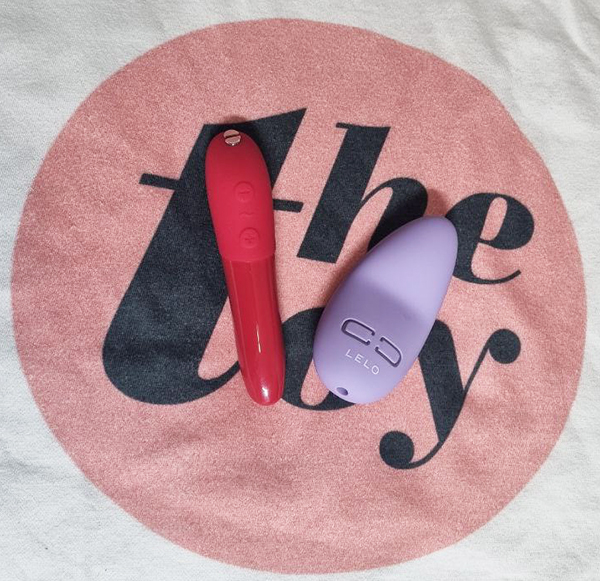
The Tango X is stronger, sharper, and more precise. Its narrow angled tip gives you pinpoint targeting the Lily 3 can’t replicate, and for bodies that orgasm from focused contact on one specific spot, the Tango X is the more effective tool. But it extracts a cost the product page won’t mention. Hand fatigue index: 10.0 — the worst I’ve measured. After ten minutes at mid-to-high intensity, your fingers buzz hard enough to lose fine grip control, and the numbness persists after the session. Its intensity ramp lurches between steps (linearity 3/10), making it harder to find and hold the narrow intensity window many bodies need during arousal building. And its deeper-to-sharp balance of 4.8 versus the Lily 3’s 6.5 means it skews buzzier — more surface-electric, more likely to fatigue tissue faster during sustained contact.
If you’ve used the Tango X and wished it were quieter, smoother, and didn’t punish your hand, the Lily 3 is what you were looking for. If you’ve used it and wished it hit harder, the Lily 3 won’t help.
Against the We-Vibe Touch X — the middle path
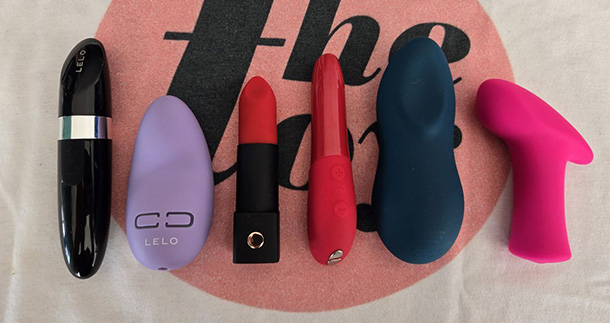
More power (6.7), silicone-cushioned for softer contact (Shore A 24 — a dramatically different material feel that rounds off the motor’s edges and forgives heavier pressure), and similarly low hand fatigue (2.1). The Touch X is a reasonable pick if you want more engine without the Tango’s hand brutality. Trade-offs: louder (32 dB), choppier ramp with that jarring depth explosion between speeds 2 and 3 (linearity 4/10), and significantly larger. For quiet plus control, the Lily 3 wins. For more power with cushioned contact, the Touch X.
The LELO Mia 2 is cheaper but sits in a different tier of motor quality entirely — power index 2.8, deep-to-sharp balance of just 1.3, which means it’s almost entirely surface buzz with minimal depth. The Lily 3’s motor is a generation ahead. If budget allows, the upgrade is worth it.
Who I’d recommend the Lily 3 to
This is the section I’d read first if other bullets have made you feel like your body is too slow or too sensitive. The Lily 3 is for people who need a smoother build, not a bigger motor.
You’ll likely love this if your body pattern includes:
- Sensitivity that makes most vibrators feel too intense at their lower settings, with not enough room to ease in before the motor is already ahead of you
- Hand fatigue that’s been cutting sessions short or forcing repeated grip breaks with other bullets
- Arousal that builds slowly and needs a ramp with real spacing between levels, not a staircase that skips the steps you needed
- Preference for stimulation that pools across the tissue rather than drilling into one spot — broader landing, more forgiveness, less angle-hunting
- A living situation where noise creates the kind of self-consciousness that actively works against arousal
It also travels well. 43 grams, flat profile, working travel lock, noise floor that’ll vanish into any hotel room. One experienced reviewer described bringing it as her sole vibrator for overnight trips and never wishing she’d packed something else. Another user reported daily use for three years with no complaints. That kind of longevity means the toy is easy to live with, not just impressive on first impression.
Who should skip it
The Lily 3 is easy to live with, but easy to outgrow if you need intensity. If one of these describes your main orgasm pattern, I’d choose a different bullet first.
- If pinpoint stimulation is how you reliably orgasm — isolating one specific spot and staying locked on it — the broad tip will feel persistently vague. The Tango X does that job better.
- If medium settings on other bullets are your starting zone, the Lily 3’s power ceiling won’t carry you. You’ll reach max before your body reaches climax.
- If you want material cushioning between the motor and your tissue — a softer surface that absorbs the motor’s edge and forgives heavier pressure — the hard ABS plastic doesn’t provide it. The Touch X’s silicone body does.
- If you want app control, Bluetooth, smart features, or anything beyond two physical buttons: none of it exists here.
Practical tips I learned through testing
These tips matter because the Lily 3 rewards technique more than force. Small changes in ramping, fabric, and grip can decide whether it feels refined or underpowered.
- Start on speed 2. Speed 1 is real stimulation, but it’s so gentle it barely registers on non-aroused tissue. Speed 2 is your actual warm-up setting.
- Hold the ramp button instead of clicking. The continuous sweep is smoother than stepping through discrete levels and less likely to overshoot the intensity you wanted.
- Try it through thin fabric first if direct contact feels too much. The hard plastic offers zero cushioning. A layer of cotton between the tip and your tissue is a free intensity reducer that keeps the lower settings useful longer.
- Charge after every two or three sessions. There’s no battery indicator. The toy dies without warning, and mid-session is when you’ll learn this.
- Rotate your grip so the buttons face away from your palm. Less instinctive than the natural hold, but it prevents the accidental button presses that interrupt builds during sustained contact.
Practical care
Charging: USB cable into the bottom port. About 2 hours for a full charge, about 2 hours of use. No low-battery warning — charge preemptively.
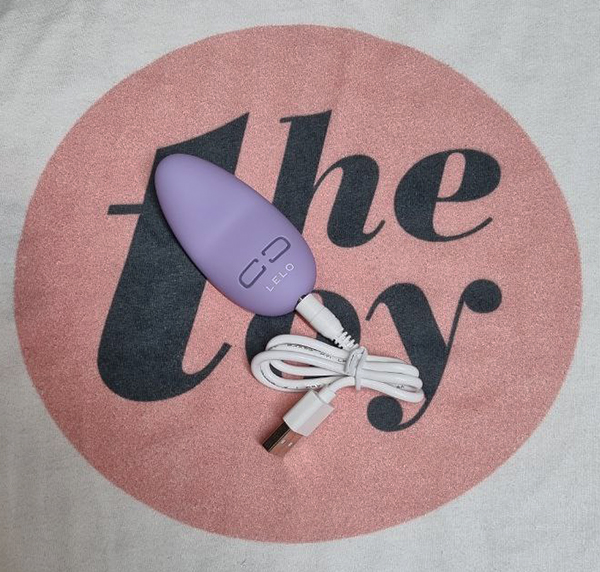
Controls: Right button turns on and increases intensity. Left decreases; hold to power off. Double-press right for patterns. Intensity is adjustable within patterns, which makes them more worth trying than usual — you’re not locked into whatever default intensity the pattern starts at. Both buttons held 5 seconds = travel lock (LED flashes twice). Same to unlock.
Cleaning: IPX7 waterproof — wash under warm running water with mild soap. Water-based lube only; silicone-based lubricant will degrade the silicone coating over time. Dry fully before storing.
Storage: The included satin pouch is genuinely decent. Keep the toy dry, away from direct sunlight, and stored separately from other silicone toys to prevent material reactions.
Final verdict
The Lily 3 doesn’t overwhelm the nervous system. It gives the nervous system room to participate — and for a lot of bodies, that room turns out to matter more than another few points on the power index.
The displacement is small. The power is middling. The material doesn’t cushion anything. On paper, this reads as a toy that compromises in every direction. In practice, the motor isolation, the ramp spacing, and the quiet operation create something more useful than the sum of those specs: a compact vibrator that preserves sensitivity instead of eroding it, that lets arousal build at the body’s own pace instead of the motor’s, and that doesn’t make your hand compete with your clit for attention.
If you’ve been concluding that you need more power because other bullets haven’t worked, it’s worth asking a different question first: was the issue actually power, or was it the spacing between the settings your toy gave you? The Lily 3 won’t answer that question for every body. But for the ones it fits, it reframes something that generic advice had made feel like a personal failure.
Buy it on sale. Start on speed 2. And notice what your body does when the toy isn’t rushing past it.
Final shortcut: choose the Lily 3 if you want quiet, smooth, low-fatigue, broad-contact stimulation. Skip it if you want deep rumble, hard pressure, pinpoint precision, or a cushioned silicone feel.
| Design: | (5.0 / 5) |
| Comfort: | (4.0 / 5) |
| Power: | (3.0 / 5) |
| Experience: | (4.0 / 5) |
| Controls: | (3.0 / 5) |
| Value: | (2.0 / 5) |
The LELO Lily 3 is a quiet, low-fatigue compact vibrator with the smoothest intensity ramp I’ve measured — best for gradual arousal, not deep power.
You can buy this product from:
What to read next
If you want to understand where all these numbers came from and how I translate them into actual body-level experience, read how I test bullet vibrators. It explains what I’m measuring, what those measurements do and do not predict, and why two toys with similar specs can feel completely different in the body.
If you’re still deciding between this and other compact options, my best bullet vibrator guide is the next stop. That’s where I break down which bullets actually suit different bodies, sensitivity patterns, and stimulation preferences instead of pretending one tiny toy fits everyone.
Sources reviewed
- Herbenick, D., Fu, T., Arter, J., Sanders, S., & Dodge, B. “Women’s Experiences With Genital Touching, Sexual Pleasure, and Orgasm: Results From a U.S. Probability Sample.” Journal of Sex & Marital Therapy, 2018.
- Puppo, V. “Anatomy and Physiology of the Clitoris, Vestibular Bulbs, and Labia Minora With a Review of the Female Orgasm.” Clinical Anatomy, 2013.
- Nagoski, Emily. Come As You Are: The Surprising New Science That Will Transform Your Sex Life. Simon & Schuster, 2015.
If there’s something you’re still wondering about that I didn’t cover here, leave a comment and I’ll do my best to help.
Add comment