
 Amie Dawson, Ph.D.
If you’ve ever held a vibrator and wondered whether your hand was going numb faster than your body was responding, you understand the specific irritation that first put the Le Wand Deux on my radar. I test compact vibes with a laser vibrometer, and the handle readings on some of the most popular bullets in the category are genuinely alarming — the We-Vibe Tango X, a toy people adore, sends more motor energy into your fingers than into its tip at certain speeds.
The first thing I noticed about the Deux wasn’t what it did against my body. It was what it didn’t do to my hand. At speed 3, handle displacement measured 0.006 mm — a number my instruments barely registered. My fingertips felt nothing. Then I looked at the tip output and the second realization landed: tip displacement at that same speed was 0.02 mm. For context, the Lovense Ambi — top of my power rankings — hits 0.36 mm. The Tango X reaches 0.16 mm. The Deux was delivering roughly one-eighth the depth of a Tango and one-eighteenth the depth of an Ambi, and the marketing page was calling it “rumbly” and claiming it “doesn’t compromise on power.”
So I had the quietest hands I’d ever measured holding the gentlest motor I’d ever tested. And a product page telling me the opposite of what my instruments were saying.
That should’ve been the whole story. But then I positioned the forked head, let both prongs settle around the clitoral glans, and felt something that raw displacement numbers don’t fully predict. The bilateral contact geometry created a different kind of conversation with the tissue — one that didn’t depend on brute depth to sustain itself. Whether that conversation works for your body is the entire question of this review.
The Deux is not secretly powerful — the fork is doing the interesting work
My lab read: The Deux has the weakest motor I’ve measured in this category: Power Index 1.3/10, Deep Rumble 0.4/10, and peak tip displacement of 0.02mm. That is not hidden rumble. That is not compact power. The motor is objectively gentle.
What makes the Deux interesting is the fork. Two lateral contact points can create a more involved sensation than one weak dome tip would. The geometry gives the motor more to work with, even though the motor itself does not push deeply into tissue.
Why this matters in a body: If your body needs depth, pressure, or a strong push through tissue, the fork will not rescue the missing displacement. If your body likes surrounding contact, low intensity, and a lighter field of stimulation, the Deux can feel clever instead of underpowered.
Quick Verdict
| Design: |  (5.0 / 5) (5.0 / 5) |
| Comfort: |  (4.0 / 5) (4.0 / 5) |
| Power: |  (1.5 / 5) (1.5 / 5) |
| Experience: |  (3.5 / 5) (3.5 / 5) |
| Controls: |  (3.0 / 5) (3.0 / 5) |
| Value: | (3.0 / 5) |
Pretty, whisper-quiet, and brilliantly easy on the hand — but if you crave real power, the Le Wand Deux will feel more like a tease than a finisher.
You can buy this bullet toy here:
Buy if you’re sensitive, share walls or a bed, deal with hand fatigue, or specifically want bilateral straddling stimulation. At $69 (its frequent sale price), this is a niche specialist that solves real problems no other compact vibe in my testing lineup addresses as well.
Skip if you need depth, rumble, or meaningful power. The motor is the weakest I’ve measured. If your minimum threshold starts where the Tango X operates, the Deux won’t get you there.
Price: $69 sale / $125 regular. Compare: We-Vibe Tango X ~$79, LELO Lily 3 ~$89, Lovense Ambi ~$59.
Sensation profile: Surface-buzzy, gentle, bilateral fork contact, essentially zero hand transfer. Stimulation stays at the skin rather than traveling into tissue. Rewards positioning and patience over pressure.
Best for: Sensitive users who value quiet operation, hand comfort, and a straddling contact geometry over raw motor strength.
The buying decision: choose the Deux for comfort, silence, and bilateral contact. Skip it if your body needs depth, pressure, or a motor that can push into tissue.
Marketing vs. Reality Score: 42/100
Verdict label: The quiet and controls deliver. The core sensation promises don’t.
Why: The product page’s two most purchase-driving sensation claims — “rumbly” vibrations and power that “doesn’t compromise” despite compact size — are directly contradicted by measurement. The Deux has the lowest power index (1.3/10), the lowest deep rumble score (0.4/10), and the most buzzy-leaning vibration character (deep-vs-sharp balance of 1.0/10) of every compact vibe I’ve tested. An independent reviewer confirmed the disconnect: “The marketing materials say it is [rumbly], but I found it quite buzzy… mostly surface-level vibration.” Where the marketing does hold up: the “whisper quiet” claim is genuine — this is one of the quietest toys in the category. The three-button controls work exactly as described and are a genuine usability improvement over single-button cycling. And the “surrounding” / “sensation in stereo” language for the forked head has real biomechanical basis. But the headline sensation pitch — that this is a rumbly powerhouse in a small body — simply isn’t true.
Reader translation: Le Wand is right about quiet, comfort, and the forked “surround” sensation. It is wrong about rumble and power.
What You’re Looking At
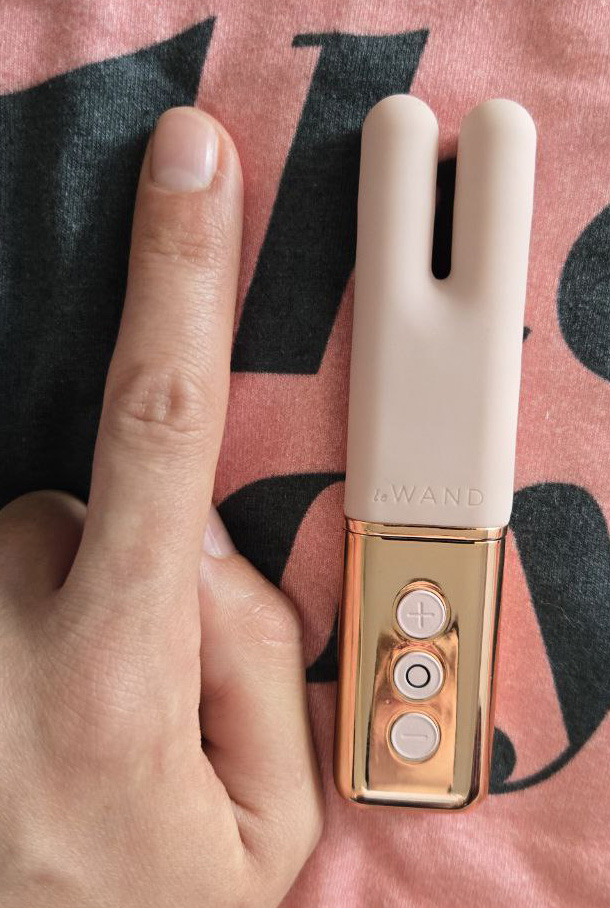
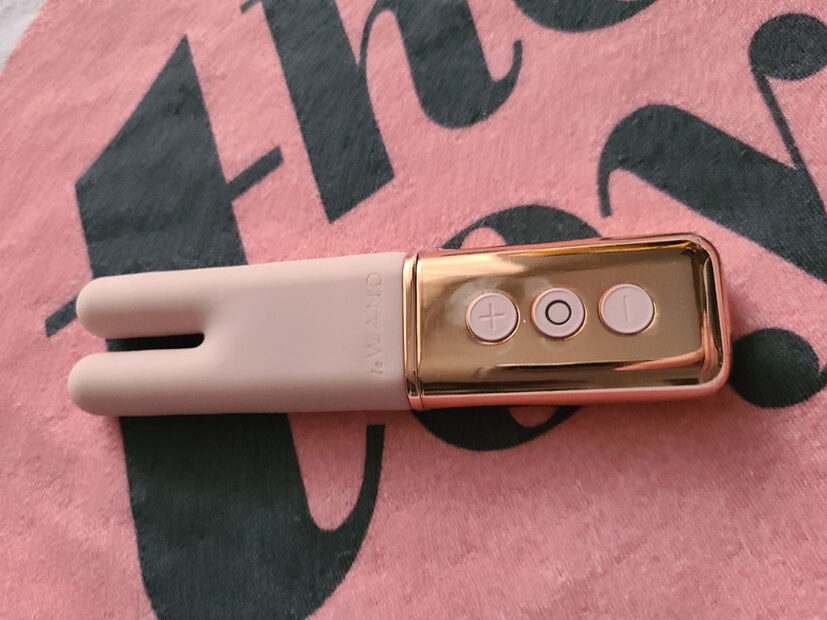
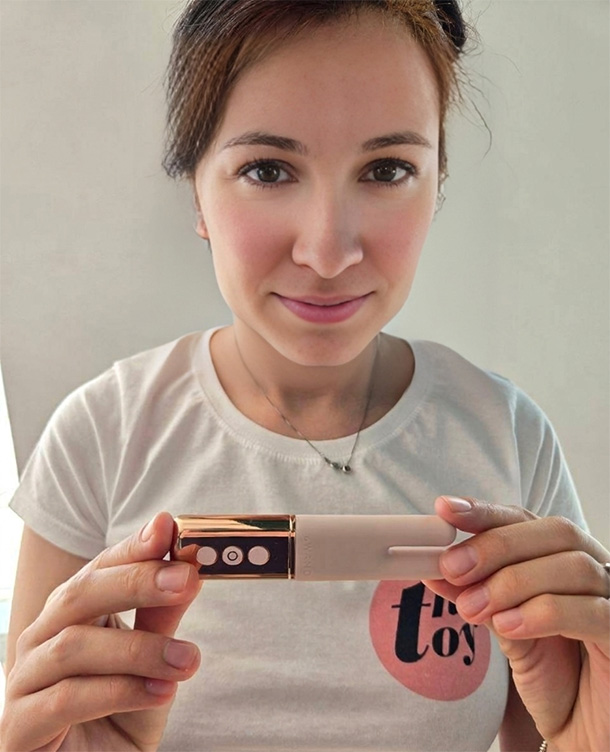
The Le Wand Deux is a compact rechargeable external vibrator with a forked silicone head — two parallel prongs separated by a channel designed to straddle rather than press. Less a bullet, more a tiny vibrating tuning fork.
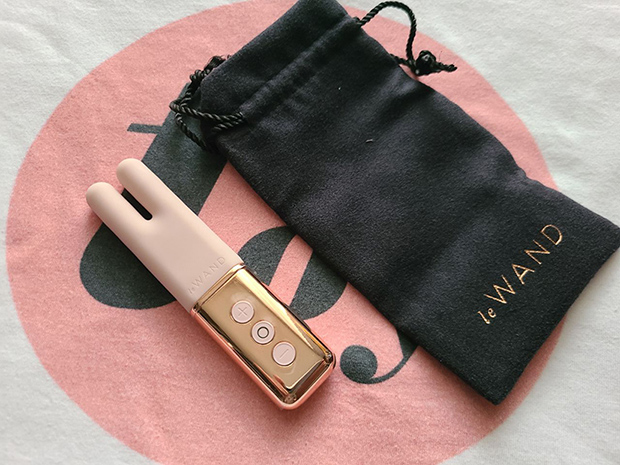
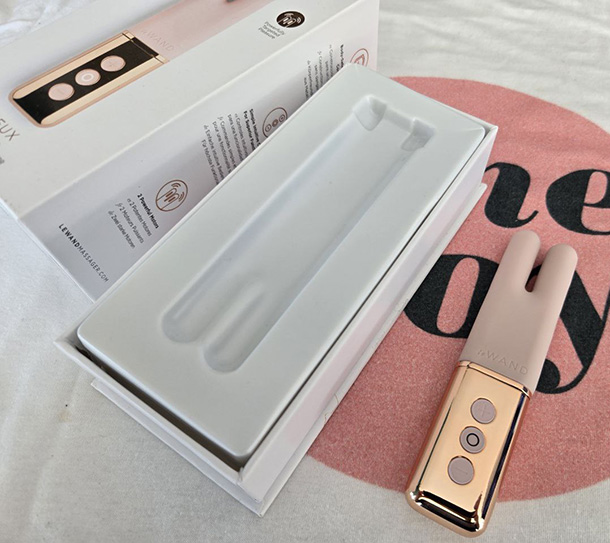
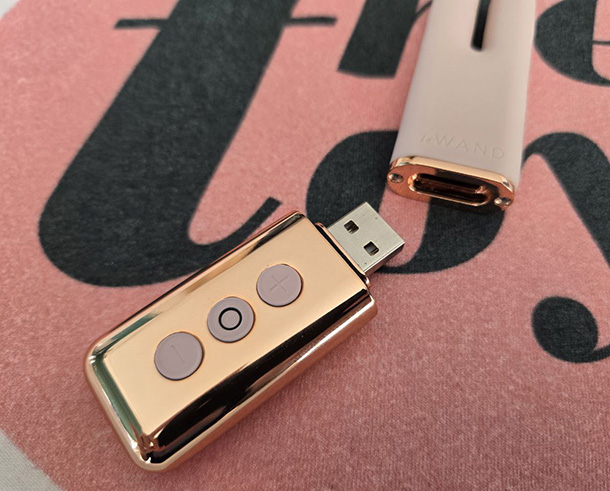
Specs: 79g. 11.5 cm long, 7 cm girth. Shore A 55 silicone head (medium-firm), metallic body. Four steady speeds plus pattern modes — the product page claims six intensity levels and fifteen modes total; my vibrometer captured four distinct steady-state levels, and the additional levels likely apply within pattern modes. Noise range: 23–28 dB at 60 cm. USB stick-style charging (the base detaches and plugs into USB-A). Splash-proof and shower-safe, not submersible. Three buttons: plus, minus, mode. Travel lock. Includes a micro-suede storage pouch.
Available in Black, Rose Gold, and Dark Cherry.
What It Feels Like in the Body
The Deux doesn’t scale linearly from gentle to strong. It shifts character between settings — each speed has a distinct personality, and the one the product page wants you to crank to maximum is probably the wrong one.
Speed 1 — barely a whisper. Tip displacement is 0.01 mm, which is smaller than a red blood cell’s width. The motor hasn’t fully locked into a stable cycle, so the sensation is diffuse and slightly irregular — a loose, drifting hum rather than a defined vibration. Against the clitoris, this reads as awareness that something is vibrating, not as directed stimulation. On nipples, where the nerve endings are more exposed and the threshold for “enough” is lower, it’s more useful. Most bodies will treat this as a warm-up or a tease, not a destination. If the lowest setting on a Tango X or Ambi already makes you flinch, though, speed 1 on the Deux gives you a softer starting line than anything else I’ve measured.
This feels like: presence more than pressure. Useful if you need an extremely gentle entry point, frustrating if you expect the first speed to do real work.
Speed 2 — the motor finds its voice. Displacement doubles to 0.02 mm at the tip, and the waveform tightens. This is the threshold where the Deux becomes genuinely stimulating rather than just present. You start feeling each prong as a separate line of contact — not one blurred area, but two surfaces doing parallel work. The handle stays calm (1.5/2.5/0.01), so the sensation difference between tip and fingers is already pronounced. This speed serves slow builders and anyone who likes a long, deliberate approach where arousal gathers rather than arrives.
Speed 3 — where the motor earns its keep. This is the best-engineered moment in the Deux’s entire range, and it’s not close. Tip output climbs to 6.8/4.5/0.02 — acceleration and velocity increase, meaning each pulse lands with more definition and the oscillation feels faster, busier, more insistent. But displacement holds at 0.02 mm. The vibration intensifies on the surface without going deeper. It gets more engaging, not heavier. Meanwhile, the handle drops to 1.5/1.5/0.006 — the best tip-to-handle isolation ratio I’ve measured on any toy at its peak operating speed.
That distinction matters more than most product pages admit. A toy can feel busier without feeling deeper, which is the real difference between rumbly and buzzy vibration in use — not just how much sensation you get, but where it seems to land.
Why the handle isolation matters more than it sounds: research on vibrotactile perception shows that sustained vibration against the fingertips progressively dulls tactile sensitivity. When a toy buzzes your holding hand, it isn’t just uncomfortable — it’s slowly eroding the precision with which you can feel where the tip sits and how your body is responding. The Deux at speed 3 sidesteps this entirely. Your proprioceptive sense of the prong placement stays intact for the full session, which matters because the fork design rewards precise positioning.
Speed 3 also sounds the most stable and full. The hum has the broadest frequency spread here — the richest version of this motor. If I could only recommend one setting on this toy, it would be this one without hesitation.
The Deux gives you the quietest hand in the category — because almost no energy leaks backward
My lab read: At speed 3, the Deux measures 0.02mm displacement at the tip and only 0.006mm at the handle. Its Finger Fatigue Index is 0.1/10. That is not just low. It is in a different universe from something like the Tango X at 10.0.
This is the best-engineered part of the toy. The Deux does not have much motor power, but the little power it has is not rattling your fingers into numbness.
Why this matters in a body: The forked head needs careful placement. If your hand is buzzing, your positioning gets sloppier and your attention shifts away from sensation. With the Deux, your fingers stay quiet enough to hold the angle, rock the prongs, and actually use the geometry.
Speed 4 — a different animal, not a louder one. Acceleration and velocity peak (7/5), but displacement drops back to 0.01 — the same as speed 1. The vibration arc tightens. The sensation shifts from a full-area buzz to a concentrated, surface-electric intensity that sits more sharply on the exact contact points. The handle wakes up for the first time (3.5/3.5/0.01) — still the lowest max-handle output of any toy in my collection, but you can feel it now. Some users will grab speed 4 as a finisher. Others will find the character shift disrupts whatever they’d been building on speed 3. The top button doesn’t just give you more — it changes the quality of what you’re getting.
One more thing the measurements predict, and it’s worth being direct about: the Deux doesn’t reward firm pressure. With peak displacement already at 0.02 mm, there’s almost no mechanical headroom for the motor to work against body resistance. Most higher-displacement motors can feel different — sometimes better — when pressed firmly into tissue, because the body provides something for the motor to push against. The Deux doesn’t have that room. Pressing harder doesn’t deepen the sensation; it just compresses the silicone and potentially mutes the already-modest movement. Light contact or a gentle rest is the way in.
Practical translation: don’t grind this toy harder when it feels too soft. The Deux responds better to placement and rocking than pressure.
The Shore A 55 silicone filters some of the motor’s sharpest frequencies — it’s medium-firm, noticeably softer than hard plastic (which transmits everything) but firmer than the pillowy silicone on the We-Vibe Touch X (Shore A 24). In practice, it gives the contact a slightly blended quality, smoothing the buzziest edges without absorbing so much that the sensation goes vague. It doesn’t forgive wildly imprecise positioning the way a very soft, broad head would, but it doesn’t punish you for being slightly off-target either.
The Fork: What Geometry Actually Changes
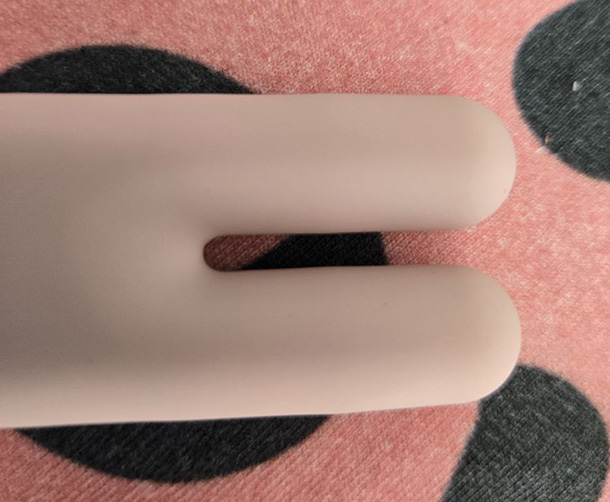
A standard dome or bullet tip delivers stimulation through one contact point. You press down, the motor pushes vibration into tissue from above. The Deux’s forked channel does something structurally different: it lets the clitoral glans (or a nipple, or the frenulum) sit inside the gap while both prong surfaces vibrate against it from each lateral side.
This isn’t just a styling choice. O’Connell and colleagues’ anatomical research documented that the clitoral complex includes bilateral crural structures extending beneath the visible glans. Bilateral stimulation engages a wider neural field than top-down single-point pressure — you’re touching more surface area with less concentrated force. In practical terms, this meant the Deux produced a sense of “surround” that felt broader and more involved than its displacement numbers alone would justify. The marketing language about “hugging” and “sensation in stereo” — that’s the one claim with genuine biomechanical backing, even if the power behind it is modest.
Le Wand calls this a “dual-motor” design. Whether each prong houses an independent motor or a single motor drives both through the fork structure isn’t something my external measurements can confirm — I capture total tip output, not per-prong activity. What I can confirm is that both prongs vibrate and the sensation reads as coming from two distinct contact surfaces rather than one.
The catch is fit specificity. The channel width is fixed, and the prongs don’t flex apart — one reviewer called them “totally inflexible,” and she’s right. Shore A 55 is firm enough to hold shape under pressing without collapsing, which means the channel is what it is. If the gap matches your anatomy, the self-centering effect is genuinely useful: you position the fork, the tissue settles into the channel, and the toy holds its own orientation without constant adjustment. If the gap is too wide, the prongs stimulate surrounding tissue while the target floats between them untouched. Too narrow, and the structure can’t seat properly. Le Wand doesn’t offer the fork in multiple widths, and there’s no way to predict the fit without trying. That’s the gamble embedded in the design.
This is the fit gamble: when the fork matches your anatomy, it feels clever and self-centering. When it doesn’t, the whole design advantage disappears.
Real-World Use
Late-night stealth session. I measured this toy at 28 dB maximum, which is a 5 dB rise over the 23 dB ambient in a quiet bedroom. Under a duvet, that margin vanishes. I used the Deux on speed 3 in bed with a sleeping partner and confirmed the next morning: they heard nothing. The pitch character leans hum-forward, which helps it blend into room noise rather than cutting through it, though there’s a faint high-frequency tail that’s audible if the toy is uncovered in dead silence. Under any real-world conditions — blanket, closed door, white noise machine, anything — it disappears. For discretion, this is as close to invisible as a vibrator gets in this category.
The build was slower than with higher-powered toys, which I expected from the displacement data. But the bilateral contact created a sustained, even field of stimulation that didn’t fatigue the tissue the way sharper, single-point buzziness sometimes does. Herbenick and colleagues’ research on genital touch preferences found that many women respond best when stimulation covers a broader area rather than concentrating on one point — the Deux’s geometry serves that pattern directly, even at lower power levels. And because my hand felt nothing, I could hold a light, steady position for the entire session without the creeping numbness that cuts other toys’ effective use time short.
The rocking discovery. Midway through a session, I tilted the Deux slightly — shifting one prong’s pressure deeper than the other — and the sensation changed immediately. That small asymmetry created a manual wave: rock left and the right prong deepens, rock right and the left prong takes over. The fork geometry rewards this micro-movement because the two contact points shift independently with tiny angle changes. Once I started rocking, the Deux stopped feeling like a weak vibrator being held still and started feeling like a responsive instrument being played.
That was a good reminder that a toy’s motor is only half the experience. Tiny shifts in angle and movement can change everything, which is why rhythm and pressure matter more than people think when a gentler toy is asking geometry to do some of the work.
Use lesson: the Deux is better rocked than parked. Small tilts make the two prongs trade pressure, which gives the weak motor more sensation to work with.
As an accent during oral stimulation. A partner held the Deux at speed 2 against the side while using their mouth, and the low vibration added a background texture without competing with what the tongue was doing. With stronger toys, there’s always a risk of the vibrator becoming the whole show — the sensation flattens into “vibrator plus extra.” Here, the oral stayed primary and the vibration was an ambient hum underneath it. My partner held the toy for over ten minutes and mentioned they couldn’t tell whether it was still on. That’s the handle isolation working as designed, even if it sounds like a complaint.
What It Solves Well
Read this section as a specialist checklist: the Deux solves hand fatigue, noise, and single-point overstimulation better than it solves power.
Hand fatigue. Finger fatigue index: 0.1 out of 10. The next-lowest toy in my lineup scores 1.7. The Deux is in a different category of hand comfort than anything else I’ve tested. If you have arthritis, carpal tunnel, repetitive strain, or any condition that makes sustained grip uncomfortable — or if other bullets leave your fingers buzzing and numb before your body catches up — this solves the problem rather than managing it. I don’t say that casually; it’s the most decisive advantage in the Deux’s entire profile.
Noise anxiety in shared spaces. At a measured +5 dB over ambient at maximum, disappearing entirely under fabric, the Deux makes shared beds and thin walls a non-issue.
Overstimulation from single-point contact. The fork distributes stimulation across two lateral surfaces instead of drilling into the glans from above. For bodies that tense up under direct pinpoint contact, that wider landing zone can be the whole appeal. It speaks to the same preference split behind broad versus pinpoint clitoral stimulation — some bodies want less drilling and more room.
Control frustration. Three buttons — plus, minus, mode — instead of one cycling button. If you’ve ever accidentally clicked past the perfect intensity mid-build and had to cycle through seven patterns to find it again, you know exactly why this matters and why someone bought this toy specifically for the controls.
Where It Falls Short
The main drawback is simple: the shape is smarter than the motor. If your body needs tissue-level vibration, the fork cannot compensate for the missing displacement.
The motor is genuinely underpowered, and I don’t mean “modest” or “gentle by preference.” Power index: 1.3 out of 10. Peak tip displacement: 0.02 mm. The Lovense Ambi delivers 0.36 mm — eighteen times more tissue depth. The vibration stays on the skin surface. It doesn’t travel into the deeper clitoral structures the way higher-displacement motors do. For users whose arousal depends on that tissue-level reach, no geometry trick compensates for what the motor simply can’t produce.
The “rumbly” marketing is factually wrong. Deep rumble: 0.4/10. Sharp/buzzy: 6.9/10. The most surface-buzzy vibration balance of every toy I’ve measured. This isn’t a matter of opinion or subjective preference — the harmonic profile is overwhelmingly high-frequency-dominant. If you’re buying this because the product page told you it’s rumbly, you’ll feel the mismatch the moment you turn it on.
The fork’s fixed channel means the design either fits your anatomy or doesn’t, with no adjustment mechanism and no way to know beforehand. Speed 4 shifts character rather than simply adding power, which can disrupt a build that was working well on speed 3. And as a sole vibrator — the only toy in a collection — the Deux’s power ceiling makes it a frustrating all-purpose choice.
What Surprised Me / What Annoyed Me
Surprised me:
- The rocking technique transformed the experience more than any speed change
- Bilateral contact at low power produced a more involved sensation than the displacement suggested it should
- My hand genuinely forgetting the toy was on — I’ve never experienced handle isolation like this
- Speed 3’s isolation engineering: 0.006 mm in the handle while the tip runs at 0.02 mm is a legitimate design achievement
Annoyed me:
- “Rumbly” on the product page when every measured metric says the opposite
- One fixed fork width for a design whose entire value depends on anatomical fit
- The USB-stick charging base is cute — another reviewer’s friend said it looked like a vape pen, which is both accurate and funny — but it’s a proprietary piece that can’t be replaced at a corner store if you lose it
- Speed 4 feeling like a step sideways from speed 3 rather than a step forward
Price and Value
At $125 regular price, this is a hard sell against the competition. You’re paying more than a Tango X ($79) that delivers 4x the power, more than a Lily 3 ($89) with 3x the power and better rumble balance, and roughly double the Lovense Ambi ($59), which sits at the top of every power metric I track. The Deux’s premium at full price buys you handle isolation, noise performance, a fork geometry, and beautiful build. It doesn’t buy you motor output, depth, or versatility.
At $69 — the sale price it frequently drops to and the price the product page flags as “as low as” — the calculation shifts. You’re paying less than a Tango X for a specialized tool that does three things the Tango physically cannot: zero hand fatigue, bilateral straddling, and near-silent operation. Whether that specialist tradeoff makes sense depends on whether those are the problems you actually need solved. If you’re buying a first or only vibrator, I’d point you elsewhere. If you’re adding a tool to an existing collection for specific scenarios — stealth nights, partnered accent, sensitive tissue, hand comfort — the sale price is reasonable.
Value frame: at full price, the Deux is hard to justify. On sale, it makes sense as a niche second toy — not as your only vibrator.
How It Compares
| Metric | Le Wand Deux | We-Vibe Tango X | LELO Lily 3 | Lovense Ambi |
|---|---|---|---|---|
| Power Index (1–10) | 1.3 | 5.2 | 4.3 | 10.0 |
| Deep Rumble (1–10) | 0.4 | 2.4 | 3.3 | 7.0 |
| Sharp/Buzzy (1–10) | 6.9 | 5.1 | 4.2 | 4.2 |
| Hand Fatigue (0–10) | 0.1 | 10.0 | 1.9 | 4.1 |
| Linearity (1–10) | 6 | 3 | 8 | 10 (app) |
| Max Noise (dB at 60 cm) | 28 | 29 | 27 | 31 |
| Approx. Price | $69–125 | ~$79 | ~$89 | ~$59 |
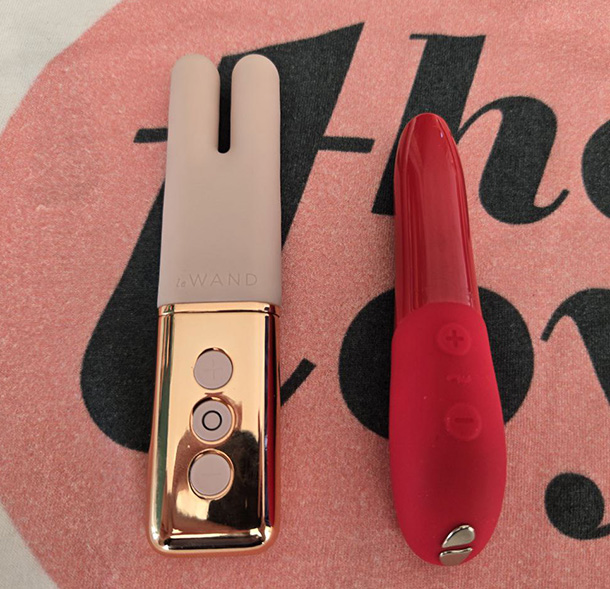
Versus the Tango X: Polar opposites. The Tango’s hard plastic tip transmits vibration with surgical precision and enough displacement to reach the deeper clitoral structures. It also has a hand fatigue index of 10.0 — the most hand-punishing toy I’ve tested. If your hands tolerate it and you want focused power, the Tango is the better driver. If the Tango leaves your fingers numb and the single-point contact feels like a sharp poke you can’t soften, the Deux addresses both complaints at the cost of almost all meaningful depth.
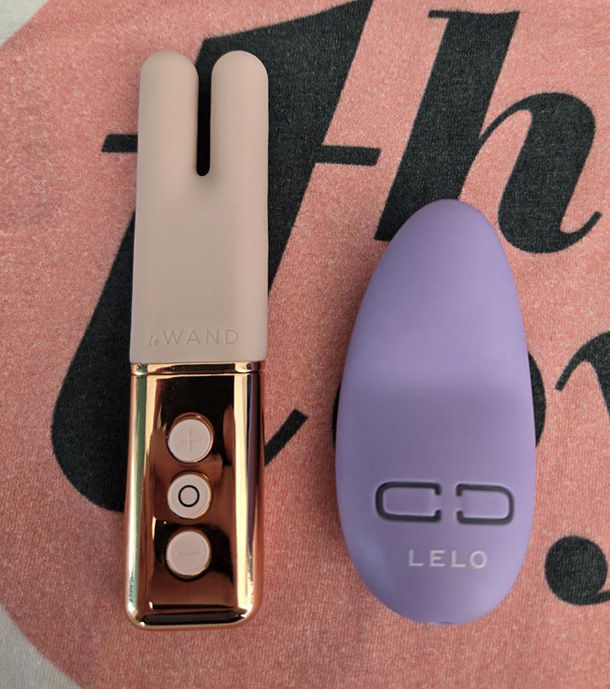
Versus the Lily 3: The Lily offers 3x the power, markedly better deep-vs-sharp balance (6.5 vs 1.0), and a smoother intensity ramp. It’s also very quiet. For someone who wants a gentle, well-tuned clitoral vibe that can actually deliver what “rumbly” means, the Lily 3 is the more complete product. The Deux wins only on hand fatigue and the fork geometry.
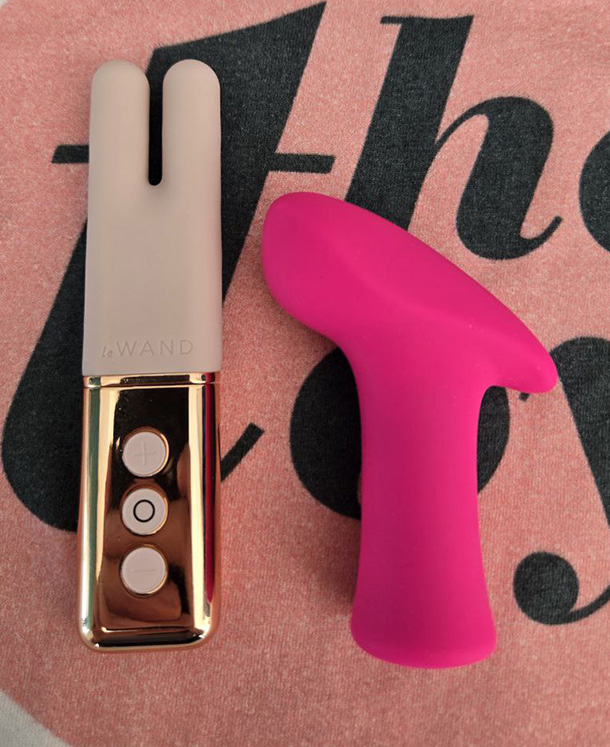
Versus the Ambi: The Ambi lives at the opposite end of the spectrum — rich, full, tissue-reaching vibration with app-controlled micro-adjustable intensity. At $59, it outperforms the Deux on every vibration metric and costs less. But it sends more buzz to the hand (FFI 4.1), it’s louder, and it can’t replicate the straddling contact. The Deux exists in a corner the Ambi doesn’t reach. Whether that corner matters to you determines whether the price premium makes any sense.
If you want Le Wand’s engineering without the fork limitation, their standard Bullet is the more versatile sibling. It delivers a 5.5 power index and 2.7 deep rumble in a classic dome format, though with somewhat more handle transfer (FFI 2.2).
Who This Fits
This is the section I’d read first if you are tempted by the forked shape. The Deux is for people who need comfort and contact geometry more than motor strength.
You’ll likely appreciate the Deux if you find most vibrators too sharp or too intense on their lowest setting, if you experience hand discomfort or finger numbness during sessions, if you share sleeping space with someone who doesn’t need a soundtrack, if you want bilateral straddling stimulation rather than single-point pressure, or if you already own a stronger vibrator and need a specialist for specific contexts — oral play, nipple stimulation, stealth sessions, long-hold comfort.
Look elsewhere if you need deep, tissue-reaching vibration to build arousal. If you expect the rumble and power the product page promises. If you want one toy that handles everything from gentle start to intense finish. If you prefer a smooth, predictable ramp without character shifts between speeds. Or if you typically press a vibe firmly into the body and expect the sensation to deepen — this motor doesn’t have the displacement headroom for that.
Practical Care
Clean with mild soap and warm water after use. The silicone-to-metal seam where the head meets the body can trap lube residue — run a fingertip along it under water to catch what a quick rinse misses. Be careful around the charging port at the base. Pat dry or air dry. Water-based lube only; silicone lube risks degrading silicone toy surfaces over time.
If you ever blank on which lube goes with which material, this guide to using lubricant with vibrators lays it out cleanly, including why silicone-on-silicone is the one pairing I stop being relaxed about.
The charging base detaches from the body and plugs directly into a standard USB-A port. Listed charge time: 1.5 hours for approximately 1 hour of use. It’s a clever, cable-free design, but that detachable base is a proprietary piece. If you lose it, you’ve lost your charger and there’s no generic replacement at a corner store. Keep it with the pouch.
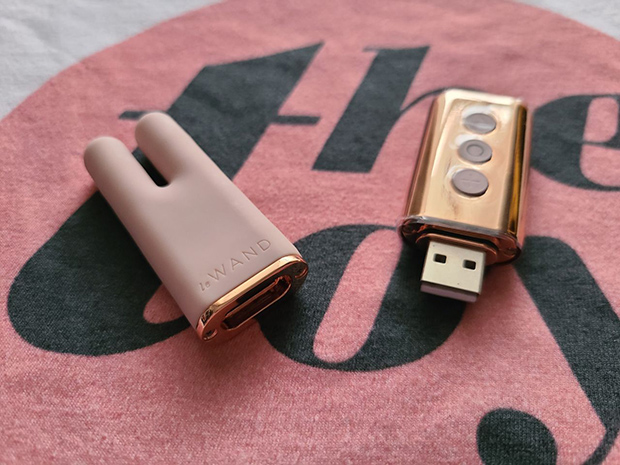
The product page says shower-friendly, not waterproof for submersion — and the FAQ is appropriately honest about this, specifying splash resistance and advising against submerging. Fine for cleaning under a tap. Fine for a shower if you’re reasonable about not aiming water directly at the port. I wouldn’t take it into a bath.
The travel lock works and is straightforward to engage. The included micro-suede pouch stores it flat and discreetly. Over several weeks of regular use, the silicone hasn’t attracted unusual lint, discolored, or developed texture changes. The metallic body shows fingerprints. Cosmetic, not functional.
Tips I Learned the Hard Way
These tips matter because the Deux does not win by force. Placement, rocking, fabric, and speed choice decide whether it feels interesting or merely weak.
- Stay on speed 3. The sweet spot lives below maximum. Speed 4 trades depth for surface sharpness — counterintuitive, but the data and the body both agree.
- Rock the fork. Don’t hold it static. Tiny tilting motions shift pressure asymmetrically between the prongs and create a manual wave effect that makes the bilateral stimulation dramatically more engaging than the vibrations alone.
- Seat the anatomy inside the channel before you commit. The fork only works when the target structure sits between the prongs, not on top of one. Take a beat during placement to feel the self-centering settle.
- Try it through a thin layer of fabric first if direct contact feels too surface-buzzy. Cotton softens the highest-frequency edges and can make the bilateral spread feel broader and less scratchy. If that ends up being your best route in, using a toy over underwear is not a consolation prize — for some bodies it’s the version that actually works.
- Don’t lose the charging base. It’s cute. It also isn’t replaceable at Walgreens.
Final Verdict
The Le Wand Deux has the weakest motor I’ve ever measured in this category and some of the smartest engineering around it. The handle isolation is unmatched — nothing else I’ve tested comes within an order of magnitude. The noise performance is genuinely invisible under real-world conditions. The forked head creates a bilateral contact pattern that no dome tip replicates, and for bodies that respond to lateral stimulation across a wider nerve field rather than concentrated top-down pressure, that geometry pulls weight the displacement numbers don’t capture.
None of that changes the fact that the motor is objectively underpowered, the marketing’s “rumbly” claim is wrong, and the fork’s fixed channel introduces an anatomical gamble you can’t resolve before buying.
What I keep coming back to is that bodies don’t always respond to what measures strongest on a vibrometer. Sometimes they respond to what’s shaped right, sustained without hand fatigue creeping in at minute eight, and quiet enough to let the nervous system focus on sensation instead of noise anxiety. The Deux doesn’t try to overwhelm you. It tries to match a specific sensitivity, a specific geometry, and a specific kind of session where the loudest tool in the drawer isn’t the one you need.
If you’ve been reaching for softer, broader, quieter options and finding them too weak in other ways — underpowered controls, clumsy cycling buttons, motors that buzz your hand into numbness — the Deux might be the first toy that respects all of those preferences simultaneously, even if the power ceiling means it won’t be your only toy. And if your body has been asking for depth this whole time, you’ll feel the mismatch within thirty seconds, and that’s useful information too.
Final shortcut: choose the Deux if you want near-zero hand buzz, whisper-quiet use, and forked bilateral contact. Skip it if you want rumble, depth, pressure, or one toy that can finish the job for most bodies.
Pay attention to what your hand and your tissue are each telling you. They don’t always want the same thing.
| Design: | (5.0 / 5) |
| Comfort: | (4.0 / 5) |
| Power: | (1.5 / 5) |
| Experience: | (3.5 / 5) |
| Controls: | (3.0 / 5) |
| Value: | (3.0 / 5) |
Pretty, whisper-quiet, and brilliantly easy on the hand — but if you crave real power, the Le Wand Deux will feel more like a tease than a finisher.
You can buy this bullet toy here:
What to Read Next
If this review made you realize you’re not just choosing a motor, you’re choosing a contact style, these are the next pieces worth opening.
- Best Bullet Vibrators Guide — if you want the short list of bullets that actually earn space in a drawer.
- How to Choose a Bullet Vibrator — if you’re still sorting out whether you need more depth, more softness, less hand buzz, or a different shape entirely.
- How We Test Bullet Vibrators — if you want to see how I measure power, handle transfer, noise, and why those numbers sometimes predict pleasure better than marketing does.
- How to Use a Bullet Vibrator — if you already own one and want better placement, less irritation, and fewer sessions wasted on the wrong angle.
Sources Reviewed
- Debby Herbenick, Tsung-chieh (Jane) Fu, Jennifer Arter, Stephanie A. Sanders, and Bryant Paul, “Women’s Experiences with Genital Touching, Sexual Pleasure, and Orgasm: Results from a U.S. Probability Sample of Women Ages 18 to 94,” Journal of Sex & Marital Therapy, 2018.
- Helen E. O’Connell, Kalavampara V. Sanjeevan, and John M. Hutson, “Anatomy of the Clitoris,” The Journal of Urology, 2005.
- Vernon B. Mountcastle, “The Sensory Hand: Neural Mechanisms of Somatic Sensation,” Harvard University Press, 2005 — referenced for vibrotactile sensitivity thresholds and adaptation in glabrous skin.
Add comment